spécimen

Nature du spécimen

228 image(s) · 18 Actualités

Galerie d'images

Fossil specimen, CM 11422, of Nyctosaurus gracilis
Taxons Nyctosauridae

Fossil specimen, CM 11422, of Nyctosaurus gracilis

fossile spécimen Nyctosauridae Nyctosaurus
Archaeopteryx lithographica, specimen displayed at the Museum für Naturkunde in Berlin. (This image shows the original fossil - not a cast.)

Archaeopteryx lithographica, specimen displayed at the Museum für Naturkunde in Berlin. (This image shows the original fossil - not a cast.)

musée moulage fossile spécimen +1
Holotype specimen of Hylaeosaurus armatus Mantell, 1833 (NMH R3775) from the Grinstead Clay Formation (late Valanginian) of Tilgate Forest, Sussex, southern England.
Taxons Hylaeosaurus

Holotype specimen of Hylaeosaurus armatus Mantell, 1833 (NMH R3775) from the Grinstead Clay Formation (late Valanginian) of Tilgate Forest, Sussex, southern England.

Valanginien holotype spécimen Hylaeosaurus +2
Holotype specimen of Hylaeosaurus armatus Mantell, 1833 (NMH R3775) from the Grinstead Clay Formation (late Valanginian) of Tilgate Forest, Sussex, southern England.
Taxons Hylosaurus

Holotype specimen of Hylaeosaurus armatus Mantell, 1833 (NMH R3775) from the Grinstead Clay Formation (late Valanginian) of Tilgate Forest, Sussex, southern England.

Valanginien holotype spécimen Hylaeosaurus +2
The nodosaurid dinosaur, Glyptodontopelta is mostly known from isolated osteoderms ("armor plates"). The specimen SMP VP-1580 (State Museum of Pennysylvania) is however, the most complete known specimen, comprising parts of the skull, hundreds of osteoderms and fragments. This specimen was discovered in 2003 by Warwick Fowler, in the Naashoibito Member of the Ojo Alamo Formation (Maatrichtian, Late Cretaceous) of the San Juan Basin, New Mexico, during an expedition led by Dr. Robert Sullivan.
Taxons Glyptodontopelta

The nodosaurid dinosaur, Glyptodontopelta is mostly known from isolated osteoderms ("armor plates"). The specimen SMP VP-1580 (State Museum of Pennysylvania) is however, the most complete known specimen, comprising parts of the skull, hundreds of osteoderms and fragments. This specimen was discovered in 2003 by Warwick Fowler, in the Naashoibito Member of the Ojo Alamo Formation (Maatrichtian, Late Cretaceous) of the San Juan Basin, New Mexico, during an expedition led by Dr. Robert Sullivan.

armure musée Mexique Denver +9
Ornithocheirus simus. A–D holotype CAMSM B54428 (Albian, Cambridge Greensand), anterior part of the rostrum A left lateral view B respective line drawing C ventral view D respective line drawing E–H referred specimen CAMSM B54552 (Albian, Cambridge Greensand), anterior part of the rostrum E anterior view F respective line drawing G left lateral view H respective line drawing. Abbreviations: m – maxillae, pm – premaxillae. Arrows and numbers indicate alveoli or teeth and their respective position. Scale bar = 10 mm.
Taxons Ornithocheirus

Ornithocheirus simus. A–D holotype CAMSM B54428 (Albian, Cambridge Greensand), anterior part of the rostrum A left lateral view B respective line drawing C ventral view D respective line drawing E–H referred specimen CAMSM B54552 (Albian, Cambridge Greensand), anterior part of the rostrum E anterior view F respective line drawing G left lateral view H respective line drawing. Abbreviations: m – maxillae, pm – premaxillae. Arrows and numbers indicate alveoli or teeth and their respective position. Scale bar = 10 mm.

écaille dessin Albien holotype +2
Photograph of Museo civico di scienze naturali di Bergamo (MCSNB) 2888, the holotype specimen of Eudimorphodon ranzii ZAMBELLI 1973, a basal pterosaur from the Norian (middle Upper Triassic) of the Italian Alps.[1]


↑ see fig. 8A in Silvio Renesto (2006): A reappraisal of the diversity and biogeographic significance of the Norian (Late Triassic) reptiles from the Calcare di Zorzino. In: Jerry D. Harris, Spencer G. Lucas, Justin A. Spielmann, Martin G. Lockley, Andrew R.C. Milner, James I. Kirkland (eds.): The Triassic-Jurassic Terrestrial Transition. New Mexico Museum of Natural History and Science Bulletin 37:445–456 (online)
Taxons Eudimorphodon

Photograph of Museo civico di scienze naturali di Bergamo (MCSNB) 2888, the holotype specimen of Eudimorphodon ranzii ZAMBELLI 1973, a basal pterosaur from the Norian (middle Upper Triassic) of the Italian Alps.[1] ↑ see fig. 8A in Silvio Renesto (2006): A reappraisal of the diversity and biogeographic significance of the Norian (Late Triassic) reptiles from the Calcare di Zorzino. In: Jerry D. Harris, Spencer G. Lucas, Justin A. Spielmann, Martin G. Lockley, Andrew R.C. Milner, James I. Kirkland (eds.): The Triassic-Jurassic Terrestrial Transition. New Mexico Museum of Natural History and Science Bulletin 37:445–456 (online)

musée Mexique Jurassique Trias supérieur +6
Holotype specimen of Pterodactylus antiquus, BSP AS I 739.
Original photograph by Steven U. Vidovic, David M. Martill in http://www.plosone.org/article/info%3Adoi%2F10.1371%2Fjournal.pone.0110646

Modified by Matthew Martyniuk: Cropped, color adjusted. Top central portion of non-fossil-bearing slab digitally altered to remove portion of ruler.
Taxons Pterodactylus

Holotype specimen of Pterodactylus antiquus, BSP AS I 739. Original photograph by Steven U. Vidovic, David M. Martill in http://www.plosone.org/article/info%3Adoi%2F10.1371%2Fjournal.pone.0110646 Modified by Matthew Martyniuk: Cropped, color adjusted. Top central portion of non-fossil-bearing slab digitally altered to remove portion of ruler.

fossile holotype spécimen Ptenodracon +1
Holotype specimen of Pterodactylus antiquus, BSP AS I 739.
Original photograph by Steven U. Vidovic, David M. Martill in http://www.plosone.org/article/info%3Adoi%2F10.1371%2Fjournal.pone.0110646

Modified by Matthew Martyniuk: Cropped, color adjusted. Top central portion of non-fossil-bearing slab digitally altered to remove portion of ruler.
Taxons Ptenodracon

Holotype specimen of Pterodactylus antiquus, BSP AS I 739. Original photograph by Steven U. Vidovic, David M. Martill in http://www.plosone.org/article/info%3Adoi%2F10.1371%2Fjournal.pone.0110646 Modified by Matthew Martyniuk: Cropped, color adjusted. Top central portion of non-fossil-bearing slab digitally altered to remove portion of ruler.

fossile holotype spécimen Ptenodracon +1
Mounted skeleton of Acrocanthosaurus specimen NCSM 14345 at North Carolina Museum of Natural Sciences

Mounted skeleton of Acrocanthosaurus specimen NCSM 14345 at North Carolina Museum of Natural Sciences

musée spécimen Acrocanthosaurus squelette
The skull of a Chasmosaurus mariscalensis, on display at the Texas Memorial Museum. Chasmosaurus was a Cretaceous ceratopsian of North America. This specimen was discovered in Brewster County, Texas.
Taxons Agujaceratops

The skull of a Chasmosaurus mariscalensis, on display at the Texas Memorial Museum. Chasmosaurus was a Cretaceous ceratopsian of North America. This specimen was discovered in Brewster County, Texas.

musée Crétacé spécimen Agujaceratops +3
An Ankylosaurus head (cast of specimen AMNH 5214), on display at the Museum of the Rockies in Bozeman, Montana.  This is from a specimen collected in Custer County, Montana.
The Ankylosauria were armored dinosaurs that lived from 122 million years ago to 66 million years ago in western North America, Europe, and East Asia.  There were two subgroups:  The Nodosauridae and Ankylosauridae. 
The Ankylosauridae contained six species, and a single subfamily -- the Ankylosaurinae.  There 18 genus within the subfamily, of which Ankylosaurus is the best known.  Ankylosaurus as the last of these, and lived 65.5 to 66.5 million years ago.
Ankylosaurus was about 20.5 feet long, 5 feet wide, and 5.5 feet tall at the hip.  It walked on all fours, with the rear legs longer than the front ones.  They ripped vegetation, and swallowed it whole.  Their defining feature was their armor.  They body was covered in thick, heavy bony plates, and most of the plates were fused together to make them even stronger.  Embedded in the skin were more knobs of bone, and the outer skin above these knobs covered in keratin (the same stuff fingernails are made of).  Ankylosaurus had a tail club, which consisted of several large osteoderms fused to the last few tail vertebrae.

Ankylosaurus was discovered in 1908.

An Ankylosaurus head (cast of specimen AMNH 5214), on display at the Museum of the Rockies in Bozeman, Montana. This is from a specimen collected in Custer County, Montana. The Ankylosauria were armored dinosaurs that lived from 122 million years ago to 66 million years ago in western North America, Europe, and East Asia. There were two subgroups: The Nodosauridae and Ankylosauridae. The Ankylosauridae contained six species, and a single subfamily -- the Ankylosaurinae. There 18 genus within the subfamily, of which Ankylosaurus is the best known. Ankylosaurus as the last of these, and lived 65.5 to 66.5 million years ago. Ankylosaurus was about 20.5 feet long, 5 feet wide, and 5.5 feet tall at the hip. It walked on all fours, with the rear legs longer than the front ones. They ripped vegetation, and swallowed it whole. Their defining feature was their armor. They body was covered in thick, heavy bony plates, and most of the plates were fused together to make them even stronger. Embedded in the skin were more knobs of bone, and the outer skin above these knobs covered in keratin (the same stuff fingernails are made of). Ankylosaurus had a tail club, which consisted of several large osteoderms fused to the last few tail vertebrae. Ankylosaurus was discovered in 1908.

armure musée moulage spécimen +5
PLATE II(IX).
Fig. 1. Anchisaurus colurus MARSH. All extant specimens in approximately 1/5 nat. size. Connecticut red sandstone (Upper Triassic). Manchester, Conn., USA. MARSH's original specimen, preserved at the Yale Museum, New Haven, Conn. Scale bar: 11 cm.

Skull: see Pl. I [VIII], forefoot: see Pl. III [X], scapula, hindleg, and pubis: see figures in the text.
Taxons Anchisaurus

PLATE II(IX). Fig. 1. Anchisaurus colurus MARSH. All extant specimens in approximately 1/5 nat. size. Connecticut red sandstone (Upper Triassic). Manchester, Conn., USA. MARSH's original specimen, preserved at the Yale Museum, New Haven, Conn. Scale bar: 11 cm. Skull: see Pl. I [VIII], forefoot: see Pl. III [X], scapula, hindleg, and pubis: see figures in the text.

écaille musée États-Unis Trias +5
PLATE II(IX).
Fig. 1. Anchisaurus colurus MARSH. All extant specimens in approximately 1/5 nat. size. Connecticut red sandstone (Upper Triassic). Manchester, Conn., USA. MARSH's original specimen, preserved at the Yale Museum, New Haven, Conn. Scale bar: 11 cm.

Skull: see Pl. I [VIII], forefoot: see Pl. III [X], scapula, hindleg, and pubis: see figures in the text.
Taxons Ammosaurus

PLATE II(IX). Fig. 1. Anchisaurus colurus MARSH. All extant specimens in approximately 1/5 nat. size. Connecticut red sandstone (Upper Triassic). Manchester, Conn., USA. MARSH's original specimen, preserved at the Yale Museum, New Haven, Conn. Scale bar: 11 cm. Skull: see Pl. I [VIII], forefoot: see Pl. III [X], scapula, hindleg, and pubis: see figures in the text.

écaille musée États-Unis Trias +5
PLATE II(IX).
Fig. 1. Anchisaurus colurus MARSH. All extant specimens in approximately 1/5 nat. size. Connecticut red sandstone (Upper Triassic). Manchester, Conn., USA. MARSH's original specimen, preserved at the Yale Museum, New Haven, Conn. Scale bar: 11 cm.

Skull: see Pl. I [VIII], forefoot: see Pl. III [X], scapula, hindleg, and pubis: see figures in the text.
Taxons Anchisauridae

PLATE II(IX). Fig. 1. Anchisaurus colurus MARSH. All extant specimens in approximately 1/5 nat. size. Connecticut red sandstone (Upper Triassic). Manchester, Conn., USA. MARSH's original specimen, preserved at the Yale Museum, New Haven, Conn. Scale bar: 11 cm. Skull: see Pl. I [VIII], forefoot: see Pl. III [X], scapula, hindleg, and pubis: see figures in the text.

écaille musée États-Unis Trias +5
The official postcard (of the American Museum of Natural History) says this is a Barosaurus, and that "this unique freestanding mount is the only Barosaurus on view in the world". This was true until the installation of another Barosaurus specimen at the Royal Ontario Museum. The adult specimen pictured is AMNH 6341, classified as Barosaurus lentus. The juvenile specimen (AMNH 7530), originally classified as a juvenile Barosaurus, has since been reclassified as a specimen of Kaatedocus siberi.
Taxons Barosaurus

The official postcard (of the American Museum of Natural History) says this is a Barosaurus, and that "this unique freestanding mount is the only Barosaurus on view in the world". This was true until the installation of another Barosaurus specimen at the Royal Ontario Museum. The adult specimen pictured is AMNH 6341, classified as Barosaurus lentus. The juvenile specimen (AMNH 7530), originally classified as a juvenile Barosaurus, has since been reclassified as a specimen of Kaatedocus siberi.

musée juvénile spécimen Barosaurus +1
1 2 3 4 5 6 7 8 9 10 11 12 13 14 15

Actualités

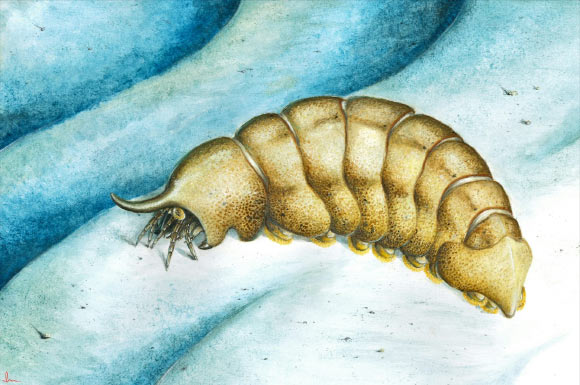
490-Million-Year-Old Arthropod Fossil Fills Puzzling Gap in Fossil Record
Un fossile d'arthropode vieux de 490 millions d'années comble une lacune déroutante dans les archives fossiles
Canada Cambrien Furongien fossile spécimen nouvelle espèce
Une nouvelle espèce d'arthropode corcoraniidé ayant vécu à l'époque furongienne, il y a entre 497 et 487 millions d'années, a été identifiée à partir d'un spécimen exceptionnellement préservé trouvé près de Québec, au Canada. L'article Un fossile d'arthropode vieux de 490 millions d'années comble une lacune déroutante dans les archives fossiles est apparu en premier sur Sci.News : Breaking Science News.
29/05/2026 sci-news ⚙ Traduction automatique
Un nouveau dinosaure carnivore du Trias identifié à Ghost Ranch
États-Unis Trias supérieur Trias fossile spécimen Coelophysis Dinosauria Ptychotherates nouvelle espèce crâne
Des chercheurs de Virginia Tech (Virginie, États-Unis) ont identifié une nouvelle espèce de dinosaure du Trias supérieur.  Le dinosaure a été nommé Ptychotherates bucculentus.  Ce nouveau taxon de dinosaure carnivore a été érigé sur la base de l'examen détaillé d'un fossile de crâne incomplet, bien conservé mais mélangé (numéro de spécimen CM 31368).  Le crâne provient de la Coelophysis de renommée mondiale
11/05/2026 everythingdinosaur ⚙ Traduction automatique
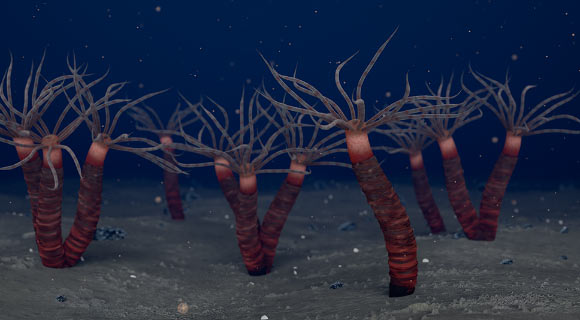
450-Million-Year-Old Fossils Reveal Strange, Tube-Dwelling Jellyfish Relative
Des fossiles vieux de 450 millions d’années révèlent un étrange parent de méduses tubicoles
Canada fossile spécimen nouvelle espèce
Les paléontologues ont identifié un nouveau genre et une nouvelle espèce de polype médusozoaire tubicole au corps mou à partir de spécimens bien conservés trouvés à environ 50 km au nord-est de la ville de Québec au Canada. L'article Des fossiles vieux de 450 millions d'années révèlent un étrange parent de méduses tubicoles apparaît en premier sur Sci.News : Breaking Science News.
21/04/2026 sci-news ⚙ Traduction automatique
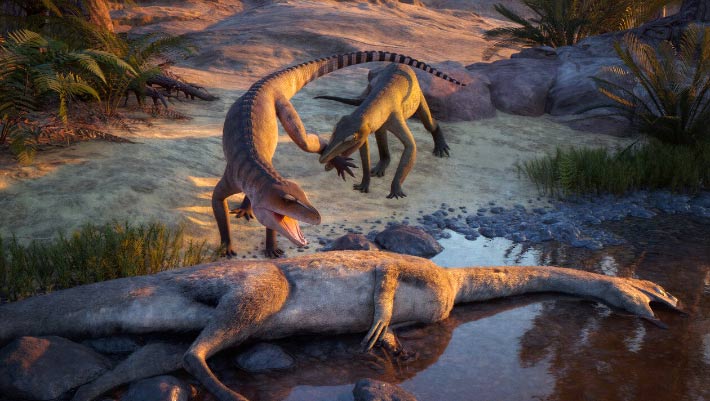
Museum Fossil Reveals Triassic Crocodile Cousin with Powerful Jaws
Un fossile de musée révèle un cousin crocodile du Trias doté de mâchoires puissantes
mâchoire musée Trias supérieur Trias fossile spécimen tomographie nouvelle espèce
Les tomodensitogrammes d'un spécimen vieux de plusieurs décennies du Musée d'histoire naturelle de Yale Peabody montrent une nouvelle espèce de crocodylomorphe au museau court et aux mâchoires inhabituellement fortes, offrant un instantané rare de la spécialisation écologique à l'époque du Trias supérieur. Le post Museum Fossil révèle un cousin crocodile du Trias doté de mâchoires puissantes est apparu en premier sur Sci.News: Breaking Science News.
20/04/2026 sci-news ⚙ Traduction automatique
Épisode 174 : Une histoire des dinosaures en 50 fossiles
musée fossile spécimen Dinosauria
Le professeur Paul Barrett du Natural History Museum de Londres a récemment écrit A History of Dinosaurs in 50 Fossils. Nous en avons profité pour avoir un aperçu de ce que nous savons réellement sur les dinosaures et comment il est même possible de raconter leur histoire avec seulement 50 spécimens. Dans cet épisode, Paul discute de l'histoire [&hellip
15/04/2026 palaeocast ⚙ Traduction automatique
1 2 3 4