←

Dinosauria

Taxon

300 image(s) · 316 News

View page

Image gallery

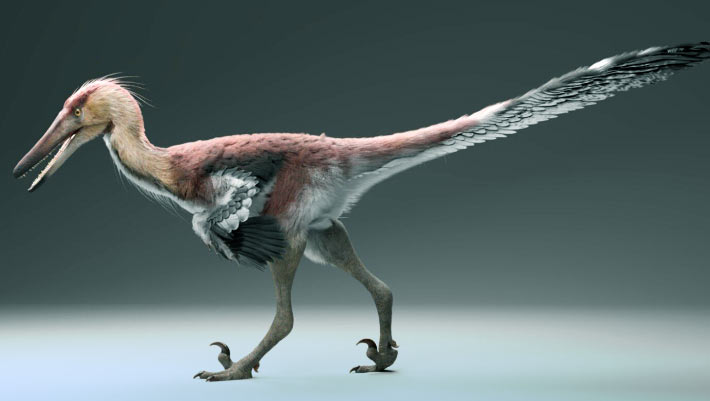
Fujianvenator is an anchiornithid avialan from the Late Jurassic of China, whose discovery gave important insight to the evolution of birds. It had proportionately long legs, with the tibia twice the length of the femur. This suggests it may have been a strong runner, and possibly had a terrestrial or wading lifestyle. Fujianvenator was a small dinosaur, weighing about 640 g. As an avialan, it was almost certainly covered in feathers, though it does not seem likely to have been capable of flight.

Fujianvenator is an anchiornithid avialan from the Late Jurassic of China, whose discovery gave important insight to the evolution of birds. It had proportionately long legs, with the tibia twice the length of the femur. This suggests it may have been a strong runner, and possibly had a terrestrial or wading lifestyle. Fujianvenator was a small dinosaur, weighing about 640 g. As an avialan, it was almost certainly covered in feathers, though it does not seem likely to have been capable of flight.

feather flight China Jurassic +7
Vectipelta at Dinosaur Isle Museum, Isle of Wight, England
Taxa Vectipelta

Vectipelta at Dinosaur Isle Museum, Isle of Wight, England

museum Dinosauria Vectipelta
Reconstruction of the skull of Spinops sternbergorum gen. et sp. nov. from the Campanian of Dinosaur Provincial Park, southern Alberta, in right lateral view. Preserved elements are stippled; missing portions are dotted and modeled after Centrosaurus apertus.
Taxa Spinops

Reconstruction of the skull of Spinops sternbergorum gen. et sp. nov. from the Campanian of Dinosaur Provincial Park, southern Alberta, in right lateral view. Preserved elements are stippled; missing portions are dotted and modeled after Centrosaurus apertus.

Campanian Centrosaurus Dinosauria Spinops +1
Goyocephale lattimorei in the exhibition "Dinosaures. Tresors del desert de Gobi" ("Dinosaurs. Treasures of Gobi Desert") in CosmoCaixa, Barcelona.
Taxa Goyocephale

Goyocephale lattimorei in the exhibition "Dinosaures. Tresors del desert de Gobi" ("Dinosaurs. Treasures of Gobi Desert") in CosmoCaixa, Barcelona.

Dinosauria Goyocephalia
Qunkasaura is a titanosaurian sauropod dinosaur that lived approximately 75 million years ago in the Late Cretaceous of what is now Spain. Specifically, it is a saltasaurid titanosaur, and its discovery marks the first instance of two distinct lineages of this group present in the same locality. In the Late Cretaceous, Europe was a large archipelago, and the coexistence of these differing lineages indicates that saltasaurids arrived in the Iberian Peninsula much later than other groups of dinosaurs.
Taxa Qunkasaura

Qunkasaura is a titanosaurian sauropod dinosaur that lived approximately 75 million years ago in the Late Cretaceous of what is now Spain. Specifically, it is a saltasaurid titanosaur, and its discovery marks the first instance of two distinct lineages of this group present in the same locality. In the Late Cretaceous, Europe was a large archipelago, and the coexistence of these differing lineages indicates that saltasaurids arrived in the Iberian Peninsula much later than other groups of dinosaurs.

Spain Cretaceous Late Cretaceous Dinosauria +4
Identifier: annalsofmedicalh01pack (find matches)
Title: Annals of medical history
Year: 1917 (1910s)
Authors:  Packard, Francis R. (Francis Randolph), 1870-1950
Subjects:  Medicine
Publisher:  New York P.B. Hoeber
Contributing Library:  Gerstein - University of Toronto
Digitizing Sponsor:  University of Toronto

View Book Page: Book Viewer
About This Book: Catalog Entry
View All Images: All Images From Book
Click here to view book online to see this illustration in context in a browseable online version of this book.

Text Appearing Before Image:
ail strongly Hexed, and the toescontracted and appressed. The whole atti-tude strongly suggests a spastic distress,possibly brought on by some form ofpoisoning of the central nervous system,from infection or the deglutition of somepoisonous substance. 14. Osteomalacia is evidently the causeof the hypertrophy of the bones of Lim-nocyron potens, an early carnivore from theWashakie Eocene of Wyoming, nearly3,000,000 years old. MATERIALS AND METHODS The material described in the presentpaper has been loaned the writer lor de-scription by the Field Museum of Chii Osborn: Hull. Amcr. \lus. Natl. Hist., 1917,vol. 35. !>• 733. P>- 28. Studies in Paleopathology 393 by the American Museum of Natural His-tory of New York City, by Walker Museumof the University of Chicago, and by the Uni-versity of Kansas Natural History Museum. made by the well-known petrographic meth-ods so common in all geological labora-tories. The diagnoses, where they are at-tempted, arc made from comparisons of the
Text Appearing After Image:
Fig. 20. The skeleton of Strutbiomimus altus, a small dinosaur from the BeliyRiver series (Cretaceous), Red Deer River, Alberta, Canada, now regarded as ofapproximately the same age as the Judith River series. The unique feature ofthe skull is the total absence of teeth, with a size of skull one-third larger thanthe ostrich and a length of body of about fifteen feet. The position of the skeletonis decidedly that of the opisthotonos which may be regarded as an indication ofdisease. (After Osborn). A beautiful specimen of an osteoma, theonly one known so far, on the vertebra of aKansas Cretaceous mosasaur, was given thewriter by Dr. J. M. Armstrong of St. Paul.The writer expresses his obligations to thegentlemen connected with the above-men-tioned institutions and to Dr. Armstrong.The methods used are a combination ofprocedures in the various lines involved.Microscopic sections, which can be madethin enough for immersion lens study, are material with similar lesions in recent hu-man mat

Note About Images

Please note that these images are extracted from scanned page images that may have been digitally enhanced for readability - coloration and appearance of these illustrations may not perfectly resemble the original work.

Identifier: annalsofmedicalh01pack (find matches) Title: Annals of medical history Year: 1917 (1910s) Authors: Packard, Francis R. (Francis Randolph), 1870-1950 Subjects: Medicine Publisher: New York P.B. Hoeber Contributing Library: Gerstein - University of Toronto Digitizing Sponsor: University of Toronto View Book Page: Book Viewer About This Book: Catalog Entry View All Images: All Images From Book Click here to view book online to see this illustration in context in a browseable online version of this book. Text Appearing Before Image: ail strongly Hexed, and the toescontracted and appressed. The whole atti-tude strongly suggests a spastic distress,possibly brought on by some form ofpoisoning of the central nervous system,from infection or the deglutition of somepoisonous substance. 14. Osteomalacia is evidently the causeof the hypertrophy of the bones of Lim-nocyron potens, an early carnivore from theWashakie Eocene of Wyoming, nearly3,000,000 years old. MATERIALS AND METHODS The material described in the presentpaper has been loaned the writer lor de-scription by the Field Museum of Chii Osborn: Hull. Amcr. \lus. Natl. Hist., 1917,vol. 35. !>• 733. P>- 28. Studies in Paleopathology 393 by the American Museum of Natural His-tory of New York City, by Walker Museumof the University of Chicago, and by the Uni-versity of Kansas Natural History Museum. made by the well-known petrographic meth-ods so common in all geological labora-tories. The diagnoses, where they are at-tempted, arc made from comparisons of the Text Appearing After Image: Fig. 20. The skeleton of Strutbiomimus altus, a small dinosaur from the BeliyRiver series (Cretaceous), Red Deer River, Alberta, Canada, now regarded as ofapproximately the same age as the Judith River series. The unique feature ofthe skull is the total absence of teeth, with a size of skull one-third larger thanthe ostrich and a length of body of about fifteen feet. The position of the skeletonis decidedly that of the opisthotonos which may be regarded as an indication ofdisease. (After Osborn). A beautiful specimen of an osteoma, theonly one known so far, on the vertebra of aKansas Cretaceous mosasaur, was given thewriter by Dr. J. M. Armstrong of St. Paul.The writer expresses his obligations to thegentlemen connected with the above-men-tioned institutions and to Dr. Armstrong.The methods used are a combination ofprocedures in the various lines involved.Microscopic sections, which can be madethin enough for immersion lens study, are material with similar lesions in recent hu-man mat Note About Images Please note that these images are extracted from scanned page images that may have been digitally enhanced for readability - coloration and appearance of these illustrations may not perfectly resemble the original work.

bone vertebra book museum +11
A diagram showing the bones and feathering preserved in IVPP V 12638, the holotype of Yixianosaurus longimanus, a feathered dinosaur.
Taxa Yixianosaurus

A diagram showing the bones and feathering preserved in IVPP V 12638, the holotype of Yixianosaurus longimanus, a feathered dinosaur.

bone holotype Dinosauria Yixianosaurus
Holotype specimen (CRILAR-Pv 151) of Huayracursor jaguensis, a long-necked dinosaur that lived approximately 230 million years ago, placed in approximate anatomical articulation.
Taxa Huayracursor

Holotype specimen (CRILAR-Pv 151) of Huayracursor jaguensis, a long-necked dinosaur that lived approximately 230 million years ago, placed in approximate anatomical articulation.

holotype specimen Dinosauria Huayracursor
Diagram featuring the holotype skull (ZPAL MgD-I/105) of Tylocephale gilmorei in left lateral view. Scale bar equals 5 cm (50 mm). Based on Maryańska & Osmólska, 1974,[1] and Sullivan, 2006.[2]
References

↑ (1974). "Pachycephalosauria, a new suborder of ornithischian dinosaurs". Palaeontologica Polonica (30): 45−102.

↑ (2006). "A taxonomic review of the Pachycephalosauridae (Dinosauria: Ornithischia)". New Mexico Museum of Natural History and Science Bulletin (35): 347–365.
Taxa Tylocephale

Diagram featuring the holotype skull (ZPAL MgD-I/105) of Tylocephale gilmorei in left lateral view. Scale bar equals 5 cm (50 mm). Based on Maryańska & Osmólska, 1974,[1] and Sullivan, 2006.[2] References ↑ (1974). "Pachycephalosauria, a new suborder of ornithischian dinosaurs". Palaeontologica Polonica (30): 45−102. ↑ (2006). "A taxonomic review of the Pachycephalosauridae (Dinosauria: Ornithischia)". New Mexico Museum of Natural History and Science Bulletin (35): 347–365.

scale museum Mexico holotype +6
A visual representation of Yamanasaurus lojaensis, first dinosaur discovered in Ecuador
Taxa Yamanasaurus

A visual representation of Yamanasaurus lojaensis, first dinosaur discovered in Ecuador

Ecuador Dinosauria Yamanasaurus
Fossil of Streptospondylus, a dinosaur from the Middle Jurassic period of France. Took the photo at the Gallery of Paleontology and Comparative Anatomy in the French National Museum of Natural History, Paris.
Taxa Streptospondylus

Fossil of Streptospondylus, a dinosaur from the Middle Jurassic period of France. Took the photo at the Gallery of Paleontology and Comparative Anatomy in the French National Museum of Natural History, Paris.

museum France Jurassic Middle Jurassic +4
Tongnanlong is a large mamenchisaurid sauropod dinosaur that lived in the Late Jurassic period of what is now China. Typical of mamenchisaurids, it had an extremely long neck, even by sauropod standards. Tongnanlong grew to approximately 25 m in length and weighed 20-30 t, making it one of the largest mamenchisaurids.

Tongnanlong is a large mamenchisaurid sauropod dinosaur that lived in the Late Jurassic period of what is now China. Typical of mamenchisaurids, it had an extremely long neck, even by sauropod standards. Tongnanlong grew to approximately 25 m in length and weighed 20-30 t, making it one of the largest mamenchisaurids.

China Jurassic Late Jurassic Dinosauria +2
Reconstruction of the holotype skull (PIN 3906/2) of the Late Cretaceous sauropod Quaesitosaurus orientalis. Based on Kurzanov & Bannikov 1983,[1] missing elements restored after Nemegtosaurus.[2]
Color Key
  Preserved
  Missing
References

↑ (1983). "A new sauropod from the Upper Cretaceous of Mongolia". Paleontological Journal 2: 90−96.

↑ (2005). "Redescription of the mongolian sauropod Nemegtosaurus mongoliensis nowinski (dinosauria: Saurischia) and comments on late cretaceous sauropod diversity". Journal of Systematic Palaeontology 3 (3): 283−318. DOI:10.1017/S1477201905001628.
Taxa Quaesitosaurus

Reconstruction of the holotype skull (PIN 3906/2) of the Late Cretaceous sauropod Quaesitosaurus orientalis. Based on Kurzanov & Bannikov 1983,[1] missing elements restored after Nemegtosaurus.[2] Color Key   Preserved   Missing References ↑ (1983). "A new sauropod from the Upper Cretaceous of Mongolia". Paleontological Journal 2: 90−96. ↑ (2005). "Redescription of the mongolian sauropod Nemegtosaurus mongoliensis nowinski (dinosauria: Saurischia) and comments on late cretaceous sauropod diversity". Journal of Systematic Palaeontology 3 (3): 283−318. DOI:10.1017/S1477201905001628.

Mongolia Cretaceous Late Cretaceous holotype +5
Jiangxititan a titanosaurian sauropod from the Late Cretaceous of China. Typical for a sauropod, it had a long neck and stood on four pillar-like legs to support its massive body. Jiangxititan is a member of the Lognkosauria, which include some of the largest dinosaurs known, and is one of the few from mainland Asia. The discovery of Jiangxititan demonstrates the presence of both early-diverging and late-diverging titanosauriform sauropods in that area during the Late Cretaceous.
Taxa Jiangxititan

Jiangxititan a titanosaurian sauropod from the Late Cretaceous of China. Typical for a sauropod, it had a long neck and stood on four pillar-like legs to support its massive body. Jiangxititan is a member of the Lognkosauria, which include some of the largest dinosaurs known, and is one of the few from mainland Asia. The discovery of Jiangxititan demonstrates the presence of both early-diverging and late-diverging titanosauriform sauropods in that area during the Late Cretaceous.

China Cretaceous Late Cretaceous Dinosauria +5
Restoration of Borealosaurus a potentially titanosaur dinosaur from the Cretaceous of China
Taxa Borealosaurus

Restoration of Borealosaurus a potentially titanosaur dinosaur from the Cretaceous of China

China Cretaceous Borealosaurus Dinosauria +1
Garumbatitan is a sauropod dinosaur from the Early Cretaceous of what is now Spain. It is classified as a basal somphospondylan - a Titanosauriform, but not a true Titanosaur.
Taxa Garumbatitan

Garumbatitan is a sauropod dinosaur from the Early Cretaceous of what is now Spain. It is classified as a basal somphospondylan - a Titanosauriform, but not a true Titanosaur.

Spain Cretaceous Early Cretaceous Dinosauria +4
1 2 3 4 5 6 7 8 9 10 11 12 13 14 15 16 17 18 19

News

New Dinosaur Species from Argentina May Have Specialized in Catching Fish
Argentina Cretaceous Late Cretaceous Dinosauria Kank Unenlagiidae
Paleontologists in Argentina have identified a previously unknown species of unenlagiid dinosaur that stalked freshwater wetlands during the Late Cretaceous epoch, adding to evidence that some dinosaurs specialized in catching fish. The post New Dinosaur Species from Argentina May Have Specialized in Catching Fish appeared first on Sci.News: Breaking Science News.
29/05/2026 sci-news
This bizarre crocodile relative from the Triassic looked like an ostrich dinosaur
limb Triassic Dinosauria
Scientists have discovered Labrujasuchus expectatus, a bizarre crocodile relative that looked more like an ostrich-like dinosaur than anything resembling a modern crocodile. It walked on two legs, had tiny arms, and sported a toothless beak—an unexpected combination for a member of the crocodile lineage.
29/05/2026 sciencedaily
This newly discovered raptor may have hunted like a giant heron
vertebra predator Dinosauria Kank
A newly discovered raptor-like dinosaur from Patagonia is changing how scientists think about ancient predators. Named Kank australis, the 70-million-year-old dinosaur appears to have hunted fish much like modern herons, using a long, flexible neck and specialized vertebrae adapted for swift, precise movements.
29/05/2026 sciencedaily
A Beautiful and Detailed Spinosaurus Illustration
drawing Dinosauria Spinosauria
Thank you Caldey for sending into Everything Dinosaur your illustration of the "Surviving Earth" Spinosaurus hatchlings.  The renowned palaeoartist Gabriel Ugueto produced concept art for this new eight-part television series. We have been lucky enough to see some of his remarkable illustrations including the hatchling Spinosaurus drawings.  Caldey's drawing faithfully recreates the scene featuring the
29/05/2026 everythingdinosaur
Fungi Bloomed Twice around End-Cretaceous Mass Extinction
pelvis Denver Cretaceous Dinosauria extinction
By studying fungal microfossils in 66-million-year-old rock samples from the Denver Basin in Colorado, Johns Hopkins University microbiologists have confirmed that the dinosaur-killing asteroid impact triggered a worldwide fungal takeover, and uncovered a second, previously unknown ecological crisis just before it. The post Fungi Bloomed Twice around End-Cretaceous Mass Extinction appeared first on Sci.News: Breaking Science News.
28/05/2026 sci-news
1 2 3 4 5 6 7 8 9 10 11 12 13 14 15 16 17 18 19 20 21 22 23 24 25 26 27 28 29 30 31 32 33 34 35 36 37 38 39 40 41 42 43 44 45 46 47 48 49 50 51 52 53 54 55 56 57 58 59 60 61 62 63 64