Dinosauria

Taxon

242 image(s) · 133 Actualités

Voir la fiche

Galerie d'images

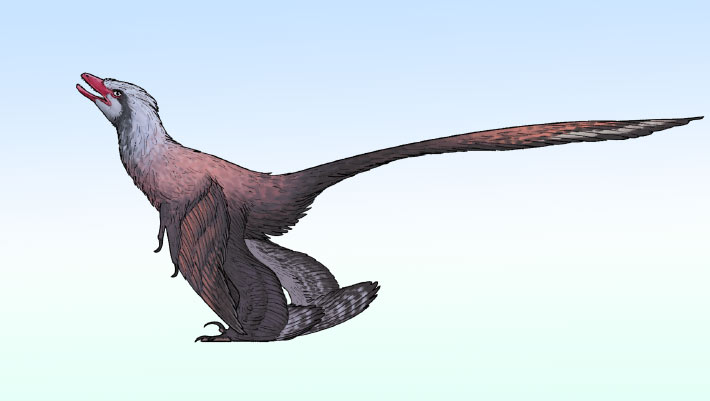
Restored profile of the oviraptorid dinosaur Heyuannia yanshini by Matt Martyniuk.

Restored profile of the oviraptorid dinosaur Heyuannia yanshini by Matt Martyniuk.

Dinosauria Heyuannia Ingenia Oviraptoridae
Reconstruction of Bissektipelta archibaldi an ankylosaurid dinosaur from the Late Cretaceous of Uzbekistan
Taxons Bissektipelta

Reconstruction of Bissektipelta archibaldi an ankylosaurid dinosaur from the Late Cretaceous of Uzbekistan

Ouzbékistan Crétacé Crétacé supérieur Ankylosauridae +2
Huaxiazhoulong is a fairly large ankylosaurid dinosaur, at around 6 m in length. It was a robust quadruped with a beak and teeth adapted for processing its herbivorous diet. Huaxiazhoulong had an armor of osteoderms, and the characteristic ankylosaurid tail club which was likely used in defense against predators, as well as intraspecific combat.
Taxons Huaxiazhoulong

Huaxiazhoulong is a fairly large ankylosaurid dinosaur, at around 6 m in length. It was a robust quadruped with a beak and teeth adapted for processing its herbivorous diet. Huaxiazhoulong had an armor of osteoderms, and the characteristic ankylosaurid tail club which was likely used in defense against predators, as well as intraspecific combat.

armure défense prédateur Ankylosauridae +2
Calvarius is a genus of styracosternan ornithopod from the Late Cretaceous of Spain. The name alludes to its chronostratigraphic proximity to the extinction event that wiped out the non-avian dinosaurs at the end of the Cretaceous. The highly modified metatarsal that is known from shows an example of convergent evolution, as it is more similar to non-iguanodontian ornithopods than to other styracosternans. It is thought that this is due to fulfilling a niche in its island habitat, resulting in Calvarius becoming a small-bodied animal, capable of rapid locomotion.
Taxons Calvarius

Calvarius is a genus of styracosternan ornithopod from the Late Cretaceous of Spain. The name alludes to its chronostratigraphic proximity to the extinction event that wiped out the non-avian dinosaurs at the end of the Cretaceous. The highly modified metatarsal that is known from shows an example of convergent evolution, as it is more similar to non-iguanodontian ornithopods than to other styracosternans. It is thought that this is due to fulfilling a niche in its island habitat, resulting in Calvarius becoming a small-bodied animal, capable of rapid locomotion.

locomotion Espagne Crétacé Crétacé supérieur +6
Astigmasaura is a medium-sized rebbachisaurid sauropod dinosaur from the Late Cretaceous period of what is now Argentina. Rebbachisaurids had highly pneumatized bones that helped them to hold their weight on their four pillar-like legs, and extremely long tails. Astigmasaura was likely a ground-level browsing herbivore.
Taxons Astigmasaura

Astigmasaura is a medium-sized rebbachisaurid sauropod dinosaur from the Late Cretaceous period of what is now Argentina. Rebbachisaurids had highly pneumatized bones that helped them to hold their weight on their four pillar-like legs, and extremely long tails. Astigmasaura was likely a ground-level browsing herbivore.

os Argentine Crétacé Crétacé supérieur +3
Rebbachisaurids are the latest known sauropod dinosaurs outside the titanosaur lineage. Cienciargentina is a rebbachisaurid from the Late Cretaceous, making it among the most recent. It had many hollow bones, and likely had batteries of teeth used for chewing, a rebbachisaurid feature unique among sauropods.
Taxons Cienciargentina

Rebbachisaurids are the latest known sauropod dinosaurs outside the titanosaur lineage. Cienciargentina is a rebbachisaurid from the Late Cretaceous, making it among the most recent. It had many hollow bones, and likely had batteries of teeth used for chewing, a rebbachisaurid feature unique among sauropods.

os Crétacé Crétacé supérieur Cienciargentina +3
Original caption: "Calibrated phylogeny of Neosauropoda. Summarized strict consensus tree showing the relationships among neosauropod dinosaurs and the phylogenetic position of Tapuiasaurus macedoi gen. n. sp. n. The support values (Bremer/Bootstrap) for the nodes labelled in the figure are: Neosauropoda (1/-), Somphospondyli (2/68), Titanosauria (2/58), Lithostrotia (3/68), “advanced titanosaurians” (3/65), Nemegtosauridae (1/-), Saltasauridae (1/-). See Figure S4 for a complete strict consensus tree including all sauropod terminal taxa used in the analysis. Age of first appearance for taxa used in the calibrated phylogeny are given in Text S4."
Taxons Rayososaurus

Original caption: "Calibrated phylogeny of Neosauropoda. Summarized strict consensus tree showing the relationships among neosauropod dinosaurs and the phylogenetic position of Tapuiasaurus macedoi gen. n. sp. n. The support values (Bremer/Bootstrap) for the nodes labelled in the figure are: Neosauropoda (1/-), Somphospondyli (2/68), Titanosauria (2/58), Lithostrotia (3/68), “advanced titanosaurians” (3/65), Nemegtosauridae (1/-), Saltasauridae (1/-). See Figure S4 for a complete strict consensus tree including all sauropod terminal taxa used in the analysis. Age of first appearance for taxa used in the calibrated phylogeny are given in Text S4."

Dinosauria Lithostrotia Nemegtosauridae Neosauropoda +6
Dzharacursor is an ornithomimid theropod dinosaur from the Late Cretaceous of what is now Uzbekistan. Ornithomimids like Dzharacursor are known for their long legs lending to a cursorial, or running, lifestyle. They had a feathered covering, and were likely omnivorous, or possibly herbivorous. Adult Dzharacursor could grow to approximately 3.5 m in length.
Taxons Dzharacursor

Dzharacursor is an ornithomimid theropod dinosaur from the Late Cretaceous of what is now Uzbekistan. Ornithomimids like Dzharacursor are known for their long legs lending to a cursorial, or running, lifestyle. They had a feathered covering, and were likely omnivorous, or possibly herbivorous. Adult Dzharacursor could grow to approximately 3.5 m in length.

Ouzbékistan Crétacé Crétacé supérieur Dinosauria +2
Ahvaytum is a saturnaliid sauropodomorph from the Late Triassic of what is now Wyoming. It is the oldest known dinosaur from the northern continent of Laurasia, challenging previous hypotheses of dinosaur origins and dispersal. Typical of basal dinosaurs from the Triassic, Ahvaytum was a small slender biped, reaching about 1 m in body length.
Taxons Ahvaytum

Ahvaytum is a saturnaliid sauropodomorph from the Late Triassic of what is now Wyoming. It is the oldest known dinosaur from the northern continent of Laurasia, challenging previous hypotheses of dinosaur origins and dispersal. Typical of basal dinosaurs from the Triassic, Ahvaytum was a small slender biped, reaching about 1 m in body length.

Trias supérieur Trias Ahvaytum Dinosauria +1
Huashanosaurus is a basal sauropod dinosaur that lived from the Early to Middle Jurassic periods of what is now China. It was a long-necked herbivore which still exhibited many basal traits of the earlier sauropodomorphs, while transitioning to obligate quardupedality. Huashanosaurus grew to approximately 12 m in length, and weighed around 10 t.
Taxons Huashanosaurus

Huashanosaurus is a basal sauropod dinosaur that lived from the Early to Middle Jurassic periods of what is now China. It was a long-necked herbivore which still exhibited many basal traits of the earlier sauropodomorphs, while transitioning to obligate quardupedality. Huashanosaurus grew to approximately 12 m in length, and weighed around 10 t.

Chine Jurassique Jurassique moyen Dinosauria +1
Fujianvenator is an anchiornithid avialan from the Late Jurassic of China, whose discovery gave important insight to the evolution of birds. It had proportionately long legs, with the tibia twice the length of the femur. This suggests it may have been a strong runner, and possibly had a terrestrial or wading lifestyle. Fujianvenator was a small dinosaur, weighing about 640 g. As an avialan, it was almost certainly covered in feathers, though it does not seem likely to have been capable of flight.
Taxons Fujianvenator

Fujianvenator is an anchiornithid avialan from the Late Jurassic of China, whose discovery gave important insight to the evolution of birds. It had proportionately long legs, with the tibia twice the length of the femur. This suggests it may have been a strong runner, and possibly had a terrestrial or wading lifestyle. Fujianvenator was a small dinosaur, weighing about 640 g. As an avialan, it was almost certainly covered in feathers, though it does not seem likely to have been capable of flight.

plume vol Chine Jurassique +7
Identifier: annalsofmedicalh01pack (find matches)
Title: Annals of medical history
Year: 1917 (1910s)
Authors:  Packard, Francis R. (Francis Randolph), 1870-1950
Subjects:  Medicine
Publisher:  New York P.B. Hoeber
Contributing Library:  Gerstein - University of Toronto
Digitizing Sponsor:  University of Toronto

View Book Page: Book Viewer
About This Book: Catalog Entry
View All Images: All Images From Book
Click here to view book online to see this illustration in context in a browseable online version of this book.

Text Appearing Before Image:
ail strongly Hexed, and the toescontracted and appressed. The whole atti-tude strongly suggests a spastic distress,possibly brought on by some form ofpoisoning of the central nervous system,from infection or the deglutition of somepoisonous substance. 14. Osteomalacia is evidently the causeof the hypertrophy of the bones of Lim-nocyron potens, an early carnivore from theWashakie Eocene of Wyoming, nearly3,000,000 years old. MATERIALS AND METHODS The material described in the presentpaper has been loaned the writer lor de-scription by the Field Museum of Chii Osborn: Hull. Amcr. \lus. Natl. Hist., 1917,vol. 35. !>• 733. P>- 28. Studies in Paleopathology 393 by the American Museum of Natural His-tory of New York City, by Walker Museumof the University of Chicago, and by the Uni-versity of Kansas Natural History Museum. made by the well-known petrographic meth-ods so common in all geological labora-tories. The diagnoses, where they are at-tempted, arc made from comparisons of the
Text Appearing After Image:
Fig. 20. The skeleton of Strutbiomimus altus, a small dinosaur from the BeliyRiver series (Cretaceous), Red Deer River, Alberta, Canada, now regarded as ofapproximately the same age as the Judith River series. The unique feature ofthe skull is the total absence of teeth, with a size of skull one-third larger thanthe ostrich and a length of body of about fifteen feet. The position of the skeletonis decidedly that of the opisthotonos which may be regarded as an indication ofdisease. (After Osborn). A beautiful specimen of an osteoma, theonly one known so far, on the vertebra of aKansas Cretaceous mosasaur, was given thewriter by Dr. J. M. Armstrong of St. Paul.The writer expresses his obligations to thegentlemen connected with the above-men-tioned institutions and to Dr. Armstrong.The methods used are a combination ofprocedures in the various lines involved.Microscopic sections, which can be madethin enough for immersion lens study, are material with similar lesions in recent hu-man mat

Note About Images

Please note that these images are extracted from scanned page images that may have been digitally enhanced for readability - coloration and appearance of these illustrations may not perfectly resemble the original work.
Taxons Hexing

Identifier: annalsofmedicalh01pack (find matches) Title: Annals of medical history Year: 1917 (1910s) Authors: Packard, Francis R. (Francis Randolph), 1870-1950 Subjects: Medicine Publisher: New York P.B. Hoeber Contributing Library: Gerstein - University of Toronto Digitizing Sponsor: University of Toronto View Book Page: Book Viewer About This Book: Catalog Entry View All Images: All Images From Book Click here to view book online to see this illustration in context in a browseable online version of this book. Text Appearing Before Image: ail strongly Hexed, and the toescontracted and appressed. The whole atti-tude strongly suggests a spastic distress,possibly brought on by some form ofpoisoning of the central nervous system,from infection or the deglutition of somepoisonous substance. 14. Osteomalacia is evidently the causeof the hypertrophy of the bones of Lim-nocyron potens, an early carnivore from theWashakie Eocene of Wyoming, nearly3,000,000 years old. MATERIALS AND METHODS The material described in the presentpaper has been loaned the writer lor de-scription by the Field Museum of Chii Osborn: Hull. Amcr. \lus. Natl. Hist., 1917,vol. 35. !>• 733. P>- 28. Studies in Paleopathology 393 by the American Museum of Natural His-tory of New York City, by Walker Museumof the University of Chicago, and by the Uni-versity of Kansas Natural History Museum. made by the well-known petrographic meth-ods so common in all geological labora-tories. The diagnoses, where they are at-tempted, arc made from comparisons of the Text Appearing After Image: Fig. 20. The skeleton of Strutbiomimus altus, a small dinosaur from the BeliyRiver series (Cretaceous), Red Deer River, Alberta, Canada, now regarded as ofapproximately the same age as the Judith River series. The unique feature ofthe skull is the total absence of teeth, with a size of skull one-third larger thanthe ostrich and a length of body of about fifteen feet. The position of the skeletonis decidedly that of the opisthotonos which may be regarded as an indication ofdisease. (After Osborn). A beautiful specimen of an osteoma, theonly one known so far, on the vertebra of aKansas Cretaceous mosasaur, was given thewriter by Dr. J. M. Armstrong of St. Paul.The writer expresses his obligations to thegentlemen connected with the above-men-tioned institutions and to Dr. Armstrong.The methods used are a combination ofprocedures in the various lines involved.Microscopic sections, which can be madethin enough for immersion lens study, are material with similar lesions in recent hu-man mat Note About Images Please note that these images are extracted from scanned page images that may have been digitally enhanced for readability - coloration and appearance of these illustrations may not perfectly resemble the original work.

os vertèbre musée Canada +10
Tongnanlong is a large mamenchisaurid sauropod dinosaur that lived in the Late Jurassic period of what is now China. Typical of mamenchisaurids, it had an extremely long neck, even by sauropod standards. Tongnanlong grew to approximately 25 m in length and weighed 20-30 t, making it one of the largest mamenchisaurids.
Taxons Tongnanlong

Tongnanlong is a large mamenchisaurid sauropod dinosaur that lived in the Late Jurassic period of what is now China. Typical of mamenchisaurids, it had an extremely long neck, even by sauropod standards. Tongnanlong grew to approximately 25 m in length and weighed 20-30 t, making it one of the largest mamenchisaurids.

Chine Jurassique Jurassique supérieur Dinosauria +2
Wudingloong is the earliest diverging, and oldest sauropodomorph dinosaur known from East Asia. Typical of basal sauropodomorphs, or "prosauropods," it was a bipedal herbivore with a long neck. Wudingloong was a fairly small prosauropod at approximately 4 m in length, and weighing around 400 kg.
Taxons Wudingloong

Wudingloong is the earliest diverging, and oldest sauropodomorph dinosaur known from East Asia. Typical of basal sauropodomorphs, or "prosauropods," it was a bipedal herbivore with a long neck. Wudingloong was a fairly small prosauropod at approximately 4 m in length, and weighing around 400 kg.

Dinosauria Wudingloong
Restoration of Analong chuanjieensis, a sauropod dinosaur from the Middle Jurassic of China
Taxons Analong

Restoration of Analong chuanjieensis, a sauropod dinosaur from the Middle Jurassic of China

Chine Jurassique Jurassique moyen Analong +1
A hypothetical form of Traukutitan, a sauropod dinosaur
Taxons Traukutitan

A hypothetical form of Traukutitan, a sauropod dinosaur

Dinosauria Traukutitan
1 2 3 4 5 6 7 8 9 10 11 12 13 14 15 16

Actualités

Irritator: Beast of the Week
Irritateur : la bête de la semaine
reconstitution Brésil Crétacé Crétacé inférieur Dinosauria Irritator
La bête de cette semaine est un dinosaure spécial qui nous aide à mieux comprendre l'apparence et le mode de vie de sa famille.  Découvrez Irritator challengeri ! Reconstitution de la vie d'Irritator à l'aquarelle par Christopher DiPiazza. Irritator était un dinosaure carnivore qui vivait dans ce qui est aujourd'hui le Brésil au début du Crétacé, il y a entre 113 et 110 millions d'années. Du museau à la queue, il mesurait entre 6 et 8 mètres et était un mangeur de viande de son vivant.  Le nom du genre, Ir
24/08/2025 prehistoricbeastoftheweek ⚙ Traduction automatique
Ceratosaurus: Beast of the Week
Ceratosaurus : Bête de la semaine
reconstitution Portugal États-Unis Jurassique Jurassique supérieur Ceratosauria Dinosauria
Cette semaine, nous allons nous intéresser à un mangeur de viande populaire doté de caractéristiques vraiment uniques.  Entrez Ceratosaurus ! Reconstitution à l'aquarelle de la vie de Ceratosaurus nascornis mangeant l'ancien poisson-poumon, Ceratodus Robustus par Christopher DiPiazza. Le Ceratosaurus était un dinosaure carnivore qui vivait à la fin du Jurassique, il y a environ 150 millions d'années, dans ce qui est aujourd'hui les États-Unis, plus précisément l'Utah et le Colorado.  Des os supposés provenir de Ceratosaurus ont également été découverts au Portugal.  En tant que
14/07/2025 prehistoricbeastoftheweek ⚙ Traduction automatique
Lepidotes: Beast of the Week
Lépidotes : la bête de la semaine
écaille reconstitution Crétacé Crétacé inférieur Jurassique inférieur Jurassique Dinosauria
 Cette fois-ci, nous examinerons une espèce unique de poissons préhistoriques qui nageaient dans les rivières et les lacs tandis que certains des plus grands dinosaures marchaient sur terre.  Découvrez Lepidotes ! Reconstitution à l'aquarelle de Lepidotes gigas par Christopher DiPiazza. Les Lepidotes étaient un genre de poissons osseux à fortes écailles qui vivaient dans ce qui est aujourd'hui l'Europe et l'Amérique du Nord au début du Jurassique, il y a entre 180 et 175 millions d'années.  Le genre a peut-être même persisté jusqu'au Crétacé inférieur, il y a seulement 115 millions d'années, mais
29/06/2025 prehistoricbeastoftheweek ⚙ Traduction automatique
1 2 3 4 5 6 7 8 9 10 11 12 13 14 15 16 17 18 19 20 21 22 23 24 25 26 27