←

Dinosauria

Taxon

251 image(s) · 248 Actualités

Voir la fiche

Galerie d'images

Fossil of Pinacosaurus, an ankylosaurian  dinosaur
Took the photo at Musee d'Histoire Naturelle, Brussels

Fossil of Pinacosaurus, an ankylosaurian dinosaur Took the photo at Musee d'Histoire Naturelle, Brussels

fossile Ankylosauria Dinosauria Eopinacosaurus +1
Fossil of Pinacosaurus, an ankylosaurid dinosaur
Took the photo at Musee d'Histoire Naturelle, Brussels

Fossil of Pinacosaurus, an ankylosaurid dinosaur Took the photo at Musee d'Histoire Naturelle, Brussels

fossile Ankylosauridae Dinosauria Eopinacosaurus +1
Eopinacosaurus is an ankylosaurid dinosaur that was originally assigned to Pinacosaurus, until a 2026 analysis reassigned it as a distinct genus. Like all ankylosaurs, it was a heavily armored quadrupedal herbivore. Notable defensive adaptations include the characteristic tail club, as well as sizable horns protruding backward from the head.

Eopinacosaurus is an ankylosaurid dinosaur that was originally assigned to Pinacosaurus, until a 2026 analysis reassigned it as a distinct genus. Like all ankylosaurs, it was a heavily armored quadrupedal herbivore. Notable defensive adaptations include the characteristic tail club, as well as sizable horns protruding backward from the head.

Ankylosauria Ankylosauridae Dinosauria Eopinacosaurus +1
Norellraptor is a microraptorian dinosaur known from a specimen with exceptionally well-preserved feathers. Its discovery supports evidence that gliding and flight-related traits evolved independently in multiple dinosaur groups. Norellraptor had long feathers on its arms and legs, typical of microraptorians, resulting in a four-winged body plan.
Taxons Norellraptor

Norellraptor is a microraptorian dinosaur known from a specimen with exceptionally well-preserved feathers. Its discovery supports evidence that gliding and flight-related traits evolved independently in multiple dinosaur groups. Norellraptor had long feathers on its arms and legs, typical of microraptorians, resulting in a four-winged body plan.

plume vol spécimen Dinosauria +2
Kayrasaurus is a therizinosaurian dinosaur that lived during the Early Cretaceous period in what is now China. At an estimated 3.6 m in total body length, it is the largest therizinosaur known from the Jehol Biota. Like other therizinosaurs, Kayrasaurus was a bipedal herbivore with large curved claws on each hand.
Taxons Kayrasaurus

Kayrasaurus is a therizinosaurian dinosaur that lived during the Early Cretaceous period in what is now China. At an estimated 3.6 m in total body length, it is the largest therizinosaur known from the Jehol Biota. Like other therizinosaurs, Kayrasaurus was a bipedal herbivore with large curved claws on each hand.

griffe Chine Crétacé Crétacé inférieur +2
Muttaburrasaurus
The plants, animals and climate of the Australian continent have changed dramatically over long periods of time. Imagine this giant creature roaming the luxuriant wet forests that covered parts of the continent in the Cretaceous period, about 100-110 million years ago. The Muttaburrasaurus ambled along on all four legs or stood on its hind legs. Its large teeth were well adapted to eat tough vegetation such as the leathery foliage of the evergreen forests of Araucaria trees, ancient relatives of the bunya pine of south-eastern Queensland.
In 1963, grazier Doug Langdon discovered the fossilised bones of a dinosaur on his property near Muttaburra in central-west Queensland. It was one of the most complete dinosaur skeletons found in Australia. The bones belonged to a new species of ornithopod and palaeontologists named it Muttaburrasaurus langdoni.

Cast of Muttaburresaurus langdoni 1987 made by Queensland Museum, Brisbane National Museum of Australia
Taxons Muttaburrasaurus

Muttaburrasaurus The plants, animals and climate of the Australian continent have changed dramatically over long periods of time. Imagine this giant creature roaming the luxuriant wet forests that covered parts of the continent in the Cretaceous period, about 100-110 million years ago. The Muttaburrasaurus ambled along on all four legs or stood on its hind legs. Its large teeth were well adapted to eat tough vegetation such as the leathery foliage of the evergreen forests of Araucaria trees, ancient relatives of the bunya pine of south-eastern Queensland. In 1963, grazier Doug Langdon discovered the fossilised bones of a dinosaur on his property near Muttaburra in central-west Queensland. It was one of the most complete dinosaur skeletons found in Australia. The bones belonged to a new species of ornithopod and palaeontologists named it Muttaburrasaurus langdoni. Cast of Muttaburresaurus langdoni 1987 made by Queensland Museum, Brisbane National Museum of Australia

os musée Australie Crétacé +5
Montanoceratops cerorhynchus (Brown & Schlaikjer, 1942) - fossil ceratopsian dinosaur skeleton from the Cretaceous of Montana, USA. (MOR 542, Museum of the Rockies, Bozeman, Montana, USA)
The species name is sometimes incorrectly spelled "cerorhynchos".  The original publication spells it "cerorhynchus".  The genus name is sometimes incorrectly spelled "Montanaceratops".
Ceratopsians are the "horned dinosaurs".  They were large, quadrupedal, herbivorous dinosaurs having a beaked skull and a frill - an extension of bone behind the skull that partially covered the neck.  Ceratopsian dinosaurs are known from the Jurassic and Cretaceous.  The last members of the group died out at the Cretaceous-Tertiary boundary, 65 million years ago.
This is a partial skeleton of a juvenile Montanoceratops, a ceratopsian from the near-latest Cretaceous of western North America.  This type of ceratopsian lacked facial horns.


From exhibit signage:
Sixty-eight million years ago, when the horned dinosaurs Triceratops and Torosaurus inhabited the coastal plain near the inland ocean, primitive "horned" dinosaurs named Montanoceratops lived in uplands near the young Rocky Mountains.  These little protoceratopsians fed on plants with slicing teeth and narrow beaks similar to their giant three-horned relatives.


Classification: Animalia, Chordata, Vertebrata, Reptilia, Archosauria, Dinosauria, Ornithischia, Marginocephalia, Ceratopsia, Leptoceratopsidae
Stratigraphy: St. Mary River Formation, Maastrichtian Stage, Upper Cretaceous
Locality: Little Rocky Coulee, north of the town of Cut Bank, eastern Glacier County, northwestern Montana, USA


Info. at:

en.wikipedia.org/wiki/Montanoceratops
Taxons Montanoceratops

Montanoceratops cerorhynchus (Brown & Schlaikjer, 1942) - fossil ceratopsian dinosaur skeleton from the Cretaceous of Montana, USA. (MOR 542, Museum of the Rockies, Bozeman, Montana, USA) The species name is sometimes incorrectly spelled "cerorhynchos". The original publication spells it "cerorhynchus". The genus name is sometimes incorrectly spelled "Montanaceratops". Ceratopsians are the "horned dinosaurs". They were large, quadrupedal, herbivorous dinosaurs having a beaked skull and a frill - an extension of bone behind the skull that partially covered the neck. Ceratopsian dinosaurs are known from the Jurassic and Cretaceous. The last members of the group died out at the Cretaceous-Tertiary boundary, 65 million years ago. This is a partial skeleton of a juvenile Montanoceratops, a ceratopsian from the near-latest Cretaceous of western North America. This type of ceratopsian lacked facial horns. From exhibit signage: Sixty-eight million years ago, when the horned dinosaurs Triceratops and Torosaurus inhabited the coastal plain near the inland ocean, primitive "horned" dinosaurs named Montanoceratops lived in uplands near the young Rocky Mountains. These little protoceratopsians fed on plants with slicing teeth and narrow beaks similar to their giant three-horned relatives. Classification: Animalia, Chordata, Vertebrata, Reptilia, Archosauria, Dinosauria, Ornithischia, Marginocephalia, Ceratopsia, Leptoceratopsidae Stratigraphy: St. Mary River Formation, Maastrichtian Stage, Upper Cretaceous Locality: Little Rocky Coulee, north of the town of Cut Bank, eastern Glacier County, northwestern Montana, USA Info. at: en.wikipedia.org/wiki/Montanoceratops

os musée États-Unis Crétacé +17
14365- dinosaur 4155
Taxons Alioramus

14365- dinosaur 4155

Alioramus Dinosauria communication
Wyoming Dinosaur Center
Taxons Mymoorapelta

Wyoming Dinosaur Center

Dinosauria Mymoorapelta
Skeleton identified as Nemegtomaia by Greg Funston.[1] Central Museum of Mongolian Dinosaurs, Ulaanbaatar. Complete indexed photo collection at WorldHistoryPics.com.
Taxons Nemegtomaia

Skeleton identified as Nemegtomaia by Greg Funston.[1] Central Museum of Mongolian Dinosaurs, Ulaanbaatar. Complete indexed photo collection at WorldHistoryPics.com.

musée Dinosauria Nemegtomaia squelette
Leaellynasaura amicagraphica, dinosaur, skull. Holotype. [P 185991]
Taxons Leaellynasaura

Leaellynasaura amicagraphica, dinosaur, skull. Holotype. [P 185991]

musée holotype Dinosauria Leaellynasaura +1
Fossil specimen RTMP 82.19.23 - A lacrimal, postorbitals, squamosals, frontals, parietals, and braincase referred to Latenivenatrix mcmasterae, but formerly assigned to Stenonychosaurus inequalis (=Troodon inequalis). Described by 

Currie, 1985. "Cranial anatomy of Stenonychosaurus inequalis (Saurischia, Theropoda) and its bearing on the origin of birds." Canadian Journal of Earth Sciences, 22(1), 643-658.
5d-dinosaur-camp-day2-20120802-15.jpg
Taxons Latenivenatrix

Fossil specimen RTMP 82.19.23 - A lacrimal, postorbitals, squamosals, frontals, parietals, and braincase referred to Latenivenatrix mcmasterae, but formerly assigned to Stenonychosaurus inequalis (=Troodon inequalis). Described by Currie, 1985. "Cranial anatomy of Stenonychosaurus inequalis (Saurischia, Theropoda) and its bearing on the origin of birds." Canadian Journal of Earth Sciences, 22(1), 643-658. 5d-dinosaur-camp-day2-20120802-15.jpg

Canada fossile spécimen Dinosauria +7
Pelvis (fused ilia and pubes) of UALVP 48778, holotype of Hesperonychus elizabethae, from the late Campanian Dinosaur Park Formation of Alberta, Canada. Fossil collected by Dr. Elizabeth Nicholls. Prepared by Clive Coy. Digital photography by Nick Longrich. Additional digital editing by Nick Longrich.
Taxons Hesperonychus

Pelvis (fused ilia and pubes) of UALVP 48778, holotype of Hesperonychus elizabethae, from the late Campanian Dinosaur Park Formation of Alberta, Canada. Fossil collected by Dr. Elizabeth Nicholls. Prepared by Clive Coy. Digital photography by Nick Longrich. Additional digital editing by Nick Longrich.

bassin Canada Dinosaur Park Campanien +6
Sarcosaurus diagram of known material: reconstruction based on basal Ceratosaurs (such as Berberosaurus and Saltriovenator). The Skull was made to look more generic and less like more derived Ceratosaurs such as Ceratosaurus. "Liassaurus", referred to "cf. Sarcosaurus woodi" and is smaller than the holotype: material in light grey is preserved, but to what extent is uncertain as it is not figured.
References:
Carrano and Sampson (2004). "A review of coelophysoids (Dinosauria: Theropoda) from the Early Jurassic of Europe, with comments on the late history of the Coelophysoidea." N. Jb. Geol. Palaont. Mh., 2004(9): 537-558. (for figures of the material)
theropoddatabase.com/Coelophysoidea.htm#Sarcosauruswoodi (for measurements of "Liassaurus")

Allain, Ronan & Tykoski, Ronald & Aquesbi, Najat & Jalil, Nour-Eddine & Monbaron, Michel & Russell, Dale & Taquet, Philippe. (2007). An abelisauroid (Dinosauria: Theropoda) from the Early Jurassic of the High Atlas Mountains, Morocco, and the radiation of Ceratosaurs. Journal of Vertebrate Paleontology. 27. 10.1671/0272-4634(2007)27[610:AADTFT]2.0.CO;2. (for measurements for Berberosaurus)
Taxons Sarcosaurus

Sarcosaurus diagram of known material: reconstruction based on basal Ceratosaurs (such as Berberosaurus and Saltriovenator). The Skull was made to look more generic and less like more derived Ceratosaurs such as Ceratosaurus. "Liassaurus", referred to "cf. Sarcosaurus woodi" and is smaller than the holotype: material in light grey is preserved, but to what extent is uncertain as it is not figured. References: Carrano and Sampson (2004). "A review of coelophysoids (Dinosauria: Theropoda) from the Early Jurassic of Europe, with comments on the late history of the Coelophysoidea." N. Jb. Geol. Palaont. Mh., 2004(9): 537-558. (for figures of the material) theropoddatabase.com/Coelophysoidea.htm#Sarcosauruswoodi (for measurements of "Liassaurus") Allain, Ronan & Tykoski, Ronald & Aquesbi, Najat & Jalil, Nour-Eddine & Monbaron, Michel & Russell, Dale & Taquet, Philippe. (2007). An abelisauroid (Dinosauria: Theropoda) from the Early Jurassic of the High Atlas Mountains, Morocco, and the radiation of Ceratosaurs. Journal of Vertebrate Paleontology. 27. 10.1671/0272-4634(2007)27[610:AADTFT]2.0.CO;2. (for measurements for Berberosaurus)

Maroc Jurassique inférieur Jurassique holotype +8
Diamantinasaurus matildae gen. et sp. nov. (AODF 603)
A. Right side
B. Left side
(both silhouettes with sketched in bone parts of the material currently known at publishing date; scale bars: 5 x 5 = 25 m; complemented with height data here)
Taxons Diamantinasaurus

Diamantinasaurus matildae gen. et sp. nov. (AODF 603) A. Right side B. Left side (both silhouettes with sketched in bone parts of the material currently known at publishing date; scale bars: 5 x 5 = 25 m; complemented with height data here)

os écaille musée Diamantinasauria +1
* Wintonotitan wattsi gen. et sp. nov. (QMF 7292)
(Silhouette with sketched in bone parts of the material currently known at publishing date; scale bar: size unknown — not mentioned in original source)
Taxons Wintonotitan

* Wintonotitan wattsi gen. et sp. nov. (QMF 7292) (Silhouette with sketched in bone parts of the material currently known at publishing date; scale bar: size unknown — not mentioned in original source)

os écaille musée Dinosauria +1
1 2 3 4 5 6 7 8 9 10 11 12 13 14 15 16

Actualités

Une illustration magnifique et détaillée du spinosaure
dessin Dinosauria Spinosauria
Merci Caldey d'avoir envoyé dans Everything Dinosaur votre illustration des nouveau-nés Spinosaurus "Surviving Earth".  Le célèbre paléoartiste Gabriel Ugueto a réalisé le concept art de cette nouvelle série télévisée en huit épisodes. Nous avons eu la chance de voir certaines de ses illustrations remarquables, notamment les dessins de Spinosaurus.  Le dessin de Caldey recrée fidèlement la scène mettant en scène le
29/05/2026 everythingdinosaur ⚙ Traduction automatique
Fungi Bloomed Twice around End-Cretaceous Mass Extinction
Les champignons ont fleuri deux fois autour de l'extinction massive de la fin du Crétacé
bassin Denver Crétacé Dinosauria extinction
En étudiant les microfossiles fongiques dans des échantillons de roches vieilles de 66 millions d'années du bassin de Denver, au Colorado, les microbiologistes de l'Université Johns Hopkins ont confirmé que l'impact de l'astéroïde tueur de dinosaures a déclenché une invasion fongique mondiale et a découvert une deuxième crise écologique, jusqu'alors inconnue, juste avant elle. L'article Les champignons ont fleuri deux fois autour de l'extinction massive de la fin du Crétacé est apparu en premier sur Sci.News : Breaking Science News.
28/05/2026 sci-news ⚙ Traduction automatique
Un nouvel e-mail de bienvenue pour les abonnés à la newsletter
Dinosauria
Everything Dinosaur a créé un nouvel e-mail de bienvenue pour les abonnés à la newsletter. Les membres de l'équipe révèlent le premier remerciement de l'entreprise pour avoir rejoint l'e-mail de la newsletter Everything Dinosaur. Mike et Sue accueillent les nouveaux abonnés avec un message personnel et amical.  De plus, l'e-mail de bienvenue met en valeur l'expertise de l'entreprise et sa vaste présence sur les réseaux sociaux. Merci pour
28/05/2026 everythingdinosaur ⚙ Traduction automatique
Quelle est la différence entre un ptérosaure et un dinosaure ?
Dinosauria Pterosauria
Quelle est la différence entre un ptérosaure et un dinosaure ? Beaucoup de gens pensent que les ptérosaures étaient des dinosaures, mais ce n’est pas exact. Les ptérosaures étaient des reptiles volants qui vivaient en même temps que les dinosaures.  Bien que les ptérosaures et les dinosaures soient tous deux des reptiles et appartiennent à un groupe plus large appelé Archosauria, les ptérosaures ont évolué séparément et
27/05/2026 everythingdinosaur ⚙ Traduction automatique
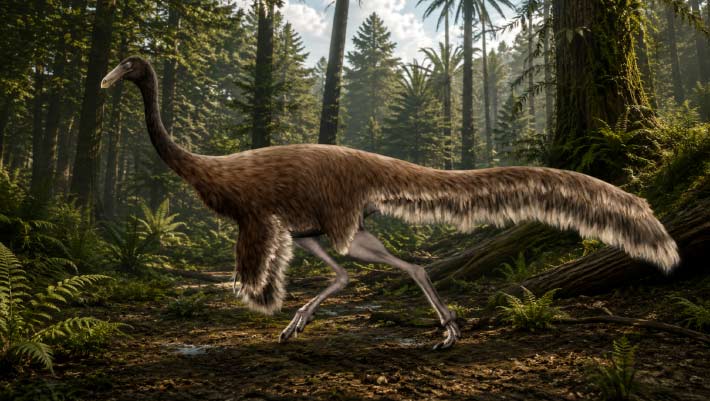
Rare Ostrich-Like Dinosaur Fossil Found on Canadian Island
Un rare fossile de dinosaure ressemblant à une autruche découvert sur une île canadienne
vertèbre Canada Colombie fossile Dinosauria Ornithomimosauria oiseau
Des paléontologues canadiens affirment avoir découvert une vertèbre caudale de dinosaure dans des roches marines vieilles de 75 à 80 millions d'années sur une petite île au large de la Colombie-Britannique, fournissant ainsi la preuve la plus claire à ce jour que des ornithomimosaures ressemblant à des oiseaux parcouraient autrefois l'ancienne côte du Pacifique de l'Amérique du Nord. L'article Un fossile rare de dinosaure ressemblant à une autruche trouvé sur une île canadienne est apparu en premier sur Sci.News : Breaking Science News.
25/05/2026 sci-news ⚙ Traduction automatique
1 2 3 4 5 6 7 8 9 10 11 12 13 14 15 16 17 18 19 20 21 22 23 24 25 26 27 28 29 30 31 32 33 34 35 36 37 38 39 40 41 42 43 44 45 46 47 48 49 50