←

spécimen

Nature du spécimen

204 image(s) · 23 Actualités

Galerie d'images

A 6.4 meter (21ft) Eurhinosaurus species specimen from the Holzmaden Formation, Baden-Wurttenburg, Germany.  ~185 million years old.
Taxons Eurhinosaurus

A 6.4 meter (21ft) Eurhinosaurus species specimen from the Holzmaden Formation, Baden-Wurttenburg, Germany. ~185 million years old.

Allemagne spécimen Eurhinosauria formation
"Daspletosaurus torosus" skeleton cast, reconstructed and mounted by Triebold Paleontology based on a nearly complete specimen from Montana's Judith River Formation
Taxons Daspletosaurini

"Daspletosaurus torosus" skeleton cast, reconstructed and mounted by Triebold Paleontology based on a nearly complete specimen from Montana's Judith River Formation

Judith River moulage spécimen Daspletosaurini +3
The holotype anterior dorsal vertebra of Uragasaurus kalasinensis (PRC 460) in anterior (a) and posterior (b) views. Digital rendering of the specimen in anterior (c), posterior (d), right lateral (e), left lateral (f), dorsal (g), and ventral (h) views. Asterisk refers to an autapomorphic character. The blue highlight indicates the pneumatic fossa and pleurocoel.

The holotype anterior dorsal vertebra of Uragasaurus kalasinensis (PRC 460) in anterior (a) and posterior (b) views. Digital rendering of the specimen in anterior (c), posterior (d), right lateral (e), left lateral (f), dorsal (g), and ventral (h) views. Asterisk refers to an autapomorphic character. The blue highlight indicates the pneumatic fossa and pleurocoel.

vertèbre holotype spécimen Uragasaurus
Neotype fossil of Ardeadactylus longicollum, specimen number SMNS 56603 (Number 58 in Wellnhofer 1970).
Taxons Ardeadactylus

Neotype fossil of Ardeadactylus longicollum, specimen number SMNS 56603 (Number 58 in Wellnhofer 1970).

fossile spécimen Ardeadactylus Wellnhoferia
Comparison of cranial features between closely related southern Laramidian taxa; (A), Akainacephalus johnsoni (UMNH VP 20202) from the Late Cretaceous Kaiparowits Formation of Utah; and (B), Nodocephalosaurus kirtlandensis (SMP VP-900) from the Late Cretaceous Kirtland Formation of New Mexico, in left lateral views. Various synapomorphies are shared with N. kirtlandensis (highlighted in black and white arrows) and includes “flaring nostrils”; enlarged, laterally projecting, loreal osteoderms that are situated directly dorsal to the external nares. Other synapomorphies include pyramid-shaped nasal and frontal osteoderms positioned on the dorsal regions of the skull. A number of significant differences have been observed between both specimens; in A. johnsoni, the anterior, and posterior supraorbital bosses form an enlarged element that is somewhat backswept, whereas in N. kirtlandensis, the posterior and anterior supraorbital bosses are clearly defined as individual osteoderms, and are much smaller in size. Additionally, the squamosal horn in Akainacephalus is very small but is prominent and tetrahedrally shaped in Nodocephalosaurus. The quadratojugal horn in Akainacephalus is massive, has a subtriangular morphology in lateral view and projects almost entirely ventral, whereas in Nodocephalosaurus, the quadratojugal horn is smaller and has a typical fin-shaped morphology. Study sites: asob, anterior supraorbital boss; ext naris, external naris; laca, lacrimal caputegulum; loca, loreal caputegulum; naca, nasal caputegulae; orb, orbit; psob, posterior supraorbital boss; qjh, quadratojugal horn; sqh, squamosal horn.
Taxons Nodocephalosaurus

Comparison of cranial features between closely related southern Laramidian taxa; (A), Akainacephalus johnsoni (UMNH VP 20202) from the Late Cretaceous Kaiparowits Formation of Utah; and (B), Nodocephalosaurus kirtlandensis (SMP VP-900) from the Late Cretaceous Kirtland Formation of New Mexico, in left lateral views. Various synapomorphies are shared with N. kirtlandensis (highlighted in black and white arrows) and includes “flaring nostrils”; enlarged, laterally projecting, loreal osteoderms that are situated directly dorsal to the external nares. Other synapomorphies include pyramid-shaped nasal and frontal osteoderms positioned on the dorsal regions of the skull. A number of significant differences have been observed between both specimens; in A. johnsoni, the anterior, and posterior supraorbital bosses form an enlarged element that is somewhat backswept, whereas in N. kirtlandensis, the posterior and anterior supraorbital bosses are clearly defined as individual osteoderms, and are much smaller in size. Additionally, the squamosal horn in Akainacephalus is very small but is prominent and tetrahedrally shaped in Nodocephalosaurus. The quadratojugal horn in Akainacephalus is massive, has a subtriangular morphology in lateral view and projects almost entirely ventral, whereas in Nodocephalosaurus, the quadratojugal horn is smaller and has a typical fin-shaped morphology. Study sites: asob, anterior supraorbital boss; ext naris, external naris; laca, lacrimal caputegulum; loca, loreal caputegulum; naca, nasal caputegulae; orb, orbit; psob, posterior supraorbital boss; qjh, quadratojugal horn; sqh, squamosal horn.

Mexique Kaiparowits Kirtland Crétacé +7
Archaeopteryx lithographica, specimen displayed at the Museum für Naturkunde in Berlin. (This image shows the original fossil - not a cast.)
Taxons Archaeopteryx

Archaeopteryx lithographica, specimen displayed at the Museum für Naturkunde in Berlin. (This image shows the original fossil - not a cast.)

musée moulage fossile spécimen +1
Mounted skeleton of Acrocanthosaurus specimen NCSM 14345 at North Carolina Museum of Natural Sciences
Taxons Acrocanthosaurus

Mounted skeleton of Acrocanthosaurus specimen NCSM 14345 at North Carolina Museum of Natural Sciences

musée spécimen Acrocanthosaurus squelette
An Ankylosaurus head (cast of specimen AMNH 5214), on display at the Museum of the Rockies in Bozeman, Montana.  This is from a specimen collected in Custer County, Montana.
The Ankylosauria were armored dinosaurs that lived from 122 million years ago to 66 million years ago in western North America, Europe, and East Asia.  There were two subgroups:  The Nodosauridae and Ankylosauridae. 
The Ankylosauridae contained six species, and a single subfamily -- the Ankylosaurinae.  There 18 genus within the subfamily, of which Ankylosaurus is the best known.  Ankylosaurus as the last of these, and lived 65.5 to 66.5 million years ago.
Ankylosaurus was about 20.5 feet long, 5 feet wide, and 5.5 feet tall at the hip.  It walked on all fours, with the rear legs longer than the front ones.  They ripped vegetation, and swallowed it whole.  Their defining feature was their armor.  They body was covered in thick, heavy bony plates, and most of the plates were fused together to make them even stronger.  Embedded in the skin were more knobs of bone, and the outer skin above these knobs covered in keratin (the same stuff fingernails are made of).  Ankylosaurus had a tail club, which consisted of several large osteoderms fused to the last few tail vertebrae.

Ankylosaurus was discovered in 1908.
Taxons Ankylosaurus

An Ankylosaurus head (cast of specimen AMNH 5214), on display at the Museum of the Rockies in Bozeman, Montana. This is from a specimen collected in Custer County, Montana. The Ankylosauria were armored dinosaurs that lived from 122 million years ago to 66 million years ago in western North America, Europe, and East Asia. There were two subgroups: The Nodosauridae and Ankylosauridae. The Ankylosauridae contained six species, and a single subfamily -- the Ankylosaurinae. There 18 genus within the subfamily, of which Ankylosaurus is the best known. Ankylosaurus as the last of these, and lived 65.5 to 66.5 million years ago. Ankylosaurus was about 20.5 feet long, 5 feet wide, and 5.5 feet tall at the hip. It walked on all fours, with the rear legs longer than the front ones. They ripped vegetation, and swallowed it whole. Their defining feature was their armor. They body was covered in thick, heavy bony plates, and most of the plates were fused together to make them even stronger. Embedded in the skin were more knobs of bone, and the outer skin above these knobs covered in keratin (the same stuff fingernails are made of). Ankylosaurus had a tail club, which consisted of several large osteoderms fused to the last few tail vertebrae. Ankylosaurus was discovered in 1908.

armure os peau musée +7
Silesaurid left dentaries.

(A) Kwanasaurus williamparkeri (based primarily on DMNH EPV.63136) in lateral view, (B) same in medial view, (C) Asilisaurus kongwe (NMT R89) in lateral view, (D) same in medial view, (E) Eucoelophysis baldwini (GR 224) in lateral view, (F) same in medial view, (G) Technosaurus smalli (TTU P-9021, reversed) in lateral view, (H) same in medial view (also reversed), (I) Sacisaurus agudoensis (composite based on MCN PV10042 and MCN PV10043) in lateral view, (J) same in medial view, (K) Silesaurus opolensis (ZPAL AbIII/361/26) in lateral view, (L) same in medial view, (M) Diodorus scytobrachion (MNHM-ARG 30) in lateral view (reversed), (N) same in medial view (also reversed), (O) Soumyasaurus aenigmaticus (TTU-P1125b) in lateral view, (P) same in medial view. Dashed lines indicate broken edges. Unshaded regions indicate the surface of the specimen is not exposed. All scale bars = 1 cm.

Silesaurid left dentaries. (A) Kwanasaurus williamparkeri (based primarily on DMNH EPV.63136) in lateral view, (B) same in medial view, (C) Asilisaurus kongwe (NMT R89) in lateral view, (D) same in medial view, (E) Eucoelophysis baldwini (GR 224) in lateral view, (F) same in medial view, (G) Technosaurus smalli (TTU P-9021, reversed) in lateral view, (H) same in medial view (also reversed), (I) Sacisaurus agudoensis (composite based on MCN PV10042 and MCN PV10043) in lateral view, (J) same in medial view, (K) Silesaurus opolensis (ZPAL AbIII/361/26) in lateral view, (L) same in medial view, (M) Diodorus scytobrachion (MNHM-ARG 30) in lateral view (reversed), (N) same in medial view (also reversed), (O) Soumyasaurus aenigmaticus (TTU-P1125b) in lateral view, (P) same in medial view. Dashed lines indicate broken edges. Unshaded regions indicate the surface of the specimen is not exposed. All scale bars = 1 cm.

écaille spécimen Asilisaurus Diodorus +7
Hypothetical reconstruction of the skeleton of Amanasaurus nesbitti gen. et sp. nov. depicting (in orange) the preserved portions. (a) CAPPA/UFSM 0374 (holotype), a proximal portion of a right femur in anterior view. (b) CAPPA/UFSM 0375 (referred specimen), a distal portion of a left femur in anterior view. Figures were generated with GIMP 2.8 (https://www.gimp.org/).
Cropped from original image and letters adjusted to match.

Hypothetical reconstruction of the skeleton of Amanasaurus nesbitti gen. et sp. nov. depicting (in orange) the preserved portions. (a) CAPPA/UFSM 0374 (holotype), a proximal portion of a right femur in anterior view. (b) CAPPA/UFSM 0375 (referred specimen), a distal portion of a left femur in anterior view. Figures were generated with GIMP 2.8 (https://www.gimp.org/). Cropped from original image and letters adjusted to match.

holotype spécimen Amanasaurus squelette
Holotype and referred specimen of Amanasaurus nesbitti gen. et sp. nov. from the Candelária Sequence (mid-to-late Carnian) of the Santa Maria Supersequence, southern Brazil. Holotype (CAPPA/UFSM 0374) in anterior (a), lateral (b), proximal (c), medial (d), and posterior (e) views. Referred specimen (CAPPA/UFSM 0375) in anterior (f), lateral (g), posterior (h), and distal (i) views. alt anterolateral tuber, amt anteromedial tuber, at anterior trochanter, cl cleft, ctfb crista tibiofibularis, dlt dorsolateral trochanter, dltp posterior portion of the dorsolateral trochanter, fo foramen, fot fossa trochanterica, gt greater trochanter, lc lateral condyle, lia linea intermuscularis cranialis, mc medial condyle, ms muscle scar, no notch, pg proximal groove, pof popliteal fossa, scs sub-circular scar. Figures were generated with GIMP 2.8 (https://www.gimp.org/).
Taxons Amanasaurus

Holotype and referred specimen of Amanasaurus nesbitti gen. et sp. nov. from the Candelária Sequence (mid-to-late Carnian) of the Santa Maria Supersequence, southern Brazil. Holotype (CAPPA/UFSM 0374) in anterior (a), lateral (b), proximal (c), medial (d), and posterior (e) views. Referred specimen (CAPPA/UFSM 0375) in anterior (f), lateral (g), posterior (h), and distal (i) views. alt anterolateral tuber, amt anteromedial tuber, at anterior trochanter, cl cleft, ctfb crista tibiofibularis, dlt dorsolateral trochanter, dltp posterior portion of the dorsolateral trochanter, fo foramen, fot fossa trochanterica, gt greater trochanter, lc lateral condyle, lia linea intermuscularis cranialis, mc medial condyle, ms muscle scar, no notch, pg proximal groove, pof popliteal fossa, scs sub-circular scar. Figures were generated with GIMP 2.8 (https://www.gimp.org/).

Brésil Carnien holotype spécimen +1
Skeletal reconstruction of Heyuannia yanshini (previously Ajancingenia yanshini). Specimens as: blue: MPC-D 100/30 (holotype); green: MPC-D 100/31; red: MPC-D 100/32; tan: MPC-D 100/20 (holotype skull of Conchoraptor gracilis).

Skeletal reconstruction of Heyuannia yanshini (previously Ajancingenia yanshini). Specimens as: blue: MPC-D 100/30 (holotype); green: MPC-D 100/31; red: MPC-D 100/32; tan: MPC-D 100/20 (holotype skull of Conchoraptor gracilis).

holotype spécimen Ajancingenia Conchoraptor +3
Life restoration of the large, Middle Triassic Nevadan ichthyosaur Cymbopsondylus petrinus. This illustration is primarily based on specimen UCMP 9950, with much of the tail restored following UCMP 9947. The size of the eye was reconstructed based on UCMP 9954 and UCMP 9913. The unknown distal portions of the flippers, as well as some of the tail, was reconstructed after the related genus Xinminosaurus.
References
Merriam, J. C. (1908)       Triassic Ichthyosauria: With special reference to the American forms, Berkley, California:  Berkley: The University Press  
Klein, N.; Schmitz, L.; Wintrich, T.; Sander, P. M. (2020). "A new cymbospondylid ichthyosaur (Ichthyosauria) from the Middle Triassic (Anisian) of the Augusta Mountains, Nevada, USA". Journal of Systematic Palaeontology 18 (14): 1167-1191. DOI:10.1080/14772019.2020.1748132.
Jiang, D.; Motani, R.; Hao, W.; Schmitz, L.; Rieppel, O.; Sun, Y.; Sun, Z. (2008). "New primitive ichthyosaurian (Reptilia, Diapsida) from the Middle Triassic of Panxian, Guizhou, southwestern China and its position in the Triassic biotic recovery". Progress in Natural Science 18 (10): 1315. DOI:10.1016/j.pnsc.2008.01.039.

Life restoration of the large, Middle Triassic Nevadan ichthyosaur Cymbopsondylus petrinus. This illustration is primarily based on specimen UCMP 9950, with much of the tail restored following UCMP 9947. The size of the eye was reconstructed based on UCMP 9954 and UCMP 9913. The unknown distal portions of the flippers, as well as some of the tail, was reconstructed after the related genus Xinminosaurus. References Merriam, J. C. (1908) Triassic Ichthyosauria: With special reference to the American forms, Berkley, California: Berkley: The University Press Klein, N.; Schmitz, L.; Wintrich, T.; Sander, P. M. (2020). "A new cymbospondylid ichthyosaur (Ichthyosauria) from the Middle Triassic (Anisian) of the Augusta Mountains, Nevada, USA". Journal of Systematic Palaeontology 18 (14): 1167-1191. DOI:10.1080/14772019.2020.1748132. Jiang, D.; Motani, R.; Hao, W.; Schmitz, L.; Rieppel, O.; Sun, Y.; Sun, Z. (2008). "New primitive ichthyosaurian (Reptilia, Diapsida) from the Middle Triassic of Panxian, Guizhou, southwestern China and its position in the Triassic biotic recovery". Progress in Natural Science 18 (10): 1315. DOI:10.1016/j.pnsc.2008.01.039.

Chine États-Unis Anisien Trias moyen +5
A Specimen  of Parapuzosia daubreei (de Grossouvre, 1894), Santonian, Shumen on display  at Sofia University "St. Kliment Ohridski' Museum of Paleontology and Historical Geology

A Specimen of Parapuzosia daubreei (de Grossouvre, 1894), Santonian, Shumen on display at Sofia University "St. Kliment Ohridski' Museum of Paleontology and Historical Geology

musée Santonien spécimen géologie
Shetwemys, Plastral remains of the podocnemidid turtle S. fajumensis (Erymnochelyini). (a–b) NHMUK R3435, anterior plastral lobe, in ventral (a) and dorsal (b) views. (c–d) NHMUK R8441, plaster cast of the specimen CGM C8509, anterior plastral lobe, in ventral (c) and dorsal (d) views. (e–f) AMNH 5093, articulated epiplastra and entoplastron, in ventral (e) and dorsal (f) views. (g–h) SMNS 11233/6, anterior plastral lobe, in ventral (g) and dorsal (h) views. (i–j) NHMUK R3103, partial anterior plastral lobe, in ventral (i) and dorsal (j) views. (k–l) SMNS 11233/5, right hypoplastron, in ventral (k) and dorsal (l) views. (m–n) SMNS 11233/3, articulated left hypoplastron and xiphiplastron, in dorsal (m) and ventral (n) views, and detail of the outer ornamental pattern (o). Gebel Quatrani Formation, Fayum depression, Egypt, Lower Oligocene (Rupelian)

Shetwemys, Plastral remains of the podocnemidid turtle S. fajumensis (Erymnochelyini). (a–b) NHMUK R3435, anterior plastral lobe, in ventral (a) and dorsal (b) views. (c–d) NHMUK R8441, plaster cast of the specimen CGM C8509, anterior plastral lobe, in ventral (c) and dorsal (d) views. (e–f) AMNH 5093, articulated epiplastra and entoplastron, in ventral (e) and dorsal (f) views. (g–h) SMNS 11233/6, anterior plastral lobe, in ventral (g) and dorsal (h) views. (i–j) NHMUK R3103, partial anterior plastral lobe, in ventral (i) and dorsal (j) views. (k–l) SMNS 11233/5, right hypoplastron, in ventral (k) and dorsal (l) views. (m–n) SMNS 11233/3, articulated left hypoplastron and xiphiplastron, in dorsal (m) and ventral (n) views, and detail of the outer ornamental pattern (o). Gebel Quatrani Formation, Fayum depression, Egypt, Lower Oligocene (Rupelian)

Égypte Oligocène Rupélien moulage +3
Close up of the Eulithomyrmex rugosus holotype head.  Museum of Comparative Zoology  specimen UCM17019.
Priabonian; Florissant Formation, Colorado, USA

Close up of the Eulithomyrmex rugosus holotype head. Museum of Comparative Zoology specimen UCM17019. Priabonian; Florissant Formation, Colorado, USA

musée États-Unis Priabonien holotype +2
1 2 3 4 5 6 7 8 9 10 11 12 13

Actualités

490-Million-Year-Old Arthropod Fossil Fills Puzzling Gap in Fossil Record
Un fossile d'arthropode vieux de 490 millions d'années comble une lacune déroutante dans les archives fossiles
Canada Cambrien Furongien fossile spécimen nouvelle espèce
Une nouvelle espèce d'arthropode corcoraniidé ayant vécu à l'époque furongienne, il y a entre 497 et 487 millions d'années, a été identifiée à partir d'un spécimen exceptionnellement préservé trouvé près de Québec, au Canada. L'article Un fossile d'arthropode vieux de 490 millions d'années comble une lacune déroutante dans les archives fossiles est apparu en premier sur Sci.News : Breaking Science News.
29/05/2026 sci-news ⚙ Traduction automatique
Un nouveau dinosaure carnivore du Trias identifié à Ghost Ranch
États-Unis Trias supérieur Trias fossile spécimen Coelophysis Dinosauria Ptychotherates nouvelle espèce crâne
Des chercheurs de Virginia Tech (Virginie, États-Unis) ont identifié une nouvelle espèce de dinosaure du Trias supérieur.  Le dinosaure a été nommé Ptychotherates bucculentus.  Ce nouveau taxon de dinosaure carnivore a été érigé sur la base de l'examen détaillé d'un fossile de crâne incomplet, bien conservé mais mélangé (numéro de spécimen CM 31368).  Le crâne provient de la Coelophysis de renommée mondiale
11/05/2026 everythingdinosaur ⚙ Traduction automatique
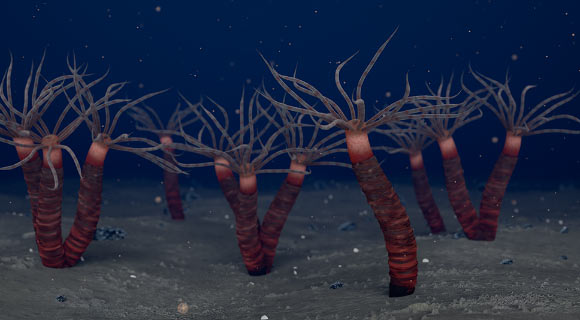
450-Million-Year-Old Fossils Reveal Strange, Tube-Dwelling Jellyfish Relative
Des fossiles vieux de 450 millions d’années révèlent un étrange parent de méduses tubicoles
Canada fossile spécimen nouvelle espèce
Les paléontologues ont identifié un nouveau genre et une nouvelle espèce de polype médusozoaire tubicole au corps mou à partir de spécimens bien conservés trouvés à environ 50 km au nord-est de la ville de Québec au Canada. L'article Des fossiles vieux de 450 millions d'années révèlent un étrange parent de méduses tubicoles apparaît en premier sur Sci.News : Breaking Science News.
21/04/2026 sci-news ⚙ Traduction automatique
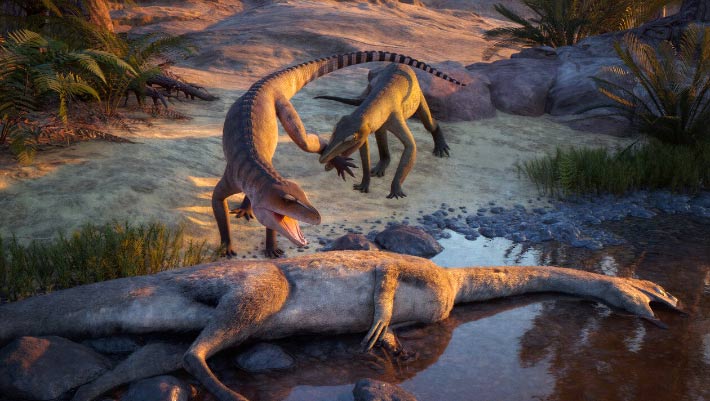
Museum Fossil Reveals Triassic Crocodile Cousin with Powerful Jaws
Un fossile de musée révèle un cousin crocodile du Trias doté de mâchoires puissantes
mâchoire musée Trias supérieur Trias fossile spécimen tomographie nouvelle espèce
Les tomodensitogrammes d'un spécimen vieux de plusieurs décennies du Musée d'histoire naturelle de Yale Peabody montrent une nouvelle espèce de crocodylomorphe au museau court et aux mâchoires inhabituellement fortes, offrant un instantané rare de la spécialisation écologique à l'époque du Trias supérieur. Le post Museum Fossil révèle un cousin crocodile du Trias doté de mâchoires puissantes est apparu en premier sur Sci.News: Breaking Science News.
20/04/2026 sci-news ⚙ Traduction automatique
Épisode 174 : Une histoire des dinosaures en 50 fossiles
musée fossile spécimen Dinosauria
Le professeur Paul Barrett du Natural History Museum de Londres a récemment écrit A History of Dinosaurs in 50 Fossils. Nous en avons profité pour avoir un aperçu de ce que nous savons réellement sur les dinosaures et comment il est même possible de raconter leur histoire avec seulement 50 spécimens. Dans cet épisode, Paul discute de l'histoire [&hellip
15/04/2026 palaeocast ⚙ Traduction automatique
1 2 3 4 5