Pterosauria

Taxon

70 image(s) · 10 Actualités

Voir la fiche

Galerie d'images

Balaenognathus maeuseri gen. et sp. nov.: comparative interpretive drawings of the skulls of suspension feeding ctenochasmatoid pterosaurs in dorsal aspect. Balaenognathus this paper; Pterodaustro based on Bonaparte (1978); Plateleorhynchus based on Howse and Milner (1995); Gnathosaurus based on specimen JME-SOS 4580; Ctenochasma based on (2007 Fig. 2F)
Taxons Plataleorhynchus

Balaenognathus maeuseri gen. et sp. nov.: comparative interpretive drawings of the skulls of suspension feeding ctenochasmatoid pterosaurs in dorsal aspect. Balaenognathus this paper; Pterodaustro based on Bonaparte (1978); Plateleorhynchus based on Howse and Milner (1995); Gnathosaurus based on specimen JME-SOS 4580; Ctenochasma based on (2007 Fig. 2F)

alimentation dessin spécimen Balaenognathus +6
Samrukia nesovi was originally described as a giant bird, but is now considered a pterodactyloid pterosaur of uncertain placement and validity. 

References: 
Naish, D., Dyke, G., Cau, A., Escuillié, F., & Godefroit, P. (2011). A gigantic bird from the Upper Cretaceous of Central Asia. Biology Letters, 8(1), 97–100. doi:10.1098/rsbl.2011.0683

Buffetaut, E. (2011). Samrukia nessovi, from the Late Cretaceous of Kazakhstan: A large pterosaur, not a giant bird. Annales de Paléontologie, 97(3–4), 133–138. doi:10.1016/j.annpal.2011.10.001
Taxons Samrukia

Samrukia nesovi was originally described as a giant bird, but is now considered a pterodactyloid pterosaur of uncertain placement and validity. References: Naish, D., Dyke, G., Cau, A., Escuillié, F., & Godefroit, P. (2011). A gigantic bird from the Upper Cretaceous of Central Asia. Biology Letters, 8(1), 97–100. doi:10.1098/rsbl.2011.0683 Buffetaut, E. (2011). Samrukia nessovi, from the Late Cretaceous of Kazakhstan: A large pterosaur, not a giant bird. Annales de Paléontologie, 97(3–4), 133–138. doi:10.1016/j.annpal.2011.10.001

Kazakhstan Crétacé Crétacé supérieur Pterosauria +2
Holotype of Alcione elainus.
Fig. 6 of:
Longrich, N. R., Martill, D. M., & Andres, B. (2018). Late Maastrichtian pterosaurs from North Africa and mass extinction of Pterosauria at the Cretaceous-Paleogene boundary. PLoS biology, 16(3), e2001663.
---
Original figure legend:
A. elainus FSAC-OB 2, holotype partial skeleton and FSAC-OB 217, metacarpal IV.

(A) Holotype right humerus in anterior view, (B) holotype right ulna and radius in anterior view, respectively, (C) holotype sternum in left lateral view, (D) referred metacarpal IV, (E) holotype, distal end of left metacarpal IV and left scapulocoracoid, and (F) holotype right femur in posterior view. Abbreviations: co, coracoid; cr, cristospine; dc, distal condyle; dpc, deltopectoral crest; ect, ectepicondyle; fh, femoral head; gl, glenoid; gt, greater trochanter; hh, humeral head; hum, humerus; mcIV, metacarpal IV, pc, proximal cotyle; pf, pneumatic foramen; rad, radius; scpr, supracondylar process; ste, sternum; uln, ulna.
Taxons Alcione

Holotype of Alcione elainus. Fig. 6 of: Longrich, N. R., Martill, D. M., & Andres, B. (2018). Late Maastrichtian pterosaurs from North Africa and mass extinction of Pterosauria at the Cretaceous-Paleogene boundary. PLoS biology, 16(3), e2001663. --- Original figure legend: A. elainus FSAC-OB 2, holotype partial skeleton and FSAC-OB 217, metacarpal IV. (A) Holotype right humerus in anterior view, (B) holotype right ulna and radius in anterior view, respectively, (C) holotype sternum in left lateral view, (D) referred metacarpal IV, (E) holotype, distal end of left metacarpal IV and left scapulocoracoid, and (F) holotype right femur in posterior view. Abbreviations: co, coracoid; cr, cristospine; dc, distal condyle; dpc, deltopectoral crest; ect, ectepicondyle; fh, femoral head; gl, glenoid; gt, greater trochanter; hh, humeral head; hum, humerus; mcIV, metacarpal IV, pc, proximal cotyle; pf, pneumatic foramen; rad, radius; scpr, supracondylar process; ste, sternum; uln, ulna.

crête humérus Crétacé Maastrichtien +7
(A)Alligator prenasalis, pterosaurs (B)Liaoxipterus brachycephalus and (C)Ludodactylus sibbicki, (D)basal ornithischian Jeholosaurus shangyuanensis, (E)tyrannosaur Yutyrannus huali (F) Sinosauropteryx prima.
Taxons Liaoxipterus

(A)Alligator prenasalis, pterosaurs (B)Liaoxipterus brachycephalus and (C)Ludodactylus sibbicki, (D)basal ornithischian Jeholosaurus shangyuanensis, (E)tyrannosaur Yutyrannus huali (F) Sinosauropteryx prima.

Jeholosaurus Liaoxipterus Ludodactylus Ornithischia +3
Rhamphinion with Dilophosaurus in the background. While the pterosaur was identified as Dimorphodon by the artist, that genus is not known to have coexisted with Dilophosaurus, so the identity is here changed to its closest contemporary relative, which is possibly which was meant to begin with.
Taxons Rhamphinion

Rhamphinion with Dilophosaurus in the background. While the pterosaur was identified as Dimorphodon by the artist, that genus is not known to have coexisted with Dilophosaurus, so the identity is here changed to its closest contemporary relative, which is possibly which was meant to begin with.

Dilophosaurus Dimorphodon Pterosauria Rhamphinion
The palatal view of the skull of NMS G.2021.6.2 and comparative assessment of the pterygoid region. The palatal region of NMS G.2021.6.2, A as seen in the ventral view. The comparative, to scale, pterosaur palatine and palatal regions in the ventral view. From left to right: B Cacibupteryx (IGO-V 208); C Parapsicephalus (GSM 3166); D Dearc (NMS G.2021.6.2); E Rhamphorhynchus (NHM R 2786); F Rhamphorhynchus (CM 11434). Abbreviations: bsp—basipterygoid; cho—choana; ec -, ectopterygoid; ipv—interpterygoid vacuity; pal—palatine; pf—posterior palatine fenestra; pte—pterygoid; stf -subtemporal fenestra; sof – suborbital fenestra; vm—vomer. Scale bar 10 mm

The palatal view of the skull of NMS G.2021.6.2 and comparative assessment of the pterygoid region. The palatal region of NMS G.2021.6.2, A as seen in the ventral view. The comparative, to scale, pterosaur palatine and palatal regions in the ventral view. From left to right: B Cacibupteryx (IGO-V 208); C Parapsicephalus (GSM 3166); D Dearc (NMS G.2021.6.2); E Rhamphorhynchus (NHM R 2786); F Rhamphorhynchus (CM 11434). Abbreviations: bsp—basipterygoid; cho—choana; ec -, ectopterygoid; ipv—interpterygoid vacuity; pal—palatine; pf—posterior palatine fenestra; pte—pterygoid; stf -subtemporal fenestra; sof – suborbital fenestra; vm—vomer. Scale bar 10 mm

écaille Cacibupteryx Dearc Parapsicephalus +3
Life restoration of Cearadactylus atrox.
Based on figure 2 of "On the systematic relationships of Cearadactylus atrox, an enigmatic Early Cretaceous pterosaur from the Santana Formation of Brazil" by D. M. Unwin Mitteilungen Museum für Naturkunde Berlin, Geowissenschaftlichen Reihe 5: 239-263

Life restoration of Cearadactylus atrox. Based on figure 2 of "On the systematic relationships of Cearadactylus atrox, an enigmatic Early Cretaceous pterosaur from the Santana Formation of Brazil" by D. M. Unwin Mitteilungen Museum für Naturkunde Berlin, Geowissenschaftlichen Reihe 5: 239-263

musée Brésil Crétacé Crétacé inférieur +4
Fossil of Coloborhynchus, an extinct pterosaur- Took the photo at Naturalis museum, Leiden

Fossil of Coloborhynchus, an extinct pterosaur- Took the photo at Naturalis museum, Leiden

musée fossile Coloborhynchus Maaradactylus +1
Representative taxa from the Santonian Iharkút fauna from the Csehbánya Formation, Bakony Mountains, western Hungary. A Pannoniasaurus inexpectatus (Squamata, Mosasauroidea), dorsal vertebra (MTM uncatalogued) in dorsal view (photo by Réka Kalmár) B Foxemys trabanti (Pleurodira, Bothremydidae), skull (MTM V 2010.215.1.) in dorsal view (photo by Márton Rabi). C Bicuspidon aff. hatzegiensis (Squamata, Borioteiioidea), left dentary (MTM 2006.112.1.) in medial view (photo by László Makádi) D Basal tetanuran (Theropoda, Tetanurae), tooth (MTM V.01.54) in ?lingual view E Indeterminate abelisaurid (Theropoda, Abelisauridae), pedal ungual phalanx (MTM V 2008.43.1.) in lateral view F Pneumatoraptor fodori (Theropoda, Paraves), left scapulocoracoid (holotype, MTM V 2008.38.1.) in lateral view G Mochlodon vorosi (Ornithopoda, Rhabdodontidae), left dentary (holotype, MTM V 2010.105.1) in lateral view H Bakonydraco galaczi (Pterosauria, Azhdarchidae), mandible (holotype, MTM 2007.110.1) in dorsal view I Iharkutosuchus makadii (Eusuchia, Hylaeochampsidae), skull (holotype, MTM 2006.52.1) in dorsal view J Hungarosaurus tormai (Ankylosauria, Nodosauridae), right dentary (MTM 2007.25.2) in lateral view K Bauxitornis mindszentyae (Aves, Enantiornithes), left tarsometatarsus (holotype, MTM V 2009.38.1) in anterior view L Ajkaceratops kozmai (Ceratopsia), fused rostral and premaxillae (holotype, MTM V 2009.192.1) in lateral view. Scale bars: 2 cm in A, V, G, H, I, J; 1 cm in D, E, F, K, L; 1 mm in C.

Representative taxa from the Santonian Iharkút fauna from the Csehbánya Formation, Bakony Mountains, western Hungary. A Pannoniasaurus inexpectatus (Squamata, Mosasauroidea), dorsal vertebra (MTM uncatalogued) in dorsal view (photo by Réka Kalmár) B Foxemys trabanti (Pleurodira, Bothremydidae), skull (MTM V 2010.215.1.) in dorsal view (photo by Márton Rabi). C Bicuspidon aff. hatzegiensis (Squamata, Borioteiioidea), left dentary (MTM 2006.112.1.) in medial view (photo by László Makádi) D Basal tetanuran (Theropoda, Tetanurae), tooth (MTM V.01.54) in ?lingual view E Indeterminate abelisaurid (Theropoda, Abelisauridae), pedal ungual phalanx (MTM V 2008.43.1.) in lateral view F Pneumatoraptor fodori (Theropoda, Paraves), left scapulocoracoid (holotype, MTM V 2008.38.1.) in lateral view G Mochlodon vorosi (Ornithopoda, Rhabdodontidae), left dentary (holotype, MTM V 2010.105.1) in lateral view H Bakonydraco galaczi (Pterosauria, Azhdarchidae), mandible (holotype, MTM 2007.110.1) in dorsal view I Iharkutosuchus makadii (Eusuchia, Hylaeochampsidae), skull (holotype, MTM 2006.52.1) in dorsal view J Hungarosaurus tormai (Ankylosauria, Nodosauridae), right dentary (MTM 2007.25.2) in lateral view K Bauxitornis mindszentyae (Aves, Enantiornithes), left tarsometatarsus (holotype, MTM V 2009.38.1) in anterior view L Ajkaceratops kozmai (Ceratopsia), fused rostral and premaxillae (holotype, MTM V 2009.192.1) in lateral view. Scale bars: 2 cm in A, V, G, H, I, J; 1 cm in D, E, F, K, L; 1 mm in C.

dent vertèbre Hongrie Santonien +15
Sketch-drawing of the vertebrate faunal assemblage of the Lisowice site (modified from Niedźwiedzki)10. (a) Large, theropod-like predatory archosaur (Smok wawelski); (b) large temnospondyl amphibian (Cyclotosaurus sp.); (c) small predatory dinosaurs (Neotheropoda indet.); (d) temnospondyl amphibian (Gerrothorax sp.); (e) small basal crocodylomorph (Crocodylomorpha indet.); (f) small diapsid (Choristodere-like animal); (g) hybodont sharks (Polyacrodus and Hybodus); (h) coelacanth fish; (i) dipnoan fish (Ptychoceratodus sp.); (j) actinopterygian fish; (k) gigantic dicynodont; (l) dinosauriforms or early dinosaurs (Dinosauriformes indet. or Dinosauria indet.); (m) small lepidosauromorphs (Sphenodontia indet.); (n) pterosaurs (Pterosauria indet.); (o) early mammaliaform (Hallautherium sp.).

Sketch-drawing of the vertebrate faunal assemblage of the Lisowice site (modified from Niedźwiedzki)10. (a) Large, theropod-like predatory archosaur (Smok wawelski); (b) large temnospondyl amphibian (Cyclotosaurus sp.); (c) small predatory dinosaurs (Neotheropoda indet.); (d) temnospondyl amphibian (Gerrothorax sp.); (e) small basal crocodylomorph (Crocodylomorpha indet.); (f) small diapsid (Choristodere-like animal); (g) hybodont sharks (Polyacrodus and Hybodus); (h) coelacanth fish; (i) dipnoan fish (Ptychoceratodus sp.); (j) actinopterygian fish; (k) gigantic dicynodont; (l) dinosauriforms or early dinosaurs (Dinosauriformes indet. or Dinosauria indet.); (m) small lepidosauromorphs (Sphenodontia indet.); (n) pterosaurs (Pterosauria indet.); (o) early mammaliaform (Hallautherium sp.).

dessin Dinosauria Neotheropoda Pterosauria
A cast replica of a skeletal mount of the prehistoric pterosaur Anhanguera blittersdorffi on display at Melbourne Museum in Victoria, Australia.

A cast replica of a skeletal mount of the prehistoric pterosaur Anhanguera blittersdorffi on display at Melbourne Museum in Victoria, Australia.

musée Australie moulage Anhanguera +1
Life restoration of the Brazilian ornithocheiroid pterosaur Anhanguera blittersdorffi. Digital painting; credit Matt Martyniuk.

Life restoration of the Brazilian ornithocheiroid pterosaur Anhanguera blittersdorffi. Digital painting; credit Matt Martyniuk.

Anhanguera Pterosauria
Duria Antiquior, célèbre aquarelle du géologue Henry de la Beche représentant la vie dans l'ancien Dorset d'après des fossiles trouvés par Mary Anning.

Duria Antiquior, célèbre aquarelle du géologue Henry de la Beche représentant la vie dans l'ancien Dorset d'après des fossiles trouvés par Mary Anning.

old school fossile Ichthyosaurus Plesiosaurus +1
Holotype of Alcione elainus.
Fig. 6 of:
Longrich, N. R., Martill, D. M., & Andres, B. (2018). Late Maastrichtian pterosaurs from North Africa and mass extinction of Pterosauria at the Cretaceous-Paleogene boundary. PLoS biology, 16(3), e2001663.
---
Original figure legend:
A. elainus FSAC-OB 2, holotype partial skeleton and FSAC-OB 217, metacarpal IV.

(A) Holotype right humerus in anterior view, (B) holotype right ulna and radius in anterior view, respectively, (C) holotype sternum in left lateral view, (D) referred metacarpal IV, (E) holotype, distal end of left metacarpal IV and left scapulocoracoid, and (F) holotype right femur in posterior view. Abbreviations: co, coracoid; cr, cristospine; dc, distal condyle; dpc, deltopectoral crest; ect, ectepicondyle; fh, femoral head; gl, glenoid; gt, greater trochanter; hh, humeral head; hum, humerus; mcIV, metacarpal IV, pc, proximal cotyle; pf, pneumatic foramen; rad, radius; scpr, supracondylar process; ste, sternum; uln, ulna.

Holotype of Alcione elainus. Fig. 6 of: Longrich, N. R., Martill, D. M., & Andres, B. (2018). Late Maastrichtian pterosaurs from North Africa and mass extinction of Pterosauria at the Cretaceous-Paleogene boundary. PLoS biology, 16(3), e2001663. --- Original figure legend: A. elainus FSAC-OB 2, holotype partial skeleton and FSAC-OB 217, metacarpal IV. (A) Holotype right humerus in anterior view, (B) holotype right ulna and radius in anterior view, respectively, (C) holotype sternum in left lateral view, (D) referred metacarpal IV, (E) holotype, distal end of left metacarpal IV and left scapulocoracoid, and (F) holotype right femur in posterior view. Abbreviations: co, coracoid; cr, cristospine; dc, distal condyle; dpc, deltopectoral crest; ect, ectepicondyle; fh, femoral head; gl, glenoid; gt, greater trochanter; hh, humeral head; hum, humerus; mcIV, metacarpal IV, pc, proximal cotyle; pf, pneumatic foramen; rad, radius; scpr, supracondylar process; ste, sternum; uln, ulna.

crête humérus Crétacé Maastrichtien +7
Holotype of Alcione elainus.
Fig. 6 of:
Longrich, N. R., Martill, D. M., & Andres, B. (2018). Late Maastrichtian pterosaurs from North Africa and mass extinction of Pterosauria at the Cretaceous-Paleogene boundary. PLoS biology, 16(3), e2001663.
---
Original figure legend:
A. elainus FSAC-OB 2, holotype partial skeleton and FSAC-OB 217, metacarpal IV.

(A) Holotype right humerus in anterior view, (B) holotype right ulna and radius in anterior view, respectively, (C) holotype sternum in left lateral view, (D) referred metacarpal IV, (E) holotype, distal end of left metacarpal IV and left scapulocoracoid, and (F) holotype right femur in posterior view. Abbreviations: co, coracoid; cr, cristospine; dc, distal condyle; dpc, deltopectoral crest; ect, ectepicondyle; fh, femoral head; gl, glenoid; gt, greater trochanter; hh, humeral head; hum, humerus; mcIV, metacarpal IV, pc, proximal cotyle; pf, pneumatic foramen; rad, radius; scpr, supracondylar process; ste, sternum; uln, ulna.

Holotype of Alcione elainus. Fig. 6 of: Longrich, N. R., Martill, D. M., & Andres, B. (2018). Late Maastrichtian pterosaurs from North Africa and mass extinction of Pterosauria at the Cretaceous-Paleogene boundary. PLoS biology, 16(3), e2001663. --- Original figure legend: A. elainus FSAC-OB 2, holotype partial skeleton and FSAC-OB 217, metacarpal IV. (A) Holotype right humerus in anterior view, (B) holotype right ulna and radius in anterior view, respectively, (C) holotype sternum in left lateral view, (D) referred metacarpal IV, (E) holotype, distal end of left metacarpal IV and left scapulocoracoid, and (F) holotype right femur in posterior view. Abbreviations: co, coracoid; cr, cristospine; dc, distal condyle; dpc, deltopectoral crest; ect, ectepicondyle; fh, femoral head; gl, glenoid; gt, greater trochanter; hh, humeral head; hum, humerus; mcIV, metacarpal IV, pc, proximal cotyle; pf, pneumatic foramen; rad, radius; scpr, supracondylar process; ste, sternum; uln, ulna.

crête humérus Crétacé Maastrichtien +7
This diagram illustrates how scientists believe the dinosaur group theropoda shall be classed in a  phylogenetic tree, besides Sauropoda and Pterosauria. The main reason of this diagram is to show groups or families which had respiratory system like birds. AS in the diagram is abbreviations for "Airsacs", and ASW means "AirSacs supported by immobile femur and a knee-driven Walk". BL means "Bellow lungs". 
Airsacs are known in many different theropods, as well as in birds, which most scientists believe are descendants of dinosaurus. Air sacs are found in the primitive Tawa hallae,[1] the abelisaurid Majungasaurus,[2] as well as Allosauroids like Aerosteon.[3] There is also evidence for respiratory systems like penguinss in Deinonychosaurians.[4] The primitive bird Archaeopteryx also had airsacs (Bonde and Christiansen, 2000).
It is very likely that Deinonychosaurians had airsacs. We don't know  whether Deinonychosauria had a walking/breathing system with immobile thighbones, ASW (like birds) or movable thighbones. However, some people suggsest coeluosaurs had the same type of leg movement as birds ("kneedriven walking").[5]
Bellow lungs are lungs like our own, which alternately is filled with air, and thereafter emptied, after which you take a new breath. This type of lungs exist in mammals, most reptiles, and most amphibians (although some frogs get their oxygen through the skin). There is no evidence for airsacs in Ornithischia, so the likely had bellow lungs.
References.=

↑ (see the video at http://www.nsf.gov/news/special_reports/tawa/)

↑ (Claessens & O'connor, 2006).

↑ Alcober O.A, Sereno P.C, Larsson H.C.E et.al (2008), "Evidence for Avian Intrathoracic Air Sacs in a New Predatory Dinosaur from Argentina", Public Library of Science Journals.

↑ http://www.stumbleupon.com/su/20q5Z4/news.bbc.co.uk/2/hi/science/nature/7081166.stm

↑ http://www.geol.umd.edu/~tholtz/G104/lectures/104coelur.html.

This diagram illustrates how scientists believe the dinosaur group theropoda shall be classed in a phylogenetic tree, besides Sauropoda and Pterosauria. The main reason of this diagram is to show groups or families which had respiratory system like birds. AS in the diagram is abbreviations for "Airsacs", and ASW means "AirSacs supported by immobile femur and a knee-driven Walk". BL means "Bellow lungs". Airsacs are known in many different theropods, as well as in birds, which most scientists believe are descendants of dinosaurus. Air sacs are found in the primitive Tawa hallae,[1] the abelisaurid Majungasaurus,[2] as well as Allosauroids like Aerosteon.[3] There is also evidence for respiratory systems like penguinss in Deinonychosaurians.[4] The primitive bird Archaeopteryx also had airsacs (Bonde and Christiansen, 2000). It is very likely that Deinonychosaurians had airsacs. We don't know whether Deinonychosauria had a walking/breathing system with immobile thighbones, ASW (like birds) or movable thighbones. However, some people suggsest coeluosaurs had the same type of leg movement as birds ("kneedriven walking").[5] Bellow lungs are lungs like our own, which alternately is filled with air, and thereafter emptied, after which you take a new breath. This type of lungs exist in mammals, most reptiles, and most amphibians (although some frogs get their oxygen through the skin). There is no evidence for airsacs in Ornithischia, so the likely had bellow lungs. References.= ↑ (see the video at http://www.nsf.gov/news/special_reports/tawa/) ↑ (Claessens & O'connor, 2006). ↑ Alcober O.A, Sereno P.C, Larsson H.C.E et.al (2008), "Evidence for Avian Intrathoracic Air Sacs in a New Predatory Dinosaur from Argentina", Public Library of Science Journals. ↑ http://www.stumbleupon.com/su/20q5Z4/news.bbc.co.uk/2/hi/science/nature/7081166.stm ↑ http://www.geol.umd.edu/~tholtz/G104/lectures/104coelur.html.

Abelisauridae Aerosteon Archaeopteryx Deinonychosauria +7
1 2 3 4 5

Actualités

Un fossile d'ichthyosaure du Queensland fournit la première preuve mondiale de prédation sur un ptérosaure
prédateur proie Australie Toolebuc Crétacé Crétacé inférieur fossile Ichthyosauria Pterosauria formation
Un fossile extraordinaire provenant du Queensland, en Australie, a fourni la preuve d'une chaîne alimentaire préhistorique. Les scientifiques ont identifié la première preuve définitive qu'un ichtyosaure a consommé un ptérosaure. De plus, le reptile marin est devenu plus tard la proie de l’un des plus grands prédateurs de l’ancienne mer d’Eromanga. Le fossile spectaculaire provient de la Formation de Toolebuc du Crétacé inférieur
28/07/2026 everythingdinosaur ⚙ Traduction automatique
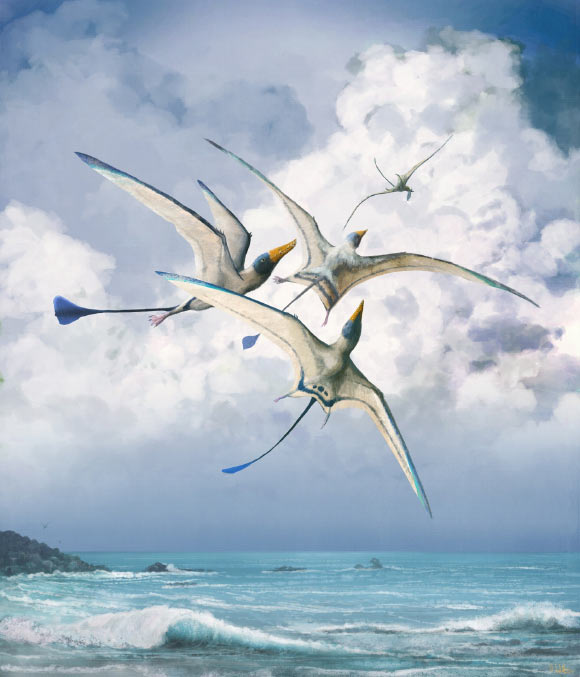
Pterosaurs May Have Sported Far More Varied Wings than Paleontologists Imagined
Les ptérosaures auraient pu arborer des ailes beaucoup plus variées que ce que les paléontologues avaient imaginé
vol fossile Pterosauria biomécanique évolution
De nouvelles recherches de l'Université de Bristol suggèrent que les ptérosaures - les premiers vertébrés à voler propulsé - présentaient probablement un éventail de formes d'ailes et de styles de vol beaucoup plus large que ce que les reconstructions basées sur des fossiles ont décrit. L'article Les ptérosaures auraient pu arborer des ailes beaucoup plus variées que ce que les paléontologues avaient imaginé est apparu en premier sur Sci.News : Breaking Science News.
30/06/2026 sci-news ⚙ Traduction automatique
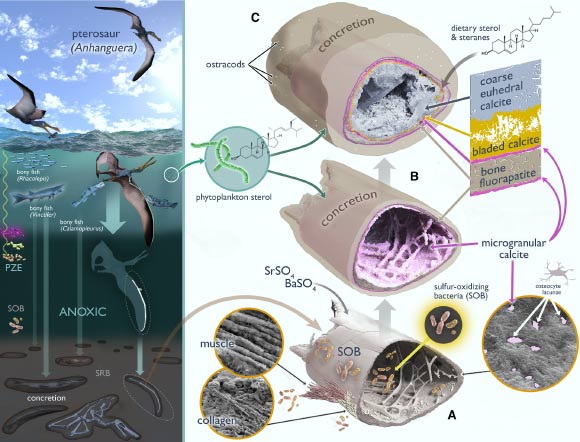
113-Million-Year-Old Pterosaur Fossil Reveals What Flying Reptiles Ate
Un fossile de ptérosaure vieux de 113 millions d'années révèle ce que mangeaient les reptiles volants
tissus alimentation Brésil fossile Anhangueridae Pterosauria poisson
Un fossile de ptérosaure vieux de 113 millions d'années provenant du nord-est du Brésil a fourni des preuves rares de tissus mous, de molécules organiques et de traces chimiques d'un régime alimentaire riche en poissons et en céphalopodes tels que les calmars ou les nautiles. L'article Un fossile de ptérosaure vieux de 113 millions d'années révèle ce que mangeaient les reptiles volants est apparu en premier sur Sci.News : Breaking Science News.
19/06/2026 sci-news ⚙ Traduction automatique
Les ptérosaures pourraient avoir possédé des pycnofibres irisées
plume Pterosauria Tapejaridae comportement étude
De nouvelles recherches suggèrent que les ptérosaures tapejaridés colorés pourraient avoir été encore plus spectaculaires qu’on ne l’imaginait auparavant. Une étude récemment publiée suggère que certains de ces reptiles volants possédaient des pycnofibres irisées produisant des couleurs chatoyantes. En conséquence, ces structures pourraient avoir joué un rôle important dans la signalisation visuelle et l’affichage. Les corps des ptérosaures, les
19/06/2026 everythingdinosaur ⚙ Traduction automatique
Geosternbergia: Beast of the Week
Geosternbergia : la bête de la semaine
fossile Geosternbergia Pteranodon Pterosauria taxonomie
 Cette semaine, nous regardons un célèbre ptérosaure.  Découvrez Geosternbergia sterngergi !  Je vais commencer cet article en soulignant que Geosternbergia est considérée comme simplement une espèce distincte au sein du genre Pteranodon, par de nombreux experts, ce qui donnerait son nom Pteranodon sternbergi.  Ceci étant dit, puisque j'ai déjà fait un article sur Pteranodon longiceps, je choisis d'appeler ce ptérosaure Geosternbergia.  (la taxonomie est compliquée et également sujette à changement, notamment avec les fossiles)
31/05/2026 prehistoricbeastoftheweek ⚙ Traduction automatique
1 2