←

Pterosauria

Taxon

56 image(s) · 11 Actualités

Voir la fiche

Galerie d'images

Several members of Pterodactyloidea (top to bottom):  Pteranodon, Pterodaustro, the skulls of several pterosaurs (Guidraco, Anhanguera, Tupandactylus, and an unnamed dsungaripterid), Quetzalcoatlus, Aerodactylus, and Coloborhynchus
Taxons Dsungaripteroidea

Several members of Pterodactyloidea (top to bottom): Pteranodon, Pterodaustro, the skulls of several pterosaurs (Guidraco, Anhanguera, Tupandactylus, and an unnamed dsungaripterid), Quetzalcoatlus, Aerodactylus, and Coloborhynchus

Aerodactylus Anhanguera Coloborhynchus Dsungaripteridae +13
Several members of Pterodactyloidea (top to bottom):  Pteranodon, Pterodaustro, the skulls of several pterosaurs (Guidraco, Anhanguera, Tupandactylus, and an unnamed dsungaripterid), Quetzalcoatlus, Aerodactylus, and Coloborhynchus
Taxons Eupterodactyloidea

Several members of Pterodactyloidea (top to bottom): Pteranodon, Pterodaustro, the skulls of several pterosaurs (Guidraco, Anhanguera, Tupandactylus, and an unnamed dsungaripterid), Quetzalcoatlus, Aerodactylus, and Coloborhynchus

Aerodactylus Anhanguera Coloborhynchus Dsungaripteridae +13
The holotype of the pterosaur Lacusovagus

The holotype of the pterosaur Lacusovagus

holotype Lacusovagus Pterosauria
Australian Mesozoic pterosaurs. A, Aussiedraco molnari (QM F10613; holotype) mandible in dorsal view. Scale = 1 cm. B, Mythunga camara (QM F18896; holotype) partial skull and mandible in left lateral view. Scale = 5 cm. C, Thapunngaka shawi (KK F494; holotype) mandible in left lateral view. Scale = 5 cm. D, Ferrodraco lentoni (AODF 0876; holotype [part]) partial skull and mandible in left lateral view. Scale = 5 cm.

Australian Mesozoic pterosaurs. A, Aussiedraco molnari (QM F10613; holotype) mandible in dorsal view. Scale = 1 cm. B, Mythunga camara (QM F18896; holotype) partial skull and mandible in left lateral view. Scale = 5 cm. C, Thapunngaka shawi (KK F494; holotype) mandible in left lateral view. Scale = 5 cm. D, Ferrodraco lentoni (AODF 0876; holotype [part]) partial skull and mandible in left lateral view. Scale = 5 cm.

écaille Mésozoïque holotype Aussiedraco +6
The Maastrichtian, Transylvanian giant azhdarchid pterosaur Hatzegopteryx sp. preys on the rhabdodontid iguanodontian Zalmoxes. Because large predatory theropods are unknown on Late Cretaceous Haţeg Island, giant azhdarchids may have played a key role as terrestrial predators in this community.

The Maastrichtian, Transylvanian giant azhdarchid pterosaur Hatzegopteryx sp. preys on the rhabdodontid iguanodontian Zalmoxes. Because large predatory theropods are unknown on Late Cretaceous Haţeg Island, giant azhdarchids may have played a key role as terrestrial predators in this community.

prédateur proie Crétacé Crétacé supérieur +8
Representative taxa from the early Campanian Muthmannsdorf fauna from the Grünbach Formation, eastern Austria. A Doratodon carcharidens (Mesoeucrocodylia) mandible (PIUW 2349/57) in dorsal view (photo by Márton Rabi) B Indeterminate azhdarchid (Pterosauria, Azhdarchidae), left humerus (PIUW 2349/102) in anterior view C ‘Megalosaurus pannoniensis’ basal tetanuran (Theropoda, Tetanurae), tooth (PIUW uncatalogued) in lateral view D Mochlodon suessi (Ornithopoda, Rhabdodontidae), right dentary (holotype, PIUW 2349/2) in medial view. Scale bars equal 2 cm in A, B and D and 1 cm in C.

Representative taxa from the early Campanian Muthmannsdorf fauna from the Grünbach Formation, eastern Austria. A Doratodon carcharidens (Mesoeucrocodylia) mandible (PIUW 2349/57) in dorsal view (photo by Márton Rabi) B Indeterminate azhdarchid (Pterosauria, Azhdarchidae), left humerus (PIUW 2349/102) in anterior view C ‘Megalosaurus pannoniensis’ basal tetanuran (Theropoda, Tetanurae), tooth (PIUW uncatalogued) in lateral view D Mochlodon suessi (Ornithopoda, Rhabdodontidae), right dentary (holotype, PIUW 2349/2) in medial view. Scale bars equal 2 cm in A, B and D and 1 cm in C.

humérus écaille dent Autriche +11
Representative taxa from the Santonian Iharkút fauna from the Csehbánya Formation, Bakony Mountains, western Hungary. A Pannoniasaurus inexpectatus (Squamata, Mosasauroidea), dorsal vertebra (MTM uncatalogued) in dorsal view (photo by Réka Kalmár) B Foxemys trabanti (Pleurodira, Bothremydidae), skull (MTM V 2010.215.1.) in dorsal view (photo by Márton Rabi). C Bicuspidon aff. hatzegiensis (Squamata, Borioteiioidea), left dentary (MTM 2006.112.1.) in medial view (photo by László Makádi) D Basal tetanuran (Theropoda, Tetanurae), tooth (MTM V.01.54) in ?lingual view E Indeterminate abelisaurid (Theropoda, Abelisauridae), pedal ungual phalanx (MTM V 2008.43.1.) in lateral view F Pneumatoraptor fodori (Theropoda, Paraves), left scapulocoracoid (holotype, MTM V 2008.38.1.) in lateral view G Mochlodon vorosi (Ornithopoda, Rhabdodontidae), left dentary (holotype, MTM V 2010.105.1) in lateral view H Bakonydraco galaczi (Pterosauria, Azhdarchidae), mandible (holotype, MTM 2007.110.1) in dorsal view I Iharkutosuchus makadii (Eusuchia, Hylaeochampsidae), skull (holotype, MTM 2006.52.1) in dorsal view J Hungarosaurus tormai (Ankylosauria, Nodosauridae), right dentary (MTM 2007.25.2) in lateral view K Bauxitornis mindszentyae (Aves, Enantiornithes), left tarsometatarsus (holotype, MTM V 2009.38.1) in anterior view L Ajkaceratops kozmai (Ceratopsia), fused rostral and premaxillae (holotype, MTM V 2009.192.1) in lateral view. Scale bars: 2 cm in A, V, G, H, I, J; 1 cm in D, E, F, K, L; 1 mm in C.

Representative taxa from the Santonian Iharkút fauna from the Csehbánya Formation, Bakony Mountains, western Hungary. A Pannoniasaurus inexpectatus (Squamata, Mosasauroidea), dorsal vertebra (MTM uncatalogued) in dorsal view (photo by Réka Kalmár) B Foxemys trabanti (Pleurodira, Bothremydidae), skull (MTM V 2010.215.1.) in dorsal view (photo by Márton Rabi). C Bicuspidon aff. hatzegiensis (Squamata, Borioteiioidea), left dentary (MTM 2006.112.1.) in medial view (photo by László Makádi) D Basal tetanuran (Theropoda, Tetanurae), tooth (MTM V.01.54) in ?lingual view E Indeterminate abelisaurid (Theropoda, Abelisauridae), pedal ungual phalanx (MTM V 2008.43.1.) in lateral view F Pneumatoraptor fodori (Theropoda, Paraves), left scapulocoracoid (holotype, MTM V 2008.38.1.) in lateral view G Mochlodon vorosi (Ornithopoda, Rhabdodontidae), left dentary (holotype, MTM V 2010.105.1) in lateral view H Bakonydraco galaczi (Pterosauria, Azhdarchidae), mandible (holotype, MTM 2007.110.1) in dorsal view I Iharkutosuchus makadii (Eusuchia, Hylaeochampsidae), skull (holotype, MTM 2006.52.1) in dorsal view J Hungarosaurus tormai (Ankylosauria, Nodosauridae), right dentary (MTM 2007.25.2) in lateral view K Bauxitornis mindszentyae (Aves, Enantiornithes), left tarsometatarsus (holotype, MTM V 2009.38.1) in anterior view L Ajkaceratops kozmai (Ceratopsia), fused rostral and premaxillae (holotype, MTM V 2009.192.1) in lateral view. Scale bars: 2 cm in A, V, G, H, I, J; 1 cm in D, E, F, K, L; 1 mm in C.

dent vertèbre Hongrie Santonien +15
Palaeogeographic distribution of late Early and early Late Cretaceous pterosaur assemblages. Taxonomic composition of assemblages shown on Fig. 1. Palaeogeography based on Smith et al. 1994. Abbreviations: 1. Cambridge Greensand, England: 2. Lower Chalk, England: 3. Züümbayan Svita, Khuren-Dukh, Mongolia: 4. Lysaya Gora, Saratov, Russia: 5. Kem Kem red beds, Morocco: 6. Paw Paw Formation, Texas, USA: 7. Lagarcito Formation, San Luis, Argentina: 8. Santana and Crato Formations, Ceara, Brazil: 9. Toolebuc Formation, Queensland, Australia.

Palaeogeographic distribution of late Early and early Late Cretaceous pterosaur assemblages. Taxonomic composition of assemblages shown on Fig. 1. Palaeogeography based on Smith et al. 1994. Abbreviations: 1. Cambridge Greensand, England: 2. Lower Chalk, England: 3. Züümbayan Svita, Khuren-Dukh, Mongolia: 4. Lysaya Gora, Saratov, Russia: 5. Kem Kem red beds, Morocco: 6. Paw Paw Formation, Texas, USA: 7. Lagarcito Formation, San Luis, Argentina: 8. Santana and Crato Formations, Ceara, Brazil: 9. Toolebuc Formation, Queensland, Australia.

Argentine Australie Brésil Mongolie +8
(A) Map of Queensland showing the extent of Cretaceous outcrop. (B) Map of the location of Dig Site Three (type locality of Haliskia), and numerous other sites in the area from which pterosaur fossils have been collected.
Formations Griman Creek

(A) Map of Queensland showing the extent of Cretaceous outcrop. (B) Map of the location of Dig Site Three (type locality of Haliskia), and numerous other sites in the area from which pterosaur fossils have been collected.

Crétacé fossile Haliskia Pterosauria
A cast replica of a skeletal mount of the prehistoric pterosaur Anhanguera blittersdorffi on display at Melbourne Museum in Victoria, Australia.

A cast replica of a skeletal mount of the prehistoric pterosaur Anhanguera blittersdorffi on display at Melbourne Museum in Victoria, Australia.

musée Australie moulage Anhanguera +1
Life restoration of the Brazilian ornithocheiroid pterosaur Anhanguera blittersdorffi. Digital painting; credit Matt Martyniuk.

Life restoration of the Brazilian ornithocheiroid pterosaur Anhanguera blittersdorffi. Digital painting; credit Matt Martyniuk.

Anhanguera Pterosauria
Fossil specimen of early Cretaceous pterosaur Sinopterus dongi, which is collected from Chaoyang, Liaoning, China. The specimen (BMNHC Ph773) is a collection of Beijing Museum of Natural History and was on display in the National Museum of Natural Science (Taichung, Taiwan) during a special exhibition.
Taxons Sinopterus

Fossil specimen of early Cretaceous pterosaur Sinopterus dongi, which is collected from Chaoyang, Liaoning, China. The specimen (BMNHC Ph773) is a collection of Beijing Museum of Natural History and was on display in the National Museum of Natural Science (Taichung, Taiwan) during a special exhibition.

musée Chine Taïwan Crétacé +6
Fossil specimen of early Cretaceous pterosaur Sinopterus dongi, which is collected from Chaoyang, Liaoning, China. The specimen (BMNHC Ph773) is a collection of Beijing Museum of Natural History and was on display in the National Museum of Natural Science (Taichung, Taiwan) during a special exhibition.
Taxons Huaxiapterus

Fossil specimen of early Cretaceous pterosaur Sinopterus dongi, which is collected from Chaoyang, Liaoning, China. The specimen (BMNHC Ph773) is a collection of Beijing Museum of Natural History and was on display in the National Museum of Natural Science (Taichung, Taiwan) during a special exhibition.

musée Chine Taïwan Crétacé +6
Classification: Pterosauria, Anhangueridae
Taxons Tropeognathus

Classification: Pterosauria, Anhangueridae

Anhangueria Anhangueridae Coloborhynchinae Istiodactyliformes +8
Classification: Pterosauria, Anhangueridae
Taxons Ornithocheiridae

Classification: Pterosauria, Anhangueridae

Anhangueria Anhangueridae Coloborhynchinae Istiodactyliformes +8
Classification: Pterosauria, Anhangueridae
Taxons Anhangueridae

Classification: Pterosauria, Anhangueridae

Anhangueria Anhangueridae Coloborhynchinae Istiodactyliformes +8
1 2 3 4

Actualités

Inspirer les jeunes paléontologues – L’étonnante connaissance des animaux préhistoriques d’Alex
Allosauria Dinosauria Pteranodon Pterosauria Spinosauria
Mike et Sue, membres de l'équipe Everything Dinosaur, ont récemment accueilli un visiteur très spécial. Alex, neuf ans, a appelé sa mère, Lisa, pour parler des animaux préhistoriques. Alex a amené certaines de ses créatures préhistoriques préférées. Ceux-ci comprenaient Allosaurus, Spinosaurus, Deinosuchus et le célèbre ptérosaure Pteranodon. Bien qu’il n’ait que neuf ans, Alex a fait preuve de connaissances remarquables. 
07/09/2026 everythingdinosaur ⚙ Traduction automatique
Un fossile d'ichthyosaure du Queensland fournit la première preuve mondiale de prédation sur un ptérosaure
prédateur proie Australie Toolebuc Crétacé Crétacé inférieur fossile Ichthyosauria Pterosauria formation
Un fossile extraordinaire provenant du Queensland, en Australie, a fourni la preuve d'une chaîne alimentaire préhistorique. Les scientifiques ont identifié la première preuve définitive qu'un ichtyosaure a consommé un ptérosaure. De plus, le reptile marin est devenu plus tard la proie de l’un des plus grands prédateurs de l’ancienne mer d’Eromanga. Le fossile spectaculaire provient de la Formation de Toolebuc du Crétacé inférieur
28/07/2026 everythingdinosaur ⚙ Traduction automatique
Pterosaurs May Have Sported Far More Varied Wings than Paleontologists Imagined
Les ptérosaures auraient pu arborer des ailes beaucoup plus variées que ce que les paléontologues avaient imaginé
vol fossile Pterosauria biomécanique évolution
De nouvelles recherches de l'Université de Bristol suggèrent que les ptérosaures - les premiers vertébrés à voler propulsé - présentaient probablement un éventail de formes d'ailes et de styles de vol beaucoup plus large que ce que les reconstructions basées sur des fossiles ont décrit. L'article Les ptérosaures auraient pu arborer des ailes beaucoup plus variées que ce que les paléontologues avaient imaginé est apparu en premier sur Sci.News : Breaking Science News.
30/06/2026 sci-news ⚙ Traduction automatique
113-Million-Year-Old Pterosaur Fossil Reveals What Flying Reptiles Ate
Un fossile de ptérosaure vieux de 113 millions d'années révèle ce que mangeaient les reptiles volants
tissus alimentation Brésil fossile Anhangueridae Pterosauria poisson
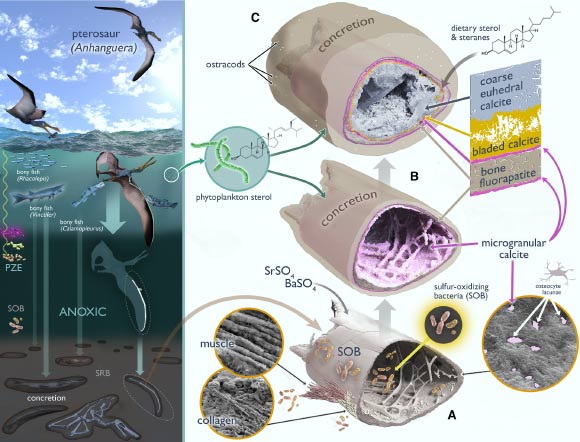
Un fossile de ptérosaure vieux de 113 millions d'années provenant du nord-est du Brésil a fourni des preuves rares de tissus mous, de molécules organiques et de traces chimiques d'un régime alimentaire riche en poissons et en céphalopodes tels que les calmars ou les nautiles. L'article Un fossile de ptérosaure vieux de 113 millions d'années révèle ce que mangeaient les reptiles volants est apparu en premier sur Sci.News : Breaking Science News.
19/06/2026 sci-news ⚙ Traduction automatique
Les ptérosaures pourraient avoir possédé des pycnofibres irisées
plume Pterosauria Tapejaridae comportement étude
De nouvelles recherches suggèrent que les ptérosaures tapejaridés colorés pourraient avoir été encore plus spectaculaires qu’on ne l’imaginait auparavant. Une étude récemment publiée suggère que certains de ces reptiles volants possédaient des pycnofibres irisées produisant des couleurs chatoyantes. En conséquence, ces structures pourraient avoir joué un rôle important dans la signalisation visuelle et l’affichage. Les corps des ptérosaures, les
19/06/2026 everythingdinosaur ⚙ Traduction automatique
1 2 3