évolution
Thématique17 image(s) · 72 Actualités
Galerie d'images

Le mosasaure identifié près d'Aix-en-Provence atteste d'une évolution du prédateur marin vers des espèces d'eau douce.


Calvarius is a genus of styracosternan ornithopod from the Late Cretaceous of Spain. The name alludes to its chronostratigraphic proximity to the extinction event that wiped out the non-avian dinosaurs at the end of the Cretaceous. The highly modified metatarsal that is known from shows an example of convergent evolution, as it is more similar to non-iguanodontian ornithopods than to other styracosternans. It is thought that this is due to fulfilling a niche in its island habitat, resulting in Calvarius becoming a small-bodied animal, capable of rapid locomotion.

Reconstructed skull of Wiehenvenator albati based on holotype specimen (white). Scale bar is 10cm, image if 10px/cm. Unknown material based on related Torvosaurus tanneri. Cranial anatomy based on Rauhut et al (2016) "A new megalosaurid theropod dinosaur from the late Middle Jurassic (Callovian) of north-western Germany: implications for theropod evolution and faunal turnover in the Jurassic"

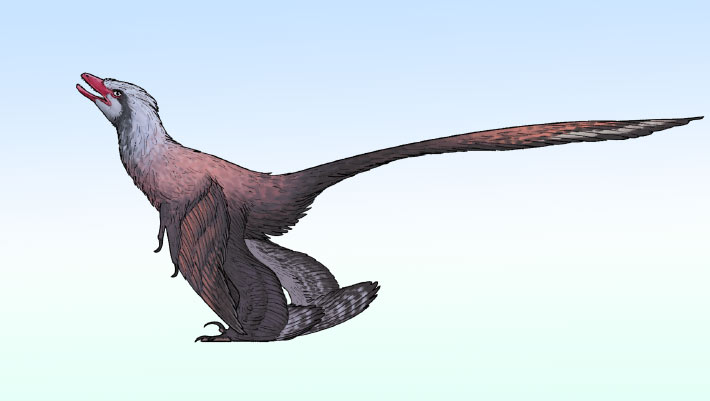
Fujianvenator is an anchiornithid avialan from the Late Jurassic of China, whose discovery gave important insight to the evolution of birds. It had proportionately long legs, with the tibia twice the length of the femur. This suggests it may have been a strong runner, and possibly had a terrestrial or wading lifestyle. Fujianvenator was a small dinosaur, weighing about 640 g. As an avialan, it was almost certainly covered in feathers, though it does not seem likely to have been capable of flight.

Identifier: waterreptilesofp1914will Title: Water reptiles of the past and present Year: 1914 (1910s) Authors: Williston, Samuel Wendell, 1851-1918 Subjects: Aquatic reptiles Publisher: Chicago, Ill., The University of Chicago Press Contributing Library: Boston Public Library Digitizing Sponsor: Boston Public Library View Book Page: Book Viewer About This Book: Catalog Entry View All Images: All Images From Book Click here to view book online to see this illustration in context in a browseable online version of this book. Text Appearing Before Image: served and very complete skeletons ofdifferent species of ichthyosaurs from the Jurassic deposits ofWiirtemberg, in which remains of these animals occur in great 112 WATER REPTILES OF THE PAST AND PRESENT profusion. His researches, and those of several authors since then,supplementing and confirming or disproving those of the manyobservers made during the preceding seventy years, have finallydetermined almost perfectly the complete structure of the moretypical ichthyosaurs, enabling us to infer not a little as to theirhabits and distribution in the old Jurassic oceans. Within thepast few years the discoveries of Professor J. C. Merriam of Cali-fornia have likewise added greatly to our knowledge of the earlierichthyosaurs. It may now truthfully be said that of no group ofextinct reptiles do we have a more complete and satisfactory knowl-edge than of the ichthyosaurs. Nevertheless we have yet very much more to learn about theorder Ichthyosauria as a whole—whence they came and how they Text Appearing After Image: Fig. 52.—Ichthyosaurus quadricissus.museum, from Dr. Dreverman. Photograph of specimen in Senckenberg originated; what their nearest kin were among other reptiles; andespecially, more about the connecting links between them andterrestrial reptiles. They have, as an order, so isolated a position,are so widely separated from all other reptiles in structure, that theyhave long been a puzzle to paleontologists. Like the whales andother cetaceans among mammals, we know the ichthyosaurs wellin the plenitude of their power and the fulness of their development,but have yet only an imperfect knowledge of their earlier history,and none whatever of their earliest. However, as will be seenfarther on, the recent discoveries by Merriam have shed much lighton some of the stages of their evolution. So nearly perfectly wereall the later ichthyosaurs adapted to their life in the water that itwas believed by nearly all paleontologists until about a score of years ICHTHYOSAURIA 3 ago that they had desc Note About Images Please note that these images are extracted from scanned page images that may have been digitally enhanced for readability - coloration and appearance of these illustrations may not perfectly resemble the original work.


This is a collage that represents three periods of Neoproterozoic and is composed of three images from Commons: File:Otavia antiqua 3D reconstruction.jpg represents Tonian period (1000-720 mya), marked by start of evolution of animals. File:AntarcticaDomeCSnow.jpg represents Cryogenian period (720-635 mya), marked by worldwide glaciations (aka "Snowball Earth"). File:Life in the Ediacaran sea.jpg represents Ediacaran period (635-541 mya), marked by first recognizable animal fauna - vendobionts.
![Diagram depicting the currently named Dinosauria from the Late Cretaceous Allen Formation of Argentina. Dinosaur taxa:
Aeolosaurus sp. → Salitral Moreno locality, Río Negro Province.[1] Length = 15 meters.[2]
Austroraptor cabazai → Santa Rosa Basin locality, Río Negro Province.[3][4] Length = 6 meters.[2]
Bonapartenykus ultimus → Salitral Ojo de Agua locality, Río Negro Province.[5] Length = 2.5 meters.[5]
Bonapartesaurus rionegrensis → Salitral Moreno locality, Río Negro Province.[6] Length = ∼6 meters.[1]
Bonatitan reigi → Salitral de Santa Rosa locality, Río Negro Province.[7] Length = Extrapolated after relatives.
Kelumapusaura machi → Cerro Matadero locality, Río Negro Province.[8] 9 meters.[8]
Lamarqueavis australis → Cerro Tortugas locality, Río Negro Province.[9] Length = ∼House sparrow-sized.[9]
Lapampasaurus cholinoi → Islas Malvinas locality, La Pampa Province.[10] Length = ∼7 meters.[2]
Limenavis patagonica → Salitral Moreno locality, Río Negro Province.[11] Length = Extrapolated after relatives.
Menucocelsior arriagadai → Salitral Ojo de Agua locality, Río Negro Province.
Niebla antiqua → Cerro Matadero locality, Río Negro Province.[12] Length = 4.5 meters.[12]
Panamericansaurus schroederi → Bodega Familia Schroeder locality, Neuquén Province.[13] Length = 11 meters.[2]
Patagopelta cristata → Salitral Moreno locality, Río Negro Province.
Quilmesaurus curriei → Salitral Ojo de Agua locality, Río Negro Province.[14] Length = 5.3 meters.[12]
Rocasaurus muniozi → Salitral Moreno locality, Río Negro Province.[15] Length = Extrapolated after relatives.
Excluded taxa:
Willinakaqe salitralensis is considered a nomen dubium,[16] and its paratype has been reassigned to Bonapartesaurus rionegrensis.[6]
Laplatasaurus araukanicus has been restricted to its lectotype which hails from the Anacleto Formation.[17]
Abelisaurus comahuensis could either belong to the Allen or Anacleto formations.[12]
Pellegrinisaurus powelli could either belong to the Allen or Anacleto formations.[18][19]
References
↑ (2013). "The titanosaur sauropods from the late Campanian-early Maastrichtian Allen Formation of Salitral Moreno, Río Negro, Argentina". Acta Palaeontologica Polonica 58 (2): 269–284. DOI:10.4202/app.2011.0055.
↑ a b c (2007) Dinosaurs: The Most Complete, Up-to-Date Encyclopedia for Dinosaur Lovers of All Ages, Random House ISBN: 9780375824197. Genus List for Holtz 2012 Weight Information
↑ (2008). "A bizarre Cretaceous theropod dinosaur from Patagonia and the evolution of Gondwanan dromaeosaurids". Proceedings of the Royal Society B: Biological Sciences 276 (1659): 1101–7. DOI:10.1098/rspb.2008.1554. ISSN 1471-2954.
↑ (2012). "A New Specimen of Austroraptor cabazai Novas, Pol, Canale, Porfiri and Calvo, 2008 (Dinosauria, Theropoda, Unenlagiidae) from the Latest Cretaceous (Maastrichtian) of Río Negro, Argentina". Ameghiniana 49 (4): 662–667. DOI:10.5710/AMGH.30.8.2012.574.
↑ a b Federico L. Agnolin (2012). "New alvarezsaurid (Dinosauria, Theropoda) from uppermost Cretaceous of north-western Patagonia with associated eggs". Cretaceous Research 35: 33–56. DOI:10.1016/j.cretres.2011.11.014.
↑ a b (2017). "Bonapartesaurus rionegrensis, a new hadrosaurine dinosaur from South America: implications for phylogenetic and biogeographic relations with North America". Journal of Vertebrate Paleontology 37 (2): 1–16. DOI:10.1080/02724634.2017.1289381.
↑ Salgado L., Gallina P.A. and Paulina Carabajal A. 2014. "Redescription of Bonatitan reigi (Sauropoda: Titanosauria), from the Campanian–Maastrichtian of the Río Negro Province (Argentina)". Historical Biology: An International Journal of Paleobiology 27(5): 525-548
↑ a b (2022). "A new hadrosaurid (Dinosauria: Ornithischia) from the Late Cretaceous of northern Patagonia and the radiation of South American hadrosaurids". Journal of Systematic Palaeontology. DOI:10.1080/14772019.2021.2020917.
↑ a b (2010). "[https://pdfs.semanticscholar.org/f6f4/c6eb05d224719916c0b20634f54dfeb37d3f.pdf An avian coracoid from the Upper
Cretaceous of Patagonia, Argentina]". Studia Geologica Salmanticensia 46 (2): 99-119. ISSN 0211-8327.
↑ Rodolfo A. Coria, Bernardo González Riga and Silvio Casadío (2012). "Un nuevo hadrosáurido (Dinosauria, Ornithopoda) de la Formación Allen, provincia de La Pampa, Argentina". Ameghiniana 49 (4): 552–572.
↑ Clarke and Chiappe, 2001. A new carinate bird from the Late Cretaceous of Patagonia (Argentina). American Museum Novitates. 3323, 1-23.
↑ a b c d (in English) Aranciaga Rolando, Mauro (2020). "A new medium-sized abelisaurid (Theropoda, Dinosauria) from the late cretaceous (Maastrichtian) Allen Formation of Northern Patagonia, Argentina". Journal of South American Earth Sciences: 102915. DOI:10.1016/j.jsames.2020.102915. ISSN 0895-9811.
↑ (2010). "Panamericansaurus schroederi gen. nov. sp. nov. Un nuevo Sauropoda (Titanosauridae-Aeolosaurini) de la Provincia del Neuquén, Cretácico Superior de Patagonia, Argentina". Brazilian Geographical Journal: Geosciences and Humanities research medium 1: 100–115.
↑ Coria, R.A. (2001) "A new theropod from the Late Cretaceous of Patagonia" in Tanke, Darren H., ed. Mesozoic Vertebrate Life, Life of the Past, Indiana University Press, pp. 3–9 ISBN: 978-0-253-33907-2.
↑ Salgado, L. and C. Azpilicueta. 2000. Un nuevo saltasaurino (Sauropoda, Titanosauridae) de la provincia de Río Negro (Formacíon Allen, Cretácico Superior), Patagonia, Argentina archive copy at the Wayback Machine. Ameghiniana 37 (3):259-264.
↑ (2016). "Revisiting the hadrosaurid diversity of the Allen Fm.: Re-evaluation of the taxonomic validity of Willinakaqe salitralensis (Ornithopoda, Hadrosauridae) from Salitral Moreno, Río Negro Province, Argentina". Ameghiniana 53 (2): 231–237. DOI:10.5710/AMGH.25.09.2015.2943.
↑ Pablo A. Gallina & Alejandro Otero (2015) Reassessment of Laplatasaurus araukanicus (SAUROPODA: TITANOSAURIA), from the Late Cretaceous of Patagonia, Argentina. Ameghiniana 52 (5):487–501. doi:10.5710/AMGH.08.06.2015.2911.
↑ (1996). "Pellegrinisaurus powelli nov. gen. et sp. (Sauropoda, Titanosauridae) from the Upper Cretaceous of Lago Pellegrini, Northwestern Patagonia, Argentina". Ameghiniana 33 (4): 355–365. ISSN 1851-8044.
↑ Heredia, S., & Salgado, L. (2014). Posición estratigráfica de los estratos supracretácicos portadores de dinosaurios en Lago Pellegrini, Patagonia septentrional, Argentina. Ameghiniana, 36(2), 229-234.](https://thumb.wikimedia.org/wikipedia/commons/thumb/4/48/Allen_Formation_Fauna.png/960px-Allen_Formation_Fauna.png?utm_source=commons.wikimedia.org&utm_campaign=imageinfo&utm_content=thumbnail)
Diagram depicting the currently named Dinosauria from the Late Cretaceous Allen Formation of Argentina. Dinosaur taxa: Aeolosaurus sp. → Salitral Moreno locality, Río Negro Province.[1] Length = 15 meters.[2] Austroraptor cabazai → Santa Rosa Basin locality, Río Negro Province.[3][4] Length = 6 meters.[2] Bonapartenykus ultimus → Salitral Ojo de Agua locality, Río Negro Province.[5] Length = 2.5 meters.[5] Bonapartesaurus rionegrensis → Salitral Moreno locality, Río Negro Province.[6] Length = ∼6 meters.[1] Bonatitan reigi → Salitral de Santa Rosa locality, Río Negro Province.[7] Length = Extrapolated after relatives. Kelumapusaura machi → Cerro Matadero locality, Río Negro Province.[8] 9 meters.[8] Lamarqueavis australis → Cerro Tortugas locality, Río Negro Province.[9] Length = ∼House sparrow-sized.[9] Lapampasaurus cholinoi → Islas Malvinas locality, La Pampa Province.[10] Length = ∼7 meters.[2] Limenavis patagonica → Salitral Moreno locality, Río Negro Province.[11] Length = Extrapolated after relatives. Menucocelsior arriagadai → Salitral Ojo de Agua locality, Río Negro Province. Niebla antiqua → Cerro Matadero locality, Río Negro Province.[12] Length = 4.5 meters.[12] Panamericansaurus schroederi → Bodega Familia Schroeder locality, Neuquén Province.[13] Length = 11 meters.[2] Patagopelta cristata → Salitral Moreno locality, Río Negro Province. Quilmesaurus curriei → Salitral Ojo de Agua locality, Río Negro Province.[14] Length = 5.3 meters.[12] Rocasaurus muniozi → Salitral Moreno locality, Río Negro Province.[15] Length = Extrapolated after relatives. Excluded taxa: Willinakaqe salitralensis is considered a nomen dubium,[16] and its paratype has been reassigned to Bonapartesaurus rionegrensis.[6] Laplatasaurus araukanicus has been restricted to its lectotype which hails from the Anacleto Formation.[17] Abelisaurus comahuensis could either belong to the Allen or Anacleto formations.[12] Pellegrinisaurus powelli could either belong to the Allen or Anacleto formations.[18][19] References ↑ (2013). "The titanosaur sauropods from the late Campanian-early Maastrichtian Allen Formation of Salitral Moreno, Río Negro, Argentina". Acta Palaeontologica Polonica 58 (2): 269–284. DOI:10.4202/app.2011.0055. ↑ a b c (2007) Dinosaurs: The Most Complete, Up-to-Date Encyclopedia for Dinosaur Lovers of All Ages, Random House ISBN: 9780375824197. Genus List for Holtz 2012 Weight Information ↑ (2008). "A bizarre Cretaceous theropod dinosaur from Patagonia and the evolution of Gondwanan dromaeosaurids". Proceedings of the Royal Society B: Biological Sciences 276 (1659): 1101–7. DOI:10.1098/rspb.2008.1554. ISSN 1471-2954. ↑ (2012). "A New Specimen of Austroraptor cabazai Novas, Pol, Canale, Porfiri and Calvo, 2008 (Dinosauria, Theropoda, Unenlagiidae) from the Latest Cretaceous (Maastrichtian) of Río Negro, Argentina". Ameghiniana 49 (4): 662–667. DOI:10.5710/AMGH.30.8.2012.574. ↑ a b Federico L. Agnolin (2012). "New alvarezsaurid (Dinosauria, Theropoda) from uppermost Cretaceous of north-western Patagonia with associated eggs". Cretaceous Research 35: 33–56. DOI:10.1016/j.cretres.2011.11.014. ↑ a b (2017). "Bonapartesaurus rionegrensis, a new hadrosaurine dinosaur from South America: implications for phylogenetic and biogeographic relations with North America". Journal of Vertebrate Paleontology 37 (2): 1–16. DOI:10.1080/02724634.2017.1289381. ↑ Salgado L., Gallina P.A. and Paulina Carabajal A. 2014. "Redescription of Bonatitan reigi (Sauropoda: Titanosauria), from the Campanian–Maastrichtian of the Río Negro Province (Argentina)". Historical Biology: An International Journal of Paleobiology 27(5): 525-548 ↑ a b (2022). "A new hadrosaurid (Dinosauria: Ornithischia) from the Late Cretaceous of northern Patagonia and the radiation of South American hadrosaurids". Journal of Systematic Palaeontology. DOI:10.1080/14772019.2021.2020917. ↑ a b (2010). "[https://pdfs.semanticscholar.org/f6f4/c6eb05d224719916c0b20634f54dfeb37d3f.pdf An avian coracoid from the Upper Cretaceous of Patagonia, Argentina]". Studia Geologica Salmanticensia 46 (2): 99-119. ISSN 0211-8327. ↑ Rodolfo A. Coria, Bernardo González Riga and Silvio Casadío (2012). "Un nuevo hadrosáurido (Dinosauria, Ornithopoda) de la Formación Allen, provincia de La Pampa, Argentina". Ameghiniana 49 (4): 552–572. ↑ Clarke and Chiappe, 2001. A new carinate bird from the Late Cretaceous of Patagonia (Argentina). American Museum Novitates. 3323, 1-23. ↑ a b c d (in English) Aranciaga Rolando, Mauro (2020). "A new medium-sized abelisaurid (Theropoda, Dinosauria) from the late cretaceous (Maastrichtian) Allen Formation of Northern Patagonia, Argentina". Journal of South American Earth Sciences: 102915. DOI:10.1016/j.jsames.2020.102915. ISSN 0895-9811. ↑ (2010). "Panamericansaurus schroederi gen. nov. sp. nov. Un nuevo Sauropoda (Titanosauridae-Aeolosaurini) de la Provincia del Neuquén, Cretácico Superior de Patagonia, Argentina". Brazilian Geographical Journal: Geosciences and Humanities research medium 1: 100–115. ↑ Coria, R.A. (2001) "A new theropod from the Late Cretaceous of Patagonia" in Tanke, Darren H., ed. Mesozoic Vertebrate Life, Life of the Past, Indiana University Press, pp. 3–9 ISBN: 978-0-253-33907-2. ↑ Salgado, L. and C. Azpilicueta. 2000. Un nuevo saltasaurino (Sauropoda, Titanosauridae) de la provincia de Río Negro (Formacíon Allen, Cretácico Superior), Patagonia, Argentina archive copy at the Wayback Machine. Ameghiniana 37 (3):259-264. ↑ (2016). "Revisiting the hadrosaurid diversity of the Allen Fm.: Re-evaluation of the taxonomic validity of Willinakaqe salitralensis (Ornithopoda, Hadrosauridae) from Salitral Moreno, Río Negro Province, Argentina". Ameghiniana 53 (2): 231–237. DOI:10.5710/AMGH.25.09.2015.2943. ↑ Pablo A. Gallina & Alejandro Otero (2015) Reassessment of Laplatasaurus araukanicus (SAUROPODA: TITANOSAURIA), from the Late Cretaceous of Patagonia, Argentina. Ameghiniana 52 (5):487–501. doi:10.5710/AMGH.08.06.2015.2911. ↑ (1996). "Pellegrinisaurus powelli nov. gen. et sp. (Sauropoda, Titanosauridae) from the Upper Cretaceous of Lago Pellegrini, Northwestern Patagonia, Argentina". Ameghiniana 33 (4): 355–365. ISSN 1851-8044. ↑ Heredia, S., & Salgado, L. (2014). Posición estratigráfica de los estratos supracretácicos portadores de dinosaurios en Lago Pellegrini, Patagonia septentrional, Argentina. Ameghiniana, 36(2), 229-234.
Diagram depicting the currently named Dinosauria from the Late Cretaceous Allen Formation of Argentina. Dinosaur taxa: Aeolosaurus sp. → Salitral Moreno locality, Río Negro Province.[1] Length = 15 meters.[2] Austroraptor cabazai → Santa Rosa Basin locality, Río Negro Province.[3][4] Length = 6 meters.[2] Bonapartenykus ultimus → Salitral Ojo de Agua locality, Río Negro Province.[5] Length = 2.5 meters.[5] Bonapartesaurus rionegrensis → Salitral Moreno locality, Río Negro Province.[6] Length = ∼6 meters.[1] Bonatitan reigi → Salitral de Santa Rosa locality, Río Negro Province.[7] Length = Extrapolated after relatives. Kelumapusaura machi → Cerro Matadero locality, Río Negro Province.[8] 9 meters.[8] Lamarqueavis australis → Cerro Tortugas locality, Río Negro Province.[9] Length = ∼House sparrow-sized.[9] Lapampasaurus cholinoi → Islas Malvinas locality, La Pampa Province.[10] Length = ∼7 meters.[2] Limenavis patagonica → Salitral Moreno locality, Río Negro Province.[11] Length = Extrapolated after relatives. Menucocelsior arriagadai → Salitral Ojo de Agua locality, Río Negro Province. Niebla antiqua → Cerro Matadero locality, Río Negro Province.[12] Length = 4.5 meters.[12] Panamericansaurus schroederi → Bodega Familia Schroeder locality, Neuquén Province.[13] Length = 11 meters.[2] Patagopelta cristata → Salitral Moreno locality, Río Negro Province. Quilmesaurus curriei → Salitral Ojo de Agua locality, Río Negro Province.[14] Length = 5.3 meters.[12] Rocasaurus muniozi → Salitral Moreno locality, Río Negro Province.[15] Length = Extrapolated after relatives. Excluded taxa: Willinakaqe salitralensis is considered a nomen dubium,[16] and its paratype has been reassigned to Bonapartesaurus rionegrensis.[6] Laplatasaurus araukanicus has been restricted to its lectotype which hails from the Anacleto Formation.[17] Abelisaurus comahuensis could either belong to the Allen or Anacleto formations.[12] Pellegrinisaurus powelli could either belong to the Allen or Anacleto formations.[18][19] References ↑ (2013). "The titanosaur sauropods from the late Campanian-early Maastrichtian Allen Formation of Salitral Moreno, Río Negro, Argentina". Acta Palaeontologica Polonica 58 (2): 269–284. DOI:10.4202/app.2011.0055. ↑ a b c (2007) Dinosaurs: The Most Complete, Up-to-Date Encyclopedia for Dinosaur Lovers of All Ages, Random House ISBN: 9780375824197. Genus List for Holtz 2012 Weight Information ↑ (2008). "A bizarre Cretaceous theropod dinosaur from Patagonia and the evolution of Gondwanan dromaeosaurids". Proceedings of the Royal Society B: Biological Sciences 276 (1659): 1101–7. DOI:10.1098/rspb.2008.1554. ISSN 1471-2954. ↑ (2012). "A New Specimen of Austroraptor cabazai Novas, Pol, Canale, Porfiri and Calvo, 2008 (Dinosauria, Theropoda, Unenlagiidae) from the Latest Cretaceous (Maastrichtian) of Río Negro, Argentina". Ameghiniana 49 (4): 662–667. DOI:10.5710/AMGH.30.8.2012.574. ↑ a b Federico L. Agnolin (2012). "New alvarezsaurid (Dinosauria, Theropoda) from uppermost Cretaceous of north-western Patagonia with associated eggs". Cretaceous Research 35: 33–56. DOI:10.1016/j.cretres.2011.11.014. ↑ a b (2017). "Bonapartesaurus rionegrensis, a new hadrosaurine dinosaur from South America: implications for phylogenetic and biogeographic relations with North America". Journal of Vertebrate Paleontology 37 (2): 1–16. DOI:10.1080/02724634.2017.1289381. ↑ Salgado L., Gallina P.A. and Paulina Carabajal A. 2014. "Redescription of Bonatitan reigi (Sauropoda: Titanosauria), from the Campanian–Maastrichtian of the Río Negro Province (Argentina)". Historical Biology: An International Journal of Paleobiology 27(5): 525-548 ↑ a b (2022). "A new hadrosaurid (Dinosauria: Ornithischia) from the Late Cretaceous of northern Patagonia and the radiation of South American hadrosaurids". Journal of Systematic Palaeontology. DOI:10.1080/14772019.2021.2020917. ↑ a b (2010). "[https://pdfs.semanticscholar.org/f6f4/c6eb05d224719916c0b20634f54dfeb37d3f.pdf An avian coracoid from the Upper Cretaceous of Patagonia, Argentina]". Studia Geologica Salmanticensia 46 (2): 99-119. ISSN 0211-8327. ↑ Rodolfo A. Coria, Bernardo González Riga and Silvio Casadío (2012). "Un nuevo hadrosáurido (Dinosauria, Ornithopoda) de la Formación Allen, provincia de La Pampa, Argentina". Ameghiniana 49 (4): 552–572. ↑ Clarke and Chiappe, 2001. A new carinate bird from the Late Cretaceous of Patagonia (Argentina). American Museum Novitates. 3323, 1-23. ↑ a b c d (in English) Aranciaga Rolando, Mauro (2020). "A new medium-sized abelisaurid (Theropoda, Dinosauria) from the late cretaceous (Maastrichtian) Allen Formation of Northern Patagonia, Argentina". Journal of South American Earth Sciences: 102915. DOI:10.1016/j.jsames.2020.102915. ISSN 0895-9811. ↑ (2010). "Panamericansaurus schroederi gen. nov. sp. nov. Un nuevo Sauropoda (Titanosauridae-Aeolosaurini) de la Provincia del Neuquén, Cretácico Superior de Patagonia, Argentina". Brazilian Geographical Journal: Geosciences and Humanities research medium 1: 100–115. ↑ Coria, R.A. (2001) "A new theropod from the Late Cretaceous of Patagonia" in Tanke, Darren H., ed. Mesozoic Vertebrate Life, Life of the Past, Indiana University Press, pp. 3–9 ISBN: 978-0-253-33907-2. ↑ Salgado, L. and C. Azpilicueta. 2000. Un nuevo saltasaurino (Sauropoda, Titanosauridae) de la provincia de Río Negro (Formacíon Allen, Cretácico Superior), Patagonia, Argentina archive copy at the Wayback Machine. Ameghiniana 37 (3):259-264. ↑ (2016). "Revisiting the hadrosaurid diversity of the Allen Fm.: Re-evaluation of the taxonomic validity of Willinakaqe salitralensis (Ornithopoda, Hadrosauridae) from Salitral Moreno, Río Negro Province, Argentina". Ameghiniana 53 (2): 231–237. DOI:10.5710/AMGH.25.09.2015.2943. ↑ Pablo A. Gallina & Alejandro Otero (2015) Reassessment of Laplatasaurus araukanicus (SAUROPODA: TITANOSAURIA), from the Late Cretaceous of Patagonia, Argentina. Ameghiniana 52 (5):487–501. doi:10.5710/AMGH.08.06.2015.2911. ↑ (1996). "Pellegrinisaurus powelli nov. gen. et sp. (Sauropoda, Titanosauridae) from the Upper Cretaceous of Lago Pellegrini, Northwestern Patagonia, Argentina". Ameghiniana 33 (4): 355–365. ISSN 1851-8044. ↑ Heredia, S., & Salgado, L. (2014). Posición estratigráfica de los estratos supracretácicos portadores de dinosaurios en Lago Pellegrini, Patagonia septentrional, Argentina. Ameghiniana, 36(2), 229-234.
Diagram depicting the currently named Dinosauria from the Late Cretaceous Allen Formation of Argentina. Dinosaur taxa: Aeolosaurus sp. → Salitral Moreno locality, Río Negro Province.[1] Length = 15 meters.[2] Austroraptor cabazai → Santa Rosa Basin locality, Río Negro Province.[3][4] Length = 6 meters.[2] Bonapartenykus ultimus → Salitral Ojo de Agua locality, Río Negro Province.[5] Length = 2.5 meters.[5] Bonapartesaurus rionegrensis → Salitral Moreno locality, Río Negro Province.[6] Length = ∼6 meters.[1] Bonatitan reigi → Salitral de Santa Rosa locality, Río Negro Province.[7] Length = Extrapolated after relatives. Kelumapusaura machi → Cerro Matadero locality, Río Negro Province.[8] 9 meters.[8] Lamarqueavis australis → Cerro Tortugas locality, Río Negro Province.[9] Length = ∼House sparrow-sized.[9] Lapampasaurus cholinoi → Islas Malvinas locality, La Pampa Province.[10] Length = ∼7 meters.[2] Limenavis patagonica → Salitral Moreno locality, Río Negro Province.[11] Length = Extrapolated after relatives. Menucocelsior arriagadai → Salitral Ojo de Agua locality, Río Negro Province. Niebla antiqua → Cerro Matadero locality, Río Negro Province.[12] Length = 4.5 meters.[12] Panamericansaurus schroederi → Bodega Familia Schroeder locality, Neuquén Province.[13] Length = 11 meters.[2] Patagopelta cristata → Salitral Moreno locality, Río Negro Province. Quilmesaurus curriei → Salitral Ojo de Agua locality, Río Negro Province.[14] Length = 5.3 meters.[12] Rocasaurus muniozi → Salitral Moreno locality, Río Negro Province.[15] Length = Extrapolated after relatives. Excluded taxa: Willinakaqe salitralensis is considered a nomen dubium,[16] and its paratype has been reassigned to Bonapartesaurus rionegrensis.[6] Laplatasaurus araukanicus has been restricted to its lectotype which hails from the Anacleto Formation.[17] Abelisaurus comahuensis could either belong to the Allen or Anacleto formations.[12] Pellegrinisaurus powelli could either belong to the Allen or Anacleto formations.[18][19] References ↑ (2013). "The titanosaur sauropods from the late Campanian-early Maastrichtian Allen Formation of Salitral Moreno, Río Negro, Argentina". Acta Palaeontologica Polonica 58 (2): 269–284. DOI:10.4202/app.2011.0055. ↑ a b c (2007) Dinosaurs: The Most Complete, Up-to-Date Encyclopedia for Dinosaur Lovers of All Ages, Random House ISBN: 9780375824197. Genus List for Holtz 2012 Weight Information ↑ (2008). "A bizarre Cretaceous theropod dinosaur from Patagonia and the evolution of Gondwanan dromaeosaurids". Proceedings of the Royal Society B: Biological Sciences 276 (1659): 1101–7. DOI:10.1098/rspb.2008.1554. ISSN 1471-2954. ↑ (2012). "A New Specimen of Austroraptor cabazai Novas, Pol, Canale, Porfiri and Calvo, 2008 (Dinosauria, Theropoda, Unenlagiidae) from the Latest Cretaceous (Maastrichtian) of Río Negro, Argentina". Ameghiniana 49 (4): 662–667. DOI:10.5710/AMGH.30.8.2012.574. ↑ a b Federico L. Agnolin (2012). "New alvarezsaurid (Dinosauria, Theropoda) from uppermost Cretaceous of north-western Patagonia with associated eggs". Cretaceous Research 35: 33–56. DOI:10.1016/j.cretres.2011.11.014. ↑ a b (2017). "Bonapartesaurus rionegrensis, a new hadrosaurine dinosaur from South America: implications for phylogenetic and biogeographic relations with North America". Journal of Vertebrate Paleontology 37 (2): 1–16. DOI:10.1080/02724634.2017.1289381. ↑ Salgado L., Gallina P.A. and Paulina Carabajal A. 2014. "Redescription of Bonatitan reigi (Sauropoda: Titanosauria), from the Campanian–Maastrichtian of the Río Negro Province (Argentina)". Historical Biology: An International Journal of Paleobiology 27(5): 525-548 ↑ a b (2022). "A new hadrosaurid (Dinosauria: Ornithischia) from the Late Cretaceous of northern Patagonia and the radiation of South American hadrosaurids". Journal of Systematic Palaeontology. DOI:10.1080/14772019.2021.2020917. ↑ a b (2010). "[https://pdfs.semanticscholar.org/f6f4/c6eb05d224719916c0b20634f54dfeb37d3f.pdf An avian coracoid from the Upper Cretaceous of Patagonia, Argentina]". Studia Geologica Salmanticensia 46 (2): 99-119. ISSN 0211-8327. ↑ Rodolfo A. Coria, Bernardo González Riga and Silvio Casadío (2012). "Un nuevo hadrosáurido (Dinosauria, Ornithopoda) de la Formación Allen, provincia de La Pampa, Argentina". Ameghiniana 49 (4): 552–572. ↑ Clarke and Chiappe, 2001. A new carinate bird from the Late Cretaceous of Patagonia (Argentina). American Museum Novitates. 3323, 1-23. ↑ a b c d (in English) Aranciaga Rolando, Mauro (2020). "A new medium-sized abelisaurid (Theropoda, Dinosauria) from the late cretaceous (Maastrichtian) Allen Formation of Northern Patagonia, Argentina". Journal of South American Earth Sciences: 102915. DOI:10.1016/j.jsames.2020.102915. ISSN 0895-9811. ↑ (2010). "Panamericansaurus schroederi gen. nov. sp. nov. Un nuevo Sauropoda (Titanosauridae-Aeolosaurini) de la Provincia del Neuquén, Cretácico Superior de Patagonia, Argentina". Brazilian Geographical Journal: Geosciences and Humanities research medium 1: 100–115. ↑ Coria, R.A. (2001) "A new theropod from the Late Cretaceous of Patagonia" in Tanke, Darren H., ed. Mesozoic Vertebrate Life, Life of the Past, Indiana University Press, pp. 3–9 ISBN: 978-0-253-33907-2. ↑ Salgado, L. and C. Azpilicueta. 2000. Un nuevo saltasaurino (Sauropoda, Titanosauridae) de la provincia de Río Negro (Formacíon Allen, Cretácico Superior), Patagonia, Argentina archive copy at the Wayback Machine. Ameghiniana 37 (3):259-264. ↑ (2016). "Revisiting the hadrosaurid diversity of the Allen Fm.: Re-evaluation of the taxonomic validity of Willinakaqe salitralensis (Ornithopoda, Hadrosauridae) from Salitral Moreno, Río Negro Province, Argentina". Ameghiniana 53 (2): 231–237. DOI:10.5710/AMGH.25.09.2015.2943. ↑ Pablo A. Gallina & Alejandro Otero (2015) Reassessment of Laplatasaurus araukanicus (SAUROPODA: TITANOSAURIA), from the Late Cretaceous of Patagonia, Argentina. Ameghiniana 52 (5):487–501. doi:10.5710/AMGH.08.06.2015.2911. ↑ (1996). "Pellegrinisaurus powelli nov. gen. et sp. (Sauropoda, Titanosauridae) from the Upper Cretaceous of Lago Pellegrini, Northwestern Patagonia, Argentina". Ameghiniana 33 (4): 355–365. ISSN 1851-8044. ↑ Heredia, S., & Salgado, L. (2014). Posición estratigráfica de los estratos supracretácicos portadores de dinosaurios en Lago Pellegrini, Patagonia septentrional, Argentina. Ameghiniana, 36(2), 229-234.

Baminornis is the oldest known bird with a fused pygostyle, a skeletal feature that implies tail feathers. Its discovery pushed back current understanding of bird evolution and global distribution by 20 million years. Baminornis was about 15 cm in length, had many features in common with modern birds, including the capability for powered flight.

Figure 1. Evolution of macroecological traits in Dinosauria. Large scale event in dinosaur evolution (a); the origin of dinosaurs (star), hyperthermals (volcano), the earliest fossil Avialae (bird), the earliest fossil angiosperm (flower), the Cretaceous/Palaeogene mass extinction (asteroid). Phylogeny of dinosaurs (b) redrawn from Sereno and adapted to the current consensus and upon which an ancestral state reconstruction of temperature niche (mean annual temperature) after Chiarenza et al. is plotted; Mesozoic palaeogeographies (c) for Triassic (T), Jurassic (J) and Cretaceous (K). Silhouette colours symbolize body mass for each of the taxa represented; information on dietary habits are plotted after Barrett and Zanno & Makovicky; numbers represent clades discussed through this study: 1, Ornithischia; 2, Thyreophora; 3, Ornithopoda; 4, Hadrosauroidea; 5, Marginocephalia; 6, Ceratopsia; 7, Saurischia; 8, Sauropodomorpha; 9, Sauropoda; 10, Theropoda; 11, Ceratosauria; 12, Tetanurae; 13, Coelurosauria; 14, Maniraptoriformes; 15, Maniraptora; 16, Deinonychosauria; 17, Avialae; 18, Ornithothoraces. Palaeogeographies modified from original plots via R package ‘mapast’ using plate models by Scotese.

Reconstruction of three Elasmosaurus hunting Hesperornis. From Osborn, H. F. (1917). The origin and evolution of life, on the theory of action, reaction and interaction of energy.

Body mass evolution of Oviraptorosauria. Time calibrated phenograms of Log10 Body Mass (kg) versus time (Ma) for Oviraptorosauria. Blue halos represent 95% confi- dence intervals and branches indicate phylogenetic relation- ships. Each plot displays the same data, but Caenagnathidae is highlighted in green in (A) and Oviraptoridae is highlighted in red in (B) for clarity. Yellow arrows indicate nodes where important changes in body size range occur. Pie charts show ancestral estimations of biogeographic range (as in Fig. 20) for important clades of caenagnathids (A) and oviraptorids (B). Node labels from left to right in (A): Oviraptorosauria; Caenagnathidae; Anomalipes + Caenagnathinae; Caenagnathinae more derived than Apatoraptor pennatus; Anzu + Caenagnathus. Node labels from left to right in (B): Oviraptorosauria; Caenagnathoidea; Oviraptoridae; Heyuanninae (bottom); Citipatinae (top). Colours for node labels as in Fig. 20. Abbreviations: Al, Albian; Ap, Aptian; Ba, Barremian; Be, Berriasian; Ca, Campanian; Ce, Cenomanian; Co, Coniacian; Ha, Hauterivian; Ma, Maastrichtian; S, Santonian; Tu, Turonian; Va, Valanginian.

Menefeeceratops is a genus of ceratopsid dinosaur from the Menefee Formation in the United States. It is is believed to have been approximately 4 m long, and had two large horns above the eyes like other ceratopsians. Menefeeceratops was one of the earliest and most basal known members of the ceratopsids, and the oldest known centrosaurine. Its age and location was instrumental in helping to understand the evolution and diversification of the centrosaurine dinosaurs.
Actualités
.jpg)