squelette

Type de vue

155 image(s) · 13 Actualités

Galerie d'images

Nemicolopterus crypticus holotype (IVPP V-14377).

(A) Skeleton overview, and (B) schematic drawing. (C) Skull (right lateral view), and (D) schematic drawing. Abbreviations: cdv, caudal vertebrae; co, coracoid; cv, cervical vertebra; d1–d4, digits 1–4; f, frontal; fe, femur; h, humerus; hy, hyoid; il, illium; is, ischium; j, jugal; l, left; la, lacrimal; mand, mandible; mc, metacarpal; mt, metatarsal; naof, nasoantorbital fenestra; or, orbit; pa, parietal; pm, premaxilla; ph, phalanx; ti, tibia; r, right; sca, scapula. Scale bars: A–B, 100 mm; C–D, 5 mm.
Taxons Nemicolopterus

Nemicolopterus crypticus holotype (IVPP V-14377). (A) Skeleton overview, and (B) schematic drawing. (C) Skull (right lateral view), and (D) schematic drawing. Abbreviations: cdv, caudal vertebrae; co, coracoid; cv, cervical vertebra; d1–d4, digits 1–4; f, frontal; fe, femur; h, humerus; hy, hyoid; il, illium; is, ischium; j, jugal; l, left; la, lacrimal; mand, mandible; mc, metacarpal; mt, metatarsal; naof, nasoantorbital fenestra; or, orbit; pa, parietal; pm, premaxilla; ph, phalanx; ti, tibia; r, right; sca, scapula. Scale bars: A–B, 100 mm; C–D, 5 mm.

humérus écaille vertèbre dessin +4
Selected elements used in the diagnosis of Saltriovenator zanellai n. gen. n. sp.

Right humerus in medial (A), frontal (B) and distal (C) views; (D) left scapula, medial view; (E) right scapular glenoid and coracoid, lateral view; (F) furcula, ventral view; tooth, labial (G) and apical (H) views; (I) left humerus, medial view; right second metacarpal in dorsal (J), lateral (L) and distal (N) views; first phalanx of the right second digit in dorsal (K), lateral (M) and proximal (O) views; (P–T) right third digit in proximal, dorsal and lateral views; (U) right distal tarsal IV, proximal view; third right metatarsal in proximal (V) and frontal (X) views; second right metatarsal, proximal (W) and frontal (Y) views; (Z) reconstructed skeleton showing identified elements (red). Abbreviations as in text, asterisks mark autapomorphic traits. Scale bars: 10 cm in (A)–(E), (I), and (U)–(Y); two cm in (F), and (J)–(T); one cm in (G).
Taxons Saltriovenator

Selected elements used in the diagnosis of Saltriovenator zanellai n. gen. n. sp. Right humerus in medial (A), frontal (B) and distal (C) views; (D) left scapula, medial view; (E) right scapular glenoid and coracoid, lateral view; (F) furcula, ventral view; tooth, labial (G) and apical (H) views; (I) left humerus, medial view; right second metacarpal in dorsal (J), lateral (L) and distal (N) views; first phalanx of the right second digit in dorsal (K), lateral (M) and proximal (O) views; (P–T) right third digit in proximal, dorsal and lateral views; (U) right distal tarsal IV, proximal view; third right metatarsal in proximal (V) and frontal (X) views; second right metatarsal, proximal (W) and frontal (Y) views; (Z) reconstructed skeleton showing identified elements (red). Abbreviations as in text, asterisks mark autapomorphic traits. Scale bars: 10 cm in (A)–(E), (I), and (U)–(Y); two cm in (F), and (J)–(T); one cm in (G).

humérus écaille dent dessin +2
Eustreptospondylus skeleton
Taxons Eustreptospondylus

Eustreptospondylus skeleton

Eustreptospondylus squelette
Holotype specimen of Linheraptor exquisitus, the blocks including nearly the entire skeleton.
Taxons Linheraptor

Holotype specimen of Linheraptor exquisitus, the blocks including nearly the entire skeleton.

Japon holotype spécimen Linheraptor +1
Hypnovenator matsubaraetoheorum gen. et sp. nov. Blocks including the forelimb, knee (A), and heel (B). (C) Reconstructed skeleton. Red and yellow colors show the confirmed and probable positions of the recovered elements, respectively (Courtesy of Genya Masukawa). (D) Left manus in medial view. (E) Left manual phalanx I-1 in dorsal view. (F) Removed fragmentary left manual phalanx II-3 (manual ungual phalanx II) for preparing the left manus. (G) Cross-section of the bent right ankle. (H) Left metatarsus in posterior view. Abbreviations: as, astragalus; dp, depression; fe, femur; fi, fibula; hu, humerus; mc I, metacarpal I; mc II, metacarpal II; mc III, metacarpal III; mp I-1, manual phalanx I-1; mp I-2, manual phalanx I-2 (manual ungual phalanx I); mp II-1, manual phalanx II-1; mp II-3, manual phalanx II-3 (manual ungual phalanx II); mp III-3, manual phalanx III-3; mp III-4, manual phalanx III-4 (manual ungual phalanx III); mr, medial ridge; mt II, metatarsal II; mt III, metatarsal III; mt IV, metatarsal IV; mt V, metatarsal V; ra, radius; ti, tibia; ul, ulna. Almost all elements are from the left side. Abbreviations for elements from the right side added ‘(r)’ at the end. This figure was created using Adobe Photoshop 25.5.1 and Adobe Illustrator 28.3 (https://www.adobe.com/).
Taxons Hypnovenator

Hypnovenator matsubaraetoheorum gen. et sp. nov. Blocks including the forelimb, knee (A), and heel (B). (C) Reconstructed skeleton. Red and yellow colors show the confirmed and probable positions of the recovered elements, respectively (Courtesy of Genya Masukawa). (D) Left manus in medial view. (E) Left manual phalanx I-1 in dorsal view. (F) Removed fragmentary left manual phalanx II-3 (manual ungual phalanx II) for preparing the left manus. (G) Cross-section of the bent right ankle. (H) Left metatarsus in posterior view. Abbreviations: as, astragalus; dp, depression; fe, femur; fi, fibula; hu, humerus; mc I, metacarpal I; mc II, metacarpal II; mc III, metacarpal III; mp I-1, manual phalanx I-1; mp I-2, manual phalanx I-2 (manual ungual phalanx I); mp II-1, manual phalanx II-1; mp II-3, manual phalanx II-3 (manual ungual phalanx II); mp III-3, manual phalanx III-3; mp III-4, manual phalanx III-4 (manual ungual phalanx III); mr, medial ridge; mt II, metatarsal II; mt III, metatarsal III; mt IV, metatarsal IV; mt V, metatarsal V; ra, radius; ti, tibia; ul, ulna. Almost all elements are from the left side. Abbreviations for elements from the right side added ‘(r)’ at the end. This figure was created using Adobe Photoshop 25.5.1 and Adobe Illustrator 28.3 (https://www.adobe.com/).

humérus Hypnovenator squelette
(a) Photograph. (b) Highly schematic outline shows general layout of the skeleton (illustrated by Zhaochuang). Scale bar, 5 cm. d, dentary; f, femur; fi, fibula; fr, frontal; lj, lower jaw; or, orbit; ti, tibia.
Taxons Beibeilong

(a) Photograph. (b) Highly schematic outline shows general layout of the skeleton (illustrated by Zhaochuang). Scale bar, 5 cm. d, dentary; f, femur; fi, fibula; fr, frontal; lj, lower jaw; or, orbit; ti, tibia.

écaille Beibeilong squelette
The whole skeleton of the holotype Tongtianlong limosus gen. et sp. nov. in dorsal view (a) and lateral view (b). Scale bar = 10 cm.
Taxons Tongtianlong

The whole skeleton of the holotype Tongtianlong limosus gen. et sp. nov. in dorsal view (a) and lateral view (b). Scale bar = 10 cm.

écaille holotype Tongtianlong squelette
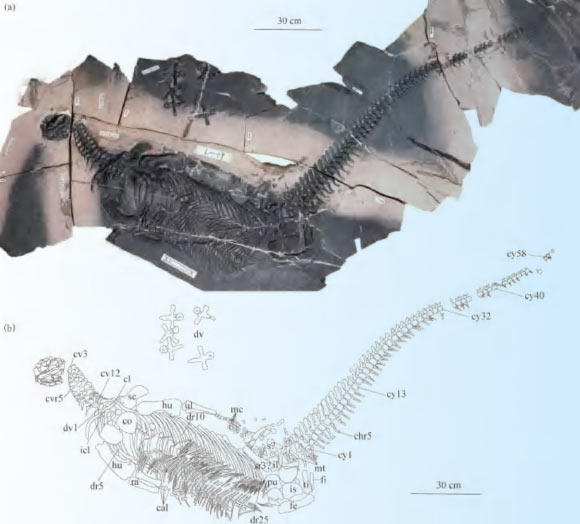
A photograph of the skeleton of Jianchangosaurus yixianensis gen. et sp. nov. (41HIII-0308A) (A) and line drawing (B).

Abbreviations: at, atlas; ax, axis; cav, caudal vertebra; cv, cervical vertebra; co, coracoid; dc, distal carpal; dv, dorsal vertebra; l., left; f, femur; fi, fibula; fur, furcula; hu, humerus; il, ilium; is, ischium; pu, pubis; ra, radius; sc, scapula; ti, tibia; ul, ulna; mc, metacarpal; mt, metatarsal; mxf, maxillary fenestra; pat, proatlas; r., right; sr, sacral rib; sv, sacral vertebra; ung, ungual. All elements of the skeleton are preserved except the distal half of the caudal vertebrae. Dashed lines of metatarsals indicate areas that have been reconstructed. The middle portion of the neck, from the fourth to ninth cervical vertebrae, and the pedal phalanges have been repositioned. The rest of elements of this specimen are in the original position.
Taxons Jianchangosaurus

A photograph of the skeleton of Jianchangosaurus yixianensis gen. et sp. nov. (41HIII-0308A) (A) and line drawing (B). Abbreviations: at, atlas; ax, axis; cav, caudal vertebra; cv, cervical vertebra; co, coracoid; dc, distal carpal; dv, dorsal vertebra; l., left; f, femur; fi, fibula; fur, furcula; hu, humerus; il, ilium; is, ischium; pu, pubis; ra, radius; sc, scapula; ti, tibia; ul, ulna; mc, metacarpal; mt, metatarsal; mxf, maxillary fenestra; pat, proatlas; r., right; sr, sacral rib; sv, sacral vertebra; ung, ungual. All elements of the skeleton are preserved except the distal half of the caudal vertebrae. Dashed lines of metatarsals indicate areas that have been reconstructed. The middle portion of the neck, from the fourth to ninth cervical vertebrae, and the pedal phalanges have been repositioned. The rest of elements of this specimen are in the original position.

humérus vertèbre dessin spécimen +2
Squelette partiel de Wulatesaurus.
Taxons Bannykus

Squelette partiel de Wulatesaurus.

Japon Bannykus partiel squelette
Alvarezsaurus skeleton restoration, Copenhagen.
Taxons Alvarezsaurus

Alvarezsaurus skeleton restoration, Copenhagen.

Alvarezsauria squelette
Skeleton outline of Dracoraptor hanigani.

Bones highlighted green for present, orange for external moulds and blue for tentatively identified bones. Many unidentified or uncertain elements have been omitted.
Taxons Dracoraptor

Skeleton outline of Dracoraptor hanigani. Bones highlighted green for present, orange for external moulds and blue for tentatively identified bones. Many unidentified or uncertain elements have been omitted.

os Dracoraptor squelette
Reconstruction of the terrestrial paleoenvironmental setting of the Sao Khua Formation by Renata Cunha.
In the center, a generalized spinosaurid feeds on a sauropod. This trophic relationship is hypothesized based on isolated tooth crowns found in association with a sauropod skeleton [67]. In the background, a small pack of the ornithomimosaur theropod Kinnareemimus. Both sauropods and ornithomimosaurs (as part of the “herbivorous” theropods) were found to be positively associated with terrestrial paleoenvironments by Butler and Barrett [15].

(cropped from File:Spinosaurid and Kinnareemimus.PNG)
Taxons Kinnareemimus

Reconstruction of the terrestrial paleoenvironmental setting of the Sao Khua Formation by Renata Cunha. In the center, a generalized spinosaurid feeds on a sauropod. This trophic relationship is hypothesized based on isolated tooth crowns found in association with a sauropod skeleton [67]. In the background, a small pack of the ornithomimosaur theropod Kinnareemimus. Both sauropods and ornithomimosaurs (as part of the “herbivorous” theropods) were found to be positively associated with terrestrial paleoenvironments by Butler and Barrett [15]. (cropped from File:Spinosaurid and Kinnareemimus.PNG)

dent Sao Khua Kinnareemimus Ornithomimosauria +3
Photo of the partial holotype skeleton of the ornithomimosaur Garudimimus brevipes, as mounted in the Mongolian Natural History Museum. Scan of physical photograph.
Taxons Garudimimus

Photo of the partial holotype skeleton of the ornithomimosaur Garudimimus brevipes, as mounted in the Mongolian Natural History Museum. Scan of physical photograph.

musée holotype Garudimimus Ornithomimosauria +2
Reconstruction of the Bravoceratops skeleton with known bones marked in white. Specimen: TMM 46015-1 (holotype). Scale bar=2 m. Total length along centra=6.97 m.
Taxons Bravoceratops

Reconstruction of the Bravoceratops skeleton with known bones marked in white. Specimen: TMM 46015-1 (holotype). Scale bar=2 m. Total length along centra=6.97 m.

os écaille holotype spécimen +2
Ornithischian dinosaur Stenopelix valdensis Meyer, 1857, holotype (GZG 741/2, formerly GPI Gö 741−2), from the Obernkirchen Sandstone (Early
Cretaceous: Berriasian), near Bückeburg, Niedersachsen, Germany. A. Large sandstone slab. B. Interpretative outline drawing of large latex cast (prepared
from large sandstone slab), showing majority of postcranial skeleton in dorsal view. C. Small sandstone slab. D. Interpretative outline drawing of small la−
tex cast (prepared from small sandstone slab), showing sacrum and caudals, pelvic region and partial hindlimbs in ventral view. For clarity elements in and
around the sacral region have not been labelled—these areas are shown in greater detail in Fig. 3. Roman numerals II–IV correspond to respective digits.

Abbreviations: mt, metatarsals; f, femur; ?, unidentified element.
Taxons Stenopelix

Ornithischian dinosaur Stenopelix valdensis Meyer, 1857, holotype (GZG 741/2, formerly GPI Gö 741−2), from the Obernkirchen Sandstone (Early Cretaceous: Berriasian), near Bückeburg, Niedersachsen, Germany. A. Large sandstone slab. B. Interpretative outline drawing of large latex cast (prepared from large sandstone slab), showing majority of postcranial skeleton in dorsal view. C. Small sandstone slab. D. Interpretative outline drawing of small la− tex cast (prepared from small sandstone slab), showing sacrum and caudals, pelvic region and partial hindlimbs in ventral view. For clarity elements in and around the sacral region have not been labelled—these areas are shown in greater detail in Fig. 3. Roman numerals II–IV correspond to respective digits. Abbreviations: mt, metatarsals; f, femur; ?, unidentified element.

dessin Allemagne Berriasien Crétacé +8
Composite skeleton on display at the Perot Museum of Nature and Science. Scale bar equals 10 cm.
Taxons Convolosaurus

Composite skeleton on display at the Perot Museum of Nature and Science. Scale bar equals 10 cm.

écaille musée Convolosaurus squelette
1 2 3 4 5 6 7 8 9 10

Actualités

Ce « crocodile terroriste » de 31 pieds mangeait des dinosaures. Maintenant c'est de retour
prédateur musée États-Unis Dinosauria squelette
Un énorme « crocodile terroriste » de la taille d’un bus qui s’attaquait autrefois aux dinosaures a été ramené à la vie avec des détails époustouflants grâce au premier squelette complet scientifiquement précis de Deinosuchus schwimmeri. S'étendant sur plus de 9 mètres de long, cet ancien prédateur suprême régnait sur le sud-est des États-Unis il y a plus de 75 millions d'années. Les visiteurs peuvent désormais le voir de près au Tellus Science Museum, le seul endroit au monde à posséder cette réplique.
15/04/2026 sciencedaily ⚙ Traduction automatique
Ce dinosaure de 2 livres réécrit ce que les scientifiques savent de l'évolution
fossile Alnashetri Alvarezsauria Dinosauria oiseau évolution squelette
Un squelette de dinosaure presque complet découvert en Patagonie aide les scientifiques à percer le mystère des alvarezsaures, un groupe étrange de dinosaures ressemblant à des oiseaux. Le fossile d'Alnashetri cerropoliciensis révèle que ces animaux sont devenus minuscules avant de développer leurs caractéristiques spécialisées ultérieures, telles que des bras tronqués et des adaptations mangeuses de fourmis. Pesant moins de deux livres, le dinosaure est l’un des plus petits connus d’Amérique du Sud.
10/03/2026 sciencedaily ⚙ Traduction automatique
Un fossile de « Sword Dragon » vieux de 190 millions d’années réécrit l’histoire des ichtyosaures
Royaume-Uni Jurassique fossile Ichthyosauria évolution squelette
Un ichtyosaure nouvellement identifié de la côte jurassique du Royaume-Uni est en train de réécrire une partie du manuel préhistorique. Surnommé le « dragon-épée du Dorset », ce reptile marin de trois mètres de long a vécu pendant une période d’évolution mal comprise, au cours de laquelle les principaux groupes d’ichtyosaures disparaissaient et de nouveaux apparaissaient. Son squelette magnifiquement préservé – doté d’un museau en forme de lame et d’un éventuel dernier repas – permet de déterminer le moment où cette transition dramatique s’est produite.
24/02/2026 sciencedaily ⚙ Traduction automatique
Hesperosuchus: Beast of the Week
Hesperosuchus : Bête de la semaine
Mexique États-Unis Trias supérieur Trias fossile squelette
Cette semaine, nous allons découvrir un parent de crocodiliens modernes qui a trompé les scientifiques à plusieurs reprises !  Entrez Hesperosuchus agilis ! Hesperosuchus était un pseudosuchien (lié aux crocodiliens) qui vivait dans ce qui est aujourd'hui l'Arizona et le Nouveau-Mexique, aux États-Unis, à la fin du Trias, il y a environ 210 millions d'années.  Il s'agissait probablement d'un mangeur de viande et, du museau à la queue, le squelette le plus complet mesure environ 1,2 m (4 pieds), mais d'autres fossiles suggèrent qu'il aurait pu devenir plus grand, jusqu'à environ 1,2 m.
01/02/2026 prehistoricbeastoftheweek ⚙ Traduction automatique
Une maladie perdue émerge de restes humains vieux de 5 500 ans
Colombie évolution squelette
Un squelette colombien vieux de 5 500 ans a révélé le plus ancien génome connu de la bactérie liée à la syphilis et aux maladies associées. L’ancienne souche ne rentre pas parfaitement dans les catégories modernes, faisant allusion à une forme oubliée qui s’est divisée au début de l’évolution de l’agent pathogène. Cela repousse l’histoire des maladies tréponémiques dans les Amériques de plusieurs millénaires et montre qu’elles se diversifiaient déjà bien avant les documents écrits.
26/01/2026 sciencedaily-human-evo ⚙ Traduction automatique
1 2 3