Crétacé

Intervalle géologique

185 image(s) · 46 Actualités

Voir la fiche

Galerie d'images

A new plesiosaur, Leurospondylus, from the Edmonton Cretaceous of Alberta
Taxons Leurospondylus

A new plesiosaur, Leurospondylus, from the Edmonton Cretaceous of Alberta

Crétacé Edmontonia Leurospondylus Plesiosauria
Dzharacursor is an ornithomimid theropod dinosaur from the Late Cretaceous of what is now Uzbekistan. Ornithomimids like Dzharacursor are known for their long legs lending to a cursorial, or running, lifestyle. They had a feathered covering, and were likely omnivorous, or possibly herbivorous. Adult Dzharacursor could grow to approximately 3.5 m in length.
Taxons Dzharacursor

Dzharacursor is an ornithomimid theropod dinosaur from the Late Cretaceous of what is now Uzbekistan. Ornithomimids like Dzharacursor are known for their long legs lending to a cursorial, or running, lifestyle. They had a feathered covering, and were likely omnivorous, or possibly herbivorous. Adult Dzharacursor could grow to approximately 3.5 m in length.

Ouzbékistan Crétacé Crétacé supérieur Dinosauria +2
Holotype of Alcione elainus.
Fig. 6 of:
Longrich, N. R., Martill, D. M., & Andres, B. (2018). Late Maastrichtian pterosaurs from North Africa and mass extinction of Pterosauria at the Cretaceous-Paleogene boundary. PLoS biology, 16(3), e2001663.
---
Original figure legend:
A. elainus FSAC-OB 2, holotype partial skeleton and FSAC-OB 217, metacarpal IV.

(A) Holotype right humerus in anterior view, (B) holotype right ulna and radius in anterior view, respectively, (C) holotype sternum in left lateral view, (D) referred metacarpal IV, (E) holotype, distal end of left metacarpal IV and left scapulocoracoid, and (F) holotype right femur in posterior view. Abbreviations: co, coracoid; cr, cristospine; dc, distal condyle; dpc, deltopectoral crest; ect, ectepicondyle; fh, femoral head; gl, glenoid; gt, greater trochanter; hh, humeral head; hum, humerus; mcIV, metacarpal IV, pc, proximal cotyle; pf, pneumatic foramen; rad, radius; scpr, supracondylar process; ste, sternum; uln, ulna.
Taxons Alcione

Holotype of Alcione elainus. Fig. 6 of: Longrich, N. R., Martill, D. M., & Andres, B. (2018). Late Maastrichtian pterosaurs from North Africa and mass extinction of Pterosauria at the Cretaceous-Paleogene boundary. PLoS biology, 16(3), e2001663. --- Original figure legend: A. elainus FSAC-OB 2, holotype partial skeleton and FSAC-OB 217, metacarpal IV. (A) Holotype right humerus in anterior view, (B) holotype right ulna and radius in anterior view, respectively, (C) holotype sternum in left lateral view, (D) referred metacarpal IV, (E) holotype, distal end of left metacarpal IV and left scapulocoracoid, and (F) holotype right femur in posterior view. Abbreviations: co, coracoid; cr, cristospine; dc, distal condyle; dpc, deltopectoral crest; ect, ectepicondyle; fh, femoral head; gl, glenoid; gt, greater trochanter; hh, humeral head; hum, humerus; mcIV, metacarpal IV, pc, proximal cotyle; pf, pneumatic foramen; rad, radius; scpr, supracondylar process; ste, sternum; uln, ulna.

crête humérus Crétacé Maastrichtien +7
Identifier: annalsofmedicalh01pack (find matches)
Title: Annals of medical history
Year: 1917 (1910s)
Authors:  Packard, Francis R. (Francis Randolph), 1870-1950
Subjects:  Medicine
Publisher:  New York P.B. Hoeber
Contributing Library:  Gerstein - University of Toronto
Digitizing Sponsor:  University of Toronto

View Book Page: Book Viewer
About This Book: Catalog Entry
View All Images: All Images From Book
Click here to view book online to see this illustration in context in a browseable online version of this book.

Text Appearing Before Image:
ail strongly Hexed, and the toescontracted and appressed. The whole atti-tude strongly suggests a spastic distress,possibly brought on by some form ofpoisoning of the central nervous system,from infection or the deglutition of somepoisonous substance. 14. Osteomalacia is evidently the causeof the hypertrophy of the bones of Lim-nocyron potens, an early carnivore from theWashakie Eocene of Wyoming, nearly3,000,000 years old. MATERIALS AND METHODS The material described in the presentpaper has been loaned the writer lor de-scription by the Field Museum of Chii Osborn: Hull. Amcr. \lus. Natl. Hist., 1917,vol. 35. !>• 733. P>- 28. Studies in Paleopathology 393 by the American Museum of Natural His-tory of New York City, by Walker Museumof the University of Chicago, and by the Uni-versity of Kansas Natural History Museum. made by the well-known petrographic meth-ods so common in all geological labora-tories. The diagnoses, where they are at-tempted, arc made from comparisons of the
Text Appearing After Image:
Fig. 20. The skeleton of Strutbiomimus altus, a small dinosaur from the BeliyRiver series (Cretaceous), Red Deer River, Alberta, Canada, now regarded as ofapproximately the same age as the Judith River series. The unique feature ofthe skull is the total absence of teeth, with a size of skull one-third larger thanthe ostrich and a length of body of about fifteen feet. The position of the skeletonis decidedly that of the opisthotonos which may be regarded as an indication ofdisease. (After Osborn). A beautiful specimen of an osteoma, theonly one known so far, on the vertebra of aKansas Cretaceous mosasaur, was given thewriter by Dr. J. M. Armstrong of St. Paul.The writer expresses his obligations to thegentlemen connected with the above-men-tioned institutions and to Dr. Armstrong.The methods used are a combination ofprocedures in the various lines involved.Microscopic sections, which can be madethin enough for immersion lens study, are material with similar lesions in recent hu-man mat

Note About Images

Please note that these images are extracted from scanned page images that may have been digitally enhanced for readability - coloration and appearance of these illustrations may not perfectly resemble the original work.
Taxons Hexing

Identifier: annalsofmedicalh01pack (find matches) Title: Annals of medical history Year: 1917 (1910s) Authors: Packard, Francis R. (Francis Randolph), 1870-1950 Subjects: Medicine Publisher: New York P.B. Hoeber Contributing Library: Gerstein - University of Toronto Digitizing Sponsor: University of Toronto View Book Page: Book Viewer About This Book: Catalog Entry View All Images: All Images From Book Click here to view book online to see this illustration in context in a browseable online version of this book. Text Appearing Before Image: ail strongly Hexed, and the toescontracted and appressed. The whole atti-tude strongly suggests a spastic distress,possibly brought on by some form ofpoisoning of the central nervous system,from infection or the deglutition of somepoisonous substance. 14. Osteomalacia is evidently the causeof the hypertrophy of the bones of Lim-nocyron potens, an early carnivore from theWashakie Eocene of Wyoming, nearly3,000,000 years old. MATERIALS AND METHODS The material described in the presentpaper has been loaned the writer lor de-scription by the Field Museum of Chii Osborn: Hull. Amcr. \lus. Natl. Hist., 1917,vol. 35. !>• 733. P>- 28. Studies in Paleopathology 393 by the American Museum of Natural His-tory of New York City, by Walker Museumof the University of Chicago, and by the Uni-versity of Kansas Natural History Museum. made by the well-known petrographic meth-ods so common in all geological labora-tories. The diagnoses, where they are at-tempted, arc made from comparisons of the Text Appearing After Image: Fig. 20. The skeleton of Strutbiomimus altus, a small dinosaur from the BeliyRiver series (Cretaceous), Red Deer River, Alberta, Canada, now regarded as ofapproximately the same age as the Judith River series. The unique feature ofthe skull is the total absence of teeth, with a size of skull one-third larger thanthe ostrich and a length of body of about fifteen feet. The position of the skeletonis decidedly that of the opisthotonos which may be regarded as an indication ofdisease. (After Osborn). A beautiful specimen of an osteoma, theonly one known so far, on the vertebra of aKansas Cretaceous mosasaur, was given thewriter by Dr. J. M. Armstrong of St. Paul.The writer expresses his obligations to thegentlemen connected with the above-men-tioned institutions and to Dr. Armstrong.The methods used are a combination ofprocedures in the various lines involved.Microscopic sections, which can be madethin enough for immersion lens study, are material with similar lesions in recent hu-man mat Note About Images Please note that these images are extracted from scanned page images that may have been digitally enhanced for readability - coloration and appearance of these illustrations may not perfectly resemble the original work.

os vertèbre musée Canada +10
Skeletal reconstruction of Ahshislepelta minor, a small ankylosaur from the Late Cretaceous Kirtland Formation of New Mexico. While originally recovered as an ankylosaurid related to Gastonia, later analyses favored a nodosaurid position which this is based on. Based on the holotype SMP VP-1930, consisting of fragmentary shoulder, forelimb, and vertebral elements as well as several osteoderms. Unknown material filled in using Niobrarasaurus, Pawpawsaurus, Silvisaurus, Sauropelta, and Borealopelta. Total length is approximately 4.9 m through the centra.
Notes: Osteoderm placement somewhat speculative, not all osteoderms and vertebral fragments are figured.

References: Burns & Sullivan, 2011.
Taxons Ahshislepelta

Skeletal reconstruction of Ahshislepelta minor, a small ankylosaur from the Late Cretaceous Kirtland Formation of New Mexico. While originally recovered as an ankylosaurid related to Gastonia, later analyses favored a nodosaurid position which this is based on. Based on the holotype SMP VP-1930, consisting of fragmentary shoulder, forelimb, and vertebral elements as well as several osteoderms. Unknown material filled in using Niobrarasaurus, Pawpawsaurus, Silvisaurus, Sauropelta, and Borealopelta. Total length is approximately 4.9 m through the centra. Notes: Osteoderm placement somewhat speculative, not all osteoderms and vertebral fragments are figured. References: Burns & Sullivan, 2011.

Mexique Kirtland Crétacé Crétacé supérieur +13
A skull reconstruction and cranial bones from Shaochilong maortuensis, a small-bodied mid Cretaceous (Turonian) carcharodontosauri-an theropod from Inner Mongolia, China. A, skull reconstruction (courtesy of Brett Booth); B, right maxilla in lateral view (IVPP V.2885.4); C, braincase and skull roof in dorsal view (IVPP V.2885.1-2). Scale bars equal 5 centimeters.
Taxons Shaochilong

A skull reconstruction and cranial bones from Shaochilong maortuensis, a small-bodied mid Cretaceous (Turonian) carcharodontosauri-an theropod from Inner Mongolia, China. A, skull reconstruction (courtesy of Brett Booth); B, right maxilla in lateral view (IVPP V.2885.4); C, braincase and skull roof in dorsal view (IVPP V.2885.1-2). Scale bars equal 5 centimeters.

os écaille Chine Mongolie +4
Spinosaurus aegyptiacus, a spinosaurid from the Middle Cretaceous of Egypt
Taxons Xiaosaurus

Spinosaurus aegyptiacus, a spinosaurid from the Middle Cretaceous of Egypt

Égypte Crétacé Penelopognathus Spinosauria +2
Spinosaurus aegyptiacus, a spinosaurid from the Middle Cretaceous of Egypt
Taxons Penelopognathus

Spinosaurus aegyptiacus, a spinosaurid from the Middle Cretaceous of Egypt

Égypte Crétacé Penelopognathus Spinosauria +2
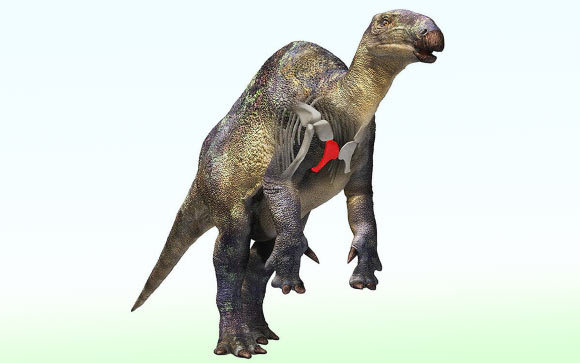
Comptonatus is an iguanodontid ornithopod dinosaur that lived about 125 million years ago, in the Early Cretaceous of what is now Europe. It was a medium sized herbivore at about 7 m in length, and weighed around 1 t in body mass. Fossilized footprints found near the original specimen indicate that Comptonatus was likely a herding animal. Comparisons between Comptonatus and other iguanodontids that lived around the same time and region show a high rate of diversity. This indicates there may have been pressure for speedy evolutionary adaptation in the region, or perhaps a high volume of migration.
Taxons Comptonatus

Comptonatus is an iguanodontid ornithopod dinosaur that lived about 125 million years ago, in the Early Cretaceous of what is now Europe. It was a medium sized herbivore at about 7 m in length, and weighed around 1 t in body mass. Fossilized footprints found near the original specimen indicate that Comptonatus was likely a herding animal. Comparisons between Comptonatus and other iguanodontids that lived around the same time and region show a high rate of diversity. This indicates there may have been pressure for speedy evolutionary adaptation in the region, or perhaps a high volume of migration.

migration Crétacé Crétacé inférieur spécimen +3
Ancient landscape across the Cretaceous/Paleogene time interval in central Patagonia. Main floristic types from the Danian: Podocarps, Cheirolepidiaceae, palms.
doi:10.1371/journal.pone.0052455.g007

Ancient landscape across the Cretaceous/Paleogene time interval in central Patagonia. Main floristic types from the Danian: Podocarps, Cheirolepidiaceae, palms. doi:10.1371/journal.pone.0052455.g007

Crétacé Danien Paléogène
Iron trapped in Cretaceous limestone, forming tables

Iron trapped in Cretaceous limestone, forming tables

Crétacé
Limestone cliff with the stratigraphic stage of Cretaceous Coniacian near the eponym town of Cognac, Charente, Poitou-Charentes, France.

Limestone cliff with the stratigraphic stage of Cretaceous Coniacian near the eponym town of Cognac, Charente, Poitou-Charentes, France.

France Coniacien Crétacé
crétacé limestone at Cognac, Charente, SW France

crétacé limestone at Cognac, Charente, SW France

France Crétacé
Cretaceous limestone at Cognac, Charente, SW France

Cretaceous limestone at Cognac, Charente, SW France

France Crétacé
Ivy and limestone cliff of Cretaceous Coniacian, Cognac, Charente, France.

Ivy and limestone cliff of Cretaceous Coniacian, Cognac, Charente, France.

France Coniacien Crétacé
Limestone Cretaceous cornices (Coniacian type), valley of the river Voultron; Blanzaguet-Saint-Cybard, Charente, France.

Limestone Cretaceous cornices (Coniacian type), valley of the river Voultron; Blanzaguet-Saint-Cybard, Charente, France.

France Coniacien Crétacé
1 2 3 4 5 6 7 8 9 10 11 12

Actualités

Modèle CollectA Deluxe Edmontosaurus se nourrissant de certains conifères
alimentation Crétacé Crétacé supérieur Dinosauria Edmontosaurus Hadrosauria
Merci Caldey de nous avoir envoyé une photo de votre CollectA Deluxe Edmontosaurus se nourrissant dans le jardin.  Le dinosaure a l’air très à l’aise en grignotant certains conifères.  Les paléontologues savent, grâce au contenu de l'estomac des hadrosaures, que ces herbivores du Crétacé supérieur se nourrissaient de conifères.  C'est une photographie délicieusement composée.  L'angle de vision donne l'impression
23/06/2026 everythingdinosaur ⚙ Traduction automatique
125-Million-Year-Old Crocodile Relative Reveals Its True Colors
Un parent de crocodile âgé de 125 millions d'années révèle ses vraies couleurs
écaille peau Espagne Crétacé Crétacé inférieur autres reptiles
La peau exceptionnellement préservée de Montsecosuchus depereti, un crocodylomorphe éteint pas plus gros qu'un chat domestique qui rôdait dans les zones humides tropicales de l'Espagne du Crétacé inférieur, a permis aux paléontologues de reconstituer les détails de ses écailles, de ses organes sensoriels et même d'éventuelles marques en bandes le long de sa queue. L'article Un parent de crocodile âgé de 125 millions d'années révèle ses vraies couleurs est apparu en premier sur Sci.News : Breaking Science News.
18/06/2026 sci-news ⚙ Traduction automatique
Sauroposeidon: Beast of the Week
Sauroposeidon : Bête de la semaine
États-Unis Crétacé Crétacé inférieur Dinosauria Sauroposeidon
 Cette semaine, nous allons découvrir un énorme dinosaure au nom tout aussi impressionnant.  Entrez Sauroposeidon proteles !Sauroposeidon était un dinosaure sauropode (à long cou) qui vivait dans ce qui est aujourd'hui l'Oklahoma, le Texas et le Wyoming, aux États-Unis, au début du Crétacé, il y a environ 113 millions d'années.  Son nom de genre se traduit par « Dieu des tremblements de terre lézard » en hommage au dieu grec Poséidon, qui, en plus de son association la plus célèbre avec l'océan, était également le dieu des tremblements de terre dans la mythologie grecque. Puisque non
14/06/2026 prehistoricbeastoftheweek ⚙ Traduction automatique
Description d'un fossile de dinosaure rare du groupe de Nanaimo du Crétacé supérieur
os vertèbre description Canada Colombie Crétacé Crétacé supérieur fossile Dinosauria Ornithomimosauria
Les chercheurs ont décrit une seule vertèbre caudale de dinosaure (coccyx) de l'île Denman (Colombie-Britannique, Canada).  Il a été identifié comme une vertèbre caudale d'ornithomimosaure. Le fossile, censé représenter un os de la partie médiane de la queue, n'est que le deuxième fossile de dinosaure identifié dans le groupe de Nanaimo du Crétacé supérieur. De plus, il
10/06/2026 everythingdinosaur ⚙ Traduction automatique
Description d'un nouveau dinosaure à quatre ailes en provenance de Chine
plume membre description Chine Crétacé Crétacé inférieur fossile Dinosauria Microraptorinae nouvelle espèce partiel
Les paléontologues ont décrit une nouvelle espèce de théropode microraptorine du nord-ouest de la Chine. Nommé Jian changmaensis, ce petit dinosaure à plumes planait probablement sur quatre ailes. Le fossile fournit de nouvelles informations sur les écosystèmes du Crétacé inférieur et étend l’aire de répartition connue des Microraptorinae. Le matériau fossile est constitué d'une ceinture pectorale gauche partielle articulée et d'un membre antérieur. Il
08/06/2026 everythingdinosaur ⚙ Traduction automatique
1 2 3 4 5 6 7 8 9 10