Crétacé

Intervalle géologique

121 image(s) · 29 Actualités

Voir la fiche

Galerie d'images

Stratigraphy of the Upper Cretaceous Neuquén Group (after Garrido) indicating stratigraphic positions of definitive unenlagiine taxa (modified from Gianechini and Gianechini & Apesteguía). Skeletal reconstructions to approximate scale, redrawn and/or modified from works by Scott Hartman (Buitreraptor gonzalezorum, Austroraptor cabazai), Gabriel Lio (Unenlagia comahuensis, Neuquenraptor argentinus, Unenlagia paynemili), and Jaime Headden (Pamparaptor micros, Diuqin lechiguanae), used with permission
Taxons Unenlagiinae

Stratigraphy of the Upper Cretaceous Neuquén Group (after Garrido) indicating stratigraphic positions of definitive unenlagiine taxa (modified from Gianechini and Gianechini & Apesteguía). Skeletal reconstructions to approximate scale, redrawn and/or modified from works by Scott Hartman (Buitreraptor gonzalezorum, Austroraptor cabazai), Gabriel Lio (Unenlagia comahuensis, Neuquenraptor argentinus, Unenlagia paynemili), and Jaime Headden (Pamparaptor micros, Diuqin lechiguanae), used with permission

écaille Crétacé Austroraptor Buitreraptor +6
Leptocleidus capensis, a plesiosaur from the Early Cretaceous of South Africa, pencil drawing, digital coloring
Taxons Leptocleididae

Leptocleidus capensis, a plesiosaur from the Early Cretaceous of South Africa, pencil drawing, digital coloring

dessin Afrique du Sud Crétacé Crétacé inférieur +4
Amargasaurus lived in the  Cretaceous Period, about 100 million years ago.Photo taken in Museum of Victoria (Melbourne, Victoria, Australia)
Taxons Dicraeosauridae

Amargasaurus lived in the Cretaceous Period, about 100 million years ago.Photo taken in Museum of Victoria (Melbourne, Victoria, Australia)

musée Australie Crétacé Amargasaurus +2
Amargasaurus lived in the  Cretaceous Period, about 100 million years ago.Photo taken in Museum of Victoria (Melbourne, Victoria, Australia)
Taxons Dicraeosaurinae

Amargasaurus lived in the Cretaceous Period, about 100 million years ago.Photo taken in Museum of Victoria (Melbourne, Victoria, Australia)

musée Australie Crétacé Amargasaurus +2
The saltasaurine sauropod Neuquensaurus australis, from the Anacleto Formation (Upper Cretaceous), Patagonia, Argentina. Restoration of the skeleton mounted at the Museo de La Plata, Argentina.
Taxons Saltasauroidea

The saltasaurine sauropod Neuquensaurus australis, from the Anacleto Formation (Upper Cretaceous), Patagonia, Argentina. Restoration of the skeleton mounted at the Museo de La Plata, Argentina.

Argentine Anacleto Crétacé Lohuecosauria +4
The saltasaurine sauropod Neuquensaurus australis, from the Anacleto Formation (Upper Cretaceous), Patagonia, Argentina. Restoration of the skeleton mounted at the Museo de La Plata, Argentina.
Taxons Lohuecosauria

The saltasaurine sauropod Neuquensaurus australis, from the Anacleto Formation (Upper Cretaceous), Patagonia, Argentina. Restoration of the skeleton mounted at the Museo de La Plata, Argentina.

Argentine Anacleto Crétacé Lohuecosauria +4
Chasmosaurus belli ROM 843, Royal Tyrrell Museum of Paleontology. Late Cretaceous 75-74.5 millions years ago. Found at Dinosaur Provincial Park, Alberta, and prepared at the Royal Tyrrell Museum of Paleontology, Drumheller, Alberta.
Taxons Chasmosaurinae

Chasmosaurus belli ROM 843, Royal Tyrrell Museum of Paleontology. Late Cretaceous 75-74.5 millions years ago. Found at Dinosaur Provincial Park, Alberta, and prepared at the Royal Tyrrell Museum of Paleontology, Drumheller, Alberta.

musée Canada Crétacé Crétacé supérieur +5
Chasmosaurus belli ROM 843, Royal Tyrrell Museum of Paleontology. Late Cretaceous 75-74.5 millions years ago. Found at Dinosaur Provincial Park, Alberta, and prepared at the Royal Tyrrell Museum of Paleontology, Drumheller, Alberta.
Taxons Triceratopsini

Chasmosaurus belli ROM 843, Royal Tyrrell Museum of Paleontology. Late Cretaceous 75-74.5 millions years ago. Found at Dinosaur Provincial Park, Alberta, and prepared at the Royal Tyrrell Museum of Paleontology, Drumheller, Alberta.

musée Canada Crétacé Crétacé supérieur +5
Holotype of the polycotylid[1] plesiosaur Edgarosaurus muddi DRUCKENMILLER, 2002, (MOR 751) comprising the skull, the neck, and the left front flipper, on display in the Museum of the Rockies in Bozeman, Montana. The specimen was collected in Edgar, Carbon County, Montana, from the Shell Creek member of the Thermopolis Shale Formation, Upper Albian, uppermost Lower Cretaceous.[2]
Taxons Edgarosaurus

Holotype of the polycotylid[1] plesiosaur Edgarosaurus muddi DRUCKENMILLER, 2002, (MOR 751) comprising the skull, the neck, and the left front flipper, on display in the Museum of the Rockies in Bozeman, Montana. The specimen was collected in Edgar, Carbon County, Montana, from the Shell Creek member of the Thermopolis Shale Formation, Upper Albian, uppermost Lower Cretaceous.[2]

musée États-Unis Albien Crétacé +7
A more complete specimen of Wapuskanectes betsynichollsae. TMP2012.50.1.

(A) Dorsal view of the originally upside down remains recovered from north of the town of Fort McMurray, Alberta. The head and most of the neck were lost when intercepted by a grader during road construction. The right flipper was lost sometime in the Early Cretaceous prior to the final burial of the body. (B) The pelvic and abdominal regions of TMP2012.50.1 showing gastroliths (black arrows) within the body cavity that settled between the ribs of the inverted carcass and hint at a more substantial collection that is hidden inside the body cavity. Scale bars on body regions are 10 cm. Source credit: Sue Sabrowski, Royal Tyrrell Museum of Palaeontology.
Taxons Wapuskanectes

A more complete specimen of Wapuskanectes betsynichollsae. TMP2012.50.1. (A) Dorsal view of the originally upside down remains recovered from north of the town of Fort McMurray, Alberta. The head and most of the neck were lost when intercepted by a grader during road construction. The right flipper was lost sometime in the Early Cretaceous prior to the final burial of the body. (B) The pelvic and abdominal regions of TMP2012.50.1 showing gastroliths (black arrows) within the body cavity that settled between the ribs of the inverted carcass and hint at a more substantial collection that is hidden inside the body cavity. Scale bars on body regions are 10 cm. Source credit: Sue Sabrowski, Royal Tyrrell Museum of Palaeontology.

écaille musée Crétacé Crétacé inférieur +2
Jeholopterus ningchengensus Wang, Zhou, Zhang, and Xu, 2002, IVPP V 12705, Lower Yixian Formation (Early Cretaceous), China.
Taxons Jeholopterus

Jeholopterus ningchengensus Wang, Zhou, Zhang, and Xu, 2002, IVPP V 12705, Lower Yixian Formation (Early Cretaceous), China.

Chine Yixian Crétacé Crétacé inférieur +2
New wing skeleton of Forfexopterus (SDUST-V1003) from Jiufotang Formation of Early Cretaceous Jehol Biota in Jianchang, western Liaoning, northeastern China. Abbreviations: ca, carpus; co, coracoid portion; hu, humerus; mc, metacarpals I–IV; mdI–III, manual digits I–III; pt, pteroid; ra, radius; sc, scapular portion; ul, ulna; wp1–4, wing phalanges 1–4.
Taxons Forfexopterus

New wing skeleton of Forfexopterus (SDUST-V1003) from Jiufotang Formation of Early Cretaceous Jehol Biota in Jianchang, western Liaoning, northeastern China. Abbreviations: ca, carpus; co, coracoid portion; hu, humerus; mc, metacarpals I–IV; mdI–III, manual digits I–III; pt, pteroid; ra, radius; sc, scapular portion; ul, ulna; wp1–4, wing phalanges 1–4.

humérus Chine Jiufotang Crétacé +4
Ningchengopterus liuae, early Cretaceous of China. digital.
Taxons Ningchengopterus

Ningchengopterus liuae, early Cretaceous of China. digital.

Chine Crétacé Crétacé inférieur Ningchengopterus +1
Bakonydraco galaczi gen. et sp. nov.MTMGyn/3, Iharkút, Bakony Mts., Hungary, Csehbánya Formation, Santonian (Upper Cretaceous). Mandible

in dorsal (A, B), ventral (C, D), and lateral (E, F) views.
Taxons Bakonydraco

Bakonydraco galaczi gen. et sp. nov.MTMGyn/3, Iharkút, Bakony Mts., Hungary, Csehbánya Formation, Santonian (Upper Cretaceous). Mandible in dorsal (A, B), ventral (C, D), and lateral (E, F) views.

Hongrie Crétacé Santonien Bakonydraco +1
Aralazhdarcho bostobensis, ZIN PH 57/43, a proximal fragment of a left humerus in proximal (a), ventral (b), anterior (c), dorsal (d), and posterior (e) views. This specimen is from the Shakh Shakh II locality in the northeasten Aral Sea region of Kazakhstan; Bostobe Formation, Upper Cretaceous (Santonian – lower Campanian). Abbreviations: h, humeral head; pf, pneumatic foramen; uc, ulnar crest. Scale bar is 10 mm.
Taxons Aralazhdarcho

Aralazhdarcho bostobensis, ZIN PH 57/43, a proximal fragment of a left humerus in proximal (a), ventral (b), anterior (c), dorsal (d), and posterior (e) views. This specimen is from the Shakh Shakh II locality in the northeasten Aral Sea region of Kazakhstan; Bostobe Formation, Upper Cretaceous (Santonian – lower Campanian). Abbreviations: h, humeral head; pf, pneumatic foramen; uc, ulnar crest. Scale bar is 10 mm.

crête humérus écaille Kazakhstan +7
Azhdarchoid pterosaur Kariridraco dianae gen. et sp. nov. holotype (MPSC R 1056) from Lower Cretaceous of Northeastern Brazil. Skull in right lateral view. Photograph (A1), interpretative drawing (A2). Dark grey areas indicate remains of the carbonate matrix still attachaed to the skull.
Taxons Kariridraco

Azhdarchoid pterosaur Kariridraco dianae gen. et sp. nov. holotype (MPSC R 1056) from Lower Cretaceous of Northeastern Brazil. Skull in right lateral view. Photograph (A1), interpretative drawing (A2). Dark grey areas indicate remains of the carbonate matrix still attachaed to the skull.

dessin Brésil Crétacé holotype +3
1 2 3 4 5 6 7 8

Actualités

Gongshuilong: Beast of the Week
Gongshuilong : Bête de la semaine
os Chine Crétacé Crétacé supérieur Gongshuilong Hadrosauria
 Aujourd'hui, nous examinons un hadrosaure récemment décrit avec un look unique, Gongshuilong fanwei ! Gongshuilong vivait dans ce qui est aujourd'hui l'est de la Chine, à la fin du Crétacé, il y a entre 68 et 66 millions d'années.  Du bec à la queue, il mesurait environ 7 m de long et aurait été un herbivore de son vivant.  Le nom du genre se traduit du mandarin par "Dragon de la rivière Gong" en référence à la rivière Gong près de l'endroit où ses os ont été découverts. Reconstruction de la vie de Gongshuilong à l'aquarelle b
10/05/2026 prehistoricbeastoftheweek ⚙ Traduction automatique
Mexidracon: Beast of the Week
Mexidracon : Bête de la semaine
Mexique Crétacé Crétacé supérieur Dinosauria
 Cette semaine, nous allons nous intéresser à un théropode inhabituel.  Découvrez Mexidracon longimanus !Mexidracon était un dinosaure théropode qui vivait dans ce qui est aujourd'hui Coahuila, au Mexique, à la fin du Crétacé, il y a environ 72 millions d'années.  Du bec à la queue, il mesurait environ 3 mètres de long.  Son nom de genre se traduit par « Dragon mexicain » et son nom d'espèce par « longue main ».  Il se peut qu'il ait mangé des plantes de son vivant ou qu'il ait peut-être mangé un mélange de plantes et de viande.  Reconstruction de la vie du Mexidracon dans
03/05/2026 prehistoricbeastoftheweek ⚙ Traduction automatique
In Cretaceous Oceans, Giant ‘Kraken-Like’ Octopuses May Have Been Top Predators
Dans les océans du Crétacé, les poulpes géants « ressemblant à un Kraken » pourraient avoir été les principaux prédateurs
prédateur Crétacé
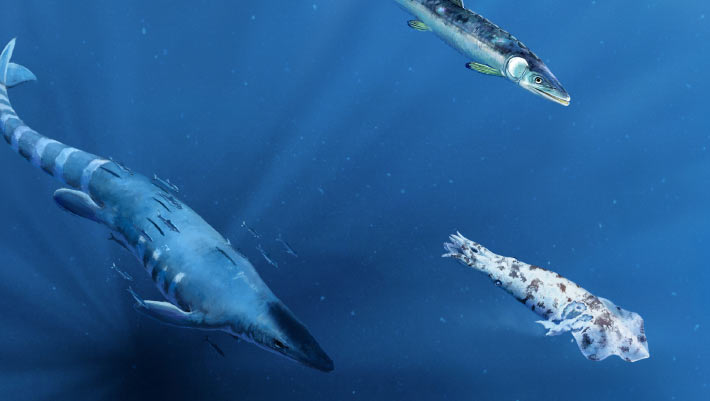
D'énormes céphalopodes au corps mou, mesurant jusqu'à 19 m de long, rivalisaient - et peut-être chassaient - avec les reptiles les plus féroces de l'océan au Crétacé, selon une nouvelle recherche menée par des paléontologues de l'Université d'Hokkaido. L'article Dans les océans du Crétacé, les poulpes géants « ressemblant à un Kraken » pourraient avoir été les principaux prédateurs est apparu en premier sur Sci.News : Breaking Science News.
27/04/2026 sci-news ⚙ Traduction automatique
Peloroplites: Beast of the Week
Péloroplites : la bête de la semaine
États-Unis Cedar Mountain Lance Crétacé Dinosauria Peloroplites
 Cette semaine, nous allons découvrir un grand dinosaure tank.  Entrez Peloroplites cedrimontanus ! Le Peloroplites était un dinosaure herbivore qui vivait dans ce qui est aujourd'hui l'Utah, aux États-Unis, pendant la période du Crétacé, il y a entre 98 et 93 millions d'années.  Du museau à la queue, il mesurait environ 6 m de long.  Son nom de genre se traduit par « Hoplite géant » en référence aux hoplites, les anciens soldats grecs qui portaient des lances et de grands boucliers.  Le nom de l'espèce se traduit par « Cedar Mountain ».
19/04/2026 prehistoricbeastoftheweek ⚙ Traduction automatique
Diamantinasaurus: Beast of the Week
Diamantinasaurus : Bête de la semaine
Australie Crétacé Diamantinasauria Dinosauria
Cette semaine, nous allons découvrir une bête qui nous aide grandement à comprendre à quoi ressemblaient et vivaient les dinosaures sauropodes (« à long cou »).  Découvrez Diamantinasaurus matildae ! Le Diamantinasaurus vivait dans ce qui est aujourd'hui le Queensland, en Australie, au cours du Crétacé moyen, il y a entre 95 et 92 millions d'années.  Il est considéré comme de taille moyenne pour un sauropode et aurait mesuré environ 16 m de long du museau à la queue. (Oui. 52 pieds n'est qu'une taille moyenne pour les sauropodes !) Comme tous les sauropodes, il aurait mangé
12/04/2026 prehistoricbeastoftheweek ⚙ Traduction automatique
1 2 3 4 5 6