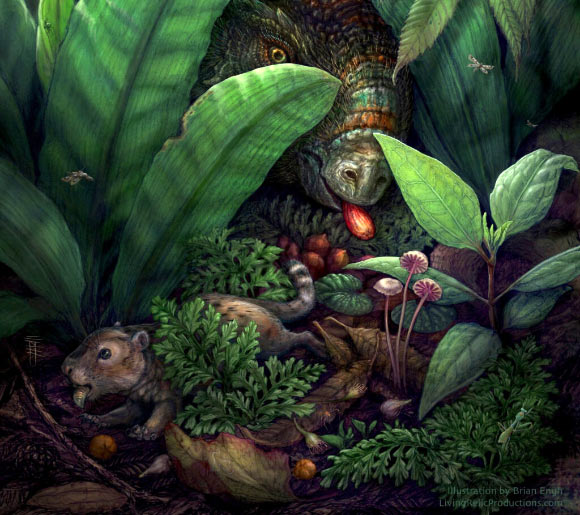
Crétacé

Intervalle géologique

185 image(s) · 46 Actualités

Voir la fiche

Galerie d'images

Comparison of cranial features between closely related southern Laramidian taxa; (A), Akainacephalus johnsoni (UMNH VP 20202) from the Late Cretaceous Kaiparowits Formation of Utah; and (B), Nodocephalosaurus kirtlandensis (SMP VP-900) from the Late Cretaceous Kirtland Formation of New Mexico, in left lateral views. Various synapomorphies are shared with N. kirtlandensis (highlighted in black and white arrows) and includes “flaring nostrils”; enlarged, laterally projecting, loreal osteoderms that are situated directly dorsal to the external nares. Other synapomorphies include pyramid-shaped nasal and frontal osteoderms positioned on the dorsal regions of the skull. A number of significant differences have been observed between both specimens; in A. johnsoni, the anterior, and posterior supraorbital bosses form an enlarged element that is somewhat backswept, whereas in N. kirtlandensis, the posterior and anterior supraorbital bosses are clearly defined as individual osteoderms, and are much smaller in size. Additionally, the squamosal horn in Akainacephalus is very small but is prominent and tetrahedrally shaped in Nodocephalosaurus. The quadratojugal horn in Akainacephalus is massive, has a subtriangular morphology in lateral view and projects almost entirely ventral, whereas in Nodocephalosaurus, the quadratojugal horn is smaller and has a typical fin-shaped morphology. Study sites: asob, anterior supraorbital boss; ext naris, external naris; laca, lacrimal caputegulum; loca, loreal caputegulum; naca, nasal caputegulae; orb, orbit; psob, posterior supraorbital boss; qjh, quadratojugal horn; sqh, squamosal horn.
Taxons Nodocephalosaurus

Comparison of cranial features between closely related southern Laramidian taxa; (A), Akainacephalus johnsoni (UMNH VP 20202) from the Late Cretaceous Kaiparowits Formation of Utah; and (B), Nodocephalosaurus kirtlandensis (SMP VP-900) from the Late Cretaceous Kirtland Formation of New Mexico, in left lateral views. Various synapomorphies are shared with N. kirtlandensis (highlighted in black and white arrows) and includes “flaring nostrils”; enlarged, laterally projecting, loreal osteoderms that are situated directly dorsal to the external nares. Other synapomorphies include pyramid-shaped nasal and frontal osteoderms positioned on the dorsal regions of the skull. A number of significant differences have been observed between both specimens; in A. johnsoni, the anterior, and posterior supraorbital bosses form an enlarged element that is somewhat backswept, whereas in N. kirtlandensis, the posterior and anterior supraorbital bosses are clearly defined as individual osteoderms, and are much smaller in size. Additionally, the squamosal horn in Akainacephalus is very small but is prominent and tetrahedrally shaped in Nodocephalosaurus. The quadratojugal horn in Akainacephalus is massive, has a subtriangular morphology in lateral view and projects almost entirely ventral, whereas in Nodocephalosaurus, the quadratojugal horn is smaller and has a typical fin-shaped morphology. Study sites: asob, anterior supraorbital boss; ext naris, external naris; laca, lacrimal caputegulum; loca, loreal caputegulum; naca, nasal caputegulae; orb, orbit; psob, posterior supraorbital boss; qjh, quadratojugal horn; sqh, squamosal horn.

Mexique Kaiparowits Kirtland Crétacé +7
Digital illustration of the Sauropod Dinosaur Isisaurus colberti from the Late Cretaceous (Maastrichtian) of India (72.2-66 MYA). References include Jain & Bandyopadhyay (1997), several papers from Wilson et al. and skeletal reconstruction by Scott Hartman.
Illustrated by Ansh Saxena.
About Isisaurus–

Isisaurus colberti (=Titanosaurus colberti) was a species of Titanosaurian Sauropod Dinosaur from the Late Cretaceous (Maastrichtian) age in the Indian Subcontinent. Isisaurus lived sympatrically with another Titanosaurian Sauropod Jainosaurus. It also lived alongside Theropods like Rajasaurus, Rahiolisaurus, Indosuchus etc. Remains of Isisaurus come from the Lameta formation of Central India.
Taxons Isisaurus

Digital illustration of the Sauropod Dinosaur Isisaurus colberti from the Late Cretaceous (Maastrichtian) of India (72.2-66 MYA). References include Jain & Bandyopadhyay (1997), several papers from Wilson et al. and skeletal reconstruction by Scott Hartman. Illustrated by Ansh Saxena. About Isisaurus– Isisaurus colberti (=Titanosaurus colberti) was a species of Titanosaurian Sauropod Dinosaur from the Late Cretaceous (Maastrichtian) age in the Indian Subcontinent. Isisaurus lived sympatrically with another Titanosaurian Sauropod Jainosaurus. It also lived alongside Theropods like Rajasaurus, Rahiolisaurus, Indosuchus etc. Remains of Isisaurus come from the Lameta formation of Central India.

Inde Lameta Crétacé Crétacé supérieur +9
Eonatator sternbergi, a mosasaur from the Late Cretaceous of Kansas. Digital.
Taxons Eonatator

Eonatator sternbergi, a mosasaur from the Late Cretaceous of Kansas. Digital.

Crétacé Crétacé supérieur Eonatator Spinops
Phylogenetic relationships, chronostratigraphic, and paleoecological implications of M. intrepidus. a Graphic illustrating temporal range of North American tyrannosauroids including species-level range prior to the discovery of M. intrepidus, extension of current range, and hypothesized range based on isolated teeth12. The current gap in the North American tyrannosauroid record spans from the Tithonian to the Aptian. Faunal composition of Late Cretaceous ecosystems was established between the Albian and Turonian, as recognized by the stratigraphic appearance of major clades (see refs. 7,12 and references therein). b generalized phylogenetic relationships of Tyrannosauroidea, showing the appearance of select traits related to cursoriality in tyrannosaurs that are newly optimized as a result of the discovery of M. intrepidus. Tree topology follows this study using the modified dataset of Carr and colleagues27. Coelurus and Tanycolagreus are grafted as basal tyrannosauroids following Brusatte and colleagues5. c Stratigraphic distribution of Allosauria in North America (incl. Megaraptora but see ref. 70 for alternative hypotheses regarding this clade) documents overlap with M. intrepidus in early Late Cretaceous ecosystems leading to (d) refined calibration on the origin of late diverging tyrannosauroids and clade-level faunal turnover within apex predator roles throughout the Late Jurassic–Late Cretaceous of North America. Colored polygons are stylized call-outs and are not intended to reflect two-dimensional data. Temporal data corresponding to this figure are available in Supplementary Table 5
Taxons Coelurus

Phylogenetic relationships, chronostratigraphic, and paleoecological implications of M. intrepidus. a Graphic illustrating temporal range of North American tyrannosauroids including species-level range prior to the discovery of M. intrepidus, extension of current range, and hypothesized range based on isolated teeth12. The current gap in the North American tyrannosauroid record spans from the Tithonian to the Aptian. Faunal composition of Late Cretaceous ecosystems was established between the Albian and Turonian, as recognized by the stratigraphic appearance of major clades (see refs. 7,12 and references therein). b generalized phylogenetic relationships of Tyrannosauroidea, showing the appearance of select traits related to cursoriality in tyrannosaurs that are newly optimized as a result of the discovery of M. intrepidus. Tree topology follows this study using the modified dataset of Carr and colleagues27. Coelurus and Tanycolagreus are grafted as basal tyrannosauroids following Brusatte and colleagues5. c Stratigraphic distribution of Allosauria in North America (incl. Megaraptora but see ref. 70 for alternative hypotheses regarding this clade) documents overlap with M. intrepidus in early Late Cretaceous ecosystems leading to (d) refined calibration on the origin of late diverging tyrannosauroids and clade-level faunal turnover within apex predator roles throughout the Late Jurassic–Late Cretaceous of North America. Colored polygons are stylized call-outs and are not intended to reflect two-dimensional data. Temporal data corresponding to this figure are available in Supplementary Table 5

prédateur Albien Aptien Crétacé +12
A photograph of partial specimen American Museum of Natural History (AMNH) 22555, posterior dorsal vertebrae, and the sacrum and pelvis (both iliae, and right ischium and pubis) of Anhanguera sp. (formerly often assigned to Anhanguera santanae),[1] from the Early Cretaceous Romualdo Formation (former Romualdo Member of the Santana Formation) of NE Brazil in dorsal view.
Taxons Anhanguera

A photograph of partial specimen American Museum of Natural History (AMNH) 22555, posterior dorsal vertebrae, and the sacrum and pelvis (both iliae, and right ischium and pubis) of Anhanguera sp. (formerly often assigned to Anhanguera santanae),[1] from the Early Cretaceous Romualdo Formation (former Romualdo Member of the Santana Formation) of NE Brazil in dorsal view.

bassin musée Brésil Conway +7
Clidastes propython, a mosasaur from the Late Cretaceous of Kansas, digital.
Taxons Clidastes

Clidastes propython, a mosasaur from the Late Cretaceous of Kansas, digital.

Crétacé Crétacé supérieur Clidastes Spinops
Reconstruction of Agustinia ligabuei from the Early Cretaceous of Argentina as a rebbachisaurid following Bellardini et al. 2022

Reconstruction of Agustinia ligabuei from the Early Cretaceous of Argentina as a rebbachisaurid following Bellardini et al. 2022

Argentine Crétacé Crétacé inférieur Agustinia +2
Agustinia ligabuei, a sauropod from the Early Cretaceous of Argentina. Digital.

Agustinia ligabuei, a sauropod from the Early Cretaceous of Argentina. Digital.

Argentine Crétacé Crétacé inférieur Agustinia +2
Pliosaurus (Luskhan itilensis) lived on the territory of the Volga region in the Hauterivian age of the Early Cretaceous period. Discovered in 2002 by G.N. Uspensky on the banks of the Volga near the village of Slantsevy Rudnik. This is the most complete pliosaurus skeleton found in Russia. This pliosaurus was not a predator and preferred to feed on fish and cephalopods.

Pliosaurus (Luskhan itilensis) lived on the territory of the Volga region in the Hauterivian age of the Early Cretaceous period. Discovered in 2002 by G.N. Uspensky on the banks of the Volga near the village of Slantsevy Rudnik. This is the most complete pliosaurus skeleton found in Russia. This pliosaurus was not a predator and preferred to feed on fish and cephalopods.

prédateur Russie Crétacé Crétacé inférieur +5
Reconstruction of brachauchenin pliosaurid Luskhan itilensis. Early Cretaceous of Ulyanovsk region. 2017.

Reconstruction of brachauchenin pliosaurid Luskhan itilensis. Early Cretaceous of Ulyanovsk region. 2017.

Crétacé Crétacé inférieur Brachaucheninae Luskhan +1
Reconstruction of Bissektipelta archibaldi an ankylosaurid dinosaur from the Late Cretaceous of Uzbekistan
Taxons Bissektipelta

Reconstruction of Bissektipelta archibaldi an ankylosaurid dinosaur from the Late Cretaceous of Uzbekistan

Ouzbékistan Crétacé Crétacé supérieur Ankylosauridae +2
Calvarius is a genus of styracosternan ornithopod from the Late Cretaceous of Spain. The name alludes to its chronostratigraphic proximity to the extinction event that wiped out the non-avian dinosaurs at the end of the Cretaceous. The highly modified metatarsal that is known from shows an example of convergent evolution, as it is more similar to non-iguanodontian ornithopods than to other styracosternans. It is thought that this is due to fulfilling a niche in its island habitat, resulting in Calvarius becoming a small-bodied animal, capable of rapid locomotion.
Taxons Calvarius

Calvarius is a genus of styracosternan ornithopod from the Late Cretaceous of Spain. The name alludes to its chronostratigraphic proximity to the extinction event that wiped out the non-avian dinosaurs at the end of the Cretaceous. The highly modified metatarsal that is known from shows an example of convergent evolution, as it is more similar to non-iguanodontian ornithopods than to other styracosternans. It is thought that this is due to fulfilling a niche in its island habitat, resulting in Calvarius becoming a small-bodied animal, capable of rapid locomotion.

locomotion Espagne Crétacé Crétacé supérieur +6
Astigmasaura is a medium-sized rebbachisaurid sauropod dinosaur from the Late Cretaceous period of what is now Argentina. Rebbachisaurids had highly pneumatized bones that helped them to hold their weight on their four pillar-like legs, and extremely long tails. Astigmasaura was likely a ground-level browsing herbivore.
Taxons Astigmasaura

Astigmasaura is a medium-sized rebbachisaurid sauropod dinosaur from the Late Cretaceous period of what is now Argentina. Rebbachisaurids had highly pneumatized bones that helped them to hold their weight on their four pillar-like legs, and extremely long tails. Astigmasaura was likely a ground-level browsing herbivore.

os Argentine Crétacé Crétacé supérieur +3
Rebbachisaurids are the latest known sauropod dinosaurs outside the titanosaur lineage. Cienciargentina is a rebbachisaurid from the Late Cretaceous, making it among the most recent. It had many hollow bones, and likely had batteries of teeth used for chewing, a rebbachisaurid feature unique among sauropods.
Taxons Cienciargentina

Rebbachisaurids are the latest known sauropod dinosaurs outside the titanosaur lineage. Cienciargentina is a rebbachisaurid from the Late Cretaceous, making it among the most recent. It had many hollow bones, and likely had batteries of teeth used for chewing, a rebbachisaurid feature unique among sauropods.

os Crétacé Crétacé supérieur Cienciargentina +3
Campananeyen is a rebbachisaurid sauropod that lived approximately 100 million years ago in the Late Cretaceous of what is now Argentina. Rebbachisaurids are the main group of diplodocoidea to have lived past the Jurassic, and had a more horizontal posture than contemporary sauropods, mainly the titanosaurs. They are unique among sauropods for having batteries of teeth used for chewing, rather than the typical peglike teeth sauropods used to strip leaves off branches.
Taxons Campananeyen

Campananeyen is a rebbachisaurid sauropod that lived approximately 100 million years ago in the Late Cretaceous of what is now Argentina. Rebbachisaurids are the main group of diplodocoidea to have lived past the Jurassic, and had a more horizontal posture than contemporary sauropods, mainly the titanosaurs. They are unique among sauropods for having batteries of teeth used for chewing, rather than the typical peglike teeth sauropods used to strip leaves off branches.

Argentine Crétacé Jurassique Crétacé supérieur +4
Samrukia nesovi was originally described as a giant bird, but is now considered a pterodactyloid pterosaur of uncertain placement and validity. 

References: 
Naish, D., Dyke, G., Cau, A., Escuillié, F., & Godefroit, P. (2011). A gigantic bird from the Upper Cretaceous of Central Asia. Biology Letters, 8(1), 97–100. doi:10.1098/rsbl.2011.0683

Buffetaut, E. (2011). Samrukia nessovi, from the Late Cretaceous of Kazakhstan: A large pterosaur, not a giant bird. Annales de Paléontologie, 97(3–4), 133–138. doi:10.1016/j.annpal.2011.10.001
Taxons Samrukia

Samrukia nesovi was originally described as a giant bird, but is now considered a pterodactyloid pterosaur of uncertain placement and validity. References: Naish, D., Dyke, G., Cau, A., Escuillié, F., & Godefroit, P. (2011). A gigantic bird from the Upper Cretaceous of Central Asia. Biology Letters, 8(1), 97–100. doi:10.1098/rsbl.2011.0683 Buffetaut, E. (2011). Samrukia nessovi, from the Late Cretaceous of Kazakhstan: A large pterosaur, not a giant bird. Annales de Paléontologie, 97(3–4), 133–138. doi:10.1016/j.annpal.2011.10.001

Kazakhstan Crétacé Crétacé supérieur Pterosauria +2
1 2 3 4 5 6 7 8 9 10 11 12

Actualités

New Dinosaur Species from Argentina May Have Specialized in Catching Fish
De nouvelles espèces de dinosaures d'Argentine pourraient s'être spécialisées dans la capture de poissons
Argentine Crétacé Crétacé supérieur Dinosauria Kank Unenlagiidae
Des paléontologues argentins ont identifié une espèce jusqu'alors inconnue de dinosaures unenlagiidés qui parcouraient les zones humides d'eau douce à la fin du Crétacé, ajoutant ainsi la preuve que certains dinosaures se spécialisaient dans la capture de poissons. L'article De nouvelles espèces de dinosaures d'Argentine pourraient s'être spécialisées dans la capture de poissons est apparu en premier sur Sci.News : Breaking Science News.
29/05/2026 sci-news ⚙ Traduction automatique
Fungi Bloomed Twice around End-Cretaceous Mass Extinction
Les champignons ont fleuri deux fois autour de l'extinction massive de la fin du Crétacé
bassin Denver Crétacé Dinosauria extinction
En étudiant les microfossiles fongiques dans des échantillons de roches vieilles de 66 millions d'années du bassin de Denver, au Colorado, les microbiologistes de l'Université Johns Hopkins ont confirmé que l'impact de l'astéroïde tueur de dinosaures a déclenché une invasion fongique mondiale et a découvert une deuxième crise écologique, jusqu'alors inconnue, juste avant elle. L'article Les champignons ont fleuri deux fois autour de l'extinction massive de la fin du Crétacé est apparu en premier sur Sci.News : Breaking Science News.
28/05/2026 sci-news ⚙ Traduction automatique
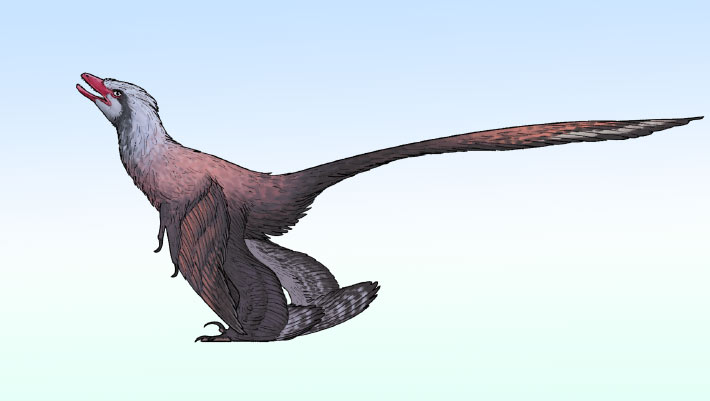
Cretaceous Bird from China Had Pair of Tail Feathers Twice as Long as Its Body
Un oiseau du Crétacé de Chine avait une paire de plumes de queue deux fois plus longues que son corps
plume Chine Crétacé oiseau
Nommée Plumadraco bankoorum, l'espèce d'oiseau énantiornithine nouvellement décrite vivait dans ce qui est aujourd'hui le nord-est de la Chine pendant la période du Crétacé, il y a environ 121 millions d'années. L'article Un oiseau du Crétacé de Chine avait une paire de plumes de queue deux fois plus longues que son corps est apparu en premier sur Sci.News : Breaking Science News.
28/05/2026 sci-news ⚙ Traduction automatique
Une nouvelle espèce d’énorme mosasaure est décrite
prédateur Campanien Crétacé Crétacé supérieur fossile Mosasaurus Tylosaurus nouvelle espèce
Une espèce géante de Tylosaurus nouvellement nommée a été nommée par les chercheurs.  La nouvelle espèce de Tylosaurus a été érigée sur la base de fossiles trouvés dans le nord du Texas. Cet énorme prédateur régnait sur les mers anciennes il y a environ 80 millions d’années (stade faunique campanien du Crétacé supérieur).  L'article scientifique a été publié dans le Bulletin of the American
26/05/2026 everythingdinosaur ⚙ Traduction automatique
Un nouveau dinosaure sauropode du Crétacé inférieur du Brésil
Brésil Crétacé Crétacé inférieur Dasosaurus Dinosauria
Un nouveau genre de dinosaure sauropode a été nommé au Brésil.  Il élargit la diversité connue des sauropodes du Crétacé inférieur dans la partie nord de l'Amérique du Sud. En outre, le nouveau dinosaure Dasosaurus tocantinensis fournit de nouvelles preuves de la dispersion des dinosaures entre l’Europe, l’Afrique et l’Amérique du Sud. L'article scientifique décrivant le nouveau taxon a été
15/05/2026 everythingdinosaur ⚙ Traduction automatique
1 2 3 4 5 6 7 8 9 10