Crétacé

Intervalle géologique

161 image(s) · 39 Actualités

Voir la fiche

Galerie d'images

Comptonatus is an iguanodontid ornithopod dinosaur that lived about 125 million years ago, in the Early Cretaceous of what is now Europe. It was a medium sized herbivore at about 7 m in length, and weighed around 1 t in body mass. Fossilized footprints found near the original specimen indicate that Comptonatus was likely a herding animal. Comparisons between Comptonatus and other iguanodontids that lived around the same time and region show a high rate of diversity. This indicates there may have been pressure for speedy evolutionary adaptation in the region, or perhaps a high volume of migration.
Taxons Comptonatus

Comptonatus is an iguanodontid ornithopod dinosaur that lived about 125 million years ago, in the Early Cretaceous of what is now Europe. It was a medium sized herbivore at about 7 m in length, and weighed around 1 t in body mass. Fossilized footprints found near the original specimen indicate that Comptonatus was likely a herding animal. Comparisons between Comptonatus and other iguanodontids that lived around the same time and region show a high rate of diversity. This indicates there may have been pressure for speedy evolutionary adaptation in the region, or perhaps a high volume of migration.

migration Crétacé Crétacé inférieur spécimen +3
Ancient landscape across the Cretaceous/Paleogene time interval in central Patagonia. Main floristic types from the Danian: Podocarps, Cheirolepidiaceae, palms.
doi:10.1371/journal.pone.0052455.g007

Ancient landscape across the Cretaceous/Paleogene time interval in central Patagonia. Main floristic types from the Danian: Podocarps, Cheirolepidiaceae, palms. doi:10.1371/journal.pone.0052455.g007

Crétacé Danien Paléogène
Iron trapped in Cretaceous limestone, forming tables

Iron trapped in Cretaceous limestone, forming tables

Crétacé
Limestone cliff with the stratigraphic stage of Cretaceous Coniacian near the eponym town of Cognac, Charente, Poitou-Charentes, France.

Limestone cliff with the stratigraphic stage of Cretaceous Coniacian near the eponym town of Cognac, Charente, Poitou-Charentes, France.

France Coniacien Crétacé
crétacé limestone at Cognac, Charente, SW France

crétacé limestone at Cognac, Charente, SW France

France Crétacé
Cretaceous limestone at Cognac, Charente, SW France

Cretaceous limestone at Cognac, Charente, SW France

France Crétacé
Ivy and limestone cliff of Cretaceous Coniacian, Cognac, Charente, France.

Ivy and limestone cliff of Cretaceous Coniacian, Cognac, Charente, France.

France Coniacien Crétacé
Limestone Cretaceous cornices (Coniacian type), valley of the river Voultron; Blanzaguet-Saint-Cybard, Charente, France.

Limestone Cretaceous cornices (Coniacian type), valley of the river Voultron; Blanzaguet-Saint-Cybard, Charente, France.

France Coniacien Crétacé
Quarry called “Ratssteinbruch” at Plauenscher Grund (gorge-like valley of the river Weißeritz nearby/in the city of Dresden, Saxony, Germany), Upper Carboniferous Monzonite (historically identified as Syenite) of the Meißen Massif (Paleozoic basement) unconformably overlain by Upper Cenomanian beds of the Dölzschen Formation, yellowish basal conglomerate and overlying bluish silty clay-marlstone (“plenus-Pläner”) of the Saxo-Bohemian Cretaceous Basin (Mesozoic platform).[1]

Quarry called “Ratssteinbruch” at Plauenscher Grund (gorge-like valley of the river Weißeritz nearby/in the city of Dresden, Saxony, Germany), Upper Carboniferous Monzonite (historically identified as Syenite) of the Meißen Massif (Paleozoic basement) unconformably overlain by Upper Cenomanian beds of the Dölzschen Formation, yellowish basal conglomerate and overlying bluish silty clay-marlstone (“plenus-Pläner”) of the Saxo-Bohemian Cretaceous Basin (Mesozoic platform).[1]

Allemagne Carbonifère Cénomanien Crétacé +3
landscape of Montmorélien (Cretaceous Campanian), Charente, SW France

landscape of Montmorélien (Cretaceous Campanian), Charente, SW France

France Campanien Crétacé
A fossil tree from the Coal Creek region, Fruitland Formation, latest Cretaceous (Late Campanian), San Juan Basin, New Mexico

A fossil tree from the Coal Creek region, Fruitland Formation, latest Cretaceous (Late Campanian), San Juan Basin, New Mexico

Mexique Fruitland Campanien Crétacé +2
Holotype skull of the centrosaurine ceratopsian dinosaur Diabloceratops eatoni from the Late Cretaceous (Campanian) of the Wahweap Formation, Grand Staircase-Escalante National Monument, Utah. Photograph by Nick Longrich, 2023.

Holotype skull of the centrosaurine ceratopsian dinosaur Diabloceratops eatoni from the Late Cretaceous (Campanian) of the Wahweap Formation, Grand Staircase-Escalante National Monument, Utah. Photograph by Nick Longrich, 2023.

Campanien Crétacé Crétacé supérieur holotype +5
Outcrops of the Late Cretaceous (Campanian) aged Aguja Formation, Big Bend National Park, Texas, USA

Outcrops of the Late Cretaceous (Campanian) aged Aguja Formation, Big Bend National Park, Texas, USA

États-Unis Aguja Campanien Crétacé +2
Mawsonia , giant coelocanth from the Cretaceous period (Albian and Cenomanian stages) of South America and North Africa

Mawsonia , giant coelocanth from the Cretaceous period (Albian and Cenomanian stages) of South America and North Africa

Albien Cénomanien Crétacé
Size of Austroraptor cabazai compared to a human, a species of Dromaeosaurid Unenlagiinae who lived during the Cretaceous period in Argentina, more precisely in the Allen Formation.
Taxons Unenlagia

Size of Austroraptor cabazai compared to a human, a species of Dromaeosaurid Unenlagiinae who lived during the Cretaceous period in Argentina, more precisely in the Allen Formation.

Argentine Allen Crétacé Austroraptor +5
Sidersaura is a rebbachisaurid sauropod dinosaur from the Late Cretaceous of Argentina. Rebbachisaurids are the last known dipldocoids, and lived alongside the titanosaurs until fairly late in the Cretaceous before disappearing from the fossil record, presumably going extinct. They have long tails and relatively short necks, by sauropod standards. Sidersaura one of the most recent rebbachisaurids yet found, living in the Cenomanian–Turonian ages of the Late Cretaceous. It was large for a rebbachisaurid, growing to about 20 m in length.
Taxons Sidersaura

Sidersaura is a rebbachisaurid sauropod dinosaur from the Late Cretaceous of Argentina. Rebbachisaurids are the last known dipldocoids, and lived alongside the titanosaurs until fairly late in the Cretaceous before disappearing from the fossil record, presumably going extinct. They have long tails and relatively short necks, by sauropod standards. Sidersaura one of the most recent rebbachisaurids yet found, living in the Cenomanian–Turonian ages of the Late Cretaceous. It was large for a rebbachisaurid, growing to about 20 m in length.

Argentine Cénomanien Crétacé Crétacé supérieur +6
1 2 3 4 5 6 7 8 9 10 11

Actualités

Des scientifiques décrivent officiellement le premier fossile de dinosaure découvert en Antarctique
vertèbre Antarctique Crétacé Crétacé supérieur fossile Dinosauria Titanosauria découverte
Les scientifiques ont officiellement décrit le premier fossile de dinosaure découvert en Antarctique. La découverte remarquable est une seule vertèbre provenant d’un titanosaure du Crétacé supérieur. Bien que le fossile ait été collecté il y a plus de quarante ans, les chercheurs n’ont confirmé son identité que récemment.  Le premier fossile de dinosaure découvert en Antarctique est décrit dans la revue Acta Palaeontologica Polonica.
29/06/2026 everythingdinosaur ⚙ Traduction automatique
Flowering Plants Were Already Thriving before Dinosaur-Killing Asteroid Hit
Les plantes à fleurs prospéraient déjà avant l’impact de l’astéroïde tueur de dinosaures
Mexique Crétacé fossile Dinosauria extinction formation
Les fossiles de la formation Jose Creek au Nouveau-Mexique révèlent que les angiospermes (plantes à fleurs) avaient construit des forêts denses et fruitières il y a près de 75 millions d'années - près de 9 millions d'années avant l'extinction massive de la fin du Crétacé qui a tué les dinosaures - remettant en question un récit évolutif de longue date sur la façon dont ils sont parvenus à dominer la planète. L'article Les plantes à fleurs prospéraient déjà avant l'attaque d'un astéroïde tueur de dinosaures apparaît en premier sur Sci.News : Breaking Science News.
29/06/2026 sci-news ⚙ Traduction automatique
New Feathered Dinosaur from China Had Peacock-Like Tail
Un nouveau dinosaure à plumes de Chine avait une queue semblable à celle d'un paon
plume Chine Crétacé Crétacé inférieur Changzhousaurus Dinosauria oiseau évolution nouvelle espèce
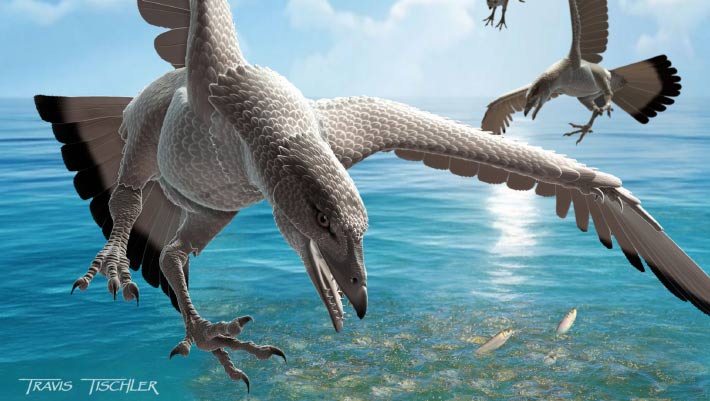
Un nouveau genre et une nouvelle espèce de dinosaure pennaraptoran à quatre ailes du Crétacé inférieur du nord de la Chine ajoutent une autre tournure à l'histoire de l'évolution des oiseaux à partir de leurs ancêtres dinosaures. L'article Un nouveau dinosaure à plumes de Chine avait une queue semblable à un paon est apparu en premier sur Sci.News : Breaking Science News.
23/06/2026 sci-news ⚙ Traduction automatique
Modèle CollectA Deluxe Edmontosaurus se nourrissant de certains conifères
alimentation Crétacé Crétacé supérieur Dinosauria Edmontosaurus Hadrosauria
Merci Caldey de nous avoir envoyé une photo de votre CollectA Deluxe Edmontosaurus se nourrissant dans le jardin.  Le dinosaure a l’air très à l’aise en grignotant certains conifères.  Les paléontologues savent, grâce au contenu de l'estomac des hadrosaures, que ces herbivores du Crétacé supérieur se nourrissaient de conifères.  C'est une photographie délicieusement composée.  L'angle de vision donne l'impression
23/06/2026 everythingdinosaur ⚙ Traduction automatique
125-Million-Year-Old Crocodile Relative Reveals Its True Colors
Un parent de crocodile âgé de 125 millions d'années révèle ses vraies couleurs
écaille peau Espagne Crétacé Crétacé inférieur autres reptiles
La peau exceptionnellement préservée de Montsecosuchus depereti, un crocodylomorphe éteint pas plus gros qu'un chat domestique qui rôdait dans les zones humides tropicales de l'Espagne du Crétacé inférieur, a permis aux paléontologues de reconstituer les détails de ses écailles, de ses organes sensoriels et même d'éventuelles marques en bandes le long de sa queue. L'article Un parent de crocodile âgé de 125 millions d'années révèle ses vraies couleurs est apparu en premier sur Sci.News : Breaking Science News.
18/06/2026 sci-news ⚙ Traduction automatique
1 2 3 4 5 6 7 8