Crétacé

Intervalle géologique

161 image(s) · 39 Actualités

Voir la fiche

Galerie d'images

Figure 1: Map of Queensland, northeast Australia, showing the distribution of Cretaceous outcrop. From Poropat et al.

Figure 1: Map of Queensland, northeast Australia, showing the distribution of Cretaceous outcrop. From Poropat et al.

Australie Crétacé
(A) Present day map of Australia with the town of Lightning Ridge indicated by the star. (B) Regional map of the Lightning Ridge region showing localities (where known) for specimens described in this text. Sealed (solid black lines) and unsealed roads (dashed lines) are indicated. The ephemeral Coocoran Lake is marked with a dotted blue line. (C) Correlative stratigraphy of the major Cretaceous depositional basins and geological units discussed in this study. The ornithopod icon and arrow indicate the approximate level of the Griman Creek Formation from which the current material pertains. Informal units are in quotation marks. Maps in (A) and (B) redrawn and modified from Bell et al. (2016) and Opal Fields—Lightning Ridge Region map produced by the NSW Department of Mineral Resources, respectively. Stratigraphy based on Toslini, McLoughlin & Drinnan (1999) and Cook, Bryan & Draper (2013). Ornithopod silhouette created by Caleb M. Brown and used under the Creative Commons Attribution-ShareAlike 3.0 Unported license.

(A) Present day map of Australia with the town of Lightning Ridge indicated by the star. (B) Regional map of the Lightning Ridge region showing localities (where known) for specimens described in this text. Sealed (solid black lines) and unsealed roads (dashed lines) are indicated. The ephemeral Coocoran Lake is marked with a dotted blue line. (C) Correlative stratigraphy of the major Cretaceous depositional basins and geological units discussed in this study. The ornithopod icon and arrow indicate the approximate level of the Griman Creek Formation from which the current material pertains. Informal units are in quotation marks. Maps in (A) and (B) redrawn and modified from Bell et al. (2016) and Opal Fields—Lightning Ridge Region map produced by the NSW Department of Mineral Resources, respectively. Stratigraphy based on Toslini, McLoughlin & Drinnan (1999) and Cook, Bryan & Draper (2013). Ornithopod silhouette created by Caleb M. Brown and used under the Creative Commons Attribution-ShareAlike 3.0 Unported license.

Australie Griman Creek Crétacé spécimen +3
(A) Map of Queensland showing the extent of Cretaceous outcrop. (B) Map of the location of Dig Site Three (type locality of Haliskia), and numerous other sites in the area from which pterosaur fossils have been collected.
Formations Griman Creek

(A) Map of Queensland showing the extent of Cretaceous outcrop. (B) Map of the location of Dig Site Three (type locality of Haliskia), and numerous other sites in the area from which pterosaur fossils have been collected.

Crétacé fossile Haliskia Pterosauria
View north across Frenchman River of Upper Cretaceous and Paleocene age strata of the Bearpaw, Whitemud, Battle, Frenchman, and Ravenscrag Formations in the Cypress Hills of southern Saskatchewan. Foreground strata on other side of (tree lined) creek represent a slumped section. Note the bright white zone is the Whitemud Formation. View includes type area of Frenchman and Ravenscrag Formations.

View north across Frenchman River of Upper Cretaceous and Paleocene age strata of the Bearpaw, Whitemud, Battle, Frenchman, and Ravenscrag Formations in the Cypress Hills of southern Saskatchewan. Foreground strata on other side of (tree lined) creek represent a slumped section. Note the bright white zone is the Whitemud Formation. View includes type area of Frenchman and Ravenscrag Formations.

Frenchman Crétacé Paléocène formation
View northeast across Frenchman River of Upper Cretaceous and Paleocene age strata of the Bearpaw, Whitemud, Battle, Frenchman, and Ravenscrag Formations in the Cypress Hills of southern Saskatchewan. Foreground strata on other side of (tree lined) creek represent a slumped section. Note the bright white zone is the Whitemud Formation. View includes type area of Frenchman and Ravenscrag Formations.

View northeast across Frenchman River of Upper Cretaceous and Paleocene age strata of the Bearpaw, Whitemud, Battle, Frenchman, and Ravenscrag Formations in the Cypress Hills of southern Saskatchewan. Foreground strata on other side of (tree lined) creek represent a slumped section. Note the bright white zone is the Whitemud Formation. View includes type area of Frenchman and Ravenscrag Formations.

Frenchman Crétacé Paléocène formation
Geological context of the Lower Cretaceous deposits of southeast England, focussing on the Purbeck Group and Wealden Supergroup.

(A) Schematic geology of the Lower Cretaceous deposits of the Weald Sub-basin (southeast England), highlighting published spinosaurid finds (Charig & Milner, 1997; Salisbury & Naish, 2011; Turmine-Juhel et al., 2019). Based on Austen & Batten (2018: Fig. 2). Note that various additional spinosaurid teeth are known from the region but remain undescribed in detail (Fowler, 2007). (B) Simplified stratigraphic column of the Weald Group in southeast England, based on Batten & Austen (2011: Fig. 3.2). Note that the Grinstead Clay Formation, which subdivides the Tunbridge Wells Sands Formation in Batten & Austen (2011) and from which the “Suchosaurus cultridens” type specimen was discovered (Salisbury & Naish, 2011), is downgraded to a member of the latter formation in other works (Hopson, Wilkinson & Woods, 2008) and has not been included in this column. Spinosaurid silhouette courtesy of Dan Folkes (CC-BY 4.0).
Formations Durlston

Geological context of the Lower Cretaceous deposits of southeast England, focussing on the Purbeck Group and Wealden Supergroup. (A) Schematic geology of the Lower Cretaceous deposits of the Weald Sub-basin (southeast England), highlighting published spinosaurid finds (Charig & Milner, 1997; Salisbury & Naish, 2011; Turmine-Juhel et al., 2019). Based on Austen & Batten (2018: Fig. 2). Note that various additional spinosaurid teeth are known from the region but remain undescribed in detail (Fowler, 2007). (B) Simplified stratigraphic column of the Weald Group in southeast England, based on Batten & Austen (2011: Fig. 3.2). Note that the Grinstead Clay Formation, which subdivides the Tunbridge Wells Sands Formation in Batten & Austen (2011) and from which the “Suchosaurus cultridens” type specimen was discovered (Salisbury & Naish, 2011), is downgraded to a member of the latter formation in other works (Hopson, Wilkinson & Woods, 2008) and has not been included in this column. Spinosaurid silhouette courtesy of Dan Folkes (CC-BY 4.0).

Crétacé spécimen Spinosauridae Suchosaurus +2
This image shows the Cedar Mountain Formation near its type section at Buckhorn Reservoir, Utah. The formation is capped by a very thin bed of Dakota Formation. The Cedar Mountain Formation is a Cretaceous fluvial formation, about 98 million years old, that was deposited in the foreland basin of the Sevier Mountains just before it was flooded by the ocean to form the Western Interior Seaway.

This image shows the Cedar Mountain Formation near its type section at Buckhorn Reservoir, Utah. The formation is capped by a very thin bed of Dakota Formation. The Cedar Mountain Formation is a Cretaceous fluvial formation, about 98 million years old, that was deposited in the foreland basin of the Sevier Mountains just before it was flooded by the ocean to form the Western Interior Seaway.

Cedar Mountain Crétacé formation
Diagram depicting the currently named Dinosauria from the Early Cretaceous Cedar Mountain Formation of Utah. Dinosaur taxa:
Cedarosaurus weiskopfae → Grand County locality.[1] Length = 15 meters.[2]
Cedrorestes crichtoni → Dave's Camp Site locality.[3] Length = 6 meters.[4]
Falcarius utahensis → Crystal Geyser Quarry & Suarez Site/Quarry localities.[5] Length = 5 meters.[5]
Gastonia burgei → Gaston Quarry, Dalton Wells, Doelling's Bowl localities.[6] Length = 5 meters.[2]
Geminiraptor suarezarum → Suarez Site/Quarry locality.[7] Length = 1.5 meters.[4]
Hippodraco scutodens → Andrew's Site locality.[8] Length = 4.5 meters.[8]
Iguanacolossus fortis → Don's Ridge & Doelling's Bowl localities.[8][6] Length = 9 meters.[8]
Martharaptor greenriverensis → Hayden-Corbett Site.[9] Length = Extrapolated after relatives.
Mierasaurus bobyoungi → Doelling’s Bowl locality.[10] Length = ∼9 meters.[10][11]
Moabosaurus utahensis → Dalton Wells locality.[12] Length = 9.75 meters.[12]
Nedcolbertia justinhofmanni → Dalton Wells & Gaston Quarry localities.[13] Length = ∼3 meters.[13]
Utahraptor ostrommaysi → Dalton Wells, Gaston Quarry, Stikes Quarry, Utahraptor Ridge localities.[14][6] Length = 5.5 meters.[2]
Yurgovuchia doellingi → Don’s Place - Doelling’s Bowl locality.[15] Length = 2.5 meters.[15]
References

↑ (1999). "New sauropod from the Lower Cretaceous of Utah, USA". Oryctos 2: 21–37.

↑ a b c (2016)  The Princeton Field Guide to Dinosaurs (2nd ed.), Princeton:  Princeton University Press  ISBN:  9780691167664. 

↑ "A possible new basal hadrosaur from the Lower Cretaceous Cedar Mountain Formation of Eastern Utah" in   (2007)  Horns and Beaks: Ceratopsian and Ornithopod Dinosaurs, Bloomington and Indianapolis:  Indiana University Press, pp. 79–89  DOI:  10.2307/j.ctt1zxz1md.10. ISBN:  0-253-34817-X. 

↑ a b (2007)  Dinosaurs: The Most Complete, Up-to-Date Encyclopedia for Dinosaur Lovers of All Ages, Random House  ISBN:  9780375824197.  Genus List for Holtz 2012  Weight Information

↑ a b (2010). "Osteology of Falcarius utahensis (Dinosauria: Theropoda): characterizing the anatomy of basal therizinosaurs". Zoological Journal of the Linnean Society 158 (1): 196–230. DOI:10.1111/j.1096-3642.2009.00464.x.

↑ a b c (2016). "The Lower Cretaceous in East-Central Utah—The Cedar Mountain Formation and its Bounding Strata". Geology of the Intermoutain West 3: 1-130.

↑  (2010). "A New Troodontid Theropod Dinosaur from the Lower Cretaceous of Utah". PLOS ONE 5 (12): e14329. DOI:10.1371/journal.pone.0014329. PMID 21179513. PMC: 3002269.

↑ a b c d (2010). "New Basal Iguanodonts from the Cedar Mountain Formation of Utah and the Evolution of Thumb-Spiked Dinosaurs". PLOS ONE 5 (11): e14075. DOI:10.1371/journal.pone.0014075. PMID 21124919. PMC: 2989904.

↑ (2012). "Martharaptor greenriverensis, a New Theropod Dinosaur from the Lower Cretaceous of Utah". PLOS ONE 7 (8): e43911. DOI:10.1371/journal.pone.0043911. PMID 22952806. PMC: 3430620.

↑ a b (2017). "Descendants of the Jurassic turiasaurs from Iberia found refuge in the Early Cretaceous of western USA". Scientific Reports 7 (1): 14311. DOI:10.1038/s41598-017-14677-2. PMID 29085006. PMC: 5662694.

↑ (2020)  Dinosaur Facts and Figures: The Sauropods and Other Sauropodomorphs, Princeton:  Princeton University Press  ISBN:  9780691202976. 

↑ a b (2017). "Moabosaurus Utahensis, N. Gen., N. SP., A New Sauropod From The Early Cretaceous (Aptian) of North America". Contributions from the Museum of Paleontology, University of Michigan 32 (11): 189–243.

↑ a b (1998). "A small coelurosaurian theropod from the Yellow Cat Member of the Cedar Mountain Formation (Lower Cretaceous, Barremian) of eastern Utah". New Mexico Museum of Natural History and Science Bulletin 14: 239–248.

↑ (1993). "A large dromaeosaurid (Theropoda) from the Lower Cretaceous of Eastern Utah". Hunteria 2 (10): 1–16.

↑ a b (2012). "New Dromaeosaurids (Dinosauria: Theropoda) from the Lower Cretaceous of Utah, and the Evolution of the Dromaeosaurid Tail". PLOS ONE 7 (5): e36790. DOI:10.1371/journal.pone.0036790. PMID 22615813. PMC: 3352940.
Formations Cedar Mountain

Diagram depicting the currently named Dinosauria from the Early Cretaceous Cedar Mountain Formation of Utah. Dinosaur taxa: Cedarosaurus weiskopfae → Grand County locality.[1] Length = 15 meters.[2] Cedrorestes crichtoni → Dave's Camp Site locality.[3] Length = 6 meters.[4] Falcarius utahensis → Crystal Geyser Quarry & Suarez Site/Quarry localities.[5] Length = 5 meters.[5] Gastonia burgei → Gaston Quarry, Dalton Wells, Doelling's Bowl localities.[6] Length = 5 meters.[2] Geminiraptor suarezarum → Suarez Site/Quarry locality.[7] Length = 1.5 meters.[4] Hippodraco scutodens → Andrew's Site locality.[8] Length = 4.5 meters.[8] Iguanacolossus fortis → Don's Ridge & Doelling's Bowl localities.[8][6] Length = 9 meters.[8] Martharaptor greenriverensis → Hayden-Corbett Site.[9] Length = Extrapolated after relatives. Mierasaurus bobyoungi → Doelling’s Bowl locality.[10] Length = ∼9 meters.[10][11] Moabosaurus utahensis → Dalton Wells locality.[12] Length = 9.75 meters.[12] Nedcolbertia justinhofmanni → Dalton Wells & Gaston Quarry localities.[13] Length = ∼3 meters.[13] Utahraptor ostrommaysi → Dalton Wells, Gaston Quarry, Stikes Quarry, Utahraptor Ridge localities.[14][6] Length = 5.5 meters.[2] Yurgovuchia doellingi → Don’s Place - Doelling’s Bowl locality.[15] Length = 2.5 meters.[15] References ↑ (1999). "New sauropod from the Lower Cretaceous of Utah, USA". Oryctos 2: 21–37. ↑ a b c (2016) The Princeton Field Guide to Dinosaurs (2nd ed.), Princeton: Princeton University Press ISBN: 9780691167664. ↑ "A possible new basal hadrosaur from the Lower Cretaceous Cedar Mountain Formation of Eastern Utah" in (2007) Horns and Beaks: Ceratopsian and Ornithopod Dinosaurs, Bloomington and Indianapolis: Indiana University Press, pp. 79–89 DOI: 10.2307/j.ctt1zxz1md.10. ISBN: 0-253-34817-X. ↑ a b (2007) Dinosaurs: The Most Complete, Up-to-Date Encyclopedia for Dinosaur Lovers of All Ages, Random House ISBN: 9780375824197. Genus List for Holtz 2012 Weight Information ↑ a b (2010). "Osteology of Falcarius utahensis (Dinosauria: Theropoda): characterizing the anatomy of basal therizinosaurs". Zoological Journal of the Linnean Society 158 (1): 196–230. DOI:10.1111/j.1096-3642.2009.00464.x. ↑ a b c (2016). "The Lower Cretaceous in East-Central Utah—The Cedar Mountain Formation and its Bounding Strata". Geology of the Intermoutain West 3: 1-130. ↑ (2010). "A New Troodontid Theropod Dinosaur from the Lower Cretaceous of Utah". PLOS ONE 5 (12): e14329. DOI:10.1371/journal.pone.0014329. PMID 21179513. PMC: 3002269. ↑ a b c d (2010). "New Basal Iguanodonts from the Cedar Mountain Formation of Utah and the Evolution of Thumb-Spiked Dinosaurs". PLOS ONE 5 (11): e14075. DOI:10.1371/journal.pone.0014075. PMID 21124919. PMC: 2989904. ↑ (2012). "Martharaptor greenriverensis, a New Theropod Dinosaur from the Lower Cretaceous of Utah". PLOS ONE 7 (8): e43911. DOI:10.1371/journal.pone.0043911. PMID 22952806. PMC: 3430620. ↑ a b (2017). "Descendants of the Jurassic turiasaurs from Iberia found refuge in the Early Cretaceous of western USA". Scientific Reports 7 (1): 14311. DOI:10.1038/s41598-017-14677-2. PMID 29085006. PMC: 5662694. ↑ (2020) Dinosaur Facts and Figures: The Sauropods and Other Sauropodomorphs, Princeton: Princeton University Press ISBN: 9780691202976. ↑ a b (2017). "Moabosaurus Utahensis, N. Gen., N. SP., A New Sauropod From The Early Cretaceous (Aptian) of North America". Contributions from the Museum of Paleontology, University of Michigan 32 (11): 189–243. ↑ a b (1998). "A small coelurosaurian theropod from the Yellow Cat Member of the Cedar Mountain Formation (Lower Cretaceous, Barremian) of eastern Utah". New Mexico Museum of Natural History and Science Bulletin 14: 239–248. ↑ (1993). "A large dromaeosaurid (Theropoda) from the Lower Cretaceous of Eastern Utah". Hunteria 2 (10): 1–16. ↑ a b (2012). "New Dromaeosaurids (Dinosauria: Theropoda) from the Lower Cretaceous of Utah, and the Evolution of the Dromaeosaurid Tail". PLOS ONE 7 (5): e36790. DOI:10.1371/journal.pone.0036790. PMID 22615813. PMC: 3352940.

Cedar Mountain Crétacé Crétacé inférieur Cedarosaurus +12
Holotype of Khunnuchelys lophorhothon sp. nov. from Baybishe, northeastern Aral Sea region, Kazakhstan, Bostobe Formation, Santonian–early Campanian, Late Cretaceous, ZIN PH 5/55, a partial skull; in dorsal (A), ventral (B), lateral (C), and anterior (D) views. Photographs (A1–D1), explanatory drawings (A2–D2).
Formations Bostobe

Holotype of Khunnuchelys lophorhothon sp. nov. from Baybishe, northeastern Aral Sea region, Kazakhstan, Bostobe Formation, Santonian–early Campanian, Late Cretaceous, ZIN PH 5/55, a partial skull; in dorsal (A), ventral (B), lateral (C), and anterior (D) views. Photographs (A1–D1), explanatory drawings (A2–D2).

dessin Kazakhstan Bostobe Campanien +8
World map showing Late Cretaceous metatherian locales.

Europe

1. Font-de-Benon quarry, Archingeay-Les Nouillers (Cenomanian, Late Cretaceous), Charente-Maritime, southwestern France (Vullo et al. 2009)
2. Valkenburg Member, Maastricht Formation (late Maastrichtian, Late Cretaceous), southern Limburg, The Netherlands (Martin et al. 2005)
Asia

3. Yixian Formation, China (Barremian, Early Cretaceous)
4. Bissekty Formation, Kyzylkum Desert, Uzbekistan (Turonian, Late Cretaceous)
5. Darbasa Formation, southern Kazakhstan (Campanian, Late Cretaceous)
6. Grey Mesa locality (Averianov 1997)
7. Barun Goyot Formation, Umuni Gobi, Mongolia (Campanian, Late Cretaceous)
8. Nemegt Formation, Omnogov, Mongolia (Maastrichtian, Late Cretaceous)
9. Djadokhta Formation, Mongolia (Campanian, Late Cretaceous)

North America
Alaska

9. Prince Creek Formation, Alaska (early Maastrichtian, Late Cretaceous)
Alberta and Saskatchewan, Canada

10. Milk River Formation, southern Alberta, Canada (late Santonian, Late Cretaceous)
11. Oldman Formation, southern Alberta, Canada (Campanian, Late Cretaceous)
12. Dinosaur Park Formation, southern Alberta, Canada (late Campanian, Late Cretaceous)


13. Horseshoe Canyon Formation, southern Alberta, Canada (early Maastrichtian, Late Cretaceous)
14. St. Mary River Formation, Alberta and northwestern Montana (early Maastrichtian, Late Cretaceous)


15. Scollard Formation, Alberta (late Maastrichtian, Late Cretaceous)
16. Frenchman Formation, Saskatchewan (late Maastrichtian, Late Cretaceous)
Montana and North Dakota

17. Judith River Formation (late Campanian, Late Cretaceous)
18. Two Medicine Formation (late Campanian, Late Cretaceous)
19. Hell Creek Formation, Montana and North Dakota (late Maastrichtian, Late Cretaceous)

South Dakota

20. Fox Hills Formation, South Dakota (late Maastrichtian, Late Cretaceous)
21. Hell Creek Formation, South Dakota (late Maastrichtian, Late Cretaceous)
Wyoming

22. “Mesa Verde Formation” (late Campanian, Late Cretaceous)
23. Lance Formation, Wyoming (late Maastrichtian, Late Cretaceous)
24. Ferris Formation, Wyoming (late Maastrichtian, Late Cretaceous)

Utah

25. Cedar Mountain Formation (Albian-Cenomanian)
26. Dakota Formation fauna (late Cenomanian, Late Cretaceous)
27. Smoky Hollow Member, Straight Cliffs Formation (Turonian, Late Cretaceous)
28. John Henry Member, Straight Cliffs Formation (Coniacian-Santonian, Late Cretaceous)
29. Wahweap Formation (early-middle Campanian, Late Cretaceous)
30. Kaiparowits Formation (late Campanian, Late Cretaceous)
31. Iron Springs Formation fauna, southern Utah (Turonian – Santonian, Late Cretaceous)
32. North Horn Formation, Utah (late Maastrichtian, Late Cretaceous)
Colorado

33. Williams Fork Formation, Colorado (late Campanian-early Maastrichtian)


34. Laramie Formation, northeastern Colorado (late Maastrichtian, Late Cretaceous)

Baja California Del Norte, Mexico

35. El Gallo Formation (late Campanian, Late Cretaceous) (Clemens 1980; Lillegraven 1972; Lillegraven 1976)
New Mexico

36. Fruitland and lower Kirtland Formation, San Juan Basin (late Campanian, Late Cretaceous)
37. Naashoibito Member, Kirtland Formation, New Mexico (late Maastrichtian, Late Cretaceous)
Oklahoma

38. Antlers Formation, Texas and Oklahoma (Aptian-Albian, Early Cretaceous)
Texas

39. Aguja Formation, West Texas (late Campanian, Late Cretaceous)
New Jersey

40. Marshalltown Formation, New Jersey (Campanian, Late Cretaceous)
Szalay 1994)
Formations Bissekty

World map showing Late Cretaceous metatherian locales. Europe 1. Font-de-Benon quarry, Archingeay-Les Nouillers (Cenomanian, Late Cretaceous), Charente-Maritime, southwestern France (Vullo et al. 2009) 2. Valkenburg Member, Maastricht Formation (late Maastrichtian, Late Cretaceous), southern Limburg, The Netherlands (Martin et al. 2005) Asia 3. Yixian Formation, China (Barremian, Early Cretaceous) 4. Bissekty Formation, Kyzylkum Desert, Uzbekistan (Turonian, Late Cretaceous) 5. Darbasa Formation, southern Kazakhstan (Campanian, Late Cretaceous) 6. Grey Mesa locality (Averianov 1997) 7. Barun Goyot Formation, Umuni Gobi, Mongolia (Campanian, Late Cretaceous) 8. Nemegt Formation, Omnogov, Mongolia (Maastrichtian, Late Cretaceous) 9. Djadokhta Formation, Mongolia (Campanian, Late Cretaceous) North America Alaska 9. Prince Creek Formation, Alaska (early Maastrichtian, Late Cretaceous) Alberta and Saskatchewan, Canada 10. Milk River Formation, southern Alberta, Canada (late Santonian, Late Cretaceous) 11. Oldman Formation, southern Alberta, Canada (Campanian, Late Cretaceous) 12. Dinosaur Park Formation, southern Alberta, Canada (late Campanian, Late Cretaceous) 13. Horseshoe Canyon Formation, southern Alberta, Canada (early Maastrichtian, Late Cretaceous) 14. St. Mary River Formation, Alberta and northwestern Montana (early Maastrichtian, Late Cretaceous) 15. Scollard Formation, Alberta (late Maastrichtian, Late Cretaceous) 16. Frenchman Formation, Saskatchewan (late Maastrichtian, Late Cretaceous) Montana and North Dakota 17. Judith River Formation (late Campanian, Late Cretaceous) 18. Two Medicine Formation (late Campanian, Late Cretaceous) 19. Hell Creek Formation, Montana and North Dakota (late Maastrichtian, Late Cretaceous) South Dakota 20. Fox Hills Formation, South Dakota (late Maastrichtian, Late Cretaceous) 21. Hell Creek Formation, South Dakota (late Maastrichtian, Late Cretaceous) Wyoming 22. “Mesa Verde Formation” (late Campanian, Late Cretaceous) 23. Lance Formation, Wyoming (late Maastrichtian, Late Cretaceous) 24. Ferris Formation, Wyoming (late Maastrichtian, Late Cretaceous) Utah 25. Cedar Mountain Formation (Albian-Cenomanian) 26. Dakota Formation fauna (late Cenomanian, Late Cretaceous) 27. Smoky Hollow Member, Straight Cliffs Formation (Turonian, Late Cretaceous) 28. John Henry Member, Straight Cliffs Formation (Coniacian-Santonian, Late Cretaceous) 29. Wahweap Formation (early-middle Campanian, Late Cretaceous) 30. Kaiparowits Formation (late Campanian, Late Cretaceous) 31. Iron Springs Formation fauna, southern Utah (Turonian – Santonian, Late Cretaceous) 32. North Horn Formation, Utah (late Maastrichtian, Late Cretaceous) Colorado 33. Williams Fork Formation, Colorado (late Campanian-early Maastrichtian) 34. Laramie Formation, northeastern Colorado (late Maastrichtian, Late Cretaceous) Baja California Del Norte, Mexico 35. El Gallo Formation (late Campanian, Late Cretaceous) (Clemens 1980; Lillegraven 1972; Lillegraven 1976) New Mexico 36. Fruitland and lower Kirtland Formation, San Juan Basin (late Campanian, Late Cretaceous) 37. Naashoibito Member, Kirtland Formation, New Mexico (late Maastrichtian, Late Cretaceous) Oklahoma 38. Antlers Formation, Texas and Oklahoma (Aptian-Albian, Early Cretaceous) Texas 39. Aguja Formation, West Texas (late Campanian, Late Cretaceous) New Jersey 40. Marshalltown Formation, New Jersey (Campanian, Late Cretaceous) Szalay 1994)

Canada Chine France Kazakhstan +18
World map showing Late Cretaceous metatherian locales.

Europe

1. Font-de-Benon quarry, Archingeay-Les Nouillers (Cenomanian, Late Cretaceous), Charente-Maritime, southwestern France (Vullo et al. 2009)
2. Valkenburg Member, Maastricht Formation (late Maastrichtian, Late Cretaceous), southern Limburg, The Netherlands (Martin et al. 2005)
Asia

3. Yixian Formation, China (Barremian, Early Cretaceous)
4. Bissekty Formation, Kyzylkum Desert, Uzbekistan (Turonian, Late Cretaceous)
5. Darbasa Formation, southern Kazakhstan (Campanian, Late Cretaceous)
6. Grey Mesa locality (Averianov 1997)
7. Barun Goyot Formation, Umuni Gobi, Mongolia (Campanian, Late Cretaceous)
8. Nemegt Formation, Omnogov, Mongolia (Maastrichtian, Late Cretaceous)
9. Djadokhta Formation, Mongolia (Campanian, Late Cretaceous)

North America
Alaska

9. Prince Creek Formation, Alaska (early Maastrichtian, Late Cretaceous)
Alberta and Saskatchewan, Canada

10. Milk River Formation, southern Alberta, Canada (late Santonian, Late Cretaceous)
11. Oldman Formation, southern Alberta, Canada (Campanian, Late Cretaceous)
12. Dinosaur Park Formation, southern Alberta, Canada (late Campanian, Late Cretaceous)


13. Horseshoe Canyon Formation, southern Alberta, Canada (early Maastrichtian, Late Cretaceous)
14. St. Mary River Formation, Alberta and northwestern Montana (early Maastrichtian, Late Cretaceous)


15. Scollard Formation, Alberta (late Maastrichtian, Late Cretaceous)
16. Frenchman Formation, Saskatchewan (late Maastrichtian, Late Cretaceous)
Montana and North Dakota

17. Judith River Formation (late Campanian, Late Cretaceous)
18. Two Medicine Formation (late Campanian, Late Cretaceous)
19. Hell Creek Formation, Montana and North Dakota (late Maastrichtian, Late Cretaceous)

South Dakota

20. Fox Hills Formation, South Dakota (late Maastrichtian, Late Cretaceous)
21. Hell Creek Formation, South Dakota (late Maastrichtian, Late Cretaceous)
Wyoming

22. “Mesa Verde Formation” (late Campanian, Late Cretaceous)
23. Lance Formation, Wyoming (late Maastrichtian, Late Cretaceous)
24. Ferris Formation, Wyoming (late Maastrichtian, Late Cretaceous)

Utah

25. Cedar Mountain Formation (Albian-Cenomanian)
26. Dakota Formation fauna (late Cenomanian, Late Cretaceous)
27. Smoky Hollow Member, Straight Cliffs Formation (Turonian, Late Cretaceous)
28. John Henry Member, Straight Cliffs Formation (Coniacian-Santonian, Late Cretaceous)
29. Wahweap Formation (early-middle Campanian, Late Cretaceous)
30. Kaiparowits Formation (late Campanian, Late Cretaceous)
31. Iron Springs Formation fauna, southern Utah (Turonian – Santonian, Late Cretaceous)
32. North Horn Formation, Utah (late Maastrichtian, Late Cretaceous)
Colorado

33. Williams Fork Formation, Colorado (late Campanian-early Maastrichtian)


34. Laramie Formation, northeastern Colorado (late Maastrichtian, Late Cretaceous)

Baja California Del Norte, Mexico

35. El Gallo Formation (late Campanian, Late Cretaceous) (Clemens 1980; Lillegraven 1972; Lillegraven 1976)
New Mexico

36. Fruitland and lower Kirtland Formation, San Juan Basin (late Campanian, Late Cretaceous)
37. Naashoibito Member, Kirtland Formation, New Mexico (late Maastrichtian, Late Cretaceous)
Oklahoma

38. Antlers Formation, Texas and Oklahoma (Aptian-Albian, Early Cretaceous)
Texas

39. Aguja Formation, West Texas (late Campanian, Late Cretaceous)
New Jersey

40. Marshalltown Formation, New Jersey (Campanian, Late Cretaceous)
Szalay 1994)
Formations Frenchman

World map showing Late Cretaceous metatherian locales. Europe 1. Font-de-Benon quarry, Archingeay-Les Nouillers (Cenomanian, Late Cretaceous), Charente-Maritime, southwestern France (Vullo et al. 2009) 2. Valkenburg Member, Maastricht Formation (late Maastrichtian, Late Cretaceous), southern Limburg, The Netherlands (Martin et al. 2005) Asia 3. Yixian Formation, China (Barremian, Early Cretaceous) 4. Bissekty Formation, Kyzylkum Desert, Uzbekistan (Turonian, Late Cretaceous) 5. Darbasa Formation, southern Kazakhstan (Campanian, Late Cretaceous) 6. Grey Mesa locality (Averianov 1997) 7. Barun Goyot Formation, Umuni Gobi, Mongolia (Campanian, Late Cretaceous) 8. Nemegt Formation, Omnogov, Mongolia (Maastrichtian, Late Cretaceous) 9. Djadokhta Formation, Mongolia (Campanian, Late Cretaceous) North America Alaska 9. Prince Creek Formation, Alaska (early Maastrichtian, Late Cretaceous) Alberta and Saskatchewan, Canada 10. Milk River Formation, southern Alberta, Canada (late Santonian, Late Cretaceous) 11. Oldman Formation, southern Alberta, Canada (Campanian, Late Cretaceous) 12. Dinosaur Park Formation, southern Alberta, Canada (late Campanian, Late Cretaceous) 13. Horseshoe Canyon Formation, southern Alberta, Canada (early Maastrichtian, Late Cretaceous) 14. St. Mary River Formation, Alberta and northwestern Montana (early Maastrichtian, Late Cretaceous) 15. Scollard Formation, Alberta (late Maastrichtian, Late Cretaceous) 16. Frenchman Formation, Saskatchewan (late Maastrichtian, Late Cretaceous) Montana and North Dakota 17. Judith River Formation (late Campanian, Late Cretaceous) 18. Two Medicine Formation (late Campanian, Late Cretaceous) 19. Hell Creek Formation, Montana and North Dakota (late Maastrichtian, Late Cretaceous) South Dakota 20. Fox Hills Formation, South Dakota (late Maastrichtian, Late Cretaceous) 21. Hell Creek Formation, South Dakota (late Maastrichtian, Late Cretaceous) Wyoming 22. “Mesa Verde Formation” (late Campanian, Late Cretaceous) 23. Lance Formation, Wyoming (late Maastrichtian, Late Cretaceous) 24. Ferris Formation, Wyoming (late Maastrichtian, Late Cretaceous) Utah 25. Cedar Mountain Formation (Albian-Cenomanian) 26. Dakota Formation fauna (late Cenomanian, Late Cretaceous) 27. Smoky Hollow Member, Straight Cliffs Formation (Turonian, Late Cretaceous) 28. John Henry Member, Straight Cliffs Formation (Coniacian-Santonian, Late Cretaceous) 29. Wahweap Formation (early-middle Campanian, Late Cretaceous) 30. Kaiparowits Formation (late Campanian, Late Cretaceous) 31. Iron Springs Formation fauna, southern Utah (Turonian – Santonian, Late Cretaceous) 32. North Horn Formation, Utah (late Maastrichtian, Late Cretaceous) Colorado 33. Williams Fork Formation, Colorado (late Campanian-early Maastrichtian) 34. Laramie Formation, northeastern Colorado (late Maastrichtian, Late Cretaceous) Baja California Del Norte, Mexico 35. El Gallo Formation (late Campanian, Late Cretaceous) (Clemens 1980; Lillegraven 1972; Lillegraven 1976) New Mexico 36. Fruitland and lower Kirtland Formation, San Juan Basin (late Campanian, Late Cretaceous) 37. Naashoibito Member, Kirtland Formation, New Mexico (late Maastrichtian, Late Cretaceous) Oklahoma 38. Antlers Formation, Texas and Oklahoma (Aptian-Albian, Early Cretaceous) Texas 39. Aguja Formation, West Texas (late Campanian, Late Cretaceous) New Jersey 40. Marshalltown Formation, New Jersey (Campanian, Late Cretaceous) Szalay 1994)

Canada Chine France Kazakhstan +18
A broken concretion with fossils inside; Late Cretaceous Pierre shale, near Ekalaka, Montana.
Formations Pierre Shale

A broken concretion with fossils inside; Late Cretaceous Pierre shale, near Ekalaka, Montana.

Pierre Shale Crétacé Crétacé supérieur fossile
Anacleto and Allen fms. (Upper Cretaceous) in Auca Mahuida, Neuquen, Argentina.
Formations Allen

Anacleto and Allen fms. (Upper Cretaceous) in Auca Mahuida, Neuquen, Argentina.

Argentine Allen Anacleto Crétacé
Map of Cretaceous-aged dinosaur fossil localities of Mongolia.
Gobihadros mongoliensis was collected from Bayshin Tsav in Area C. Open squares indicate Late Cretaceous sites, solid squares represent Early Cretaceous localities. Abbreviations: A, Localities of Western Gobi Desert in Mongolia, mainly group of localities of Nemegtian age (early Maastrichtian), Late Cretaceous; B, Localities of Central Gobi Desert in Mongolia, mainly Djadokhtian age (Campanian), Late Cretaceous; C & D- Localities of Eastern Gobi Desert in Mongolia, mainly Baynshirenian age (Cenomanian-Santonian), Late Cretaceous. Figure has been modified from Tsogtbaatar et al. 2014, Figure 1 [24].
Formations Baynshire

Map of Cretaceous-aged dinosaur fossil localities of Mongolia. Gobihadros mongoliensis was collected from Bayshin Tsav in Area C. Open squares indicate Late Cretaceous sites, solid squares represent Early Cretaceous localities. Abbreviations: A, Localities of Western Gobi Desert in Mongolia, mainly group of localities of Nemegtian age (early Maastrichtian), Late Cretaceous; B, Localities of Central Gobi Desert in Mongolia, mainly Djadokhtian age (Campanian), Late Cretaceous; C & D- Localities of Eastern Gobi Desert in Mongolia, mainly Baynshirenian age (Cenomanian-Santonian), Late Cretaceous. Figure has been modified from Tsogtbaatar et al. 2014, Figure 1 [24].

Mongolie Campanien Cénomanien Crétacé +8
Anacleto fm. (Upper Cretaceous) in Auca Mahuida, Neuquen, Argentina.
Formations Anacleto

Anacleto fm. (Upper Cretaceous) in Auca Mahuida, Neuquen, Argentina.

Argentine Anacleto Crétacé
Candeleros fm. (Upper Cretaceous) near Cerro El Vagon, Neuquen, Argentina.
Formations Candeleros

Candeleros fm. (Upper Cretaceous) near Cerro El Vagon, Neuquen, Argentina.

Argentine Candeleros Crétacé
1 2 3 4 5 6 7 8 9 10 11

Actualités

Des scientifiques décrivent officiellement le premier fossile de dinosaure découvert en Antarctique
vertèbre Antarctique Crétacé Crétacé supérieur fossile Dinosauria Titanosauria découverte
Les scientifiques ont officiellement décrit le premier fossile de dinosaure découvert en Antarctique. La découverte remarquable est une seule vertèbre provenant d’un titanosaure du Crétacé supérieur. Bien que le fossile ait été collecté il y a plus de quarante ans, les chercheurs n’ont confirmé son identité que récemment.  Le premier fossile de dinosaure découvert en Antarctique est décrit dans la revue Acta Palaeontologica Polonica.
29/06/2026 everythingdinosaur ⚙ Traduction automatique
Flowering Plants Were Already Thriving before Dinosaur-Killing Asteroid Hit
Les plantes à fleurs prospéraient déjà avant l’impact de l’astéroïde tueur de dinosaures
Mexique Crétacé fossile Dinosauria extinction formation
Les fossiles de la formation Jose Creek au Nouveau-Mexique révèlent que les angiospermes (plantes à fleurs) avaient construit des forêts denses et fruitières il y a près de 75 millions d'années - près de 9 millions d'années avant l'extinction massive de la fin du Crétacé qui a tué les dinosaures - remettant en question un récit évolutif de longue date sur la façon dont ils sont parvenus à dominer la planète. L'article Les plantes à fleurs prospéraient déjà avant l'attaque d'un astéroïde tueur de dinosaures apparaît en premier sur Sci.News : Breaking Science News.
29/06/2026 sci-news ⚙ Traduction automatique
New Feathered Dinosaur from China Had Peacock-Like Tail
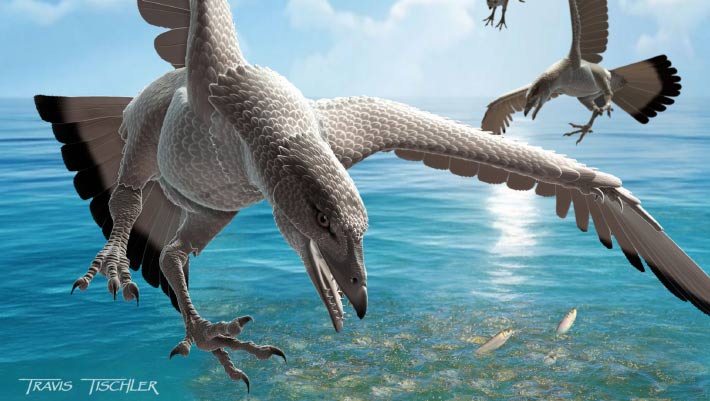
Un nouveau dinosaure à plumes de Chine avait une queue semblable à celle d'un paon
plume Chine Crétacé Crétacé inférieur Changzhousaurus Dinosauria oiseau évolution nouvelle espèce
Un nouveau genre et une nouvelle espèce de dinosaure pennaraptoran à quatre ailes du Crétacé inférieur du nord de la Chine ajoutent une autre tournure à l'histoire de l'évolution des oiseaux à partir de leurs ancêtres dinosaures. L'article Un nouveau dinosaure à plumes de Chine avait une queue semblable à un paon est apparu en premier sur Sci.News : Breaking Science News.
23/06/2026 sci-news ⚙ Traduction automatique
Modèle CollectA Deluxe Edmontosaurus se nourrissant de certains conifères
alimentation Crétacé Crétacé supérieur Dinosauria Edmontosaurus Hadrosauria
Merci Caldey de nous avoir envoyé une photo de votre CollectA Deluxe Edmontosaurus se nourrissant dans le jardin.  Le dinosaure a l’air très à l’aise en grignotant certains conifères.  Les paléontologues savent, grâce au contenu de l'estomac des hadrosaures, que ces herbivores du Crétacé supérieur se nourrissaient de conifères.  C'est une photographie délicieusement composée.  L'angle de vision donne l'impression
23/06/2026 everythingdinosaur ⚙ Traduction automatique
125-Million-Year-Old Crocodile Relative Reveals Its True Colors
Un parent de crocodile âgé de 125 millions d'années révèle ses vraies couleurs
écaille peau Espagne Crétacé Crétacé inférieur autres reptiles
La peau exceptionnellement préservée de Montsecosuchus depereti, un crocodylomorphe éteint pas plus gros qu'un chat domestique qui rôdait dans les zones humides tropicales de l'Espagne du Crétacé inférieur, a permis aux paléontologues de reconstituer les détails de ses écailles, de ses organes sensoriels et même d'éventuelles marques en bandes le long de sa queue. L'article Un parent de crocodile âgé de 125 millions d'années révèle ses vraies couleurs est apparu en premier sur Sci.News : Breaking Science News.
18/06/2026 sci-news ⚙ Traduction automatique
1 2 3 4 5 6 7 8