Crétacé

Intervalle géologique

185 image(s) · 46 Actualités

Voir la fiche

Galerie d'images

Qunkasaura is a titanosaurian sauropod dinosaur that lived approximately 75 million years ago in the Late Cretaceous of what is now Spain. Specifically, it is a saltasaurid titanosaur, and its discovery marks the first instance of two distinct lineages of this group present in the same locality. In the Late Cretaceous, Europe was a large archipelago, and the coexistence of these differing lineages indicates that saltasaurids arrived in the Iberian Peninsula much later than other groups of dinosaurs.
Taxons Qunkasaura

Qunkasaura is a titanosaurian sauropod dinosaur that lived approximately 75 million years ago in the Late Cretaceous of what is now Spain. Specifically, it is a saltasaurid titanosaur, and its discovery marks the first instance of two distinct lineages of this group present in the same locality. In the Late Cretaceous, Europe was a large archipelago, and the coexistence of these differing lineages indicates that saltasaurids arrived in the Iberian Peninsula much later than other groups of dinosaurs.

Espagne Crétacé Crétacé supérieur Dinosauria +4
Saltasaurus (which means "lizard from Salta") was a sauropod dinosaur of the Late Cretaceous Period. Relatively small among sauropods, though still massive by human standards, it was characterized by a diplodocid-like head
Taxons Saltasaurus

Saltasaurus (which means "lizard from Salta") was a sauropod dinosaur of the Late Cretaceous Period. Relatively small among sauropods, though still massive by human standards, it was characterized by a diplodocid-like head

Crétacé Crétacé supérieur Balochisauridae Dinosauria +7
Saltasaurus (which means "lizard from Salta") was a sauropod dinosaur of the Late Cretaceous Period. Relatively small among sauropods, though still massive by human standards, it was characterized by a diplodocid-like head
Taxons Lithostrotia

Saltasaurus (which means "lizard from Salta") was a sauropod dinosaur of the Late Cretaceous Period. Relatively small among sauropods, though still massive by human standards, it was characterized by a diplodocid-like head

Crétacé Crétacé supérieur Balochisauridae Dinosauria +7
Saltasaurus (which means "lizard from Salta") was a sauropod dinosaur of the Late Cretaceous Period. Relatively small among sauropods, though still massive by human standards, it was characterized by a diplodocid-like head
Taxons Titanosauridae

Saltasaurus (which means "lizard from Salta") was a sauropod dinosaur of the Late Cretaceous Period. Relatively small among sauropods, though still massive by human standards, it was characterized by a diplodocid-like head

Crétacé Crétacé supérieur Balochisauridae Dinosauria +7
Saltasaurus (which means "lizard from Salta") was a sauropod dinosaur of the Late Cretaceous Period. Relatively small among sauropods, though still massive by human standards, it was characterized by a diplodocid-like head
Taxons Saltasauridae

Saltasaurus (which means "lizard from Salta") was a sauropod dinosaur of the Late Cretaceous Period. Relatively small among sauropods, though still massive by human standards, it was characterized by a diplodocid-like head

Crétacé Crétacé supérieur Balochisauridae Dinosauria +7
Saltasaurus (which means "lizard from Salta") was a sauropod dinosaur of the Late Cretaceous Period. Relatively small among sauropods, though still massive by human standards, it was characterized by a diplodocid-like head
Taxons Saltasaurinae

Saltasaurus (which means "lizard from Salta") was a sauropod dinosaur of the Late Cretaceous Period. Relatively small among sauropods, though still massive by human standards, it was characterized by a diplodocid-like head

Crétacé Crétacé supérieur Balochisauridae Dinosauria +7
Saltasaurus (which means "lizard from Salta") was a sauropod dinosaur of the Late Cretaceous Period. Relatively small among sauropods, though still massive by human standards, it was characterized by a diplodocid-like head
Taxons Balochisauridae

Saltasaurus (which means "lizard from Salta") was a sauropod dinosaur of the Late Cretaceous Period. Relatively small among sauropods, though still massive by human standards, it was characterized by a diplodocid-like head

Crétacé Crétacé supérieur Balochisauridae Dinosauria +7
Saltasaurus (which means "lizard from Salta") was a sauropod dinosaur of the Late Cretaceous Period. Relatively small among sauropods, though still massive by human standards, it was characterized by a diplodocid-like head
Taxons Saltasaurini

Saltasaurus (which means "lizard from Salta") was a sauropod dinosaur of the Late Cretaceous Period. Relatively small among sauropods, though still massive by human standards, it was characterized by a diplodocid-like head

Crétacé Crétacé supérieur Balochisauridae Dinosauria +7
Reconstruction of the holotype skull (PIN 3906/2) of the Late Cretaceous sauropod Quaesitosaurus orientalis. Based on Kurzanov & Bannikov 1983,[1] missing elements restored after Nemegtosaurus.[2]
Color Key
  Preserved
  Missing
References

↑ (1983). "A new sauropod from the Upper Cretaceous of Mongolia". Paleontological Journal 2: 90−96.

↑ (2005). "Redescription of the mongolian sauropod Nemegtosaurus mongoliensis nowinski (dinosauria: Saurischia) and comments on late cretaceous sauropod diversity". Journal of Systematic Palaeontology 3 (3): 283−318. DOI:10.1017/S1477201905001628.
Taxons Quaesitosaurus

Reconstruction of the holotype skull (PIN 3906/2) of the Late Cretaceous sauropod Quaesitosaurus orientalis. Based on Kurzanov & Bannikov 1983,[1] missing elements restored after Nemegtosaurus.[2] Color Key   Preserved   Missing References ↑ (1983). "A new sauropod from the Upper Cretaceous of Mongolia". Paleontological Journal 2: 90−96. ↑ (2005). "Redescription of the mongolian sauropod Nemegtosaurus mongoliensis nowinski (dinosauria: Saurischia) and comments on late cretaceous sauropod diversity". Journal of Systematic Palaeontology 3 (3): 283−318. DOI:10.1017/S1477201905001628.

Mongolie Crétacé Crétacé supérieur holotype +5
Restoration of Borealosaurus a potentially titanosaur dinosaur from the Cretaceous of China
Taxons Borealosaurus

Restoration of Borealosaurus a potentially titanosaur dinosaur from the Cretaceous of China

Chine Crétacé Borealosaurus Dinosauria +1
Globidens aegyptiacus Zdansky, 1934 - Ouled Abdoun, Khouribgha Province, Chaouia-Ouardigha Region, Morocco - Maastrichtian, Cretaceous (≈ -70,6 MA ± ≈ 0,6 MA)

Globidens aegyptiacus Zdansky, 1934 - Ouled Abdoun, Khouribgha Province, Chaouia-Ouardigha Region, Morocco - Maastrichtian, Cretaceous (≈ -70,6 MA ± ≈ 0,6 MA)

Maroc Crétacé Maastrichtien Globidens +1
Globidens aegyptiacus Zdansky, 1934 - Ouled Abdoun, Khouribgha Province, Chaouia-Ouardigha Region, Morocco - Maastrichtian, Cretaceous (≈ -70,6 MA ± ≈ 0,6 MA)

Globidens aegyptiacus Zdansky, 1934 - Ouled Abdoun, Khouribgha Province, Chaouia-Ouardigha Region, Morocco - Maastrichtian, Cretaceous (≈ -70,6 MA ± ≈ 0,6 MA)

Maroc Crétacé Maastrichtien Globidens +1
The Maastrichtian, Transylvanian giant azhdarchid pterosaur Hatzegopteryx sp. preys on the rhabdodontid iguanodontian Zalmoxes. Because large predatory theropods are unknown on Late Cretaceous Haţeg Island, giant azhdarchids may have played a key role as terrestrial predators in this community.

The Maastrichtian, Transylvanian giant azhdarchid pterosaur Hatzegopteryx sp. preys on the rhabdodontid iguanodontian Zalmoxes. Because large predatory theropods are unknown on Late Cretaceous Haţeg Island, giant azhdarchids may have played a key role as terrestrial predators in this community.

prédateur proie Crétacé Crétacé supérieur +8
Reconstruction of Mochlodon suessi from the Late Cretaceous of Austria. Based on Zalmoxes by Scott Hartman
Taxons Mochlodon

Reconstruction of Mochlodon suessi from the Late Cretaceous of Austria. Based on Zalmoxes by Scott Hartman

Autriche Crétacé Crétacé supérieur Mochlodon +1
Palaeogeographic distribution of late Early and early Late Cretaceous pterosaur assemblages. Taxonomic composition of assemblages shown on Fig. 1. Palaeogeography based on Smith et al. 1994. Abbreviations: 1. Cambridge Greensand, England: 2. Lower Chalk, England: 3. Züümbayan Svita, Khuren-Dukh, Mongolia: 4. Lysaya Gora, Saratov, Russia: 5. Kem Kem red beds, Morocco: 6. Paw Paw Formation, Texas, USA: 7. Lagarcito Formation, San Luis, Argentina: 8. Santana and Crato Formations, Ceara, Brazil: 9. Toolebuc Formation, Queensland, Australia.

Palaeogeographic distribution of late Early and early Late Cretaceous pterosaur assemblages. Taxonomic composition of assemblages shown on Fig. 1. Palaeogeography based on Smith et al. 1994. Abbreviations: 1. Cambridge Greensand, England: 2. Lower Chalk, England: 3. Züümbayan Svita, Khuren-Dukh, Mongolia: 4. Lysaya Gora, Saratov, Russia: 5. Kem Kem red beds, Morocco: 6. Paw Paw Formation, Texas, USA: 7. Lagarcito Formation, San Luis, Argentina: 8. Santana and Crato Formations, Ceara, Brazil: 9. Toolebuc Formation, Queensland, Australia.

Argentine Australie Brésil Mongolie +8
Locality map: Grand Staircase-Escalante National Monument, southern Utah.
Map showing the Nipple Butte area (indicated by yellow star) of Grand Staircase-Escalante National Monument (GSENM). GSENM is bounded by the red rectangle and silhouetted in dark gray on the inset of Utah and surrounding states (modified from [1]).

The original map has been modified to show the Nipple Butte area instead of the Machairoceratops fossil locality as in the original source. New location based on map in A New Macrovertebrate Assemblage from the Late Cretaceous (Campanian) of Southern Utah, page 601.

Locality map: Grand Staircase-Escalante National Monument, southern Utah. Map showing the Nipple Butte area (indicated by yellow star) of Grand Staircase-Escalante National Monument (GSENM). GSENM is bounded by the red rectangle and silhouetted in dark gray on the inset of Utah and surrounding states (modified from [1]). The original map has been modified to show the Nipple Butte area instead of the Machairoceratops fossil locality as in the original source. New location based on map in A New Macrovertebrate Assemblage from the Late Cretaceous (Campanian) of Southern Utah, page 601.

Campanien Crétacé Crétacé supérieur fossile +1
1 2 3 4 5 6 7 8 9 10 11 12

Actualités

Leptoceratops: Beast of the Week
Leptocératops : la bête de la semaine
membre Canada Crétacé Crétacé supérieur Ceratopsia Dinosauria Leptoceratops
 Aujourd'hui, nous allons nous intéresser au petit dinosaure cératopsien, Leptoceratops gracilis ! Leptoceratops était un dinosaure cératopsien herbivore qui vivait dans ce qui est aujourd'hui l'Alberta, au Canada, à la fin du Crétacé, il y a entre 68 et 66 millions d'années.  Du bec à la queue, il mesurait environ 6,5 pieds (environ 2 m) et aurait pu marcher sur quatre ou deux membres de son vivant. Le nom du genre se traduit par « petit visage cornu ». Reconstitution de la vie du Leptoceratops à l'aquarelle par Christopher DiPiazza.L
08/06/2026 prehistoricbeastoftheweek ⚙ Traduction automatique
Un vrai cauchemar volant : des chercheurs ont découvert un « dragon » préhistorique avec 4 ailes qui terrorisait les premiers oiseaux !
plume chasse Chine Crétacé fossile Dinosauria oiseau étude
Les raptors, dinosaures à plumes du Crétacé, ne pouvaient pas voler malgré leur lien étroit avec les oiseaux. Une nouvelle étude menée sur un site fossilifère en Chine révèle toutefois que certains d’entre eux auraient été capables de planer et de chasser les premiers oiseaux.
05/06/2026 futura-terre
New Microraptorine Dinosaur Discovered in China
Un nouveau dinosaure microraptorine découvert en Chine
Chine Crétacé Crétacé inférieur spécimen Dinosauria Jian Microraptorinae oiseau
Jian changmaensis est le premier dinosaure non aviaire découvert sur un site paléontologique ayant livré plus de 100 spécimens d'oiseaux du Crétacé inférieur. L'article Un nouveau dinosaure microraptorine découvert en Chine est apparu en premier sur Sci.News : Breaking Science News.
04/06/2026 sci-news ⚙ Traduction automatique
Un nouveau dinosaure Unenlagiid de Patagonie (Argentine)
Argentine Japon Crétacé Crétacé supérieur fossile Dinosauria Kank Unenlagiidae découverte formation nouvelle espèce
Une équipe de scientifiques argentins et japonais a décrit une nouvelle espèce de dinosaure unenlagiidé du sud de la Patagonie. Nommé Kank australis, ce petit dinosaure théropode vivait il y a environ 70 millions d'années à la fin du Crétacé. Les restes fossiles ont été découverts dans la formation Chorrillo de la province de Santa Cruz, en Argentine. La découverte aide mieux les paléontologues
02/06/2026 everythingdinosaur ⚙ Traduction automatique
Cet oiseau fossile arborait un étonnant plumage sur la queue
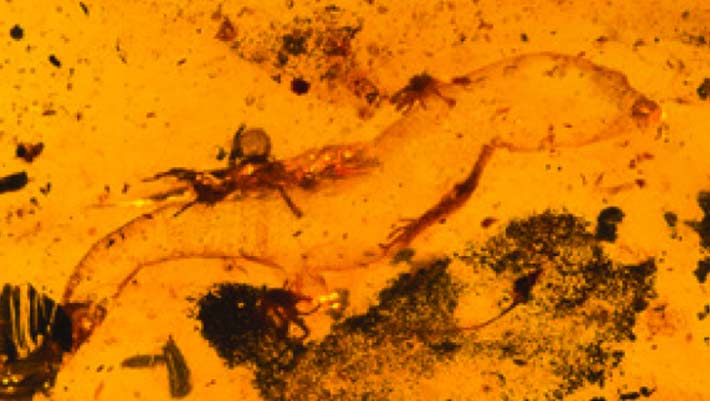
plume Crétacé fossile oiseau
Une espèce d'oiseau du Crétacé nouvellement décrite possédait d'étonnamment longues plumes sur la queue. Les chercheurs supposent qu'elles aidaient les mâles à séduire les femelles.
01/06/2026 sciencesetavenir
1 2 3 4 5 6 7 8 9 10