←

Crétacé

Intervalle géologique

163 image(s) · 58 Actualités

Voir la fiche

Galerie d'images

Eonatator sternbergi, a mosasaur from the Late Cretaceous of Kansas. Digital.
Taxons Eonatator

Eonatator sternbergi, a mosasaur from the Late Cretaceous of Kansas. Digital.

Crétacé Crétacé supérieur Eonatator Spinops
Phylogenetic relationships, chronostratigraphic, and paleoecological implications of M. intrepidus. a Graphic illustrating temporal range of North American tyrannosauroids including species-level range prior to the discovery of M. intrepidus, extension of current range, and hypothesized range based on isolated teeth12. The current gap in the North American tyrannosauroid record spans from the Tithonian to the Aptian. Faunal composition of Late Cretaceous ecosystems was established between the Albian and Turonian, as recognized by the stratigraphic appearance of major clades (see refs. 7,12 and references therein). b generalized phylogenetic relationships of Tyrannosauroidea, showing the appearance of select traits related to cursoriality in tyrannosaurs that are newly optimized as a result of the discovery of M. intrepidus. Tree topology follows this study using the modified dataset of Carr and colleagues27. Coelurus and Tanycolagreus are grafted as basal tyrannosauroids following Brusatte and colleagues5. c Stratigraphic distribution of Allosauria in North America (incl. Megaraptora but see ref. 70 for alternative hypotheses regarding this clade) documents overlap with M. intrepidus in early Late Cretaceous ecosystems leading to (d) refined calibration on the origin of late diverging tyrannosauroids and clade-level faunal turnover within apex predator roles throughout the Late Jurassic–Late Cretaceous of North America. Colored polygons are stylized call-outs and are not intended to reflect two-dimensional data. Temporal data corresponding to this figure are available in Supplementary Table 5
Taxons Coelurus

Phylogenetic relationships, chronostratigraphic, and paleoecological implications of M. intrepidus. a Graphic illustrating temporal range of North American tyrannosauroids including species-level range prior to the discovery of M. intrepidus, extension of current range, and hypothesized range based on isolated teeth12. The current gap in the North American tyrannosauroid record spans from the Tithonian to the Aptian. Faunal composition of Late Cretaceous ecosystems was established between the Albian and Turonian, as recognized by the stratigraphic appearance of major clades (see refs. 7,12 and references therein). b generalized phylogenetic relationships of Tyrannosauroidea, showing the appearance of select traits related to cursoriality in tyrannosaurs that are newly optimized as a result of the discovery of M. intrepidus. Tree topology follows this study using the modified dataset of Carr and colleagues27. Coelurus and Tanycolagreus are grafted as basal tyrannosauroids following Brusatte and colleagues5. c Stratigraphic distribution of Allosauria in North America (incl. Megaraptora but see ref. 70 for alternative hypotheses regarding this clade) documents overlap with M. intrepidus in early Late Cretaceous ecosystems leading to (d) refined calibration on the origin of late diverging tyrannosauroids and clade-level faunal turnover within apex predator roles throughout the Late Jurassic–Late Cretaceous of North America. Colored polygons are stylized call-outs and are not intended to reflect two-dimensional data. Temporal data corresponding to this figure are available in Supplementary Table 5

prédateur Albien Aptien Crétacé +12
Clidastes propython, a mosasaur from the Late Cretaceous of Kansas, digital.
Taxons Clidastes

Clidastes propython, a mosasaur from the Late Cretaceous of Kansas, digital.

Crétacé Crétacé supérieur Clidastes Spinops
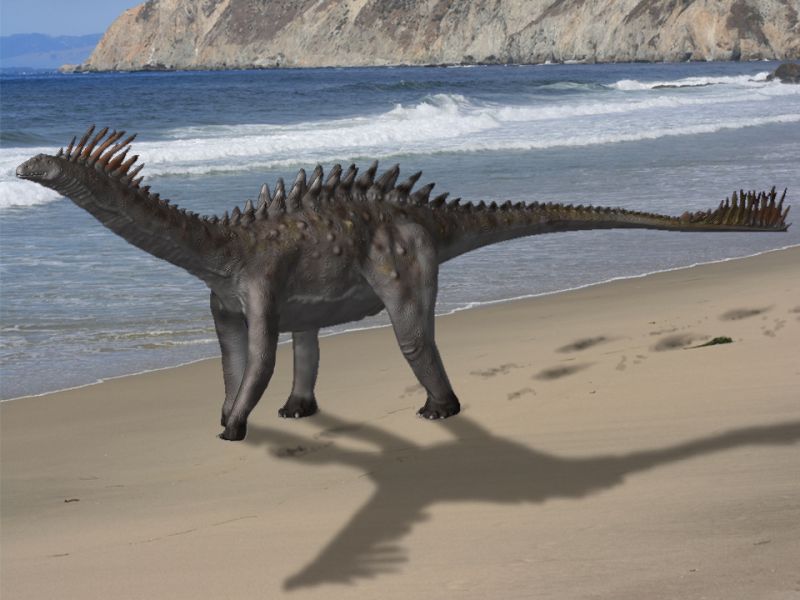
Reconstruction of Agustinia ligabuei from the Early Cretaceous of Argentina as a rebbachisaurid following Bellardini et al. 2022

Reconstruction of Agustinia ligabuei from the Early Cretaceous of Argentina as a rebbachisaurid following Bellardini et al. 2022

Argentine Crétacé Crétacé inférieur Agustinia +2
Agustinia ligabuei, a sauropod from the Early Cretaceous of Argentina. Digital.

Agustinia ligabuei, a sauropod from the Early Cretaceous of Argentina. Digital.

Argentine Crétacé Crétacé inférieur Agustinia +2
Pliosaurus (Luskhan itilensis) lived on the territory of the Volga region in the Hauterivian age of the Early Cretaceous period. Discovered in 2002 by G.N. Uspensky on the banks of the Volga near the village of Slantsevy Rudnik. This is the most complete pliosaurus skeleton found in Russia. This pliosaurus was not a predator and preferred to feed on fish and cephalopods.

Pliosaurus (Luskhan itilensis) lived on the territory of the Volga region in the Hauterivian age of the Early Cretaceous period. Discovered in 2002 by G.N. Uspensky on the banks of the Volga near the village of Slantsevy Rudnik. This is the most complete pliosaurus skeleton found in Russia. This pliosaurus was not a predator and preferred to feed on fish and cephalopods.

prédateur Russie Crétacé Crétacé inférieur +5
Reconstruction of brachauchenin pliosaurid Luskhan itilensis. Early Cretaceous of Ulyanovsk region. 2017.

Reconstruction of brachauchenin pliosaurid Luskhan itilensis. Early Cretaceous of Ulyanovsk region. 2017.

Crétacé Crétacé inférieur Brachaucheninae Luskhan +1
A new plesiosaur, Leurospondylus, from the Edmonton Cretaceous of Alberta

A new plesiosaur, Leurospondylus, from the Edmonton Cretaceous of Alberta

Crétacé Edmontonia Leurospondylus Plesiosauria
Ancient landscape across the Cretaceous/Paleogene time interval in central Patagonia. Main floristic types from the Danian: Podocarps, Cheirolepidiaceae, palms.
doi:10.1371/journal.pone.0052455.g007

Ancient landscape across the Cretaceous/Paleogene time interval in central Patagonia. Main floristic types from the Danian: Podocarps, Cheirolepidiaceae, palms. doi:10.1371/journal.pone.0052455.g007

Crétacé Danien Paléogène
Iron trapped in Cretaceous limestone, forming tables

Iron trapped in Cretaceous limestone, forming tables

Crétacé
Limestone cliff with the stratigraphic stage of Cretaceous Coniacian near the eponym town of Cognac, Charente, Poitou-Charentes, France.

Limestone cliff with the stratigraphic stage of Cretaceous Coniacian near the eponym town of Cognac, Charente, Poitou-Charentes, France.

France Coniacien Crétacé
crétacé limestone at Cognac, Charente, SW France

crétacé limestone at Cognac, Charente, SW France

France Crétacé
Cretaceous limestone at Cognac, Charente, SW France

Cretaceous limestone at Cognac, Charente, SW France

France Crétacé
Ivy and limestone cliff of Cretaceous Coniacian, Cognac, Charente, France.

Ivy and limestone cliff of Cretaceous Coniacian, Cognac, Charente, France.

France Coniacien Crétacé
Limestone Cretaceous cornices (Coniacian type), valley of the river Voultron; Blanzaguet-Saint-Cybard, Charente, France.

Limestone Cretaceous cornices (Coniacian type), valley of the river Voultron; Blanzaguet-Saint-Cybard, Charente, France.

France Coniacien Crétacé
Quarry called “Ratssteinbruch” at Plauenscher Grund (gorge-like valley of the river Weißeritz nearby/in the city of Dresden, Saxony, Germany), Upper Carboniferous Monzonite (historically identified as Syenite) of the Meißen Massif (Paleozoic basement) unconformably overlain by Upper Cenomanian beds of the Dölzschen Formation, yellowish basal conglomerate and overlying bluish silty clay-marlstone (“plenus-Pläner”) of the Saxo-Bohemian Cretaceous Basin (Mesozoic platform).[1]

Quarry called “Ratssteinbruch” at Plauenscher Grund (gorge-like valley of the river Weißeritz nearby/in the city of Dresden, Saxony, Germany), Upper Carboniferous Monzonite (historically identified as Syenite) of the Meißen Massif (Paleozoic basement) unconformably overlain by Upper Cenomanian beds of the Dölzschen Formation, yellowish basal conglomerate and overlying bluish silty clay-marlstone (“plenus-Pläner”) of the Saxo-Bohemian Cretaceous Basin (Mesozoic platform).[1]

Allemagne Carbonifère Cénomanien Crétacé +3
1 2 3 4 5 6 7 8 9 10 11

Actualités

Un fossile d'ichthyosaure du Queensland fournit la première preuve mondiale de prédation sur un ptérosaure
prédateur proie Australie Toolebuc Crétacé Crétacé inférieur fossile Ichthyosauria Pterosauria formation
Un fossile extraordinaire provenant du Queensland, en Australie, a fourni la preuve d'une chaîne alimentaire préhistorique. Les scientifiques ont identifié la première preuve définitive qu'un ichtyosaure a consommé un ptérosaure. De plus, le reptile marin est devenu plus tard la proie de l’un des plus grands prédateurs de l’ancienne mer d’Eromanga. Le fossile spectaculaire provient de la Formation de Toolebuc du Crétacé inférieur
28/07/2026 everythingdinosaur ⚙ Traduction automatique
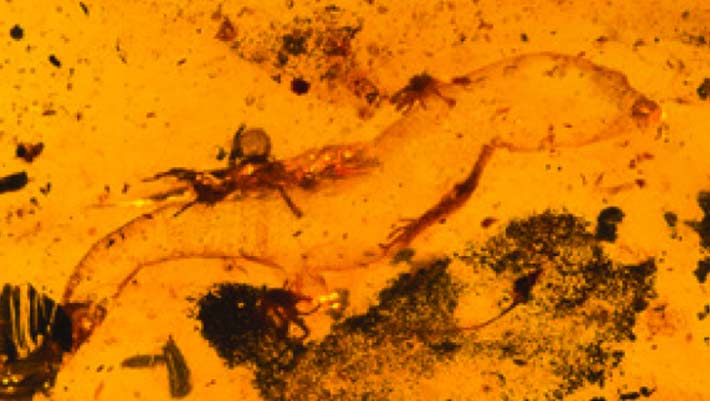
Oldest Known Male Gecko Found Preserved in Kachin Amber
Le plus ancien gecko mâle connu trouvé préservé dans l'ambre Kachin
Myanmar Crétacé nouvelle espèce autres reptiles
Les paléontologues ont décrit un nouveau genre et une nouvelle espèce de gecko ancien trouvés dans deux morceaux d'ambre provenant de gisements d'ambre vieux de 99 millions d'années (Crétacé moyen) dans la province de Kachin, au Myanmar. Le post Le plus ancien gecko mâle connu trouvé conservé dans Kachin Amber est apparu en premier sur Sci.News: Breaking Science News.
20/07/2026 sci-news ⚙ Traduction automatique
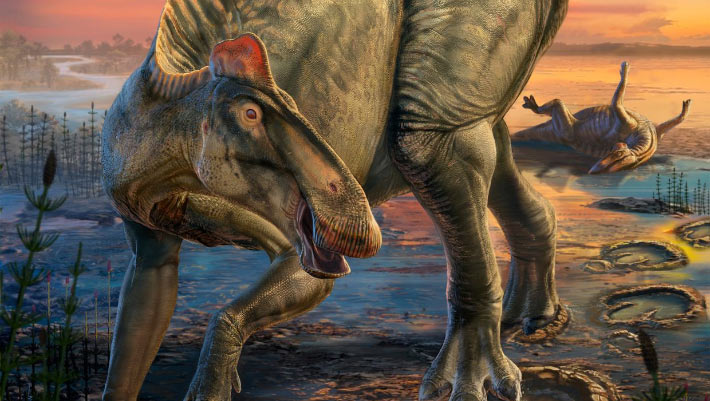
Tyrannosaurus rex Scavenged Duck-Billed Dinosaurs in Ancient Wyoming, Bite Marks Reveal
Des dinosaures à bec de canard récupérés par Tyrannosaurus rex dans l'ancien Wyoming et des marques de morsure révélées
os alimentation chasse États-Unis Crétacé Canardia Dinosauria Edmontosaurus Tyrannosaurus comportement
Des milliers d'os fossilisés provenant d'un gisement d'ossements du Crétacé dans le Wyoming, aux États-Unis, offrent des preuves physiques rares que le Tyrannosaurus rex s'est nourri des carcasses d'une espèce de dinosaure à bec de canard appelée Edmontosaurus annectens. L'article Tyrannosaurus rex a récupéré des dinosaures à bec de canard dans l'ancien Wyoming, les marques de morsure révèlent est apparu en premier sur Sci.News : Breaking Science News.
16/07/2026 sci-news ⚙ Traduction automatique
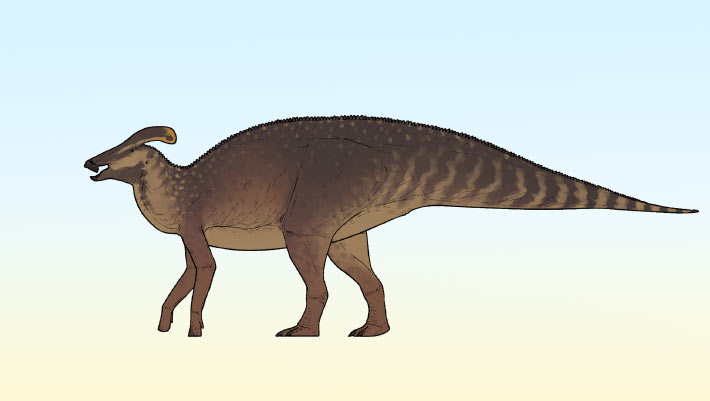
New Crested Dinosaur Species Identified in Canada
De nouvelles espèces de dinosaures à crête identifiées au Canada
crête Canada Campanien Crétacé Dinosauria Hadrosauridae datation nouvelle espèce
Un nouveau genre et une nouvelle espèce de dinosaure hadrosauridé lambéosaurine ont été identifiés dans le sud de l'Alberta, au Canada, remontant à 77 millions d'années, à l'âge campanien du Crétacé. L'article Nouvelles espèces de dinosaures à crête identifiées au Canada apparaît en premier sur Sci.News : Breaking Science News.
14/07/2026 sci-news ⚙ Traduction automatique
Des scientifiques décrivent officiellement le premier fossile de dinosaure découvert en Antarctique
vertèbre Antarctique Crétacé Crétacé supérieur fossile Dinosauria Titanosauria découverte
Les scientifiques ont officiellement décrit le premier fossile de dinosaure découvert en Antarctique. La découverte remarquable est une seule vertèbre provenant d’un titanosaure du Crétacé supérieur. Bien que le fossile ait été collecté il y a plus de quarante ans, les chercheurs n’ont confirmé son identité que récemment.  Le premier fossile de dinosaure découvert en Antarctique est décrit dans la revue Acta Palaeontologica Polonica.
29/06/2026 everythingdinosaur ⚙ Traduction automatique
1 2 3 4 5 6 7 8 9 10 11 12