Crétacé

Intervalle géologique

121 image(s) · 33 Actualités

Voir la fiche

Galerie d'images

Anacleto and Allen fms. (Upper Cretaceous) in Auca Mahuida, Neuquen, Argentina.
Formations Allen

Anacleto and Allen fms. (Upper Cretaceous) in Auca Mahuida, Neuquen, Argentina.

Argentine Allen Anacleto Crétacé
Map of Cretaceous-aged dinosaur fossil localities of Mongolia.
Gobihadros mongoliensis was collected from Bayshin Tsav in Area C. Open squares indicate Late Cretaceous sites, solid squares represent Early Cretaceous localities. Abbreviations: A, Localities of Western Gobi Desert in Mongolia, mainly group of localities of Nemegtian age (early Maastrichtian), Late Cretaceous; B, Localities of Central Gobi Desert in Mongolia, mainly Djadokhtian age (Campanian), Late Cretaceous; C & D- Localities of Eastern Gobi Desert in Mongolia, mainly Baynshirenian age (Cenomanian-Santonian), Late Cretaceous. Figure has been modified from Tsogtbaatar et al. 2014, Figure 1 [24].
Formations Baynshire

Map of Cretaceous-aged dinosaur fossil localities of Mongolia. Gobihadros mongoliensis was collected from Bayshin Tsav in Area C. Open squares indicate Late Cretaceous sites, solid squares represent Early Cretaceous localities. Abbreviations: A, Localities of Western Gobi Desert in Mongolia, mainly group of localities of Nemegtian age (early Maastrichtian), Late Cretaceous; B, Localities of Central Gobi Desert in Mongolia, mainly Djadokhtian age (Campanian), Late Cretaceous; C & D- Localities of Eastern Gobi Desert in Mongolia, mainly Baynshirenian age (Cenomanian-Santonian), Late Cretaceous. Figure has been modified from Tsogtbaatar et al. 2014, Figure 1 [24].

Mongolie Campanien Cénomanien Crétacé +8
Anacleto fm. (Upper Cretaceous) in Auca Mahuida, Neuquen, Argentina.
Formations Anacleto

Anacleto fm. (Upper Cretaceous) in Auca Mahuida, Neuquen, Argentina.

Argentine Anacleto Crétacé
Candeleros fm. (Upper Cretaceous) near Cerro El Vagon, Neuquen, Argentina.
Formations Candeleros

Candeleros fm. (Upper Cretaceous) near Cerro El Vagon, Neuquen, Argentina.

Argentine Candeleros Crétacé
Plotosaurus bennisoni is a mosasaur from the Upper Cretaceous (Maastrichtian) North America.

Plotosaurus bennisoni is a mosasaur from the Upper Cretaceous (Maastrichtian) North America.

Crétacé Maastrichtien Plotosaurus
A 1.7cm tall tooth from Liodon anceps.  Cretaceous, Phosphate beds, Kouribga, Morocco.

A 1.7cm tall tooth from Liodon anceps. Cretaceous, Phosphate beds, Kouribga, Morocco.

dent Maroc Crétacé Leiodon +1
Main evolutionary steps proposed for the morphofunctional and postural changes of the sauropod pedes. (A) Sauropod body mass through time (in metric tons) based on the sauropod body mass estimations of (41) (NB: data lacking for the second half of the Upper Cretaceous so illustrated here faded, in continuity with the data recorded in the Cretaceous). Schematic outlines of selected large specimens illustrated in the curve, including (from left to right) P. engelhardti, Vulcanodon karibaensis, R. brownei, G. brancai, Cedarosaurus weiskopfae, and Notocolossus gonzalezparejasi. (B) Projected evolutionary changes occurring in the sauropod pes associated with trend in body mass, including 1, skeletal and functional digitigrade pedal posture among basal non-sauropod sauropodomorphs with an incipient soft tissue pad (ISP) (see figs. S34 and S35); 2 and 3, expansion of a well-developed soft tissue pad beneath the elevated pedal bones (SP), resulting in a functionally plantigrade pes + retention of skeletal posture within a range of digitigrady; 4, retention of a soft tissue pad and yet undetermined trend toward more elevated bones; 5, conservation of the neomorphic soft tissue pad within all lineages. Selected examples of well-preserved non-sauropod sauropodomorph and sauropod pedal tracks illustrated above the trends, including (from left to right) Evazoum siriguii; Pseudotetrasauropus bipedoida, Eosauropus isp., Lavinipes cheminii; Kalosauropus pollex, Liujianpus shunan, Polyonyx gomesi; Parabrontopodus mcintoshi; Brontopodus birdi; Titanopodus mendozensis; and unnamed Asian sauropod track. Source of adapted drawing and notes are listed in table S9 and data S2.
Taxons Evazoum

Main evolutionary steps proposed for the morphofunctional and postural changes of the sauropod pedes. (A) Sauropod body mass through time (in metric tons) based on the sauropod body mass estimations of (41) (NB: data lacking for the second half of the Upper Cretaceous so illustrated here faded, in continuity with the data recorded in the Cretaceous). Schematic outlines of selected large specimens illustrated in the curve, including (from left to right) P. engelhardti, Vulcanodon karibaensis, R. brownei, G. brancai, Cedarosaurus weiskopfae, and Notocolossus gonzalezparejasi. (B) Projected evolutionary changes occurring in the sauropod pes associated with trend in body mass, including 1, skeletal and functional digitigrade pedal posture among basal non-sauropod sauropodomorphs with an incipient soft tissue pad (ISP) (see figs. S34 and S35); 2 and 3, expansion of a well-developed soft tissue pad beneath the elevated pedal bones (SP), resulting in a functionally plantigrade pes + retention of skeletal posture within a range of digitigrady; 4, retention of a soft tissue pad and yet undetermined trend toward more elevated bones; 5, conservation of the neomorphic soft tissue pad within all lineages. Selected examples of well-preserved non-sauropod sauropodomorph and sauropod pedal tracks illustrated above the trends, including (from left to right) Evazoum siriguii; Pseudotetrasauropus bipedoida, Eosauropus isp., Lavinipes cheminii; Kalosauropus pollex, Liujianpus shunan, Polyonyx gomesi; Parabrontopodus mcintoshi; Brontopodus birdi; Titanopodus mendozensis; and unnamed Asian sauropod track. Source of adapted drawing and notes are listed in table S9 and data S2.

os tissus Crétacé spécimen +6
Main evolutionary steps proposed for the morphofunctional and postural changes of the sauropod pedes. (A) Sauropod body mass through time (in metric tons) based on the sauropod body mass estimations of (41) (NB: data lacking for the second half of the Upper Cretaceous so illustrated here faded, in continuity with the data recorded in the Cretaceous). Schematic outlines of selected large specimens illustrated in the curve, including (from left to right) P. engelhardti, Vulcanodon karibaensis, R. brownei, G. brancai, Cedarosaurus weiskopfae, and Notocolossus gonzalezparejasi. (B) Projected evolutionary changes occurring in the sauropod pes associated with trend in body mass, including 1, skeletal and functional digitigrade pedal posture among basal non-sauropod sauropodomorphs with an incipient soft tissue pad (ISP) (see figs. S34 and S35); 2 and 3, expansion of a well-developed soft tissue pad beneath the elevated pedal bones (SP), resulting in a functionally plantigrade pes + retention of skeletal posture within a range of digitigrady; 4, retention of a soft tissue pad and yet undetermined trend toward more elevated bones; 5, conservation of the neomorphic soft tissue pad within all lineages. Selected examples of well-preserved non-sauropod sauropodomorph and sauropod pedal tracks illustrated above the trends, including (from left to right) Evazoum siriguii; Pseudotetrasauropus bipedoida, Eosauropus isp., Lavinipes cheminii; Kalosauropus pollex, Liujianpus shunan, Polyonyx gomesi; Parabrontopodus mcintoshi; Brontopodus birdi; Titanopodus mendozensis; and unnamed Asian sauropod track. Source of adapted drawing and notes are listed in table S9 and data S2.
Taxons Kalosauropus

Main evolutionary steps proposed for the morphofunctional and postural changes of the sauropod pedes. (A) Sauropod body mass through time (in metric tons) based on the sauropod body mass estimations of (41) (NB: data lacking for the second half of the Upper Cretaceous so illustrated here faded, in continuity with the data recorded in the Cretaceous). Schematic outlines of selected large specimens illustrated in the curve, including (from left to right) P. engelhardti, Vulcanodon karibaensis, R. brownei, G. brancai, Cedarosaurus weiskopfae, and Notocolossus gonzalezparejasi. (B) Projected evolutionary changes occurring in the sauropod pes associated with trend in body mass, including 1, skeletal and functional digitigrade pedal posture among basal non-sauropod sauropodomorphs with an incipient soft tissue pad (ISP) (see figs. S34 and S35); 2 and 3, expansion of a well-developed soft tissue pad beneath the elevated pedal bones (SP), resulting in a functionally plantigrade pes + retention of skeletal posture within a range of digitigrady; 4, retention of a soft tissue pad and yet undetermined trend toward more elevated bones; 5, conservation of the neomorphic soft tissue pad within all lineages. Selected examples of well-preserved non-sauropod sauropodomorph and sauropod pedal tracks illustrated above the trends, including (from left to right) Evazoum siriguii; Pseudotetrasauropus bipedoida, Eosauropus isp., Lavinipes cheminii; Kalosauropus pollex, Liujianpus shunan, Polyonyx gomesi; Parabrontopodus mcintoshi; Brontopodus birdi; Titanopodus mendozensis; and unnamed Asian sauropod track. Source of adapted drawing and notes are listed in table S9 and data S2.

os tissus Crétacé spécimen +6
Thescelosaurus neglectus, a hypsilophodont from the Late cretaceous of North America

Thescelosaurus neglectus, a hypsilophodont from the Late cretaceous of North America

Crétacé Crétacé supérieur Hypsilophodontia Spinops +1
Paleoartistic depiction of a Cretaceous forest of what is today the Tanis site, in North Dakota, hours after the K-Pg impact. We observe a burnt carcass of a Thescelosaurus, a impaled nanhsiungchelyid turtle, a small multituberculate mammal and a small ornithuran avialan.

Paleoartistic depiction of a Cretaceous forest of what is today the Tanis site, in North Dakota, hours after the K-Pg impact. We observe a burnt carcass of a Thescelosaurus, a impaled nanhsiungchelyid turtle, a small multituberculate mammal and a small ornithuran avialan.

Crétacé Thescelosaurus
Dorsal vertebra of platecarpus, a cretaceous. Mosasaur from the Niobrara Chalk of Kansas etc.

General Collections
Keywords: prehistoric archaeology; Paleopathology; Moodie, Roy Lee

Dorsal vertebra of platecarpus, a cretaceous. Mosasaur from the Niobrara Chalk of Kansas etc. General Collections Keywords: prehistoric archaeology; Paleopathology; Moodie, Roy Lee

vertèbre Niobrara Crétacé Platecarpus
Crâne de mosasaure d'espèce Platecarpus tympaniticus (squamates, mosasaures).
Provenance : Smoky Hill Chalk, Kansas (aux Etats-Unis).
Date : Crétacé supérieur, période du Campanien, 88 millions d'années avant notre ère.
Collections du Muséum national d'histoire naturelle de Paris (France).
Exposé à l'occasion de l'exposition "Un T-Rex à Paris" au Muséum national d'histoire naturelle de Paris (France) du 6 juin au 2 septembre 2018.

Légende du fossile dans cette exposition : "Les mosasaures ne sont pas des dinosaures mais des reptiles marins, très répandus à la fin du Crétacé. Certains genres comme Globidens et Halisaurus sont connus aussi bien aux Etats-Unis qu'au Maroc. Ces animaux étaient d'excellents nageurs, capables de traverser l'Atlantique."

Crâne de mosasaure d'espèce Platecarpus tympaniticus (squamates, mosasaures). Provenance : Smoky Hill Chalk, Kansas (aux Etats-Unis). Date : Crétacé supérieur, période du Campanien, 88 millions d'années avant notre ère. Collections du Muséum national d'histoire naturelle de Paris (France). Exposé à l'occasion de l'exposition "Un T-Rex à Paris" au Muséum national d'histoire naturelle de Paris (France) du 6 juin au 2 septembre 2018. Légende du fossile dans cette exposition : "Les mosasaures ne sont pas des dinosaures mais des reptiles marins, très répandus à la fin du Crétacé. Certains genres comme Globidens et Halisaurus sont connus aussi bien aux Etats-Unis qu'au Maroc. Ces animaux étaient d'excellents nageurs, capables de traverser l'Atlantique."

France Maroc Campanien Crétacé +8
Holotype specimen TMP 2000.29.01 of the ophthalmosaurian ichthyosaur Athabascasaurus bitumineus from the Lower Cretaceous Clearwater Formation of Alberta, in Royal Tyrrell Museum, Drumheller, Alberta, Canada.

Holotype specimen TMP 2000.29.01 of the ophthalmosaurian ichthyosaur Athabascasaurus bitumineus from the Lower Cretaceous Clearwater Formation of Alberta, in Royal Tyrrell Museum, Drumheller, Alberta, Canada.

musée Canada Crétacé holotype +5
Life restoration of the mosasaurine mosasaurid Eremiasaurus, with unknown portions and soft tissues based primarily on Prognathodon and supplemented with Mosasaurus where needed.
References
Leblanc, A.R.H.; Caldwell, M.W.; Bardet, N. (2012). "A new mosasaurine from the Maastrichtian (Upper Cretaceous) phosphates of Morocco and its implications for mosasaurine systematics". Journal of Vertebrate Paleontology 32 (1): 82–104.
Lindgren, J.; Kaddumi, H.; Polcyn, M. (2013). "Soft tissue preservation in a fossil marine lizard with a bilobed tail fin". Nature Communications 4: 2423. DOI:10.1038/ncomms3423.
Konishi, T.; Brinkman, D.; Massare, J.A.; Caldwell, M.W. (2011). "New exceptional specimens of Prognathodon overtoni (Squamata, Mosasauridae) from the upper Campanian of Alberta, Canada, and the systematics and ecology of the genus". Journal of Vertebrate Paleontology 31 (5): 1026–1046.
Russell, D.A. (1967). "Systematics and morphology of American mosasaurs". Bulletin of the Peabody Museum of Natural History 23: 1–241.
Taxons Eremiasaurus

Life restoration of the mosasaurine mosasaurid Eremiasaurus, with unknown portions and soft tissues based primarily on Prognathodon and supplemented with Mosasaurus where needed. References Leblanc, A.R.H.; Caldwell, M.W.; Bardet, N. (2012). "A new mosasaurine from the Maastrichtian (Upper Cretaceous) phosphates of Morocco and its implications for mosasaurine systematics". Journal of Vertebrate Paleontology 32 (1): 82–104. Lindgren, J.; Kaddumi, H.; Polcyn, M. (2013). "Soft tissue preservation in a fossil marine lizard with a bilobed tail fin". Nature Communications 4: 2423. DOI:10.1038/ncomms3423. Konishi, T.; Brinkman, D.; Massare, J.A.; Caldwell, M.W. (2011). "New exceptional specimens of Prognathodon overtoni (Squamata, Mosasauridae) from the upper Campanian of Alberta, Canada, and the systematics and ecology of the genus". Journal of Vertebrate Paleontology 31 (5): 1026–1046. Russell, D.A. (1967). "Systematics and morphology of American mosasaurs". Bulletin of the Peabody Museum of Natural History 23: 1–241.

tissus écologie musée Canada +11
Simple drawing of Ankylosaurus magniventris, a North American Cretaceous ankylosaurid. Based on skeletal reconstruction in Paul 2010.
Taxons Crichtonpelta

Simple drawing of Ankylosaurus magniventris, a North American Cretaceous ankylosaurid. Based on skeletal reconstruction in Paul 2010.

dessin Crétacé Ankylosauria Ankylosauridae +2
Left ilium of the camarasauromorph sauropod Brontomerus mcintoshi from the Lower Cretaceous Cedar Mountain Formation of Utah, type specimen OMNH 66430 in lateral view reconstructed from the three fragments (A), and ventral view (B).
Taxons Brontomerus

Left ilium of the camarasauromorph sauropod Brontomerus mcintoshi from the Lower Cretaceous Cedar Mountain Formation of Utah, type specimen OMNH 66430 in lateral view reconstructed from the three fragments (A), and ventral view (B).

Cedar Mountain Crétacé spécimen Brontomerus +1
1 2 3 4 5 6 7 8

Actualités

Description d'un fossile de dinosaure rare du groupe de Nanaimo du Crétacé supérieur
os vertèbre description Canada Colombie Crétacé Crétacé supérieur fossile Dinosauria Ornithomimosauria
Les chercheurs ont décrit une seule vertèbre caudale de dinosaure (coccyx) de l'île Denman (Colombie-Britannique, Canada).  Il a été identifié comme une vertèbre caudale d'ornithomimosaure. Le fossile, censé représenter un os de la partie médiane de la queue, n'est que le deuxième fossile de dinosaure identifié dans le groupe de Nanaimo du Crétacé supérieur. De plus, il
10/06/2026 everythingdinosaur ⚙ Traduction automatique
Description d'un nouveau dinosaure à quatre ailes en provenance de Chine
plume membre description Chine Crétacé Crétacé inférieur fossile Dinosauria Jian Microraptorinae nouvelle espèce partiel
Les paléontologues ont décrit une nouvelle espèce de théropode microraptorine du nord-ouest de la Chine. Nommé Jian changmaensis, ce petit dinosaure à plumes planait probablement sur quatre ailes. Le fossile fournit de nouvelles informations sur les écosystèmes du Crétacé inférieur et étend l’aire de répartition connue des Microraptorinae. Le matériau fossile est constitué d'une ceinture pectorale gauche partielle articulée et d'un membre antérieur. Il
08/06/2026 everythingdinosaur ⚙ Traduction automatique
Leptoceratops: Beast of the Week
Leptocératops : la bête de la semaine
membre Canada Crétacé Crétacé supérieur Ceratopsia Dinosauria Leptoceratops
 Aujourd'hui, nous allons nous intéresser au petit dinosaure cératopsien, Leptoceratops gracilis ! Leptoceratops était un dinosaure cératopsien herbivore qui vivait dans ce qui est aujourd'hui l'Alberta, au Canada, à la fin du Crétacé, il y a entre 68 et 66 millions d'années.  Du bec à la queue, il mesurait environ 6,5 pieds (environ 2 m) et aurait pu marcher sur quatre ou deux membres de son vivant. Le nom du genre se traduit par « petit visage cornu ». Reconstitution de la vie du Leptoceratops à l'aquarelle par Christopher DiPiazza.L
08/06/2026 prehistoricbeastoftheweek ⚙ Traduction automatique
Un vrai cauchemar volant : des chercheurs ont découvert un « dragon » préhistorique avec 4 ailes qui terrorisait les premiers oiseaux !
plume Chine Crétacé Dinosauria étude
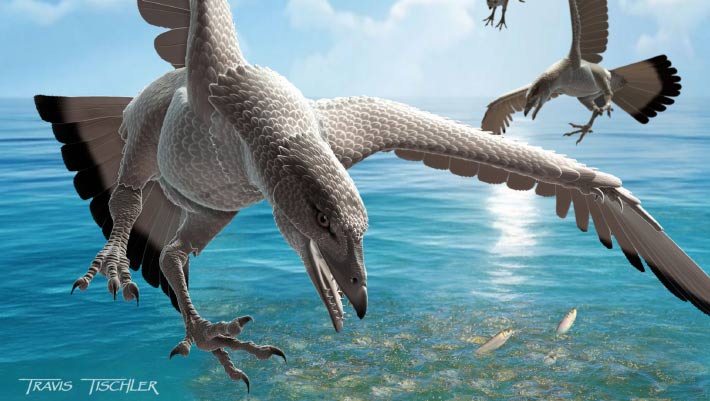
Les raptors, dinosaures à plumes du Crétacé, ne pouvaient pas voler malgré leur lien étroit avec les oiseaux. Une nouvelle étude menée sur un site fossilifère en Chine révèle toutefois que certains d’entre eux auraient été capables de planer et de chasser les premiers oiseaux.
05/06/2026 futura-terre
New Microraptorine Dinosaur Discovered in China
Un nouveau dinosaure microraptorine découvert en Chine
Chine Crétacé Crétacé inférieur spécimen Dinosauria Jian Microraptorinae oiseau
Jian changmaensis est le premier dinosaure non aviaire découvert sur un site paléontologique ayant livré plus de 100 spécimens d'oiseaux du Crétacé inférieur. L'article Un nouveau dinosaure microraptorine découvert en Chine est apparu en premier sur Sci.News : Breaking Science News.
04/06/2026 sci-news ⚙ Traduction automatique
1 2 3 4 5 6 7