←

Crétacé

Intervalle géologique

163 image(s) · 58 Actualités

Voir la fiche

Galerie d'images

Skull of troodontid theropod Xixiasaurus henanensis gen. et sp. nov. (HGM 41HIII−0201; holotype), lower–middle Majiacun Formation (Upper Cretaceous: Coniacian–Campanian), Henan Province, China; in dorsal (A); lateral (B), and ventral (C) views.

Note that this version of the image does not include the interpretative lines of the version in the paper.
Taxons Xixiasaurus

Skull of troodontid theropod Xixiasaurus henanensis gen. et sp. nov. (HGM 41HIII−0201; holotype), lower–middle Majiacun Formation (Upper Cretaceous: Coniacian–Campanian), Henan Province, China; in dorsal (A); lateral (B), and ventral (C) views. Note that this version of the image does not include the interpretative lines of the version in the paper.

Chine Campanien Coniacien Crétacé +5
Skull diagram featuring the holotype skull (ROM 1790) of the ornithomimid Rativates evadens, from the Late Cretaceous period. Abbreviations: d, dentary; f, frontal; l, lacrimal; m, maxilla; n, nasal; pm, premaxila; ps, paraphenoid.
Taxons Rativates

Skull diagram featuring the holotype skull (ROM 1790) of the ornithomimid Rativates evadens, from the Late Cretaceous period. Abbreviations: d, dentary; f, frontal; l, lacrimal; m, maxilla; n, nasal; pm, premaxila; ps, paraphenoid.

Crétacé Crétacé supérieur holotype Ornithomimidae +2
Riojavenatrix: "La Rioja huntress" Early Cretaceous, Europe
Taxons Riojavenatrix

Riojavenatrix: "La Rioja huntress" Early Cretaceous, Europe

Crétacé Crétacé inférieur Riojavenatrix
Restoration of Zhuchengtitan zangjiazhuangensis from the Late Cretaceous of China
Taxons Zhuchengtitan

Restoration of Zhuchengtitan zangjiazhuangensis from the Late Cretaceous of China

Chine Crétacé Crétacé supérieur Zhuchengtitan
Qunkasaura is a titanosaurian sauropod dinosaur that lived approximately 75 million years ago in the Late Cretaceous of what is now Spain. Specifically, it is a saltasaurid titanosaur, and its discovery marks the first instance of two distinct lineages of this group present in the same locality. In the Late Cretaceous, Europe was a large archipelago, and the coexistence of these differing lineages indicates that saltasaurids arrived in the Iberian Peninsula much later than other groups of dinosaurs.
Taxons Qunkasaura

Qunkasaura is a titanosaurian sauropod dinosaur that lived approximately 75 million years ago in the Late Cretaceous of what is now Spain. Specifically, it is a saltasaurid titanosaur, and its discovery marks the first instance of two distinct lineages of this group present in the same locality. In the Late Cretaceous, Europe was a large archipelago, and the coexistence of these differing lineages indicates that saltasaurids arrived in the Iberian Peninsula much later than other groups of dinosaurs.

Espagne Crétacé Crétacé supérieur Dinosauria +4
Life reconstruction of the Late Cretaceous south american paravian, Overoraptor chimentoi
Taxons Overoraptor

Life reconstruction of the Late Cretaceous south american paravian, Overoraptor chimentoi

Crétacé Crétacé supérieur Overoraptor
Reconstruction of the holotype material of Silutitan sinensis (IVPP V27874), a Cretaceous euhelopid sauropod from the Chinese Shengjinkou Formation, scaled after Euhelopus zdanskyi. Silhouette modified from  "Euhelopus zdanskyi Skeletal" by Gunnar Bivens (CC BY 3.0) (https://www.deviantart.com/gunnarbivens/art/Euhelopus-zdanskyi-Skeletal-833724646)
Taxons Silutitan

Reconstruction of the holotype material of Silutitan sinensis (IVPP V27874), a Cretaceous euhelopid sauropod from the Chinese Shengjinkou Formation, scaled after Euhelopus zdanskyi. Silhouette modified from "Euhelopus zdanskyi Skeletal" by Gunnar Bivens (CC BY 3.0) (https://www.deviantart.com/gunnarbivens/art/Euhelopus-zdanskyi-Skeletal-833724646)

Crétacé holotype Euhelopus Silutitan +1
Identifier: annalsofmedicalh01pack (find matches)
Title: Annals of medical history
Year: 1917 (1910s)
Authors:  Packard, Francis R. (Francis Randolph), 1870-1950
Subjects:  Medicine
Publisher:  New York P.B. Hoeber
Contributing Library:  Gerstein - University of Toronto
Digitizing Sponsor:  University of Toronto

View Book Page: Book Viewer
About This Book: Catalog Entry
View All Images: All Images From Book
Click here to view book online to see this illustration in context in a browseable online version of this book.

Text Appearing Before Image:
ail strongly Hexed, and the toescontracted and appressed. The whole atti-tude strongly suggests a spastic distress,possibly brought on by some form ofpoisoning of the central nervous system,from infection or the deglutition of somepoisonous substance. 14. Osteomalacia is evidently the causeof the hypertrophy of the bones of Lim-nocyron potens, an early carnivore from theWashakie Eocene of Wyoming, nearly3,000,000 years old. MATERIALS AND METHODS The material described in the presentpaper has been loaned the writer lor de-scription by the Field Museum of Chii Osborn: Hull. Amcr. \lus. Natl. Hist., 1917,vol. 35. !>• 733. P>- 28. Studies in Paleopathology 393 by the American Museum of Natural His-tory of New York City, by Walker Museumof the University of Chicago, and by the Uni-versity of Kansas Natural History Museum. made by the well-known petrographic meth-ods so common in all geological labora-tories. The diagnoses, where they are at-tempted, arc made from comparisons of the
Text Appearing After Image:
Fig. 20. The skeleton of Strutbiomimus altus, a small dinosaur from the BeliyRiver series (Cretaceous), Red Deer River, Alberta, Canada, now regarded as ofapproximately the same age as the Judith River series. The unique feature ofthe skull is the total absence of teeth, with a size of skull one-third larger thanthe ostrich and a length of body of about fifteen feet. The position of the skeletonis decidedly that of the opisthotonos which may be regarded as an indication ofdisease. (After Osborn). A beautiful specimen of an osteoma, theonly one known so far, on the vertebra of aKansas Cretaceous mosasaur, was given thewriter by Dr. J. M. Armstrong of St. Paul.The writer expresses his obligations to thegentlemen connected with the above-men-tioned institutions and to Dr. Armstrong.The methods used are a combination ofprocedures in the various lines involved.Microscopic sections, which can be madethin enough for immersion lens study, are material with similar lesions in recent hu-man mat

Note About Images

Please note that these images are extracted from scanned page images that may have been digitally enhanced for readability - coloration and appearance of these illustrations may not perfectly resemble the original work.
Taxons Hexing

Identifier: annalsofmedicalh01pack (find matches) Title: Annals of medical history Year: 1917 (1910s) Authors: Packard, Francis R. (Francis Randolph), 1870-1950 Subjects: Medicine Publisher: New York P.B. Hoeber Contributing Library: Gerstein - University of Toronto Digitizing Sponsor: University of Toronto View Book Page: Book Viewer About This Book: Catalog Entry View All Images: All Images From Book Click here to view book online to see this illustration in context in a browseable online version of this book. Text Appearing Before Image: ail strongly Hexed, and the toescontracted and appressed. The whole atti-tude strongly suggests a spastic distress,possibly brought on by some form ofpoisoning of the central nervous system,from infection or the deglutition of somepoisonous substance. 14. Osteomalacia is evidently the causeof the hypertrophy of the bones of Lim-nocyron potens, an early carnivore from theWashakie Eocene of Wyoming, nearly3,000,000 years old. MATERIALS AND METHODS The material described in the presentpaper has been loaned the writer lor de-scription by the Field Museum of Chii Osborn: Hull. Amcr. \lus. Natl. Hist., 1917,vol. 35. !>• 733. P>- 28. Studies in Paleopathology 393 by the American Museum of Natural His-tory of New York City, by Walker Museumof the University of Chicago, and by the Uni-versity of Kansas Natural History Museum. made by the well-known petrographic meth-ods so common in all geological labora-tories. The diagnoses, where they are at-tempted, arc made from comparisons of the Text Appearing After Image: Fig. 20. The skeleton of Strutbiomimus altus, a small dinosaur from the BeliyRiver series (Cretaceous), Red Deer River, Alberta, Canada, now regarded as ofapproximately the same age as the Judith River series. The unique feature ofthe skull is the total absence of teeth, with a size of skull one-third larger thanthe ostrich and a length of body of about fifteen feet. The position of the skeletonis decidedly that of the opisthotonos which may be regarded as an indication ofdisease. (After Osborn). A beautiful specimen of an osteoma, theonly one known so far, on the vertebra of aKansas Cretaceous mosasaur, was given thewriter by Dr. J. M. Armstrong of St. Paul.The writer expresses his obligations to thegentlemen connected with the above-men-tioned institutions and to Dr. Armstrong.The methods used are a combination ofprocedures in the various lines involved.Microscopic sections, which can be madethin enough for immersion lens study, are material with similar lesions in recent hu-man mat Note About Images Please note that these images are extracted from scanned page images that may have been digitally enhanced for readability - coloration and appearance of these illustrations may not perfectly resemble the original work.

os vertèbre livre musée +11
Alvarezsauridae gen. et sp. indet., posterior caudal vertebrae. Dzharakuduk, Uzbekistan; Bissekty Formation, Upper Cretaceous (Turonian). a-e, ZIN PH 2441/16, two vertebrae preserved in articulation, in anterior (a), dorsal (b), posterior (c), lateral (d), and ventral (e) views. f-j, ZIN PH 2442/16, vertebra missing ventral part of the centrum, in dorsal (f), lateral (g), ventral (h), anterior (i), and posterior (j).
Taxons Dzharaonyx

Alvarezsauridae gen. et sp. indet., posterior caudal vertebrae. Dzharakuduk, Uzbekistan; Bissekty Formation, Upper Cretaceous (Turonian). a-e, ZIN PH 2441/16, two vertebrae preserved in articulation, in anterior (a), dorsal (b), posterior (c), lateral (d), and ventral (e) views. f-j, ZIN PH 2442/16, vertebra missing ventral part of the centrum, in dorsal (f), lateral (g), ventral (h), anterior (i), and posterior (j).

vertèbre Ouzbékistan Bissekty Crétacé +4
Ceratonykus oculatus, Late Cretaceous of Mongolia. Digital.
Taxons Ceratonykus

Ceratonykus oculatus, Late Cretaceous of Mongolia. Digital.

Mongolie Crétacé Crétacé supérieur Ceratonykus +1
Reconstruction of the holotype skull (PIN 3906/2) of the Late Cretaceous sauropod Quaesitosaurus orientalis. Based on Kurzanov & Bannikov 1983,[1] missing elements restored after Nemegtosaurus.[2]
Color Key
  Preserved
  Missing
References

↑ (1983). "A new sauropod from the Upper Cretaceous of Mongolia". Paleontological Journal 2: 90−96.

↑ (2005). "Redescription of the mongolian sauropod Nemegtosaurus mongoliensis nowinski (dinosauria: Saurischia) and comments on late cretaceous sauropod diversity". Journal of Systematic Palaeontology 3 (3): 283−318. DOI:10.1017/S1477201905001628.
Taxons Quaesitosaurus

Reconstruction of the holotype skull (PIN 3906/2) of the Late Cretaceous sauropod Quaesitosaurus orientalis. Based on Kurzanov & Bannikov 1983,[1] missing elements restored after Nemegtosaurus.[2] Color Key   Preserved   Missing References ↑ (1983). "A new sauropod from the Upper Cretaceous of Mongolia". Paleontological Journal 2: 90−96. ↑ (2005). "Redescription of the mongolian sauropod Nemegtosaurus mongoliensis nowinski (dinosauria: Saurischia) and comments on late cretaceous sauropod diversity". Journal of Systematic Palaeontology 3 (3): 283−318. DOI:10.1017/S1477201905001628.

Mongolie Crétacé Crétacé supérieur holotype +5
Jiangxititan a titanosaurian sauropod from the Late Cretaceous of China. Typical for a sauropod, it had a long neck and stood on four pillar-like legs to support its massive body. Jiangxititan is a member of the Lognkosauria, which include some of the largest dinosaurs known, and is one of the few from mainland Asia. The discovery of Jiangxititan demonstrates the presence of both early-diverging and late-diverging titanosauriform sauropods in that area during the Late Cretaceous.
Taxons Jiangxititan

Jiangxititan a titanosaurian sauropod from the Late Cretaceous of China. Typical for a sauropod, it had a long neck and stood on four pillar-like legs to support its massive body. Jiangxititan is a member of the Lognkosauria, which include some of the largest dinosaurs known, and is one of the few from mainland Asia. The discovery of Jiangxititan demonstrates the presence of both early-diverging and late-diverging titanosauriform sauropods in that area during the Late Cretaceous.

Chine Crétacé Crétacé supérieur Dinosauria +5
Restoration of Dongbeititan dongi from the Early Cretaceous of China
Taxons Dongbeititan

Restoration of Dongbeititan dongi from the Early Cretaceous of China

Chine Crétacé Crétacé inférieur Dongbeititan
Restoration of Borealosaurus a potentially titanosaur dinosaur from the Cretaceous of China
Taxons Borealosaurus

Restoration of Borealosaurus a potentially titanosaur dinosaur from the Cretaceous of China

Chine Crétacé Borealosaurus Dinosauria +1
Jeholopterus ningchengensus Wang, Zhou, Zhang, and Xu, 2002, IVPP V 12705, Lower Yixian Formation (Early Cretaceous), China.
Taxons Jeholopterus

Jeholopterus ningchengensus Wang, Zhou, Zhang, and Xu, 2002, IVPP V 12705, Lower Yixian Formation (Early Cretaceous), China.

Chine Yixian Crétacé Crétacé inférieur +2
Skeletal reconstruction of Ahshislepelta minor, a small ankylosaur from the Late Cretaceous Kirtland Formation of New Mexico. While originally recovered as an ankylosaurid related to Gastonia, later analyses favored a nodosaurid position which this is based on. Based on the holotype SMP VP-1930, consisting of fragmentary shoulder, forelimb, and vertebral elements as well as several osteoderms. Unknown material filled in using Niobrarasaurus, Pawpawsaurus, Silvisaurus, Sauropelta, and Borealopelta. Total length is approximately 4.9 m through the centra.
Notes: Osteoderm placement somewhat speculative, not all osteoderms and vertebral fragments are figured.

References: Burns & Sullivan, 2011.
Taxons Ahshislepelta

Skeletal reconstruction of Ahshislepelta minor, a small ankylosaur from the Late Cretaceous Kirtland Formation of New Mexico. While originally recovered as an ankylosaurid related to Gastonia, later analyses favored a nodosaurid position which this is based on. Based on the holotype SMP VP-1930, consisting of fragmentary shoulder, forelimb, and vertebral elements as well as several osteoderms. Unknown material filled in using Niobrarasaurus, Pawpawsaurus, Silvisaurus, Sauropelta, and Borealopelta. Total length is approximately 4.9 m through the centra. Notes: Osteoderm placement somewhat speculative, not all osteoderms and vertebral fragments are figured. References: Burns & Sullivan, 2011.

Mexique Kirtland Crétacé Crétacé supérieur +13
1 2 3 4 5 6 7 8 9 10 11

Actualités

Un fossile d'ichthyosaure du Queensland fournit la première preuve mondiale de prédation sur un ptérosaure
prédateur proie Australie Toolebuc Crétacé Crétacé inférieur fossile Ichthyosauria Pterosauria formation
Un fossile extraordinaire provenant du Queensland, en Australie, a fourni la preuve d'une chaîne alimentaire préhistorique. Les scientifiques ont identifié la première preuve définitive qu'un ichtyosaure a consommé un ptérosaure. De plus, le reptile marin est devenu plus tard la proie de l’un des plus grands prédateurs de l’ancienne mer d’Eromanga. Le fossile spectaculaire provient de la Formation de Toolebuc du Crétacé inférieur
28/07/2026 everythingdinosaur ⚙ Traduction automatique
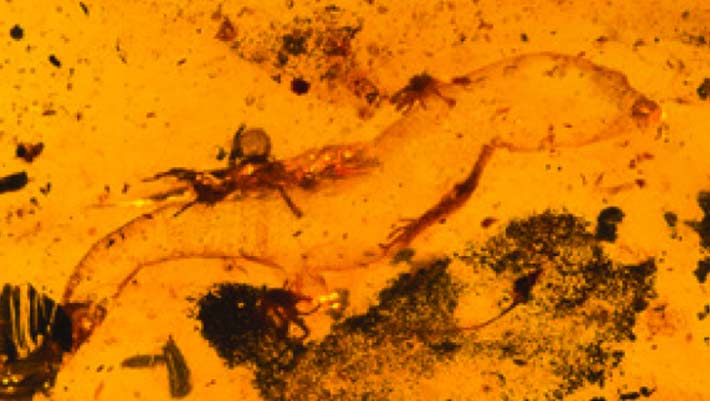
Oldest Known Male Gecko Found Preserved in Kachin Amber
Le plus ancien gecko mâle connu trouvé préservé dans l'ambre Kachin
Myanmar Crétacé nouvelle espèce autres reptiles
Les paléontologues ont décrit un nouveau genre et une nouvelle espèce de gecko ancien trouvés dans deux morceaux d'ambre provenant de gisements d'ambre vieux de 99 millions d'années (Crétacé moyen) dans la province de Kachin, au Myanmar. Le post Le plus ancien gecko mâle connu trouvé conservé dans Kachin Amber est apparu en premier sur Sci.News: Breaking Science News.
20/07/2026 sci-news ⚙ Traduction automatique
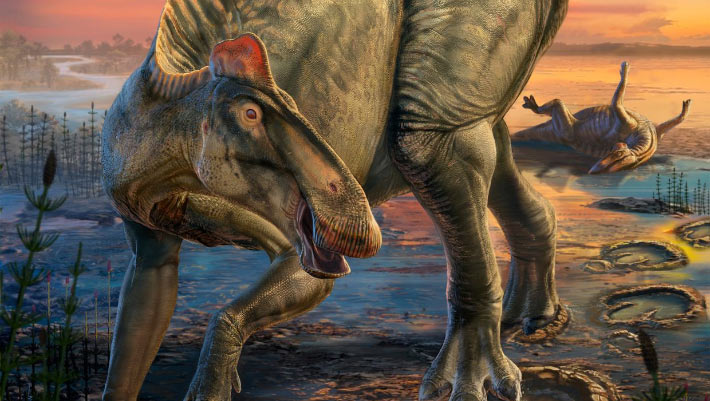
Tyrannosaurus rex Scavenged Duck-Billed Dinosaurs in Ancient Wyoming, Bite Marks Reveal
Des dinosaures à bec de canard récupérés par Tyrannosaurus rex dans l'ancien Wyoming et des marques de morsure révélées
os alimentation chasse États-Unis Crétacé Canardia Dinosauria Edmontosaurus Tyrannosaurus comportement
Des milliers d'os fossilisés provenant d'un gisement d'ossements du Crétacé dans le Wyoming, aux États-Unis, offrent des preuves physiques rares que le Tyrannosaurus rex s'est nourri des carcasses d'une espèce de dinosaure à bec de canard appelée Edmontosaurus annectens. L'article Tyrannosaurus rex a récupéré des dinosaures à bec de canard dans l'ancien Wyoming, les marques de morsure révèlent est apparu en premier sur Sci.News : Breaking Science News.
16/07/2026 sci-news ⚙ Traduction automatique
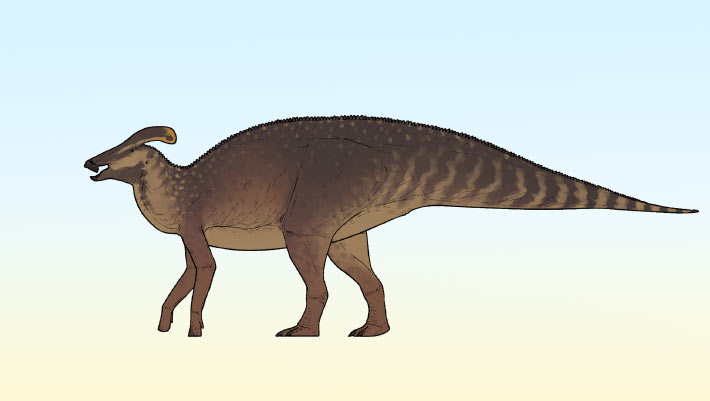
New Crested Dinosaur Species Identified in Canada
De nouvelles espèces de dinosaures à crête identifiées au Canada
crête Canada Campanien Crétacé Dinosauria Hadrosauridae datation nouvelle espèce
Un nouveau genre et une nouvelle espèce de dinosaure hadrosauridé lambéosaurine ont été identifiés dans le sud de l'Alberta, au Canada, remontant à 77 millions d'années, à l'âge campanien du Crétacé. L'article Nouvelles espèces de dinosaures à crête identifiées au Canada apparaît en premier sur Sci.News : Breaking Science News.
14/07/2026 sci-news ⚙ Traduction automatique
Des scientifiques décrivent officiellement le premier fossile de dinosaure découvert en Antarctique
vertèbre Antarctique Crétacé Crétacé supérieur fossile Dinosauria Titanosauria découverte
Les scientifiques ont officiellement décrit le premier fossile de dinosaure découvert en Antarctique. La découverte remarquable est une seule vertèbre provenant d’un titanosaure du Crétacé supérieur. Bien que le fossile ait été collecté il y a plus de quarante ans, les chercheurs n’ont confirmé son identité que récemment.  Le premier fossile de dinosaure découvert en Antarctique est décrit dans la revue Acta Palaeontologica Polonica.
29/06/2026 everythingdinosaur ⚙ Traduction automatique
1 2 3 4 5 6 7 8 9 10 11 12