Dinosauria

Taxon

285 image(s) · 194 Actualités

Voir la fiche

Galerie d'images

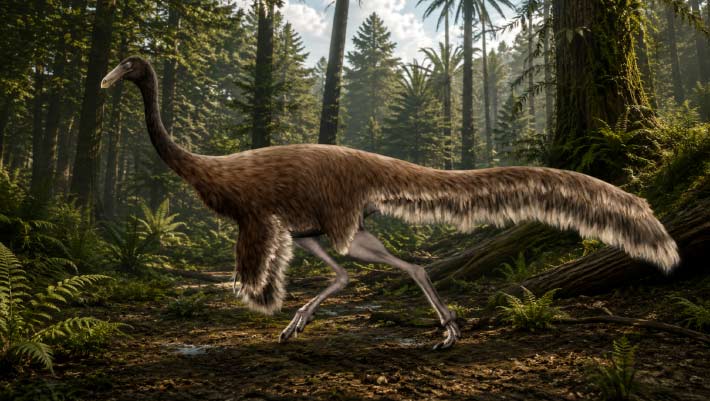
Anzu is a fairly large caenagnathid oviraptorosaurian dinosaur that grew to nearly 4 m in length, and weighed 200-300 kg. It was a bipedal dinosaur and was covered in feathers, with a large sloping crest atop its head. Typical of oviraptorosaurs, Anzu had a short toothless beak, an adaptation that suggests it was most likely herbivorous or possibly omnivorous.

Anzu is a fairly large caenagnathid oviraptorosaurian dinosaur that grew to nearly 4 m in length, and weighed 200-300 kg. It was a bipedal dinosaur and was covered in feathers, with a large sloping crest atop its head. Typical of oviraptorosaurs, Anzu had a short toothless beak, an adaptation that suggests it was most likely herbivorous or possibly omnivorous.

crête plume Anzu Caenagnathidae +2
Dinosaur Bones

Dinosaur Bones

os Sri Lanka Anzu Dinosauria
Skeletal reconstructions of Dinosaur Park Formation caenagnathids. Skeletal reconstructions of Citipes elegans (left), Chirostenotes pergracilis (middle), and Caenagnathus collinsi (right), showing variation in skeletal representation and body size. Previously referred material is indicated in white and newly referred material is indicated in red for each taxon. Blue asterisks indicate elements that have been histologically sampled for each taxon. Citipes elegans: dentaries, metatarsal IV; Chirostenotes pergracilis: dentaries, tibia; Caenagnathus collinsi: pubis.

Skeletal reconstructions of Dinosaur Park Formation caenagnathids. Skeletal reconstructions of Citipes elegans (left), Chirostenotes pergracilis (middle), and Caenagnathus collinsi (right), showing variation in skeletal representation and body size. Previously referred material is indicated in white and newly referred material is indicated in red for each taxon. Blue asterisks indicate elements that have been histologically sampled for each taxon. Citipes elegans: dentaries, metatarsal IV; Chirostenotes pergracilis: dentaries, tibia; Caenagnathus collinsi: pubis.

Dinosaur Park Caenagnathidae Caenagnathus Chirostenotes +4
Tarsometatarsi of caenagnathids from the Upper Campanian Dinosaur Park Formation, Dinosaur Provincial Park, Alberta, Canada. A. TMP 1993.036.0181 (Chirostenotes pergracilis). B. TMP 1982.016.0006 (Citipes elegans). C. ROM 781 (Citipes elegans holotype). D. TMP 1996.012.0141 (Citipes elegans). Tarsometatarsi in proximal (A1–D1), anterior (A2–D2), and posterior (A3–D3) views.

Tarsometatarsi of caenagnathids from the Upper Campanian Dinosaur Park Formation, Dinosaur Provincial Park, Alberta, Canada. A. TMP 1993.036.0181 (Chirostenotes pergracilis). B. TMP 1982.016.0006 (Citipes elegans). C. ROM 781 (Citipes elegans holotype). D. TMP 1996.012.0141 (Citipes elegans). Tarsometatarsi in proximal (A1–D1), anterior (A2–D2), and posterior (A3–D3) views.

Canada Dinosaur Park Campanien holotype +6
The Naturmuseum Senckenberg in Frankfurt is the second largest museum of natural history in Germany. It is particularly popular with children, who enjoy the extensive collection of dinosaur skeletons: Senckenberg boasts the largest exhibition of large dinosaurs in Europe. One particular treasure is a dinosaur fossil with unique, preserved scaled skin. The museum contains the world's largest and most diverse collection of stuffed birds with about 2000 specimens.

The Naturmuseum Senckenberg in Frankfurt is the second largest museum of natural history in Germany. It is particularly popular with children, who enjoy the extensive collection of dinosaur skeletons: Senckenberg boasts the largest exhibition of large dinosaurs in Europe. One particular treasure is a dinosaur fossil with unique, preserved scaled skin. The museum contains the world's largest and most diverse collection of stuffed birds with about 2000 specimens.

musée Allemagne fossile spécimen +4
Large Predatory Pliosaur Size in comparison to a Human, Great White Shark, and Blue Whale. I have included Walking with Dinosaurs Liopleurodon to show its vastly inaccurate size.

Large Predatory Pliosaur Size in comparison to a Human, Great White Shark, and Blue Whale. I have included Walking with Dinosaurs Liopleurodon to show its vastly inaccurate size.

Dinosauria Liopleurodon
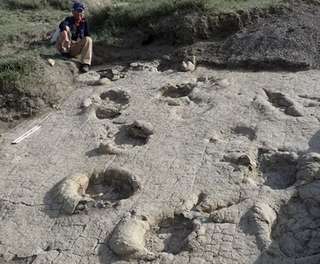
Cast of the holotype trackway of Eosauropus, a probable sauropodomorph dinosaur ichnogenus, on display at the Museum of Western Colorado’s Dinosaur Journey Museum in Fruita, Colorado
Taxons Eosauropus

Cast of the holotype trackway of Eosauropus, a probable sauropodomorph dinosaur ichnogenus, on display at the Museum of Western Colorado’s Dinosaur Journey Museum in Fruita, Colorado

musée moulage holotype Dinosauria +1
The theropod dinosaur Coelophysis bauri by John Conway [1]

The theropod dinosaur Coelophysis bauri by John Conway [1]

Conway Coelophysis Dinosauria Syntarsus
Badlands Dinosaur Museum, North Dakota 5-9-2022 (157)

Badlands Dinosaur Museum, North Dakota 5-9-2022 (157)

musée Dinosauria Thescelosaurus
Pectoral girdles and forelimbs of dinosaurs in left lateral view, depicting resting scapular and forelimb orientations in different dinosaurian groups as recommended according to the results of this study.

In each case, solid horizontal line is parallel to long axis of sacrum. A. theropods without semilunate carpals (Dilophosaurus wetherilli, UCMP 37302). B. theropods with semilunate carpals other than Caudipteryx (Velociraptor mongoliensis, after reference [60]). C. Caudipteryx (C. sp., after reference [8]). D. ceratopsids (Styracosaurus albertensis, NMC 344). E. basal sauropodomorphs (Plateosaurus engelhardti, AMNH 6810). F. non-hadrosaurian ornithopods (Thescelosaurus neglectus, reference [62]). G. hadrosaurids (Parasaurolophus walkeri, after reference [48]). Angle labels: B = scapular orientation relative to long axis of sacrum. E = elbow angle. S = shoulder angle. W = wrist angle. See Materials and Methods section for descriptions of angles.

Pectoral girdles and forelimbs of dinosaurs in left lateral view, depicting resting scapular and forelimb orientations in different dinosaurian groups as recommended according to the results of this study. In each case, solid horizontal line is parallel to long axis of sacrum. A. theropods without semilunate carpals (Dilophosaurus wetherilli, UCMP 37302). B. theropods with semilunate carpals other than Caudipteryx (Velociraptor mongoliensis, after reference [60]). C. Caudipteryx (C. sp., after reference [8]). D. ceratopsids (Styracosaurus albertensis, NMC 344). E. basal sauropodomorphs (Plateosaurus engelhardti, AMNH 6810). F. non-hadrosaurian ornithopods (Thescelosaurus neglectus, reference [62]). G. hadrosaurids (Parasaurolophus walkeri, after reference [48]). Angle labels: B = scapular orientation relative to long axis of sacrum. E = elbow angle. S = shoulder angle. W = wrist angle. See Materials and Methods section for descriptions of angles.

description Caudipteryx Ceratopsidae Dilophosaurus +9
Crâne de mosasaure d'espèce Platecarpus tympaniticus (squamates, mosasaures).
Provenance : Smoky Hill Chalk, Kansas (aux Etats-Unis).
Date : Crétacé supérieur, période du Campanien, 88 millions d'années avant notre ère.
Collections du Muséum national d'histoire naturelle de Paris (France).
Exposé à l'occasion de l'exposition "Un T-Rex à Paris" au Muséum national d'histoire naturelle de Paris (France) du 6 juin au 2 septembre 2018.

Légende du fossile dans cette exposition : "Les mosasaures ne sont pas des dinosaures mais des reptiles marins, très répandus à la fin du Crétacé. Certains genres comme Globidens et Halisaurus sont connus aussi bien aux Etats-Unis qu'au Maroc. Ces animaux étaient d'excellents nageurs, capables de traverser l'Atlantique."

Crâne de mosasaure d'espèce Platecarpus tympaniticus (squamates, mosasaures). Provenance : Smoky Hill Chalk, Kansas (aux Etats-Unis). Date : Crétacé supérieur, période du Campanien, 88 millions d'années avant notre ère. Collections du Muséum national d'histoire naturelle de Paris (France). Exposé à l'occasion de l'exposition "Un T-Rex à Paris" au Muséum national d'histoire naturelle de Paris (France) du 6 juin au 2 septembre 2018. Légende du fossile dans cette exposition : "Les mosasaures ne sont pas des dinosaures mais des reptiles marins, très répandus à la fin du Crétacé. Certains genres comme Globidens et Halisaurus sont connus aussi bien aux Etats-Unis qu'au Maroc. Ces animaux étaient d'excellents nageurs, capables de traverser l'Atlantique."

France Maroc Campanien Crétacé +8
Fig 2. Chrono-, bio- and lithostratigraphic context of the Reuchenette Formation in the Ajoie district, Canton Jura, NW Switzerland (modified from [20,23,28,31]. Four track-bearing intervals, named lower, intermediate, and upper (dinosaur track) levels, and track levels 600 have been identified within the Courtedoux Member (Nerinean Limestones, sensu [32]). All studied material comes from the intermediate (levels 1000–1100) and upper (levels 1500–1650) dinosaur track levels, details shown on inset on the upper right.

Fig 2. Chrono-, bio- and lithostratigraphic context of the Reuchenette Formation in the Ajoie district, Canton Jura, NW Switzerland (modified from [20,23,28,31]. Four track-bearing intervals, named lower, intermediate, and upper (dinosaur track) levels, and track levels 600 have been identified within the Courtedoux Member (Nerinean Limestones, sensu [32]). All studied material comes from the intermediate (levels 1000–1100) and upper (levels 1500–1650) dinosaur track levels, details shown on inset on the upper right.

Suisse Reuchenette Dinosauria Megalosauripus +1
Remake of the original picture of the Drzewica Formation. Terrestrial environment of the Pliensbachian-Toarcian boundary of Fennoscandinavia  Inland environment of the  Bornholm Coast, nearby the German realm of the Ciechocinek Formation. Includes
Ciechocinek Formation (Lower Toarcian, Bones) and Drzwica Formation (Latest Pliensbachian, Footprints) Fauna
Sorthat Formation environment, fluvial influenced mainland with Cheirolepidaceae and Bennetitales as dominant flora
Dinosaurs are based on material found on various locations of Northern Germany, and Footprints of the underliying Drzewica Formation at the Holy Cross Mountains, connected with Bornholm at the time.
Dinosaur Species appeared: 

Megalosauripus isp. Large Footprints (+65 cm) found on the Drzewica Formation. There is a dorsal vertebrae on the German Margin of the Ciechocinek Formation assigend to Megalosauria (Huene, 1966).
Gravisauria spp. representing the Grimmen Sauropod reported on 2014, as a taxon related with Tazoudasaurus. Barapasaurus-like footprints are know from the Drzewica Formation.
Coelophysoidea spp. based on coeval Anchisauripus tracks from the Holy Cross Mountains.
Basal Ornithischan, related to Eocursor, based on a crouching trace (Gerard Dariusz Gierlinski, Martin G. Lockley, Grzegorz Niedźwiedzki:2009).
Massospondylidae spp. based on Otozum-like tracks.

Remake of the original picture of the Drzewica Formation. Terrestrial environment of the Pliensbachian-Toarcian boundary of Fennoscandinavia Inland environment of the Bornholm Coast, nearby the German realm of the Ciechocinek Formation. Includes Ciechocinek Formation (Lower Toarcian, Bones) and Drzwica Formation (Latest Pliensbachian, Footprints) Fauna Sorthat Formation environment, fluvial influenced mainland with Cheirolepidaceae and Bennetitales as dominant flora Dinosaurs are based on material found on various locations of Northern Germany, and Footprints of the underliying Drzewica Formation at the Holy Cross Mountains, connected with Bornholm at the time. Dinosaur Species appeared: Megalosauripus isp. Large Footprints (+65 cm) found on the Drzewica Formation. There is a dorsal vertebrae on the German Margin of the Ciechocinek Formation assigend to Megalosauria (Huene, 1966). Gravisauria spp. representing the Grimmen Sauropod reported on 2014, as a taxon related with Tazoudasaurus. Barapasaurus-like footprints are know from the Drzewica Formation. Coelophysoidea spp. based on coeval Anchisauripus tracks from the Holy Cross Mountains. Basal Ornithischan, related to Eocursor, based on a crouching trace (Gerard Dariusz Gierlinski, Martin G. Lockley, Grzegorz Niedźwiedzki:2009). Massospondylidae spp. based on Otozum-like tracks.

os Allemagne Pliensbachien Toarcien +7
Heterodontosaurus tucki life restoration. Integument based on the related Tianyulong, proportions based on photos of specimen SAM-PK-K1332 and skeletal reconstruction by Gregory S. Paul (The Princeton Field Guide to Dinosaurs, 2010, p. 240).
Taxons Ferganocephale

Heterodontosaurus tucki life restoration. Integument based on the related Tianyulong, proportions based on photos of specimen SAM-PK-K1332 and skeletal reconstruction by Gregory S. Paul (The Princeton Field Guide to Dinosaurs, 2010, p. 240).

spécimen Dinosauria Ferganocephale Heterodontosauria +1
Depiction of dietary niche partitioning among megaherbivorous dinosaurs from the DPF (MAZ-2). Left to right: Chasmosaurus belli, Lambeosaurus lambei, Styracosaurus albertensis, Scolosaurus cutleri (formerly sunk in Euoplocephalus tutus), Prosaurolophus maximus, Panoplosaurus mirus. A herd of S. albertensis looms in the background.
Taxons Continuoolithus

Depiction of dietary niche partitioning among megaherbivorous dinosaurs from the DPF (MAZ-2). Left to right: Chasmosaurus belli, Lambeosaurus lambei, Styracosaurus albertensis, Scolosaurus cutleri (formerly sunk in Euoplocephalus tutus), Prosaurolophus maximus, Panoplosaurus mirus. A herd of S. albertensis looms in the background.

Chasmosaurus Continuoolithus Dinosauria Euoplocephalus +5
A hypothetical life restoration of Ampelosaurus atacis

• Ampelosaurus is known from hundreds of fossil specimens which show most of the dinosaur's osteological details, however, there are few articulated remains or reconstructions of the material so its overall proportions and life appearance are uncertain.
• Ampelosaurus is known to have supported osteoderms, only four are currently known. The number of these osteoderms that an individual Ampelosaurus would have supported in life and their and position on the body is not currently known. It's thought that due to the rarity of titanosaur osteoderms that they would be quite sparse on the body. The position and layout of the osteoderms has been loosely based on this interpretation, which is based on the work of Vidal et al 2015. [1]
Taxons Dashanpusaurus

A hypothetical life restoration of Ampelosaurus atacis • Ampelosaurus is known from hundreds of fossil specimens which show most of the dinosaur's osteological details, however, there are few articulated remains or reconstructions of the material so its overall proportions and life appearance are uncertain. • Ampelosaurus is known to have supported osteoderms, only four are currently known. The number of these osteoderms that an individual Ampelosaurus would have supported in life and their and position on the body is not currently known. It's thought that due to the rarity of titanosaur osteoderms that they would be quite sparse on the body. The position and layout of the osteoderms has been loosely based on this interpretation, which is based on the work of Vidal et al 2015. [1]

fossile spécimen Ampelosaurus Bagualosauria +6
1 2 3 4 5 6 7 8 9 10 11 12 13 14 15 16 17 18

Actualités

Un spinosaure géant à crête, le « héron de l'enfer », découvert dans le Sahara
crête prédateur Niger fossile Dinosauria Spinosauria
Au cœur du Sahara, des scientifiques ont découvert Spinosaurus mirabilis, un nouveau prédateur spectaculaire couronné d'une crête massive en forme de cimeterre qui aurait pu autrefois briller de couleurs sous le soleil du désert. Découvert dans des gisements de rivières intérieures isolées au Niger, le fossile réécrit ce que nous pensions savoir sur les dinosaures spinosaures, suggérant qu'ils n'étaient pas des chasseurs entièrement aquatiques mais de puissants échassiers traquant les poissons dans les cours d'eau boisés à des centaines de kilomètres de la mer.
23/02/2026 sciencedaily ⚙ Traduction automatique
Spinosaurus: Beast of the Week
Spinosaure : la bête de la semaine
Égypte Maroc Niger Crétacé Crétacé supérieur Dinosauria Spinosauria
Faites place (beaucoup d'espace... sauvegardez davantage... continuez... continuez... backbackbackback) pour le puissant Spinosaurus Aegyptiacus ! Le Spinosaurus était un dinosaure carnivore qui vivait dans ce qui est aujourd'hui l'Afrique, notamment en Égypte, au Maroc et au Niger, à la fin du Crétacé, il y a environ 97 à 95 millions d'années.  C'était un animal massif, le plus gros individu connu mesurant peut-être 49 pieds (environ 15 m) de long du museau à la queue à l'âge adulte, ce qui en fait le plus long dinosaure carnivore connu de la science.  La génération
22/02/2026 prehistoricbeastoftheweek ⚙ Traduction automatique
Un dinosaure vieux de 125 millions d'années avec des pointes creuses jamais vues auparavant découvert en Chine
Chine juvénile Dinosauria Iguanodontia
Un dinosaure vieux de 125 millions d’années vient de réécrire ce que nous pensions savoir sur la vie préhistorique. Des scientifiques chinois ont découvert un iguanodontien juvénile exceptionnellement préservé, avec une peau fossilisée si détaillée que les cellules individuelles sont encore visibles. Plus étonnant encore, le dinosaure herbivore était couvert de pointes creuses ressemblant à des porcs-épics, des structures jamais documentées auparavant chez aucun dinosaure.
18/02/2026 sciencedaily ⚙ Traduction automatique
Corythosaurus: Beast of the Week
Corythosaure : Bête de la semaine
crête Canada Canardia Corythosaurus Dinosauria Hadrosauria Hadrosauridae Hypacrosaurus Lambeosauria Parasaurolophus Velafrons
Cette semaine, nous allons jeter un œil à un dinosaure à bec de canard bien connu.  Entrez le Corythosaure !  Le Corythosaurus était un herbivore appartenant au groupe des lambiosaurines de la famille des Hadrosauridae. (becs de canard) Les hadrosaures lambiosaurines avaient généralement une crête creuse sur la tête et un bec plus étroit que les autres types d'hadrosaures.  Il était étroitement lié à d'autres hadrosaures lambiosaurines tels que Parasaurolophus, Hypacrosaurus, Lambeosaurus et Velafrons.  Il vivait dans ce qui est aujourd'hui l'Alberta, au Canada,
15/02/2026 prehistoricbeastoftheweek ⚙ Traduction automatique
Torvosaurus: Beast of the Week
Torvosaurus : Bête de la semaine
os prédateur Allemagne Portugal États-Unis Jurassique Jurassique supérieur Dinosauria Torvosaurus
Aujourd'hui, nous allons nous intéresser à un énorme dinosaure prédateur du Jurassique, Torvosaurus tanneri !  Torvosaurus vivait il y a environ 150 millions d’années à la fin du Jurassique. Ses ossements ont été découverts dans le Colorado, aux États-Unis, au Portugal et peut-être en Allemagne (l'Europe et l'Amérique du Nord n'étaient pas aussi éloignées à l'époque, rappelez-vous, donc beaucoup de dinosaures présents sur chacun d'eux partageaient des ancêtres récents).  Du nez à la queue, il mesurait jusqu'à 36 pieds (environ 11 m) et aurait été parmi les plus grands,
08/02/2026 prehistoricbeastoftheweek ⚙ Traduction automatique
1 2 3 4 5 6 7 8 9 10 11 12 13 14 15 16 17 18 19 20 21 22 23 24 25 26 27 28 29 30 31 32 33 34 35 36 37 38 39