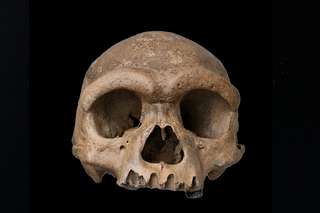
crâne

Type de vue

209 image(s) · 21 Actualités

Galerie d'images

Leaellynasaura amicagraphica, dinosaur, skull. Holotype. [P 185991]
Taxons Leaellynasaura

Leaellynasaura amicagraphica, dinosaur, skull. Holotype. [P 185991]

musée holotype Dinosauria Leaellynasaura +1
Rhomboid distal nasal process of the crest of Tsintaosaurus spinorhinus.

A. Partial distal nasal process of IVPP V725 in right lateral view. B. Lateral view of composite skull (reversed). C. partial premaxillonasal complex of IVPP V829 in right lateral view. D. Line drawing of (C) showing nasal-premaxilla articulation, and the displacement (arrow) experienced by the distal nasal process relative to its articular position. E. Mounted holotype skull (IVPP V725) of T. spinorhinus in left lateral view (reversed). F. Partial right distal nasal process (although catalogued as IVPP V725, this element corresponds to a different specimen than the type; reversed).
Taxons Tsintaosaurus

Rhomboid distal nasal process of the crest of Tsintaosaurus spinorhinus. A. Partial distal nasal process of IVPP V725 in right lateral view. B. Lateral view of composite skull (reversed). C. partial premaxillonasal complex of IVPP V829 in right lateral view. D. Line drawing of (C) showing nasal-premaxilla articulation, and the displacement (arrow) experienced by the distal nasal process relative to its articular position. E. Mounted holotype skull (IVPP V725) of T. spinorhinus in left lateral view (reversed). F. Partial right distal nasal process (although catalogued as IVPP V725, this element corresponds to a different specimen than the type; reversed).

crête dessin holotype spécimen +3
Xenovenator espinosai, holotype braincase CPC 2973. In (A) left lateral; (B) right lateral; (C) dorsal; (D) ventral; (E) anterior; (F) posterior. Abbreviations: bo, basicoccipital; bul, parabasisphenoid bulla; ex, exoccipital; fr, frontal; lad, lateral depression; lac, lacrimal articulation; lat, laterosphenoid; osp, orbitosphenoid; par, parietal; pbs, parabasisphenoid; po, postorbital; ri, median ridge; sk, skull; stf, supratemporal fossa.
Taxons Xenovenator

Xenovenator espinosai, holotype braincase CPC 2973. In (A) left lateral; (B) right lateral; (C) dorsal; (D) ventral; (E) anterior; (F) posterior. Abbreviations: bo, basicoccipital; bul, parabasisphenoid bulla; ex, exoccipital; fr, frontal; lad, lateral depression; lac, lacrimal articulation; lat, laterosphenoid; osp, orbitosphenoid; par, parietal; pbs, parabasisphenoid; po, postorbital; ri, median ridge; sk, skull; stf, supratemporal fossa.

holotype Xenovenator crâne
Skull of Dromiceiomimus
Taxons Dromiceiomimus

Skull of Dromiceiomimus

Dromiceiomimus crâne
Skull of Saichania, Warsaw Museum of Evolution
Taxons Saichania

Skull of Saichania, Warsaw Museum of Evolution

musée Saichania évolution crâne
Skull of Oohkotokia horneri, gen. et sp. nov. (MOR 433, holotype)
Taxons Oohkotokia

Skull of Oohkotokia horneri, gen. et sp. nov. (MOR 433, holotype)

holotype Oohkotokia crâne
The incomplete skull and vertebrae of the holotype of Omphalosaurus nevadanus, seen in dorsal (left) and ventral view (right). This image was derived by combining plates 8 and 9 of Merriam (1906), done by an uncredited artist.
Legend:

A - angular
D - dentary
Pl - palatine
Pt - pterygoid
Sa - surangular
Sp - splenial
V - vertebrae
a, b, c - "doubtful elements"
Taxons Omphalosaurus

The incomplete skull and vertebrae of the holotype of Omphalosaurus nevadanus, seen in dorsal (left) and ventral view (right). This image was derived by combining plates 8 and 9 of Merriam (1906), done by an uncredited artist. Legend: A - angular D - dentary Pl - palatine Pt - pterygoid Sa - surangular Sp - splenial V - vertebrae a, b, c - "doubtful elements"

holotype Merriamia Omphalosaurus crâne
Restored Placochelys placodonta skull at the Museum für Naturkunde, Berlin.
Taxons Placochelys

Restored Placochelys placodonta skull at the Museum für Naturkunde, Berlin.

musée Placochelyidae Placochelys crâne
Restored Placochelys placodonta skull at the Museum für Naturkunde, Berlin.
Taxons Placochelyidae

Restored Placochelys placodonta skull at the Museum für Naturkunde, Berlin.

musée Placochelyidae Placochelys crâne
Comparison of cranial features between closely related southern Laramidian taxa; (A), Akainacephalus johnsoni (UMNH VP 20202) from the Late Cretaceous Kaiparowits Formation of Utah; and (B), Nodocephalosaurus kirtlandensis (SMP VP-900) from the Late Cretaceous Kirtland Formation of New Mexico, in left lateral views. Various synapomorphies are shared with N. kirtlandensis (highlighted in black and white arrows) and includes “flaring nostrils”; enlarged, laterally projecting, loreal osteoderms that are situated directly dorsal to the external nares. Other synapomorphies include pyramid-shaped nasal and frontal osteoderms positioned on the dorsal regions of the skull. A number of significant differences have been observed between both specimens; in A. johnsoni, the anterior, and posterior supraorbital bosses form an enlarged element that is somewhat backswept, whereas in N. kirtlandensis, the posterior and anterior supraorbital bosses are clearly defined as individual osteoderms, and are much smaller in size. Additionally, the squamosal horn in Akainacephalus is very small but is prominent and tetrahedrally shaped in Nodocephalosaurus. The quadratojugal horn in Akainacephalus is massive, has a subtriangular morphology in lateral view and projects almost entirely ventral, whereas in Nodocephalosaurus, the quadratojugal horn is smaller and has a typical fin-shaped morphology. Study sites: asob, anterior supraorbital boss; ext naris, external naris; laca, lacrimal caputegulum; loca, loreal caputegulum; naca, nasal caputegulae; orb, orbit; psob, posterior supraorbital boss; qjh, quadratojugal horn; sqh, squamosal horn.
Taxons Nodocephalosaurus

Comparison of cranial features between closely related southern Laramidian taxa; (A), Akainacephalus johnsoni (UMNH VP 20202) from the Late Cretaceous Kaiparowits Formation of Utah; and (B), Nodocephalosaurus kirtlandensis (SMP VP-900) from the Late Cretaceous Kirtland Formation of New Mexico, in left lateral views. Various synapomorphies are shared with N. kirtlandensis (highlighted in black and white arrows) and includes “flaring nostrils”; enlarged, laterally projecting, loreal osteoderms that are situated directly dorsal to the external nares. Other synapomorphies include pyramid-shaped nasal and frontal osteoderms positioned on the dorsal regions of the skull. A number of significant differences have been observed between both specimens; in A. johnsoni, the anterior, and posterior supraorbital bosses form an enlarged element that is somewhat backswept, whereas in N. kirtlandensis, the posterior and anterior supraorbital bosses are clearly defined as individual osteoderms, and are much smaller in size. Additionally, the squamosal horn in Akainacephalus is very small but is prominent and tetrahedrally shaped in Nodocephalosaurus. The quadratojugal horn in Akainacephalus is massive, has a subtriangular morphology in lateral view and projects almost entirely ventral, whereas in Nodocephalosaurus, the quadratojugal horn is smaller and has a typical fin-shaped morphology. Study sites: asob, anterior supraorbital boss; ext naris, external naris; laca, lacrimal caputegulum; loca, loreal caputegulum; naca, nasal caputegulae; orb, orbit; psob, posterior supraorbital boss; qjh, quadratojugal horn; sqh, squamosal horn.

Mexique Kaiparowits Kirtland Crétacé +6
Riojasaurus skull cast, Copenhagen.
Taxons Riojasaurus

Riojasaurus skull cast, Copenhagen.

moulage Riojasauridae Riojasaurus crâne
Riojasaurus skull cast, Copenhagen.
Taxons Riojasauridae

Riojasaurus skull cast, Copenhagen.

moulage Riojasauridae Riojasaurus crâne
Skull of Pistosaurus longaevus (cast - USNM 16107) in right, left and posterior views.
Taxons Pistosaurus

Skull of Pistosaurus longaevus (cast - USNM 16107) in right, left and posterior views.

moulage Pistosauria Pistosauridae crâne
Skull of Pistosaurus longaevus (cast - USNM 16107) in right, left and posterior views.
Taxons Pistosauridae

Skull of Pistosaurus longaevus (cast - USNM 16107) in right, left and posterior views.

moulage Pistosauria Pistosauridae crâne
Skull replica of Vagaceratops at Canadian Museum of Nature
Taxons Vagaceratops

Skull replica of Vagaceratops at Canadian Museum of Nature

musée Vagaceratops crâne
Skull cast of Anchiceratops ornatus (original specimen: TMP 1983.001.0001) on display at the University of Michigan Museum of Natural History.
Taxons Anchiceratops

Skull cast of Anchiceratops ornatus (original specimen: TMP 1983.001.0001) on display at the University of Michigan Museum of Natural History.

musée moulage spécimen Anchiceratops +1
1 2 3 4 5 6 7 8 9 10 11 12 13 14

Actualités

Daemonosaurus: Beast of the Week
Démonosaure : la bête de la semaine
Mexique États-Unis Trias supérieur Trias Daemonosaurus Dinosauria crâne
 Cette semaine, nous allons découvrir un premier dinosaure au look unique avec un nom très cool.  Rencontrez Daemonosaurus chaoliodus ! Daemonosaurus était un petit dinosaure carnivore qui vivait dans ce qui est aujourd'hui le Nouveau-Mexique, aux États-Unis, à la fin du Trias, il y a environ 205 à 200 millions d'années.  Du nez à la queue, on estime qu'il mesurait environ 5 à 7 pieds (1,5 à 2,2 m).  Il s’agit d’estimations basées sur le fait que seuls le crâne et le cou ont été retrouvés.  Le nom du genre se traduit par "Demo
05/04/2026 prehistoricbeastoftheweek ⚙ Traduction automatique
Les scientifiques ont trouvé un bébé dinosaure caché dans la roche et il est étonnamment mignon
os dessin Corée du Sud Dinosauria Doolysaurus tomographie découverte crâne
Des scientifiques ont découvert un bébé dinosaure rare en Corée du Sud et l'ont baptisé Doolysaurus, en hommage à un célèbre personnage de dessin animé. Grâce à des tomodensitogrammes de pointe, ils ont découvert des os cachés, notamment un crâne, dans la roche beaucoup plus rapidement que les méthodes traditionnelles. Le jeune dinosaure, peut-être duveteux et ressemblant à un agneau, avait même des calculs gastriques révélant qu'il mangeait un mélange de plantes et de petits animaux. Cette découverte suggère que de nombreux autres dinosaures pourraient encore être cachés dans les roches coréennes.
01/04/2026 sciencedaily ⚙ Traduction automatique
Des fossiles de poissons vieux de 400 millions d'années révèlent comment la vie a commencé à s'installer sur terre
Australie Chine fossile formation crâne
Les scientifiques ont découvert de nouveaux indices sur certains des premiers poissons de la Terre, mettant ainsi en lumière les origines anciennes des vertébrés qui ont fini par s’installer sur terre. En réanalysant de mystérieux fossiles de la célèbre formation australienne Gogo et en étudiant un crâne de poisson-poumon récemment reconstruit, vieux de 410 millions d'années et provenant de Chine, les chercheurs révèlent comment ces créatures primitives ont évolué.
12/03/2026 sciencedaily ⚙ Traduction automatique
Le tricératops avait un nez géant qui aurait pu refroidir sa tête massive
fossile Triceratops tomographie crâne
La tête massive du tricératops faisait peut-être plus que simplement montrer ces fameuses cornes. À l’aide de tomodensitogrammes et de reconstructions 3D de crânes fossiles, les chercheurs ont découvert un système nasal étonnamment complexe caché à l’intérieur de son énorme museau. Au lieu d’être simplement un nez surdimensionné pour sentir, il abritait probablement des réseaux complexes de nerfs et de vaisseaux sanguins, et même des structures spéciales qui aidaient à réguler la chaleur et l’humidité.
22/02/2026 sciencedaily ⚙ Traduction automatique
Cet animal ancien fut l'un des premiers à manger des plantes sur terre
dent fossile crâne
Il y a des centaines de millions d’années, les premiers animaux à ramper sur terre étaient de purs mangeurs de viande, alors même que les plantes avaient déjà envahi le paysage. Aujourd’hui, les scientifiques ont découvert un fossile vieux de 307 millions d’années qui réécrit cette histoire : l’un des premiers vertébrés terrestres connus à avoir commencé à manger des plantes. L'animal, nommé Tyrannoroter heberti, était une créature trapue de la taille d'un ballon de football avec un crâne rempli de dents spécialisées conçues pour écraser et broyer la végétation.
11/02/2026 sciencedaily ⚙ Traduction automatique
1 2 3 4 5