skull

View type

244 image(s) · 27 News

Image gallery

Diagram of the skull of Haya griva in lateral view, reconstructed from IGM 100/2017
Taxa Haya

Diagram of the skull of Haya griva in lateral view, reconstructed from IGM 100/2017

Haya skull
Skull cast of Liaoceratops yanzigouensis on display at the Baoding Natural History Museum.
Taxa Liaoceratops

Skull cast of Liaoceratops yanzigouensis on display at the Baoding Natural History Museum.

museum cast Liaoceratops skull
Skeleton of Yamaceratops dorngobiensis (MPC-D 100/553) in right dorsolateral view. (A) Photograph; (B) Interpretive drawing. Bones are bounded by solid lines and colored beige; the matrix is gray. Shaded areas represent the broken surface of bones. Abbreviations: cd, caudal vertebrae; dr, dorsal ribs; dv, dorsal vertebrae; f, femur; fi, fibula; h, humerus; L, bone on the left side; p, isolated parietal; pp, pedal phalanges; R, bone on the right side; ra, radius; sk, skull; sv, sacral vertebrae; ti, tibia; u, ulna; il, ilium; is, ischium.
Taxa Yamaceratops

Skeleton of Yamaceratops dorngobiensis (MPC-D 100/553) in right dorsolateral view. (A) Photograph; (B) Interpretive drawing. Bones are bounded by solid lines and colored beige; the matrix is gray. Shaded areas represent the broken surface of bones. Abbreviations: cd, caudal vertebrae; dr, dorsal ribs; dv, dorsal vertebrae; f, femur; fi, fibula; h, humerus; L, bone on the left side; p, isolated parietal; pp, pedal phalanges; R, bone on the right side; ra, radius; sk, skull; sv, sacral vertebrae; ti, tibia; u, ulna; il, ilium; is, ischium.

bone humerus drawing Yamaceratops +2
Reconstructions of diplodocoid skulls used in this analysis.

Reconstructions of Nigersaurus and Diplodocus modified from [10] and [34], respectively. All other reconstructions based on material listed in Table S1. Skulls scaled to equivalent anteroposterior lengths.
Taxa Suuwassea

Reconstructions of diplodocoid skulls used in this analysis. Reconstructions of Nigersaurus and Diplodocus modified from [10] and [34], respectively. All other reconstructions based on material listed in Table S1. Skulls scaled to equivalent anteroposterior lengths.

Diplodocia Nigersaurus Suuwassea skull
Partial skull of Manidens condorensis from the Middle Jurassic Cañadón Asfalto Formation of Argentina. Skull reconstructions in lateral view. Dashed lines indicate estimated edges. Abbreviations: a angular antfo antorbital fossa asaf anterior surangular foramen be buccal emargination bo basioccipital bt basal tubera d dentary d1, 2, 11 dentary tooth 1, 2, 11 emfo external mandibular fossa f frontal gl glenoid gr groove j jugal jfl jugal flange jh jugal horn m maxilla m1, 11 maxillary tooth 1, 11 n nasal pd predentary pm premaxilla po postorbital pof postorbital fossa popr paroccipital process q quadrate qj quadratojugal ri ridge sa surangular sq squamosal.
Taxa Manidens

Partial skull of Manidens condorensis from the Middle Jurassic Cañadón Asfalto Formation of Argentina. Skull reconstructions in lateral view. Dashed lines indicate estimated edges. Abbreviations: a angular antfo antorbital fossa asaf anterior surangular foramen be buccal emargination bo basioccipital bt basal tubera d dentary d1, 2, 11 dentary tooth 1, 2, 11 emfo external mandibular fossa f frontal gl glenoid gr groove j jugal jfl jugal flange jh jugal horn m maxilla m1, 11 maxillary tooth 1, 11 n nasal pd predentary pm premaxilla po postorbital pof postorbital fossa popr paroccipital process q quadrate qj quadratojugal ri ridge sa surangular sq squamosal.

tooth Argentina Jurassic Middle Jurassic +4
Achelousaurus horneri skull, collected in Glacier County, Montana, at the Museum of the Rockies in Bozeman, Montana.
The Ceratopsidae are those dinosaurs with head frills.  There are three large subgroups of Ceratopsidae: Centrosaurinae, Ceratopsinae, and Chasmosaurinae. The Triceratopsini are a "tribe" of the Chasmosaurinae -- a genus so vast that it gets the special name "tribe".  The Pachyrhinosaurini are a "tribe" within the Centrosaurinae.

Achelousaurus is a genus within the Pachyrhinosaurini.  So far, only three skulls and some limited skeletal remains have been collected anywhere in the world -- and all of them in Montana.  Their bony frills are quite similar to the Styracosaurus albertensis, although their other skull features (such as big bony bosses on the nose and behind the eyes) are not.
Taxa Achelousaurus

Achelousaurus horneri skull, collected in Glacier County, Montana, at the Museum of the Rockies in Bozeman, Montana. The Ceratopsidae are those dinosaurs with head frills. There are three large subgroups of Ceratopsidae: Centrosaurinae, Ceratopsinae, and Chasmosaurinae. The Triceratopsini are a "tribe" of the Chasmosaurinae -- a genus so vast that it gets the special name "tribe". The Pachyrhinosaurini are a "tribe" within the Centrosaurinae. Achelousaurus is a genus within the Pachyrhinosaurini. So far, only three skulls and some limited skeletal remains have been collected anywhere in the world -- and all of them in Montana. Their bony frills are quite similar to the Styracosaurus albertensis, although their other skull features (such as big bony bosses on the nose and behind the eyes) are not.

museum United States Achelousaurus Centrosaurinae +8
a Skeletal reconstruction of A. greppini. Elements preserved in the material and therefore providing information for the skeletal reconstruction are marked in blue. Because much information is missing from the incomplete skeletal material, the dorsal vertebrae, the proportions and morphology of the cervical vertebrae and the skull were modified from Camarasaurus. b Scaled silhouette drawings of Cetiosauriscus stewarti (in black) and A. greppini (in grey) demonstrating the significant size difference between the two taxa. Scale bar is 1 m
Taxa Amanzia

a Skeletal reconstruction of A. greppini. Elements preserved in the material and therefore providing information for the skeletal reconstruction are marked in blue. Because much information is missing from the incomplete skeletal material, the dorsal vertebrae, the proportions and morphology of the cervical vertebrae and the skull were modified from Camarasaurus. b Scaled silhouette drawings of Cetiosauriscus stewarti (in black) and A. greppini (in grey) demonstrating the significant size difference between the two taxa. Scale bar is 1 m

scale drawing Amanzia Camarasaurus +2
The palatal view of the skull of NMS G.2021.6.2 and comparative assessment of the pterygoid region. The palatal region of NMS G.2021.6.2, A as seen in the ventral view. The comparative, to scale, pterosaur palatine and palatal regions in the ventral view. From left to right: B Cacibupteryx (IGO-V 208); C Parapsicephalus (GSM 3166); D Dearc (NMS G.2021.6.2); E Rhamphorhynchus (NHM R 2786); F Rhamphorhynchus (CM 11434). Abbreviations: bsp—basipterygoid; cho—choana; ec -, ectopterygoid; ipv—interpterygoid vacuity; pal—palatine; pf—posterior palatine fenestra; pte—pterygoid; stf -subtemporal fenestra; sof – suborbital fenestra; vm—vomer. Scale bar 10 mm
Taxa Cacibupteryx

The palatal view of the skull of NMS G.2021.6.2 and comparative assessment of the pterygoid region. The palatal region of NMS G.2021.6.2, A as seen in the ventral view. The comparative, to scale, pterosaur palatine and palatal regions in the ventral view. From left to right: B Cacibupteryx (IGO-V 208); C Parapsicephalus (GSM 3166); D Dearc (NMS G.2021.6.2); E Rhamphorhynchus (NHM R 2786); F Rhamphorhynchus (CM 11434). Abbreviations: bsp—basipterygoid; cho—choana; ec -, ectopterygoid; ipv—interpterygoid vacuity; pal—palatine; pf—posterior palatine fenestra; pte—pterygoid; stf -subtemporal fenestra; sof – suborbital fenestra; vm—vomer. Scale bar 10 mm

scale Cacibupteryx Dearc Parapsicephalus +3
Selmasaurus johnsoni mounted skull in the Rocky Mountain Dinosaur Resource Center in Woodland Park, Colorado
Taxa Selmasaurus

Selmasaurus johnsoni mounted skull in the Rocky Mountain Dinosaur Resource Center in Woodland Park, Colorado

Dinosauria Selmasaurus skull
Skull of Yulong mini. The horizontal line projected through the posterodorsal corner of the antorbital fenestra is parallel to the line linking the articular end of the quadrate and the ventral margin of the premaxillae.
Taxa Yulong

Skull of Yulong mini. The horizontal line projected through the posterodorsal corner of the antorbital fenestra is parallel to the line linking the articular end of the quadrate and the ventral margin of the premaxillae.

Yulong skull
Cast of the skull of Parapsicephalus purdoni (specimen AMNH 1694) in the American Museum of Natural History.
Taxa Parapsicephalus

Cast of the skull of Parapsicephalus purdoni (specimen AMNH 1694) in the American Museum of Natural History.

museum cast specimen Parapsicephalus +1
Sarahsaurus aurifontanalis, referred skull (MCZ 8893), in (a) lateral, (b) occipital, (c) dorsal and (d) ventral views. an, angular; ar, articular; bo, basioccipital; bs, basisphenoid; ec, ectopterygoid; f, frontal; h, hyoid; j, jugal; l, lacrimal; ls, laterosphenoid; m, maxilla; n, nasal; op, opisthotic-exoccipital; p, parietal; po, postorbital; prf, prefrontal; pm, premaxilla; pt, pterygoid; q, quadrate; qj, quadratojugal; so, supraoccipital; sq, squamosal. Scale bar, 5 cm.
Taxa Sarahsaurus

Sarahsaurus aurifontanalis, referred skull (MCZ 8893), in (a) lateral, (b) occipital, (c) dorsal and (d) ventral views. an, angular; ar, articular; bo, basioccipital; bs, basisphenoid; ec, ectopterygoid; f, frontal; h, hyoid; j, jugal; l, lacrimal; ls, laterosphenoid; m, maxilla; n, nasal; op, opisthotic-exoccipital; p, parietal; po, postorbital; prf, prefrontal; pm, premaxilla; pt, pterygoid; q, quadrate; qj, quadratojugal; so, supraoccipital; sq, squamosal. Scale bar, 5 cm.

scale Sarahsaurus skull
Holotype skull of Plesiotylosaurus crassidens (LACM 2759) on display at the Natural History Museum of Los Angeles County.
Taxa Plesiotylosaurus

Holotype skull of Plesiotylosaurus crassidens (LACM 2759) on display at the Natural History Museum of Los Angeles County.

museum holotype Plesiotylosaurus skull
Skull of the mosasaurid squamate Thalassotitan atrox from the late Maastrichtian of Sidi Daoui, Ouled Abdoun Basin, Khouribga Province, Morocco, North Africa.
Taxa Thalassotitan

Skull of the mosasaurid squamate Thalassotitan atrox from the late Maastrichtian of Sidi Daoui, Ouled Abdoun Basin, Khouribga Province, Morocco, North Africa.

Morocco Maastrichtian Mosasauridae Thalassotitan +1
Alioramus altai skull in the exhibit, T. rex, The Ultimate Predator, in the American Museum of Natural History (with permission by Ben Miller).
Taxa Alioramini

Alioramus altai skull in the exhibit, T. rex, The Ultimate Predator, in the American Museum of Natural History (with permission by Ben Miller).

predator museum Alioramini Alioramus +1
Holotype of Ulughbegsaurus as well as the holotype placed on a reconstruction of Ulughbegsaurus's skull
Taxa Ulughbegsaurus

Holotype of Ulughbegsaurus as well as the holotype placed on a reconstruction of Ulughbegsaurus's skull

holotype Ulughbegsaurus skull
1 2 3 4 5 6 7 8 9 10 11 12 13 14 15 16

News

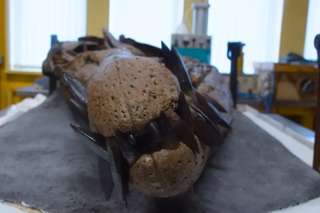
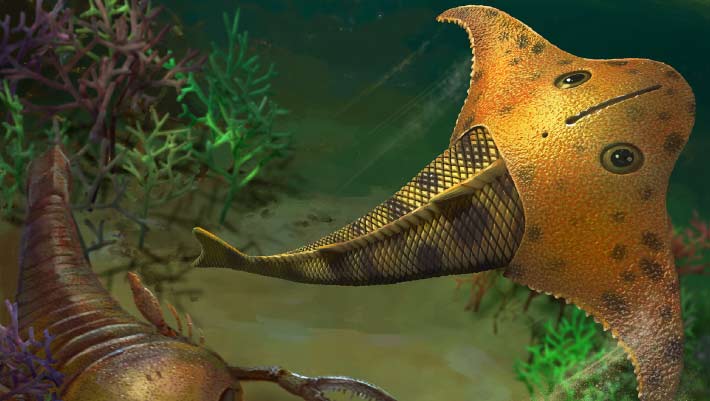
Meet Bataspis crux, Jawless Fish that Cruised Devonian Seas with Batwing Head
jaw China Devonian Late Devonian fish new species skull
Paleontologists in China have identified a new species of armored, jawless fish from rocks around 419 million years old whose skull was shaped like the wing of a bat and whose unusual head made it an efficient glider through Devonian seas. The post Meet Bataspis crux, Jawless Fish that Cruised Devonian Seas with Batwing Head appeared first on Sci.News: Breaking Science News.
18/08/2026 sci-news
A 30-year-old fossil was hiding bones from a mysterious ancient sea monster
bone jaw Cretaceous fossil Mosasaurus new species skull
Fossils collected in Osaka more than 30 years ago have revealed a surprise hiding in plain sight: four previously unrecognized bones from a giant Cretaceous mosasaur. Among them is the first confirmed premaxilla—the frontmost bone of the upper jaw—ever identified in a Japanese mosasaur fossil. Even more intriguing, parts of the skull show unusual anatomical features that don’t match known mosasaurs, raising the possibility that the remains belong to an entirely new species.
15/08/2026 sciencedaily
A New Genus of Troodontid Dinosaur from New Mexico
bone Mexico Campanian Cretaceous Late Cretaceous fossil Dinevenator Dinosauria Troodontidae new species skull
Palaeontologists have named a new species of theropod dinosaur from New Mexico. The dinosaur, Dinevenator robustus, lived around 73 million years ago (Campanian faunal stage of the Late Cretaceous). Researchers identified the dinosaur from a fossil skull bone (a frontal) found in north-western New Mexico. It represents a new genus and species of troodontid. Troodontids
13/08/2026 everythingdinosaur
The dodo bird had a secret sensory world scientists are only now discovering
bird CT-scan discovery skull
CT scans of the world’s rarest dodo skulls suggest the extinct bird may have had a stronger sense of smell, a highly sensitive beak, and a lifestyle that extended into dawn and dusk. The discoveries are helping overturn centuries-old myths and reveal a far more complex animal than the famously “dumb” dodo of popular imagination.
09/08/2026 sciencedaily-paleo
A forgotten fossil just revealed a new Triassic predator from 210 million years ago
jaw predator prey Mexico Triassic fossil skull
A fossil overlooked for nearly 80 years has revealed a previously unknown crocodile relative that lived 210 million years ago in what is now New Mexico. Named Eosphorosuchus lacrimosa, the jackal-sized predator had a reinforced skull, powerful jaw muscles, and a short snout built for tackling larger prey.
30/07/2026 sciencedaily
1 2 3 4 5 6