crâne

Type de vue

244 image(s) · 27 Actualités

Galerie d'images

The skull of Zupaysaurus rougieri (A) in right lateral view. Scale bar equals 5 cm. Cropped from Figure 2 in the source.
anfe - antorbital fenestra
emf - external mandibular fenestra
itf - infratemporal fenestra
or - orbit
Taxons Zupaysaurus

The skull of Zupaysaurus rougieri (A) in right lateral view. Scale bar equals 5 cm. Cropped from Figure 2 in the source. anfe - antorbital fenestra emf - external mandibular fenestra itf - infratemporal fenestra or - orbit

écaille Zupaysaurus crâne
Skull diagram featuring the holotype skull (ROM 1790) of the ornithomimid Rativates evadens, from the Late Cretaceous period. Abbreviations: d, dentary; f, frontal; l, lacrimal; m, maxilla; n, nasal; pm, premaxila; ps, paraphenoid.
Taxons Rativates

Skull diagram featuring the holotype skull (ROM 1790) of the ornithomimid Rativates evadens, from the Late Cretaceous period. Abbreviations: d, dentary; f, frontal; l, lacrimal; m, maxilla; n, nasal; pm, premaxila; ps, paraphenoid.

Crétacé Crétacé supérieur holotype Ornithomimidae +2
Mounted skull of EMK 0012 (Lokiceratops rangiformis holotype). (A) Mounted skull in posterior view. (B) Mounted skull in right lateral view. (C) Mounted skull in dorsal view. (D) Mounted skull in left lateral view. Areas in gray are reconstructed. Minor changes from side to side and in the orbits are the result of post-depositional deformation. Photos contain parallax. Scale bar equals 1 m.
Taxons Lokiceratops

Mounted skull of EMK 0012 (Lokiceratops rangiformis holotype). (A) Mounted skull in posterior view. (B) Mounted skull in right lateral view. (C) Mounted skull in dorsal view. (D) Mounted skull in left lateral view. Areas in gray are reconstructed. Minor changes from side to side and in the orbits are the result of post-depositional deformation. Photos contain parallax. Scale bar equals 1 m.

écaille holotype Lokiceratops crâne
Reconstruction of the skull of Spinops sternbergorum gen. et sp. nov. from the Campanian of Dinosaur Provincial Park, southern Alberta, in right lateral view. Preserved elements are stippled; missing portions are dotted and modeled after Centrosaurus apertus.
Taxons Spinops

Reconstruction of the skull of Spinops sternbergorum gen. et sp. nov. from the Campanian of Dinosaur Provincial Park, southern Alberta, in right lateral view. Preserved elements are stippled; missing portions are dotted and modeled after Centrosaurus apertus.

Campanien Centrosaurus Dinosauria Spinops +1
Photograph of the holotype skull of Titanoceratops ouranos, from the late Campanian aged Kirtland/Fruitland beds of New Mexico, USA. Photograph by Nick Longrich
Taxons Titanoceratops

Photograph of the holotype skull of Titanoceratops ouranos, from the late Campanian aged Kirtland/Fruitland beds of New Mexico, USA. Photograph by Nick Longrich

Mexique États-Unis Fruitland Kirtland +4
Ceratopsipes goldenensis Lockley & Hunt, 1995 - ceratopsian dinosaur trackway in the Cretaceous of Colorado, USA.
Ceratopsians are the "horned dinosaurs".  They were large, quadrupedal, herbivorous dinosaurs having a beaked skull and a frill - an extension of bone behind the skull that partially covered the neck.  Ceratopsian dinosaurs are known from the Jurassic and Cretaceous.  The last members of the group died out at the Cretaceous-Tertiary boundary, 65 million years ago.
Seen here is a ceratopsian dinosaur trackway.  Ceratopsian footprints are very rare.  The best examples are in Colorado's Laramie Formation, a nonmarine, coastal plain to deltaic succession of mostly mixed siliciclastic sedimentary rocks - sandstones, siltstones, claystones, and coals.  The footprints here consist of convex bulges on the basal surfaces of structurally-tilted sandstone beds.
The ichnospecies Ceratopsipes goldenensis was named based on footprints at this locality.  The trackmaker was very likely Triceratops, the # 1 most famous ceratopsian dinosaur.


From on-site signage:
Triceratops Tracks
Several tracks of Triceratops, or a closely related horned dinosaur were first discovered in this area and named Ceratopsipes goldenensis (meaning tracks of a horned dinosaur from Golden).  By happy coincidence, the first Triceratops known to science also comes from the greater Denver area near 13th Avenue and Federal Blvd.  Growing to a length of almost 25 feet, Triceratops and other members of the horned dinosaur family were herbivorous animals that roamed in herds.  Their trademark horns and frills that covered their necks probably served for defense.  A replica Triceratops skull is on display in the clubhouse at the Fossil Trace Golf Club.
These tracks (identified by small signs) help us understand that Triceratops walked with a narrow gait and erect front limbs  than with a wide, sprawling gait as previously depicted.  In 1887, the first Triceratops bones known to science were also discovered locally at a site near 13th Avenue and Federal Boulevard in Denver.
Nearby one may see many other traces of life such as burrows, probably made by invertebrates and impressions of plant debris.  Note that you are looking at all tracks and traces from the underside - in negative aspect - what one might call a worm’s eye view.  All of these trace fossils indicate that the Golden area once had a warm, temperate to subtropical climate.


Classification: Animalia, Chordata, Vertebrata, Reptilia, Archosauria, Dinosauria, Ornithischia, Marginocephalia, Ceratopsia, Ceratopsidae
Stratigraphy: Laramie Formation, Maastrichtian Stage, upper Upper Cretaceous
Locality: outcrop along Triceratops Trail, Parfet Prehistoric Preserve, southern side of the town of Golden, Colorado, USA (~vicinity of 39° 44' 35.24" North latitude, 105° 13’ 09.69" West longitude)


Some info. from:

Lockley & Hunt (1995) - Ceratopsid tracks and associated ichnofauna from the Laramie Formation (Upper Cretaceous: Maastrichtian) of Colorado.  Journal of Vertebrate Paleontology 15: 592-614.
Taxons Ceratopsipes

Ceratopsipes goldenensis Lockley & Hunt, 1995 - ceratopsian dinosaur trackway in the Cretaceous of Colorado, USA. Ceratopsians are the "horned dinosaurs". They were large, quadrupedal, herbivorous dinosaurs having a beaked skull and a frill - an extension of bone behind the skull that partially covered the neck. Ceratopsian dinosaurs are known from the Jurassic and Cretaceous. The last members of the group died out at the Cretaceous-Tertiary boundary, 65 million years ago. Seen here is a ceratopsian dinosaur trackway. Ceratopsian footprints are very rare. The best examples are in Colorado's Laramie Formation, a nonmarine, coastal plain to deltaic succession of mostly mixed siliciclastic sedimentary rocks - sandstones, siltstones, claystones, and coals. The footprints here consist of convex bulges on the basal surfaces of structurally-tilted sandstone beds. The ichnospecies Ceratopsipes goldenensis was named based on footprints at this locality. The trackmaker was very likely Triceratops, the # 1 most famous ceratopsian dinosaur. From on-site signage: Triceratops Tracks Several tracks of Triceratops, or a closely related horned dinosaur were first discovered in this area and named Ceratopsipes goldenensis (meaning tracks of a horned dinosaur from Golden). By happy coincidence, the first Triceratops known to science also comes from the greater Denver area near 13th Avenue and Federal Blvd. Growing to a length of almost 25 feet, Triceratops and other members of the horned dinosaur family were herbivorous animals that roamed in herds. Their trademark horns and frills that covered their necks probably served for defense. A replica Triceratops skull is on display in the clubhouse at the Fossil Trace Golf Club. These tracks (identified by small signs) help us understand that Triceratops walked with a narrow gait and erect front limbs than with a wide, sprawling gait as previously depicted. In 1887, the first Triceratops bones known to science were also discovered locally at a site near 13th Avenue and Federal Boulevard in Denver. Nearby one may see many other traces of life such as burrows, probably made by invertebrates and impressions of plant debris. Note that you are looking at all tracks and traces from the underside - in negative aspect - what one might call a worm’s eye view. All of these trace fossils indicate that the Golden area once had a warm, temperate to subtropical climate. Classification: Animalia, Chordata, Vertebrata, Reptilia, Archosauria, Dinosauria, Ornithischia, Marginocephalia, Ceratopsia, Ceratopsidae Stratigraphy: Laramie Formation, Maastrichtian Stage, upper Upper Cretaceous Locality: outcrop along Triceratops Trail, Parfet Prehistoric Preserve, southern side of the town of Golden, Colorado, USA (~vicinity of 39° 44' 35.24" North latitude, 105° 13’ 09.69" West longitude) Some info. from: Lockley & Hunt (1995) - Ceratopsid tracks and associated ichnofauna from the Laramie Formation (Upper Cretaceous: Maastrichtian) of Colorado. Journal of Vertebrate Paleontology 15: 592-614.

os États-Unis Crétacé Jurassique +6
Hualianceratops holotype IVVP V18641, Skull reconstruction
Taxons Hualianceratops

Hualianceratops holotype IVVP V18641, Skull reconstruction

holotype Hualianceratops crâne
Figure 1: Holotype and skeletal reconstruction of Mosaiceratops azumai, gen. et sp. nov (ZMNH M8856). (a) photograph and line drawing of ZMNH M8856; (b) skeletal reconstruction showing preserved elements in white. Scale bar 10 cm. Abbreviations: a, astragalus; boc, basioccipital; c, calcaneum; cav, caudal vertebra; ch, chevron; cv, cervical vertebra; dr, dorsal rib; dv, dorsal vertebra; f, frontal; fem, femur; fl, fibula; h, humerus; il, ilium; is, ischium; L, left; mt, metatarsal; ph, phalanx/phalanges; po, postorbital; R, right; sk, skull; sq, squamosal; t, tibia; td, tendon; ?, undiagnostic remains.
Taxons Mosaiceratops

Figure 1: Holotype and skeletal reconstruction of Mosaiceratops azumai, gen. et sp. nov (ZMNH M8856). (a) photograph and line drawing of ZMNH M8856; (b) skeletal reconstruction showing preserved elements in white. Scale bar 10 cm. Abbreviations: a, astragalus; boc, basioccipital; c, calcaneum; cav, caudal vertebra; ch, chevron; cv, cervical vertebra; dr, dorsal rib; dv, dorsal vertebra; f, frontal; fem, femur; fl, fibula; h, humerus; il, ilium; is, ischium; L, left; mt, metatarsal; ph, phalanx/phalanges; po, postorbital; R, right; sk, skull; sq, squamosal; t, tibia; td, tendon; ?, undiagnostic remains.

humérus écaille vertèbre dessin +3
Skeletal diagram featuring the optimal remains of the holotype of Graciliceratops mongoliensis: ZPAL MgD-I/156.[1] Found in the Bayan Shireh Formation, in the original description the remains were referred to the genus Microceratops (now obsolete).[2] However, Sereno in 2000 noted that there was no base for this referral, then, he created a new genus and species for this specimen.[1] The holotype is very fragmented (specially the skull), consisting of:[2]
Fragmented skull; 4 cervical, 12 dorsal and 7 sacral vertebrae; right scapula; proximal end of left scapula; left coracoid; right humerus, radius and fragmentary ulna; proximal and distal end of left humerus; proximal fragments of both pubis; fragments of both illium and fragment of right ischium; right femur, tibia and nearly complete pes; distal part of left tibia, fragmentary left pes; tarsals and isolated ribs.[2]

The sacral vertebrae are not fused, an indicator of the immaturity of this specimen; the estimated adult size is about 2 meters long or similar to Protoceratops.[2][1] Right quadratojugal, quadrate and fragmentary jugal were reversed in order to get an optimal view.
Taxons Graciliceratops

Skeletal diagram featuring the optimal remains of the holotype of Graciliceratops mongoliensis: ZPAL MgD-I/156.[1] Found in the Bayan Shireh Formation, in the original description the remains were referred to the genus Microceratops (now obsolete).[2] However, Sereno in 2000 noted that there was no base for this referral, then, he created a new genus and species for this specimen.[1] The holotype is very fragmented (specially the skull), consisting of:[2] Fragmented skull; 4 cervical, 12 dorsal and 7 sacral vertebrae; right scapula; proximal end of left scapula; left coracoid; right humerus, radius and fragmentary ulna; proximal and distal end of left humerus; proximal fragments of both pubis; fragments of both illium and fragment of right ischium; right femur, tibia and nearly complete pes; distal part of left tibia, fragmentary left pes; tarsals and isolated ribs.[2] The sacral vertebrae are not fused, an indicator of the immaturity of this specimen; the estimated adult size is about 2 meters long or similar to Protoceratops.[2][1] Right quadratojugal, quadrate and fragmentary jugal were reversed in order to get an optimal view.

humérus description holotype spécimen +4
Holotype skull of Wannanosaurus yansiensis on display at the Paleozoological Museum of China.
Taxons Wannanosaurus

Holotype skull of Wannanosaurus yansiensis on display at the Paleozoological Museum of China.

musée Chine holotype Wannanosaurus +1
Diagram featuring the holotype skull (ZPAL MgD-I/105) of Tylocephale gilmorei in left lateral view. Scale bar equals 5 cm (50 mm). Based on Maryańska & Osmólska, 1974,[1] and Sullivan, 2006.[2]
References

↑ (1974). "Pachycephalosauria, a new suborder of ornithischian dinosaurs". Palaeontologica Polonica (30): 45−102.

↑ (2006). "A taxonomic review of the Pachycephalosauridae (Dinosauria: Ornithischia)". New Mexico Museum of Natural History and Science Bulletin (35): 347–365.
Taxons Tylocephale

Diagram featuring the holotype skull (ZPAL MgD-I/105) of Tylocephale gilmorei in left lateral view. Scale bar equals 5 cm (50 mm). Based on Maryańska & Osmólska, 1974,[1] and Sullivan, 2006.[2] References ↑ (1974). "Pachycephalosauria, a new suborder of ornithischian dinosaurs". Palaeontologica Polonica (30): 45−102. ↑ (2006). "A taxonomic review of the Pachycephalosauridae (Dinosauria: Ornithischia)". New Mexico Museum of Natural History and Science Bulletin (35): 347–365.

écaille musée Mexique holotype +6
Lateral diagram of the skull of Sinocephale bexelli (Bohlin, 1953) with unknown regions (grey) restored after Stegoceras
Taxons Sinocephale

Lateral diagram of the skull of Sinocephale bexelli (Bohlin, 1953) with unknown regions (grey) restored after Stegoceras

Sinocephale Stegoceras crâne
Holotype of Transylvanosaurus platycephalus, LPB (FGGUB) R.2070, a partial skull comprising the articulated basicranium and both frontals. Scale bar: 1 cm.
Taxons Transylvanosaurus

Holotype of Transylvanosaurus platycephalus, LPB (FGGUB) R.2070, a partial skull comprising the articulated basicranium and both frontals. Scale bar: 1 cm.

écaille holotype Transylvanosaurus partiel +1
skull of iguanodontian Altirhinus kurzanovi
Taxons Altirhinus

skull of iguanodontian Altirhinus kurzanovi

Altirhinus Iguanodontia crâne
Figure 4: Anterior portion of the skull of Dakotadon lakotaensis (SDSM 8656).
(A) photograph in left lateral view; (B) photograph in right lateral view; (C) photograph in ventral view. Abbreviations: ant, anterior; post, posterior; vent, ventral. Scale bars equal 5.0 cm.
Taxons Dakotadon

Figure 4: Anterior portion of the skull of Dakotadon lakotaensis (SDSM 8656). (A) photograph in left lateral view; (B) photograph in right lateral view; (C) photograph in ventral view. Abbreviations: ant, anterior; post, posterior; vent, ventral. Scale bars equal 5.0 cm.

écaille Dakotadon crâne
Angulomastacator skull reconstruction with known elements in white. 
Scale bar 20 cm.
Taxons Angulomastacator

Angulomastacator skull reconstruction with known elements in white. Scale bar 20 cm.

écaille Angulomastacator crâne
1 2 3 4 5 6 7 8 9 10 11 12 13 14 15 16

Actualités

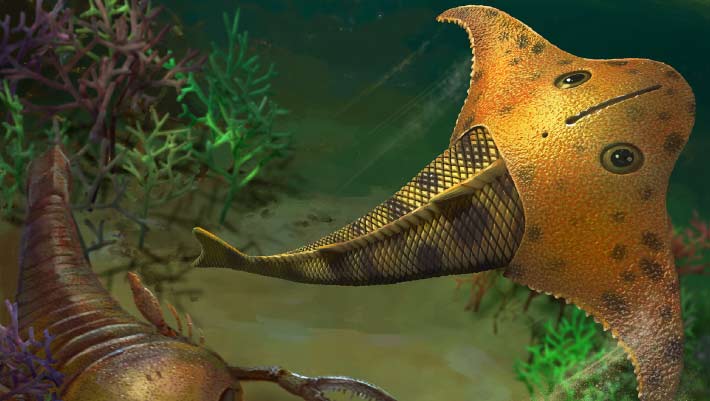
Meet Bataspis crux, Jawless Fish that Cruised Devonian Seas with Batwing Head
Rencontrez Bataspis crux, un poisson sans mâchoire qui naviguait dans les mers du Dévonien avec une tête de chauve-souris
mâchoire Chine Dévonien Dévonien poisson nouvelle espèce crâne
Des paléontologues chinois ont identifié une nouvelle espèce de poisson blindé et sans mâchoire provenant de roches vieilles d'environ 419 millions d'années, dont le crâne avait la forme d'une aile de chauve-souris et dont la tête inhabituelle en faisait un planeur efficace dans les mers du Dévonien. L'article Rencontrez Bataspis crux, un poisson sans mâchoire qui a navigué dans les mers du Dévonien avec une tête de chauve-souris est apparu en premier sur Sci.News : Breaking Science News.
18/08/2026 sci-news ⚙ Traduction automatique
Un fossile vieux de 30 ans cachait les os d'un mystérieux monstre marin ancien
os mâchoire Crétacé fossile Mosasaurus nouvelle espèce crâne
Des fossiles collectés à Osaka il y a plus de 30 ans ont révélé une surprise cachée à la vue de tous : quatre os jusqu'alors méconnus provenant d'un mosasaure géant du Crétacé. Parmi eux se trouve le premier prémaxillaire confirmé – l’os le plus en avant de la mâchoire supérieure – jamais identifié dans un fossile de mosasaure japonais. Plus intrigant encore, certaines parties du crâne présentent des caractéristiques anatomiques inhabituelles qui ne correspondent pas aux mosasaures connus, ce qui laisse penser que les restes appartiennent à une espèce entièrement nouvelle.
15/08/2026 sciencedaily ⚙ Traduction automatique
Un nouveau genre de dinosaure troodontidé du Nouveau-Mexique
os Mexique Campanien Crétacé Crétacé supérieur fossile Dinevenator Dinosauria Troodontidae nouvelle espèce crâne
Les paléontologues ont nommé une nouvelle espèce de dinosaure théropode du Nouveau-Mexique. Le dinosaure, Dinevenator Robustus, vivait il y a environ 73 millions d'années (stade faunique campanien du Crétacé supérieur). Les chercheurs ont identifié le dinosaure à partir d’un os fossile du crâne (un frontal) trouvé dans le nord-ouest du Nouveau-Mexique. Il représente un nouveau genre et une nouvelle espèce de troodontidé. Troodontidés
13/08/2026 everythingdinosaur ⚙ Traduction automatique
L’oiseau dodo possédait un monde sensoriel secret que les scientifiques découvrent seulement maintenant
oiseau tomographie découverte crâne
Les tomodensitogrammes des crânes de dodo les plus rares au monde suggèrent que l'oiseau disparu aurait pu avoir un odorat plus fort, un bec très sensible et un mode de vie qui s'étendait jusqu'à l'aube et au crépuscule. Ces découvertes contribuent à renverser des mythes vieux de plusieurs siècles et à révéler un animal bien plus complexe que le fameux dodo « stupide » de l’imagination populaire.
09/08/2026 sciencedaily-paleo ⚙ Traduction automatique
Un fossile oublié vient de révéler un nouveau prédateur du Trias datant d'il y a 210 millions d'années
mâchoire prédateur proie Mexique Trias fossile crâne
Un fossile négligé depuis près de 80 ans a révélé un parent de crocodile jusqu'alors inconnu qui vivait il y a 210 millions d'années dans ce qui est aujourd'hui le Nouveau-Mexique. Nommé Eosphorosuchus lacrimosa, ce prédateur de la taille d'un chacal avait un crâne renforcé, des muscles de mâchoire puissants et un museau court conçu pour s'attaquer à des proies plus grosses.
30/07/2026 sciencedaily ⚙ Traduction automatique
1 2 3 4 5 6