←

crâne

Type de vue

215 image(s) · 30 Actualités

Galerie d'images

Holotype of Jaculinykus yaruui gen. et sp. nov. (MPC-D 100/209). (A) Photograph of the specimen. (B) Explanatory drawing of (A). Highlighted areas refer to the indication of the skeletal elements; skull in green, tail in grey, pectoral girdle and forelimbs in red, pelvis and hind limbs in purple. (C) Reconstruction of Jaculinykus yaruui gen. et sp. nov. Grey areas are missing parts.
Taxons Jaculinykus

Holotype of Jaculinykus yaruui gen. et sp. nov. (MPC-D 100/209). (A) Photograph of the specimen. (B) Explanatory drawing of (A). Highlighted areas refer to the indication of the skeletal elements; skull in green, tail in grey, pectoral girdle and forelimbs in red, pelvis and hind limbs in purple. (C) Reconstruction of Jaculinykus yaruui gen. et sp. nov. Grey areas are missing parts.

membre bassin dessin holotype +3
Reconstruction of the skull of Lagenanectes richterae in right lateral view. Only the anterior part of the skull and lower jaw is preserved in the type and only known specimen. The posterior parts are reconstructed based on the related genus Libonectes.
Taxons Lagenanectes

Reconstruction of the skull of Lagenanectes richterae in right lateral view. Only the anterior part of the skull and lower jaw is preserved in the type and only known specimen. The posterior parts are reconstructed based on the related genus Libonectes.

spécimen Lagenanectes Libonectes crâne
Diagram featuring the holotype skull (ZPAL MgD-I/105) of Tylocephale gilmorei in left lateral view. Scale bar equals 5 cm (50 mm). Based on Maryańska & Osmólska, 1974,[1] and Sullivan, 2006.[2]
References

↑ (1974). "Pachycephalosauria, a new suborder of ornithischian dinosaurs". Palaeontologica Polonica (30): 45−102.

↑ (2006). "A taxonomic review of the Pachycephalosauridae (Dinosauria: Ornithischia)". New Mexico Museum of Natural History and Science Bulletin (35): 347–365.
Taxons Tylocephale

Diagram featuring the holotype skull (ZPAL MgD-I/105) of Tylocephale gilmorei in left lateral view. Scale bar equals 5 cm (50 mm). Based on Maryańska & Osmólska, 1974,[1] and Sullivan, 2006.[2] References ↑ (1974). "Pachycephalosauria, a new suborder of ornithischian dinosaurs". Palaeontologica Polonica (30): 45−102. ↑ (2006). "A taxonomic review of the Pachycephalosauridae (Dinosauria: Ornithischia)". New Mexico Museum of Natural History and Science Bulletin (35): 347–365.

écaille musée Mexique holotype +6
Photograph of the holotype skull of Titanoceratops ouranos, from the late Campanian aged Kirtland/Fruitland beds of New Mexico, USA. Photograph by Nick Longrich
Taxons Titanoceratops

Photograph of the holotype skull of Titanoceratops ouranos, from the late Campanian aged Kirtland/Fruitland beds of New Mexico, USA. Photograph by Nick Longrich

Mexique États-Unis Fruitland Kirtland +4
Lateral diagram of the skull of Sinocephale bexelli (Bohlin, 1953) with unknown regions (grey) restored after Stegoceras
Taxons Sinocephale

Lateral diagram of the skull of Sinocephale bexelli (Bohlin, 1953) with unknown regions (grey) restored after Stegoceras

Sinocephale Stegoceras crâne
Cearadactylus atrox holotype (MN 7019-V), A, B, skull in left lateral view; C, skull and lower jaw in right lateral view
Taxons Cearadactylus

Cearadactylus atrox holotype (MN 7019-V), A, B, skull in left lateral view; C, skull and lower jaw in right lateral view

holotype Cearadactylus crâne
Paratype skull of Hamipterus tianshanensis on display at the Paleozoological Museum of China.
Taxons Hamipteridae

Paratype skull of Hamipterus tianshanensis on display at the Paleozoological Museum of China.

musée Chine Hamipteridae Hamipterus +1
Paratype skull of Hamipterus tianshanensis on display at the Paleozoological Museum of China.
Taxons Hamipterus

Paratype skull of Hamipterus tianshanensis on display at the Paleozoological Museum of China.

musée Chine Hamipteridae Hamipterus +1
Reconstruction of the holotype skull (PIN 3906/2) of the Late Cretaceous sauropod Quaesitosaurus orientalis. Based on Kurzanov & Bannikov 1983,[1] missing elements restored after Nemegtosaurus.[2]
Color Key
  Preserved
  Missing
References

↑ (1983). "A new sauropod from the Upper Cretaceous of Mongolia". Paleontological Journal 2: 90−96.

↑ (2005). "Redescription of the mongolian sauropod Nemegtosaurus mongoliensis nowinski (dinosauria: Saurischia) and comments on late cretaceous sauropod diversity". Journal of Systematic Palaeontology 3 (3): 283−318. DOI:10.1017/S1477201905001628.
Taxons Quaesitosaurus

Reconstruction of the holotype skull (PIN 3906/2) of the Late Cretaceous sauropod Quaesitosaurus orientalis. Based on Kurzanov & Bannikov 1983,[1] missing elements restored after Nemegtosaurus.[2] Color Key   Preserved   Missing References ↑ (1983). "A new sauropod from the Upper Cretaceous of Mongolia". Paleontological Journal 2: 90−96. ↑ (2005). "Redescription of the mongolian sauropod Nemegtosaurus mongoliensis nowinski (dinosauria: Saurischia) and comments on late cretaceous sauropod diversity". Journal of Systematic Palaeontology 3 (3): 283−318. DOI:10.1017/S1477201905001628.

Mongolie Crétacé Crétacé supérieur holotype +5
Australian Mesozoic pterosaurs. A, Aussiedraco molnari (QM F10613; holotype) mandible in dorsal view. Scale = 1 cm. B, Mythunga camara (QM F18896; holotype) partial skull and mandible in left lateral view. Scale = 5 cm. C, Thapunngaka shawi (KK F494; holotype) mandible in left lateral view. Scale = 5 cm. D, Ferrodraco lentoni (AODF 0876; holotype [part]) partial skull and mandible in left lateral view. Scale = 5 cm.
Taxons Aussiedraco

Australian Mesozoic pterosaurs. A, Aussiedraco molnari (QM F10613; holotype) mandible in dorsal view. Scale = 1 cm. B, Mythunga camara (QM F18896; holotype) partial skull and mandible in left lateral view. Scale = 5 cm. C, Thapunngaka shawi (KK F494; holotype) mandible in left lateral view. Scale = 5 cm. D, Ferrodraco lentoni (AODF 0876; holotype [part]) partial skull and mandible in left lateral view. Scale = 5 cm.

écaille Mésozoïque holotype Aussiedraco +6
Holotype skull (IVPP V17083) of Guidraco venator on display at the Paleozoological Museum of China.
Taxons Guidraco

Holotype skull (IVPP V17083) of Guidraco venator on display at the Paleozoological Museum of China.

musée Chine holotype Guidraco +1
Figure 1: Reconstruction of the skull of Bellusaurus sui from the Middle-Late Jurassic Shishugou Formation of Xinjiang, China.
This reconstruction is a composite based on isolated holotypic and referred material. (A) Right lateral view. (B) Dorsal view. Holotypic elements are indicated in blue and referred elements are in green.
Taxons Bellusaurus

Figure 1: Reconstruction of the skull of Bellusaurus sui from the Middle-Late Jurassic Shishugou Formation of Xinjiang, China. This reconstruction is a composite based on isolated holotypic and referred material. (A) Right lateral view. (B) Dorsal view. Holotypic elements are indicated in blue and referred elements are in green.

Chine Jurassique Jurassique supérieur Bellusaurus +2
Photograph of the skulls NHMD 164741 and NHMD 164758. (A) NHMD 164741 in left lateral view. (B) NHMD 164758 in left lateral view.
Taxons Issi

Photograph of the skulls NHMD 164741 and NHMD 164758. (A) NHMD 164741 in left lateral view. (B) NHMD 164758 in left lateral view.

Issi crâne
Known skull material of Kuru kulla (gen. et sp. nov. Napoli et al. 2022) - premaxilla, dentary, surangular, lacrimal, and teeth - shown with a speculative restoration of the remainder of the skull based on the related taxon Velociraptor mongoliensis.  Known skull material is shown in light grey and labeled; unknown parts of the skull are shown in dark grey.
Taxons Kuru

Known skull material of Kuru kulla (gen. et sp. nov. Napoli et al. 2022) - premaxilla, dentary, surangular, lacrimal, and teeth - shown with a speculative restoration of the remainder of the skull based on the related taxon Velociraptor mongoliensis. Known skull material is shown in light grey and labeled; unknown parts of the skull are shown in dark grey.

Kuru Velociraptor crâne
Photos of caudodorsal part of the skull of Yunganglong datongensis (SXMG V 00001).
(A)-Right lateral view. (B)-Dorsal view. (C)-Caudal view.

Scale bar = 10 cm.
Taxons Yunganglong

Photos of caudodorsal part of the skull of Yunganglong datongensis (SXMG V 00001). (A)-Right lateral view. (B)-Dorsal view. (C)-Caudal view. Scale bar = 10 cm.

écaille Jian Yunganglong crâne
Illustration of the skull of Abrosaurus with known remains in grey
Taxons Abrosaurus

Illustration of the skull of Abrosaurus with known remains in grey

Abrosaurus crâne
1 2 3 4 5 6 7 8 9 10 11 12 13 14

Actualités

Son crâne mesure 2 mètres et compte encore 130 dents : découvrez ce redoutable prédateur du Jurassique
dent prédateur livre Jurassique Pliosaurus découverte crâne
Une découverte paléontologique majeure vient de secouer la communauté scientifique mondiale. Un crâne gigantesque de pliosaure, reptile marin datant de 150 millions d'années, a récemment été inscrit au Guinness Book des records. Cette relique exceptionnellement préservée nous offre une fenêtre...
04/10/2026 futura-terre
Paleontologists Identify New Species of Glyptodont
Des paléontologues identifient de nouvelles espèces de glyptodontes
musée Danemark nouvelle espèce crâne
Un crâne fossilisé incomplet qui se trouve dans les collections du Musée d'histoire naturelle du Danemark depuis le 19e siècle s'est avéré représenter une espèce de glyptodont (genre Glyptotherium) jusqu'alors méconnue qui parcourait autrefois l'Amérique du Sud. L'article Les paléontologues identifient de nouvelles espèces de Glyptodont apparaît en premier sur Sci.News : Breaking Science News.
28/08/2026 sci-news ⚙ Traduction automatique
De nouvelles galeries remarquables du Musée de la Nature de Berlin ouvertes aux visiteurs
musée crâne
Deux remarquables galeries du Museum für Naturkunde Berlin sont ouvertes pour la première fois aux visiteurs. Les nouvelles galeries « Crânes de mammifères » et « Cerfs et animaux à cornes » accueilleront le public lors de la Longue Nuit des Musées le samedi 29 août. Jusqu'à présent, ces collections étaient réservées exclusivement aux chercheurs. Leur
28/08/2026 everythingdinosaur ⚙ Traduction automatique
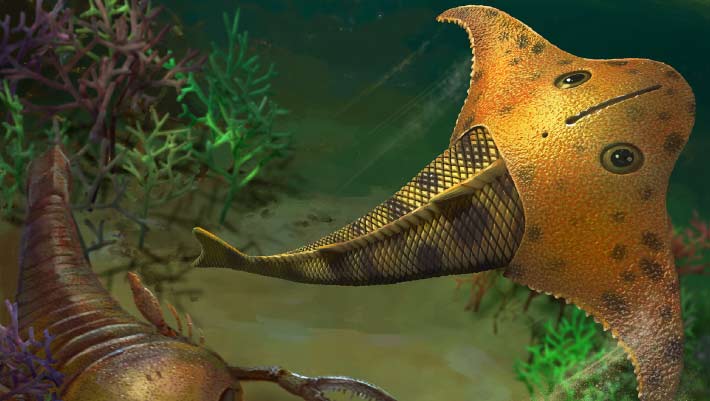
Meet Bataspis crux, Jawless Fish that Cruised Devonian Seas with Batwing Head
Rencontrez Bataspis crux, un poisson sans mâchoire qui naviguait dans les mers du Dévonien avec une tête de chauve-souris
mâchoire Chine Dévonien Dévonien poisson nouvelle espèce crâne
Des paléontologues chinois ont identifié une nouvelle espèce de poisson blindé et sans mâchoire provenant de roches vieilles d'environ 419 millions d'années, dont le crâne avait la forme d'une aile de chauve-souris et dont la tête inhabituelle en faisait un planeur efficace dans les mers du Dévonien. L'article Rencontrez Bataspis crux, un poisson sans mâchoire qui a navigué dans les mers du Dévonien avec une tête de chauve-souris est apparu en premier sur Sci.News : Breaking Science News.
18/08/2026 sci-news ⚙ Traduction automatique
Un fossile vieux de 30 ans cachait les os d'un mystérieux monstre marin ancien
os mâchoire Crétacé fossile Mosasaurus nouvelle espèce crâne
Des fossiles collectés à Osaka il y a plus de 30 ans ont révélé une surprise cachée à la vue de tous : quatre os jusqu'alors méconnus provenant d'un mosasaure géant du Crétacé. Parmi eux se trouve le premier prémaxillaire confirmé – l’os le plus en avant de la mâchoire supérieure – jamais identifié dans un fossile de mosasaure japonais. Plus intrigant encore, certaines parties du crâne présentent des caractéristiques anatomiques inhabituelles qui ne correspondent pas aux mosasaures connus, ce qui laisse penser que les restes appartiennent à une espèce entièrement nouvelle.
15/08/2026 sciencedaily ⚙ Traduction automatique
1 2 3 4 5 6