skull

View type

244 image(s) · 27 News

Image gallery

Pterodaustro skull
Taxa Archaeopterodactyloidea

Pterodaustro skull

Archaeopterodactyloidea Pterodaustro skull
Proceratosaurus bradleyi holotype NHMUK PV R 4860. Almost complete skull and mandibles in articulation, hyoid element and anterior cervical vertebrae in oolite block.
Taxa Proceratosauridae

Proceratosaurus bradleyi holotype NHMUK PV R 4860. Almost complete skull and mandibles in articulation, hyoid element and anterior cervical vertebrae in oolite block.

museum holotype Proceratosauridae Proceratosaurus +1
Restored Placochelys placodonta skull at the Museum für Naturkunde, Berlin.
Taxa Placochelyidae

Restored Placochelys placodonta skull at the Museum für Naturkunde, Berlin.

museum Placochelyidae Placochelys skull
Riojasaurus skull cast, Copenhagen.
Taxa Riojasauridae

Riojasaurus skull cast, Copenhagen.

cast Riojasauridae Riojasaurus skull
A restoration of Rinconsaurus compared to a human ,

•  Based proportionally on fossil elements and skeletal reconstruction featured in the Rinconsaurus description,[1] with missing parts based on other titanosaur reconstructions. The remains of Rinconsaurus represent two adults and a juvenile all of which are incomplete; some of the proportions shown here, such as the neck, limb lengths, and skull shape are not certain.
•  Osteroderms are not yet known in Rinconsaurus.  The osteoderms shown here are based loosely on Mendozasaurus.[2] Osteoderms are known from at least 10 titanosaur genera spread across the family tree but it's not clear if all titanosaurs had them.[3] Titanosaur osteoderms are rare and their layout and position on the body are not certain. [4]
•  The colours and patterns, as with the majority of reconstructions of prehistoric creatures, are speculative.
•  Human silhouette approximately 180 cm tall.

NOTE: I often update my images. If you want to have any of my images on a website, please (if possible) don’t host/save it to the website server. I’d prefer it if the image's Wikimedia URL is used. This means that if I update an image, it will be updated on the site as well.  Thanks.   


References


↑ Coria, Jorge; B.J.G. Riga (2003). "Rinconsaurus caudamirus gen. et sp nov., a new titanosaurid (Dinosauria, Sauropoda) from the Late Cretaceous of Patagonia, Argentina". Revista Geologica de Chile 30 (2): 333–353. ISSN 0716-0208. Retrieved on 2007-05-21.

↑   González Riga B (2003) A new titanosaur (Dinosauria, Sauropoda) from the Upper Cretaceous of Mendoza, Argentina. Ameghiniana 40 (2) 

↑  Carrano, M.T. and D’Emic, M.D.  2015 'Osteoderms of the titanosaur sauropod dinosaur Alamosaurus sanjuanensis Gilmore, 1922'. Journal of Vertebrate Paleontology.

↑    Vidal D, Ortega F, Sanz JL (2014) Titanosaur Osteoderms from the Upper Cretaceous of Lo Hueco (Spain) and Their Implications on the Armor of Laurasian Titanosaurs. PLoS ONE 9(8): e102488. doi:10.1371/journal.pone.0102488
Taxa Rinconsauria

A restoration of Rinconsaurus compared to a human , • Based proportionally on fossil elements and skeletal reconstruction featured in the Rinconsaurus description,[1] with missing parts based on other titanosaur reconstructions. The remains of Rinconsaurus represent two adults and a juvenile all of which are incomplete; some of the proportions shown here, such as the neck, limb lengths, and skull shape are not certain. • Osteroderms are not yet known in Rinconsaurus. The osteoderms shown here are based loosely on Mendozasaurus.[2] Osteoderms are known from at least 10 titanosaur genera spread across the family tree but it's not clear if all titanosaurs had them.[3] Titanosaur osteoderms are rare and their layout and position on the body are not certain. [4] • The colours and patterns, as with the majority of reconstructions of prehistoric creatures, are speculative. • Human silhouette approximately 180 cm tall. NOTE: I often update my images. If you want to have any of my images on a website, please (if possible) don’t host/save it to the website server. I’d prefer it if the image's Wikimedia URL is used. This means that if I update an image, it will be updated on the site as well. Thanks. References ↑ Coria, Jorge; B.J.G. Riga (2003). "Rinconsaurus caudamirus gen. et sp nov., a new titanosaurid (Dinosauria, Sauropoda) from the Late Cretaceous of Patagonia, Argentina". Revista Geologica de Chile 30 (2): 333–353. ISSN 0716-0208. Retrieved on 2007-05-21. ↑ González Riga B (2003) A new titanosaur (Dinosauria, Sauropoda) from the Upper Cretaceous of Mendoza, Argentina. Ameghiniana 40 (2) ↑ Carrano, M.T. and D’Emic, M.D. 2015 'Osteoderms of the titanosaur sauropod dinosaur Alamosaurus sanjuanensis Gilmore, 1922'. Journal of Vertebrate Paleontology. ↑ Vidal D, Ortega F, Sanz JL (2014) Titanosaur Osteoderms from the Upper Cretaceous of Lo Hueco (Spain) and Their Implications on the Armor of Laurasian Titanosaurs. PLoS ONE 9(8): e102488. doi:10.1371/journal.pone.0102488

armor limb description Argentina +14
Collage of three leptoceratopsids, clockwise from top left: Prenoceratops, Montanoceratops and Leptoceratops. These files are already on Commons with their respective licenses. This montage was made for the article Leptoceratopsidae on Wikipedia.
File:The Childrens Museum of Indianapolis - Prenoceratops pieganensis -1.jpg
File:Montanoceratops Royal Tyrrell 1.jpg
File:Leptoceratopsidae - Leptoceratops.JPG
File:Leptoceratops skull Royal Tyrrell.jpg
Taxa Leptoceratopsidae

Collage of three leptoceratopsids, clockwise from top left: Prenoceratops, Montanoceratops and Leptoceratops. These files are already on Commons with their respective licenses. This montage was made for the article Leptoceratopsidae on Wikipedia. File:The Childrens Museum of Indianapolis - Prenoceratops pieganensis -1.jpg File:Montanoceratops Royal Tyrrell 1.jpg File:Leptoceratopsidae - Leptoceratops.JPG File:Leptoceratops skull Royal Tyrrell.jpg

museum Leptoceratops Leptoceratopsidae Montanoceratops +2
Mounted replica of a composite skeleton of Edmontosaurus annectens on display at the University of Oxford Museum, Oxford, England. The original skeleton is compiled from disarticulated fossil bones from a bonebed of the Hell Creek Formation, exposed in the Ruth Mason Quarry in Harding County, South Dakota. It is 8.5 m (28 ft.) long and the skull is almost 1 m (39 in.) in length.[1][2]


↑ Dinosaurs in the Museum. Oxford University Museum of Natural History (brochure, PDF), p. 7

↑ BHI Fossil Replica Catalog 2012. Black Hills Institute of Geological Research, Inc., Hill City, SD, 2012 (PDF), p. 22
Taxa Saurolophinae

Mounted replica of a composite skeleton of Edmontosaurus annectens on display at the University of Oxford Museum, Oxford, England. The original skeleton is compiled from disarticulated fossil bones from a bonebed of the Hell Creek Formation, exposed in the Ruth Mason Quarry in Harding County, South Dakota. It is 8.5 m (28 ft.) long and the skull is almost 1 m (39 in.) in length.[1][2] ↑ Dinosaurs in the Museum. Oxford University Museum of Natural History (brochure, PDF), p. 7 ↑ BHI Fossil Replica Catalog 2012. Black Hills Institute of Geological Research, Inc., Hill City, SD, 2012 (PDF), p. 22

bone museum Hell Creek fossil +6
Figure 4
The reconstruction of the skull and lower jaw of the holotype of Darwinopterus camposi sp. nov. (IVPP V 17957). Scale bar: 50 mm. Abbreviations: d, dentary; f, frontal; j, jugal; ltf, lower temporal fenestra; m, maxilla; man.sys, mandibular symphysis; naof, nasoantorbital fenestra; o, orbit; p, parietal; pm, premaxilla; pmcr, premaxillary crest; po, postorbital; prn, nasal process; q, quadrate; sq, squamosal; utf, upper temporal fenestra.
Taxa Monofenestrata

Figure 4 The reconstruction of the skull and lower jaw of the holotype of Darwinopterus camposi sp. nov. (IVPP V 17957). Scale bar: 50 mm. Abbreviations: d, dentary; f, frontal; j, jugal; ltf, lower temporal fenestra; m, maxilla; man.sys, mandibular symphysis; naof, nasoantorbital fenestra; o, orbit; p, parietal; pm, premaxilla; pmcr, premaxillary crest; po, postorbital; prn, nasal process; q, quadrate; sq, squamosal; utf, upper temporal fenestra.

crest scale holotype Darwinopterus +2
A) Skull reconstruction of Murusraptor barrosaensis, MCF-PVPH-411. B) Body reconstruction of Murusraptor barrosaensis, MCF-PVPH-411.

Both illustrations show recovered elements in white. Scale bars: A = 10 cm, B = 1 m.
Taxa Megaraptora

A) Skull reconstruction of Murusraptor barrosaensis, MCF-PVPH-411. B) Body reconstruction of Murusraptor barrosaensis, MCF-PVPH-411. Both illustrations show recovered elements in white. Scale bars: A = 10 cm, B = 1 m.

scale Megaraptora Murusraptor skull
Plesiolophus is a lambeosaurine hadrosaur known from the same locality, but an earlier time period than Parasaurolophus. Though it is nearly impossible to know conclusively, Plesiolophus cannot be ruled out as a direct ancestor. Like Parasaurolophus, Plesiolophus would have had a distinct crest protruding backward from its skull.

Plesiolophus is a lambeosaurine hadrosaur known from the same locality, but an earlier time period than Parasaurolophus. Though it is nearly impossible to know conclusively, Plesiolophus cannot be ruled out as a direct ancestor. Like Parasaurolophus, Plesiolophus would have had a distinct crest protruding backward from its skull.

crest Hadrosauria Parasaurolophus Plesiolophus +1
Reconstructed skull of Einiosaurus procurvicornis on display at the Natural History Museum of Los Angeles County.
Taxa Einiosaurus

Reconstructed skull of Einiosaurus procurvicornis on display at the Natural History Museum of Los Angeles County.

museum Einiosaurus skull
Kronosaurus queenslandicus (QM F18827; proposed neotype [part]) skull in dorsal view (modified from McHenry Citation2009). Scale = 30 cm.
Taxa Kronosaurus

Kronosaurus queenslandicus (QM F18827; proposed neotype [part]) skull in dorsal view (modified from McHenry Citation2009). Scale = 30 cm.

scale Kronosaurus skull
Brontotholus is a relatively large pachycephalosaurian dinosaur. Like all pachycephalosaurs, it was bipedal and sported the characteristic bony dome on top of its skull. Brontotholus grew to nearly 4 m in length, making it one of the largest known pachycephalosaurs, and the largest from the Campanian age.
Taxa Brontotholus

Brontotholus is a relatively large pachycephalosaurian dinosaur. Like all pachycephalosaurs, it was bipedal and sported the characteristic bony dome on top of its skull. Brontotholus grew to nearly 4 m in length, making it one of the largest known pachycephalosaurs, and the largest from the Campanian age.

Campanian Brontotholus Dinosauria Pachycephalosauria +1
Comparison of cranial features between closely related southern Laramidian taxa; (A), Akainacephalus johnsoni (UMNH VP 20202) from the Late Cretaceous Kaiparowits Formation of Utah; and (B), Nodocephalosaurus kirtlandensis (SMP VP-900) from the Late Cretaceous Kirtland Formation of New Mexico, in left lateral views. Various synapomorphies are shared with N. kirtlandensis (highlighted in black and white arrows) and includes “flaring nostrils”; enlarged, laterally projecting, loreal osteoderms that are situated directly dorsal to the external nares. Other synapomorphies include pyramid-shaped nasal and frontal osteoderms positioned on the dorsal regions of the skull. A number of significant differences have been observed between both specimens; in A. johnsoni, the anterior, and posterior supraorbital bosses form an enlarged element that is somewhat backswept, whereas in N. kirtlandensis, the posterior and anterior supraorbital bosses are clearly defined as individual osteoderms, and are much smaller in size. Additionally, the squamosal horn in Akainacephalus is very small but is prominent and tetrahedrally shaped in Nodocephalosaurus. The quadratojugal horn in Akainacephalus is massive, has a subtriangular morphology in lateral view and projects almost entirely ventral, whereas in Nodocephalosaurus, the quadratojugal horn is smaller and has a typical fin-shaped morphology. Study sites: asob, anterior supraorbital boss; ext naris, external naris; laca, lacrimal caputegulum; loca, loreal caputegulum; naca, nasal caputegulae; orb, orbit; psob, posterior supraorbital boss; qjh, quadratojugal horn; sqh, squamosal horn.
Taxa Nodocephalosaurus

Comparison of cranial features between closely related southern Laramidian taxa; (A), Akainacephalus johnsoni (UMNH VP 20202) from the Late Cretaceous Kaiparowits Formation of Utah; and (B), Nodocephalosaurus kirtlandensis (SMP VP-900) from the Late Cretaceous Kirtland Formation of New Mexico, in left lateral views. Various synapomorphies are shared with N. kirtlandensis (highlighted in black and white arrows) and includes “flaring nostrils”; enlarged, laterally projecting, loreal osteoderms that are situated directly dorsal to the external nares. Other synapomorphies include pyramid-shaped nasal and frontal osteoderms positioned on the dorsal regions of the skull. A number of significant differences have been observed between both specimens; in A. johnsoni, the anterior, and posterior supraorbital bosses form an enlarged element that is somewhat backswept, whereas in N. kirtlandensis, the posterior and anterior supraorbital bosses are clearly defined as individual osteoderms, and are much smaller in size. Additionally, the squamosal horn in Akainacephalus is very small but is prominent and tetrahedrally shaped in Nodocephalosaurus. The quadratojugal horn in Akainacephalus is massive, has a subtriangular morphology in lateral view and projects almost entirely ventral, whereas in Nodocephalosaurus, the quadratojugal horn is smaller and has a typical fin-shaped morphology. Study sites: asob, anterior supraorbital boss; ext naris, external naris; laca, lacrimal caputegulum; loca, loreal caputegulum; naca, nasal caputegulae; orb, orbit; psob, posterior supraorbital boss; qjh, quadratojugal horn; sqh, squamosal horn.

Mexico Kaiparowits Kirtland Cretaceous +7
Fossil samples – e.g. ‘primitive’ bony fish (1, 2), a skull of a temnospondyl ‘amphibian’ (probably a metoposauroid) in dorsal view (3), a skull of an archosaur of the crocodile lineage (probably a phytosaur) in palatal view (4), holotype of the “gliding reptile” Icarosaurus siefkeri [1] (5) and Atreipus-Grallator-type dinosaur tracks (bottom right) – from the Newark Supergroup, i.e. a series of mainly Late Triassic to Early Jurassic sedimentary rocks of eastern North America


↑ Edwin H. Colbert: A gliding reptile from the Triassic of New Jersey. American Museum Novitates, 2230. American Museum of Natural History, New York 1966, digitallibrary.amnh.org, cf. fig. 3 therein.
Taxa Atreipus

Fossil samples – e.g. ‘primitive’ bony fish (1, 2), a skull of a temnospondyl ‘amphibian’ (probably a metoposauroid) in dorsal view (3), a skull of an archosaur of the crocodile lineage (probably a phytosaur) in palatal view (4), holotype of the “gliding reptile” Icarosaurus siefkeri [1] (5) and Atreipus-Grallator-type dinosaur tracks (bottom right) – from the Newark Supergroup, i.e. a series of mainly Late Triassic to Early Jurassic sedimentary rocks of eastern North America ↑ Edwin H. Colbert: A gliding reptile from the Triassic of New Jersey. American Museum Novitates, 2230. American Museum of Natural History, New York 1966, digitallibrary.amnh.org, cf. fig. 3 therein.

museum Early Jurassic Jurassic Late Triassic +9
Type skull of Pentaceratops sternbergii, American Museum of Natural History # AMNH6325
Taxa Pentaceratops

Type skull of Pentaceratops sternbergii, American Museum of Natural History # AMNH6325

museum Pentaceratops skull
1 2 3 4 5 6 7 8 9 10 11 12 13 14 15 16

News

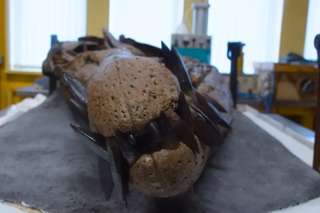
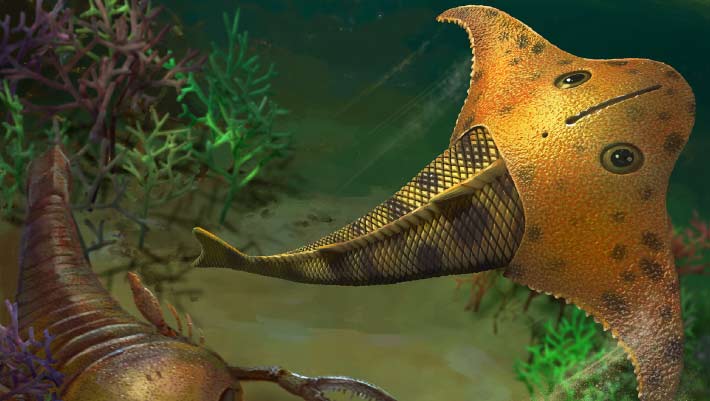
Meet Bataspis crux, Jawless Fish that Cruised Devonian Seas with Batwing Head
jaw China Devonian Late Devonian fish new species skull
Paleontologists in China have identified a new species of armored, jawless fish from rocks around 419 million years old whose skull was shaped like the wing of a bat and whose unusual head made it an efficient glider through Devonian seas. The post Meet Bataspis crux, Jawless Fish that Cruised Devonian Seas with Batwing Head appeared first on Sci.News: Breaking Science News.
18/08/2026 sci-news
A 30-year-old fossil was hiding bones from a mysterious ancient sea monster
bone jaw Cretaceous fossil Mosasaurus new species skull
Fossils collected in Osaka more than 30 years ago have revealed a surprise hiding in plain sight: four previously unrecognized bones from a giant Cretaceous mosasaur. Among them is the first confirmed premaxilla—the frontmost bone of the upper jaw—ever identified in a Japanese mosasaur fossil. Even more intriguing, parts of the skull show unusual anatomical features that don’t match known mosasaurs, raising the possibility that the remains belong to an entirely new species.
15/08/2026 sciencedaily
A New Genus of Troodontid Dinosaur from New Mexico
bone Mexico Campanian Cretaceous Late Cretaceous fossil Dinevenator Dinosauria Troodontidae new species skull
Palaeontologists have named a new species of theropod dinosaur from New Mexico. The dinosaur, Dinevenator robustus, lived around 73 million years ago (Campanian faunal stage of the Late Cretaceous). Researchers identified the dinosaur from a fossil skull bone (a frontal) found in north-western New Mexico. It represents a new genus and species of troodontid. Troodontids
13/08/2026 everythingdinosaur
The dodo bird had a secret sensory world scientists are only now discovering
bird CT-scan discovery skull
CT scans of the world’s rarest dodo skulls suggest the extinct bird may have had a stronger sense of smell, a highly sensitive beak, and a lifestyle that extended into dawn and dusk. The discoveries are helping overturn centuries-old myths and reveal a far more complex animal than the famously “dumb” dodo of popular imagination.
09/08/2026 sciencedaily-paleo
A forgotten fossil just revealed a new Triassic predator from 210 million years ago
jaw predator prey Mexico Triassic fossil skull
A fossil overlooked for nearly 80 years has revealed a previously unknown crocodile relative that lived 210 million years ago in what is now New Mexico. Named Eosphorosuchus lacrimosa, the jackal-sized predator had a reinforced skull, powerful jaw muscles, and a short snout built for tackling larger prey.
30/07/2026 sciencedaily
1 2 3 4 5 6