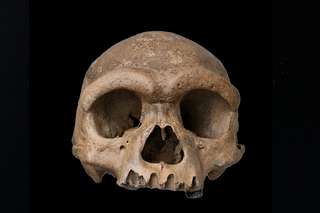
crâne

Type de vue

188 image(s) · 20 Actualités

Galerie d'images

Diagram of the skull of Taniwhasaurus antarcticus, the areas in black being the known fossil material.
Reference source:

Álvarez–Herrera, Agnolin & Novas (2020) "A rostral neurovascular system in the mosasaur Taniwhasaurus antarcticus"

Diagram of the skull of Taniwhasaurus antarcticus, the areas in black being the known fossil material. Reference source: Álvarez–Herrera, Agnolin & Novas (2020) "A rostral neurovascular system in the mosasaur Taniwhasaurus antarcticus"

fossile Plioplatecarpinae Taniwhasaurus crâne
Alioramus altai skull in the exhibit, T. rex, The Ultimate Predator, in the American Museum of Natural History (with permission by Ben Miller).
Taxons Alioramini

Alioramus altai skull in the exhibit, T. rex, The Ultimate Predator, in the American Museum of Natural History (with permission by Ben Miller).

prédateur musée Alioramini Alioramus +1
Pterodaustro skull
Taxons Ctenochasmatoidea

Pterodaustro skull

Archaeopterodactyloidea Aurorazhdarchidae Ctenochasmatoidea Euctenochasmatia +2
Pterodaustro skull
Taxons Euctenochasmatia

Pterodaustro skull

Archaeopterodactyloidea Aurorazhdarchidae Ctenochasmatoidea Euctenochasmatia +2
Pterodaustro skull
Taxons Archaeopterodactyloidea

Pterodaustro skull

Archaeopterodactyloidea Aurorazhdarchidae Ctenochasmatoidea Euctenochasmatia +2
Pterodaustro skull
Taxons Aurorazhdarchidae

Pterodaustro skull

Archaeopterodactyloidea Aurorazhdarchidae Ctenochasmatoidea Euctenochasmatia +2
Collage of three leptoceratopsids, clockwise from top left: Prenoceratops, Montanoceratops and Leptoceratops. These files are already on Commons with their respective licenses. This montage was made for the article Leptoceratopsidae on Wikipedia.
File:The Childrens Museum of Indianapolis - Prenoceratops pieganensis -1.jpg
File:Montanoceratops Royal Tyrrell 1.jpg
File:Leptoceratopsidae - Leptoceratops.JPG
File:Leptoceratops skull Royal Tyrrell.jpg
Taxons Leptoceratopsidae

Collage of three leptoceratopsids, clockwise from top left: Prenoceratops, Montanoceratops and Leptoceratops. These files are already on Commons with their respective licenses. This montage was made for the article Leptoceratopsidae on Wikipedia. File:The Childrens Museum of Indianapolis - Prenoceratops pieganensis -1.jpg File:Montanoceratops Royal Tyrrell 1.jpg File:Leptoceratopsidae - Leptoceratops.JPG File:Leptoceratops skull Royal Tyrrell.jpg

musée Leptoceratops Leptoceratopsidae Montanoceratops +2
Figure 4
The reconstruction of the skull and lower jaw of the holotype of Darwinopterus camposi sp. nov. (IVPP V 17957). Scale bar: 50 mm. Abbreviations: d, dentary; f, frontal; j, jugal; ltf, lower temporal fenestra; m, maxilla; man.sys, mandibular symphysis; naof, nasoantorbital fenestra; o, orbit; p, parietal; pm, premaxilla; pmcr, premaxillary crest; po, postorbital; prn, nasal process; q, quadrate; sq, squamosal; utf, upper temporal fenestra.
Taxons Monofenestrata

Figure 4 The reconstruction of the skull and lower jaw of the holotype of Darwinopterus camposi sp. nov. (IVPP V 17957). Scale bar: 50 mm. Abbreviations: d, dentary; f, frontal; j, jugal; ltf, lower temporal fenestra; m, maxilla; man.sys, mandibular symphysis; naof, nasoantorbital fenestra; o, orbit; p, parietal; pm, premaxilla; pmcr, premaxillary crest; po, postorbital; prn, nasal process; q, quadrate; sq, squamosal; utf, upper temporal fenestra.

crête écaille holotype Darwinoptera +3
Figure 4
The reconstruction of the skull and lower jaw of the holotype of Darwinopterus camposi sp. nov. (IVPP V 17957). Scale bar: 50 mm. Abbreviations: d, dentary; f, frontal; j, jugal; ltf, lower temporal fenestra; m, maxilla; man.sys, mandibular symphysis; naof, nasoantorbital fenestra; o, orbit; p, parietal; pm, premaxilla; pmcr, premaxillary crest; po, postorbital; prn, nasal process; q, quadrate; sq, squamosal; utf, upper temporal fenestra.
Taxons Darwinoptera

Figure 4 The reconstruction of the skull and lower jaw of the holotype of Darwinopterus camposi sp. nov. (IVPP V 17957). Scale bar: 50 mm. Abbreviations: d, dentary; f, frontal; j, jugal; ltf, lower temporal fenestra; m, maxilla; man.sys, mandibular symphysis; naof, nasoantorbital fenestra; o, orbit; p, parietal; pm, premaxilla; pmcr, premaxillary crest; po, postorbital; prn, nasal process; q, quadrate; sq, squamosal; utf, upper temporal fenestra.

crête écaille holotype Darwinoptera +3
Albertosaurus skull cast (specimen TMP 1981.010.0001) at the Geological Museum in Copenhagen.
Taxons Albertosaurinae

Albertosaurus skull cast (specimen TMP 1981.010.0001) at the Geological Museum in Copenhagen.

musée moulage spécimen Albertosaurinae +2
Mounted replica of a composite skeleton of Edmontosaurus annectens on display at the University of Oxford Museum, Oxford, England. The original skeleton is compiled from disarticulated fossil bones from a bonebed of the Hell Creek Formation, exposed in the Ruth Mason Quarry in Harding County, South Dakota. It is 8.5 m (28 ft.) long and the skull is almost 1 m (39 in.) in length.[1][2]


↑ Dinosaurs in the Museum. Oxford University Museum of Natural History (brochure, PDF), p. 7

↑ BHI Fossil Replica Catalog 2012. Black Hills Institute of Geological Research, Inc., Hill City, SD, 2012 (PDF), p. 22
Taxons Edmontosaurini

Mounted replica of a composite skeleton of Edmontosaurus annectens on display at the University of Oxford Museum, Oxford, England. The original skeleton is compiled from disarticulated fossil bones from a bonebed of the Hell Creek Formation, exposed in the Ruth Mason Quarry in Harding County, South Dakota. It is 8.5 m (28 ft.) long and the skull is almost 1 m (39 in.) in length.[1][2] ↑ Dinosaurs in the Museum. Oxford University Museum of Natural History (brochure, PDF), p. 7 ↑ BHI Fossil Replica Catalog 2012. Black Hills Institute of Geological Research, Inc., Hill City, SD, 2012 (PDF), p. 22

os musée Hell Creek fossile +10
Mounted replica of a composite skeleton of Edmontosaurus annectens on display at the University of Oxford Museum, Oxford, England. The original skeleton is compiled from disarticulated fossil bones from a bonebed of the Hell Creek Formation, exposed in the Ruth Mason Quarry in Harding County, South Dakota. It is 8.5 m (28 ft.) long and the skull is almost 1 m (39 in.) in length.[1][2]


↑ Dinosaurs in the Museum. Oxford University Museum of Natural History (brochure, PDF), p. 7

↑ BHI Fossil Replica Catalog 2012. Black Hills Institute of Geological Research, Inc., Hill City, SD, 2012 (PDF), p. 22
Taxons Kritosaurini

Mounted replica of a composite skeleton of Edmontosaurus annectens on display at the University of Oxford Museum, Oxford, England. The original skeleton is compiled from disarticulated fossil bones from a bonebed of the Hell Creek Formation, exposed in the Ruth Mason Quarry in Harding County, South Dakota. It is 8.5 m (28 ft.) long and the skull is almost 1 m (39 in.) in length.[1][2] ↑ Dinosaurs in the Museum. Oxford University Museum of Natural History (brochure, PDF), p. 7 ↑ BHI Fossil Replica Catalog 2012. Black Hills Institute of Geological Research, Inc., Hill City, SD, 2012 (PDF), p. 22

os musée Hell Creek fossile +10
Mounted replica of a composite skeleton of Edmontosaurus annectens on display at the University of Oxford Museum, Oxford, England. The original skeleton is compiled from disarticulated fossil bones from a bonebed of the Hell Creek Formation, exposed in the Ruth Mason Quarry in Harding County, South Dakota. It is 8.5 m (28 ft.) long and the skull is almost 1 m (39 in.) in length.[1][2]


↑ Dinosaurs in the Museum. Oxford University Museum of Natural History (brochure, PDF), p. 7

↑ BHI Fossil Replica Catalog 2012. Black Hills Institute of Geological Research, Inc., Hill City, SD, 2012 (PDF), p. 22
Taxons Saurolophini

Mounted replica of a composite skeleton of Edmontosaurus annectens on display at the University of Oxford Museum, Oxford, England. The original skeleton is compiled from disarticulated fossil bones from a bonebed of the Hell Creek Formation, exposed in the Ruth Mason Quarry in Harding County, South Dakota. It is 8.5 m (28 ft.) long and the skull is almost 1 m (39 in.) in length.[1][2] ↑ Dinosaurs in the Museum. Oxford University Museum of Natural History (brochure, PDF), p. 7 ↑ BHI Fossil Replica Catalog 2012. Black Hills Institute of Geological Research, Inc., Hill City, SD, 2012 (PDF), p. 22

os musée Hell Creek fossile +10
Mounted replica of a composite skeleton of Edmontosaurus annectens on display at the University of Oxford Museum, Oxford, England. The original skeleton is compiled from disarticulated fossil bones from a bonebed of the Hell Creek Formation, exposed in the Ruth Mason Quarry in Harding County, South Dakota. It is 8.5 m (28 ft.) long and the skull is almost 1 m (39 in.) in length.[1][2]


↑ Dinosaurs in the Museum. Oxford University Museum of Natural History (brochure, PDF), p. 7

↑ BHI Fossil Replica Catalog 2012. Black Hills Institute of Geological Research, Inc., Hill City, SD, 2012 (PDF), p. 22
Taxons Saurolophinae

Mounted replica of a composite skeleton of Edmontosaurus annectens on display at the University of Oxford Museum, Oxford, England. The original skeleton is compiled from disarticulated fossil bones from a bonebed of the Hell Creek Formation, exposed in the Ruth Mason Quarry in Harding County, South Dakota. It is 8.5 m (28 ft.) long and the skull is almost 1 m (39 in.) in length.[1][2] ↑ Dinosaurs in the Museum. Oxford University Museum of Natural History (brochure, PDF), p. 7 ↑ BHI Fossil Replica Catalog 2012. Black Hills Institute of Geological Research, Inc., Hill City, SD, 2012 (PDF), p. 22

os musée Hell Creek fossile +10
Mounted replica of a composite skeleton of Edmontosaurus annectens on display at the University of Oxford Museum, Oxford, England. The original skeleton is compiled from disarticulated fossil bones from a bonebed of the Hell Creek Formation, exposed in the Ruth Mason Quarry in Harding County, South Dakota. It is 8.5 m (28 ft.) long and the skull is almost 1 m (39 in.) in length.[1][2]


↑ Dinosaurs in the Museum. Oxford University Museum of Natural History (brochure, PDF), p. 7

↑ BHI Fossil Replica Catalog 2012. Black Hills Institute of Geological Research, Inc., Hill City, SD, 2012 (PDF), p. 22
Taxons Brachylophosaurini

Mounted replica of a composite skeleton of Edmontosaurus annectens on display at the University of Oxford Museum, Oxford, England. The original skeleton is compiled from disarticulated fossil bones from a bonebed of the Hell Creek Formation, exposed in the Ruth Mason Quarry in Harding County, South Dakota. It is 8.5 m (28 ft.) long and the skull is almost 1 m (39 in.) in length.[1][2] ↑ Dinosaurs in the Museum. Oxford University Museum of Natural History (brochure, PDF), p. 7 ↑ BHI Fossil Replica Catalog 2012. Black Hills Institute of Geological Research, Inc., Hill City, SD, 2012 (PDF), p. 22

os musée Hell Creek fossile +10
Restored skull and neck vertebra of Anzu wyliei (previously labelled as a specimen of Chirostenotes)
Taxons Caenagnathidae

Restored skull and neck vertebra of Anzu wyliei (previously labelled as a specimen of Chirostenotes)

vertèbre spécimen Anzu Caenagnathidae +4
1 2 3 4 5 6 7 8 9 10 11 12

Actualités

Les scientifiques ont trouvé un bébé dinosaure caché dans la roche et il est étonnamment mignon
os dessin Corée du Sud Dinosauria Doolysaurus tomographie découverte crâne
Des scientifiques ont découvert un bébé dinosaure rare en Corée du Sud et l'ont baptisé Doolysaurus, en hommage à un célèbre personnage de dessin animé. Grâce à des tomodensitogrammes de pointe, ils ont découvert des os cachés, notamment un crâne, dans la roche beaucoup plus rapidement que les méthodes traditionnelles. Le jeune dinosaure, peut-être duveteux et ressemblant à un agneau, avait même des calculs gastriques révélant qu'il mangeait un mélange de plantes et de petits animaux. Cette découverte suggère que de nombreux autres dinosaures pourraient encore être cachés dans les roches coréennes.
01/04/2026 sciencedaily ⚙ Traduction automatique
Des fossiles de poissons vieux de 400 millions d'années révèlent comment la vie a commencé à s'installer sur terre
Australie Chine fossile formation crâne
Les scientifiques ont découvert de nouveaux indices sur certains des premiers poissons de la Terre, mettant ainsi en lumière les origines anciennes des vertébrés qui ont fini par s’installer sur terre. En réanalysant de mystérieux fossiles de la célèbre formation australienne Gogo et en étudiant un crâne de poisson-poumon récemment reconstruit, vieux de 410 millions d'années et provenant de Chine, les chercheurs révèlent comment ces créatures primitives ont évolué.
12/03/2026 sciencedaily ⚙ Traduction automatique
Le tricératops avait un nez géant qui aurait pu refroidir sa tête massive
fossile Triceratops tomographie crâne
La tête massive du tricératops faisait peut-être plus que simplement montrer ces fameuses cornes. À l’aide de tomodensitogrammes et de reconstructions 3D de crânes fossiles, les chercheurs ont découvert un système nasal étonnamment complexe caché à l’intérieur de son énorme museau. Au lieu d’être simplement un nez surdimensionné pour sentir, il abritait probablement des réseaux complexes de nerfs et de vaisseaux sanguins, et même des structures spéciales qui aidaient à réguler la chaleur et l’humidité.
22/02/2026 sciencedaily ⚙ Traduction automatique
Cet animal ancien fut l'un des premiers à manger des plantes sur terre
dent fossile crâne
Il y a des centaines de millions d’années, les premiers animaux à ramper sur terre étaient de purs mangeurs de viande, alors même que les plantes avaient déjà envahi le paysage. Aujourd’hui, les scientifiques ont découvert un fossile vieux de 307 millions d’années qui réécrit cette histoire : l’un des premiers vertébrés terrestres connus à avoir commencé à manger des plantes. L'animal, nommé Tyrannoroter heberti, était une créature trapue de la taille d'un ballon de football avec un crâne rempli de dents spécialisées conçues pour écraser et broyer la végétation.
11/02/2026 sciencedaily ⚙ Traduction automatique
Cet étrange petit dinosaure oblige à repenser l'évolution
os dent métabolisme Dinosauria Foskeia anatomie oiseau évolution mammifères étude crâne
Un petit dinosaure nouvellement identifié, Foskeia pelendonum, bouleverse les idées reçues de longue date sur l'évolution des dinosaures herbivores. Même si les adultes adultes étaient remarquablement petits et légers, leur anatomie était tout sauf simple : elles présentaient un crâne bizarre et hautement spécialisé et des traits évolutifs inattendus. Des études osseuses détaillées montrent que ces dinosaures ont mûri rapidement avec un métabolisme semblable à celui des oiseaux ou des mammifères, tandis que leurs dents et leur posture suggèrent une vie rapide et agile dans des forêts denses.
03/02/2026 sciencedaily ⚙ Traduction automatique
1 2 3 4