←

crâne

Type de vue

215 image(s) · 30 Actualités

Galerie d'images

The skull of the holotype of Acristavus, MOR 1155
Taxons Acristavus

The skull of the holotype of Acristavus, MOR 1155

holotype Acristavus Montanoceratops crâne
Holotype skull of Augustynolophus morrisi (LACM 2852) on display at the Natural History Museum of Los Angeles County.
Taxons Augustynolophus

Holotype skull of Augustynolophus morrisi (LACM 2852) on display at the Natural History Museum of Los Angeles County.

musée holotype Augustynolophus crâne
Albertosaurus skull cast (specimen TMP 1981.010.0001) at the Geological Museum in Copenhagen.
Taxons Albertosaurinae

Albertosaurus skull cast (specimen TMP 1981.010.0001) at the Geological Museum in Copenhagen.

musée moulage spécimen Albertosaurinae +2
Skull of Globidens dakotensis in the Field Museum of Natural History.
Taxons Globidensini

Skull of Globidens dakotensis in the Field Museum of Natural History.

musée Globidens Globidensini crâne
Duck-billed dinosaurs at the Royal Ontario Museum. A Maiasaura skeleton is visible on the foreground, with two Maiasaura juveniles at the foot of the skeletal mount. On the background, flushing with the wall, there's the two-dimensional mount of a Gryposaurus specimen. The unidentified skull of another duck-billed dinosaur is visible on the low right corner of the photograph.
Taxons Hadrosauridae

Duck-billed dinosaurs at the Royal Ontario Museum. A Maiasaura skeleton is visible on the foreground, with two Maiasaura juveniles at the foot of the skeletal mount. On the background, flushing with the wall, there's the two-dimensional mount of a Gryposaurus specimen. The unidentified skull of another duck-billed dinosaur is visible on the low right corner of the photograph.

musée juvénile spécimen Dinosauria +5
Duck-billed dinosaurs at the Royal Ontario Museum. A Maiasaura skeleton is visible on the foreground, with two Maiasaura juveniles at the foot of the skeletal mount. On the background, flushing with the wall, there's the two-dimensional mount of a Gryposaurus specimen. The unidentified skull of another duck-billed dinosaur is visible on the low right corner of the photograph.
Taxons Hadrosauridae

Duck-billed dinosaurs at the Royal Ontario Museum. A Maiasaura skeleton is visible on the foreground, with two Maiasaura juveniles at the foot of the skeletal mount. On the background, flushing with the wall, there's the two-dimensional mount of a Gryposaurus specimen. The unidentified skull of another duck-billed dinosaur is visible on the low right corner of the photograph.

musée juvénile spécimen Dinosauria +5
Restoration of the spinosaurid dinosaur Siamosaurus in the Sao Khua Formation palaeoenvironment, with Sunosuchus in the middle left and a herd of Phuwiangosaurus in the background.
References:
Siamosaurus based on tooth specimens [1] and the neural spine of a possibly referable skeleton[2], with other missing elements filled in with relatives (Suchomimus[3], Baryonyx[4], IchthyovenatorFile:Ichthyovenator_laosensis_skeletal_reconstruction_by_PaleoGeek.png).
Phuwiangosaurus based on skeletal by Suteethorn et al. (2009)[5] and missing elements of skull of EuhelopusFile:Euhelopus.png.

Sunosuchus based on Suteethorn and Ingavat (1983)[6] and missing elements based on Goniopholis[7].
Formations Sao Khua

Restoration of the spinosaurid dinosaur Siamosaurus in the Sao Khua Formation palaeoenvironment, with Sunosuchus in the middle left and a herd of Phuwiangosaurus in the background. References: Siamosaurus based on tooth specimens [1] and the neural spine of a possibly referable skeleton[2], with other missing elements filled in with relatives (Suchomimus[3], Baryonyx[4], IchthyovenatorFile:Ichthyovenator_laosensis_skeletal_reconstruction_by_PaleoGeek.png). Phuwiangosaurus based on skeletal by Suteethorn et al. (2009)[5] and missing elements of skull of EuhelopusFile:Euhelopus.png. Sunosuchus based on Suteethorn and Ingavat (1983)[6] and missing elements based on Goniopholis[7].

dent dessin Sao Khua spécimen +11
Diagram of the skull of Haya griva in lateral view, reconstructed from IGM 100/2017
Taxons Haya

Diagram of the skull of Haya griva in lateral view, reconstructed from IGM 100/2017

Haya crâne
Skull cast of Liaoceratops yanzigouensis on display at the Baoding Natural History Museum.
Taxons Liaoceratops

Skull cast of Liaoceratops yanzigouensis on display at the Baoding Natural History Museum.

musée moulage Liaoceratops crâne
Skeleton of Yamaceratops dorngobiensis (MPC-D 100/553) in right dorsolateral view. (A) Photograph; (B) Interpretive drawing. Bones are bounded by solid lines and colored beige; the matrix is gray. Shaded areas represent the broken surface of bones. Abbreviations: cd, caudal vertebrae; dr, dorsal ribs; dv, dorsal vertebrae; f, femur; fi, fibula; h, humerus; L, bone on the left side; p, isolated parietal; pp, pedal phalanges; R, bone on the right side; ra, radius; sk, skull; sv, sacral vertebrae; ti, tibia; u, ulna; il, ilium; is, ischium.
Taxons Yamaceratops

Skeleton of Yamaceratops dorngobiensis (MPC-D 100/553) in right dorsolateral view. (A) Photograph; (B) Interpretive drawing. Bones are bounded by solid lines and colored beige; the matrix is gray. Shaded areas represent the broken surface of bones. Abbreviations: cd, caudal vertebrae; dr, dorsal ribs; dv, dorsal vertebrae; f, femur; fi, fibula; h, humerus; L, bone on the left side; p, isolated parietal; pp, pedal phalanges; R, bone on the right side; ra, radius; sk, skull; sv, sacral vertebrae; ti, tibia; u, ulna; il, ilium; is, ischium.

os humérus dessin Yamaceratops +2
Reconstructions of diplodocoid skulls used in this analysis.

Reconstructions of Nigersaurus and Diplodocus modified from [10] and [34], respectively. All other reconstructions based on material listed in Table S1. Skulls scaled to equivalent anteroposterior lengths.
Taxons Suuwassea

Reconstructions of diplodocoid skulls used in this analysis. Reconstructions of Nigersaurus and Diplodocus modified from [10] and [34], respectively. All other reconstructions based on material listed in Table S1. Skulls scaled to equivalent anteroposterior lengths.

Diplodocia Nigersaurus Suuwassea crâne
Partial skull of Manidens condorensis from the Middle Jurassic Cañadón Asfalto Formation of Argentina. Skull reconstructions in lateral view. Dashed lines indicate estimated edges. Abbreviations: a angular antfo antorbital fossa asaf anterior surangular foramen be buccal emargination bo basioccipital bt basal tubera d dentary d1, 2, 11 dentary tooth 1, 2, 11 emfo external mandibular fossa f frontal gl glenoid gr groove j jugal jfl jugal flange jh jugal horn m maxilla m1, 11 maxillary tooth 1, 11 n nasal pd predentary pm premaxilla po postorbital pof postorbital fossa popr paroccipital process q quadrate qj quadratojugal ri ridge sa surangular sq squamosal.
Taxons Manidens

Partial skull of Manidens condorensis from the Middle Jurassic Cañadón Asfalto Formation of Argentina. Skull reconstructions in lateral view. Dashed lines indicate estimated edges. Abbreviations: a angular antfo antorbital fossa asaf anterior surangular foramen be buccal emargination bo basioccipital bt basal tubera d dentary d1, 2, 11 dentary tooth 1, 2, 11 emfo external mandibular fossa f frontal gl glenoid gr groove j jugal jfl jugal flange jh jugal horn m maxilla m1, 11 maxillary tooth 1, 11 n nasal pd predentary pm premaxilla po postorbital pof postorbital fossa popr paroccipital process q quadrate qj quadratojugal ri ridge sa surangular sq squamosal.

dent Argentine Jurassique Jurassique moyen +4
Achelousaurus horneri skull, collected in Glacier County, Montana, at the Museum of the Rockies in Bozeman, Montana.
The Ceratopsidae are those dinosaurs with head frills.  There are three large subgroups of Ceratopsidae: Centrosaurinae, Ceratopsinae, and Chasmosaurinae. The Triceratopsini are a "tribe" of the Chasmosaurinae -- a genus so vast that it gets the special name "tribe".  The Pachyrhinosaurini are a "tribe" within the Centrosaurinae.

Achelousaurus is a genus within the Pachyrhinosaurini.  So far, only three skulls and some limited skeletal remains have been collected anywhere in the world -- and all of them in Montana.  Their bony frills are quite similar to the Styracosaurus albertensis, although their other skull features (such as big bony bosses on the nose and behind the eyes) are not.
Taxons Achelousaurus

Achelousaurus horneri skull, collected in Glacier County, Montana, at the Museum of the Rockies in Bozeman, Montana. The Ceratopsidae are those dinosaurs with head frills. There are three large subgroups of Ceratopsidae: Centrosaurinae, Ceratopsinae, and Chasmosaurinae. The Triceratopsini are a "tribe" of the Chasmosaurinae -- a genus so vast that it gets the special name "tribe". The Pachyrhinosaurini are a "tribe" within the Centrosaurinae. Achelousaurus is a genus within the Pachyrhinosaurini. So far, only three skulls and some limited skeletal remains have been collected anywhere in the world -- and all of them in Montana. Their bony frills are quite similar to the Styracosaurus albertensis, although their other skull features (such as big bony bosses on the nose and behind the eyes) are not.

musée États-Unis Achelousaurus Centrosaurinae +8
a Skeletal reconstruction of A. greppini. Elements preserved in the material and therefore providing information for the skeletal reconstruction are marked in blue. Because much information is missing from the incomplete skeletal material, the dorsal vertebrae, the proportions and morphology of the cervical vertebrae and the skull were modified from Camarasaurus. b Scaled silhouette drawings of Cetiosauriscus stewarti (in black) and A. greppini (in grey) demonstrating the significant size difference between the two taxa. Scale bar is 1 m
Taxons Amanzia

a Skeletal reconstruction of A. greppini. Elements preserved in the material and therefore providing information for the skeletal reconstruction are marked in blue. Because much information is missing from the incomplete skeletal material, the dorsal vertebrae, the proportions and morphology of the cervical vertebrae and the skull were modified from Camarasaurus. b Scaled silhouette drawings of Cetiosauriscus stewarti (in black) and A. greppini (in grey) demonstrating the significant size difference between the two taxa. Scale bar is 1 m

écaille dessin Amanzia Camarasaurus +2
The palatal view of the skull of NMS G.2021.6.2 and comparative assessment of the pterygoid region. The palatal region of NMS G.2021.6.2, A as seen in the ventral view. The comparative, to scale, pterosaur palatine and palatal regions in the ventral view. From left to right: B Cacibupteryx (IGO-V 208); C Parapsicephalus (GSM 3166); D Dearc (NMS G.2021.6.2); E Rhamphorhynchus (NHM R 2786); F Rhamphorhynchus (CM 11434). Abbreviations: bsp—basipterygoid; cho—choana; ec -, ectopterygoid; ipv—interpterygoid vacuity; pal—palatine; pf—posterior palatine fenestra; pte—pterygoid; stf -subtemporal fenestra; sof – suborbital fenestra; vm—vomer. Scale bar 10 mm
Taxons Cacibupteryx

The palatal view of the skull of NMS G.2021.6.2 and comparative assessment of the pterygoid region. The palatal region of NMS G.2021.6.2, A as seen in the ventral view. The comparative, to scale, pterosaur palatine and palatal regions in the ventral view. From left to right: B Cacibupteryx (IGO-V 208); C Parapsicephalus (GSM 3166); D Dearc (NMS G.2021.6.2); E Rhamphorhynchus (NHM R 2786); F Rhamphorhynchus (CM 11434). Abbreviations: bsp—basipterygoid; cho—choana; ec -, ectopterygoid; ipv—interpterygoid vacuity; pal—palatine; pf—posterior palatine fenestra; pte—pterygoid; stf -subtemporal fenestra; sof – suborbital fenestra; vm—vomer. Scale bar 10 mm

écaille Cacibupteryx Dearc Parapsicephalus +3
Selmasaurus johnsoni mounted skull in the Rocky Mountain Dinosaur Resource Center in Woodland Park, Colorado
Taxons Selmasaurus

Selmasaurus johnsoni mounted skull in the Rocky Mountain Dinosaur Resource Center in Woodland Park, Colorado

Dinosauria Selmasaurus crâne
1 2 3 4 5 6 7 8 9 10 11 12 13 14

Actualités

Un superbe crâne de théropode exposé
musée fossile Tyrannosaurus crâne
Lors d'une visite au Museum für Naturkunde (Berlin) nous en avons profité pour photographier le magnifique crâne de Tristan le Tyrannosaurus rex.  Le crâne est l’un des crânes de tyrannosaure les plus complets et les mieux conservés connus de la science.  Les fossiles de T. rex, exposés à côté du crâne, ont été nommés Tristan Otto.  À
12/06/2026 everythingdinosaur ⚙ Traduction automatique
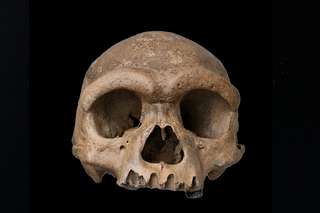
Les scientifiques pensaient les Denisoviens introuvables : cette découverte spectaculaire change désormais tout
os ADN Chine découverte Homo sapiens origine humaine crâne
Pendant quinze ans, les Denisoviens n'ont eu ni visage ni contour. Juste de l'ADN extrait d'un fragment d'os sibérien grand comme un ongle. En 2025, un crâne exceptionnel découvert en Chine a tout changé. Homo longi, surnommé l'Homme dragon, donne enfin un visage à ce groupe humain fantôme. 
06/06/2026 futura-terre
Ce poisson préhistorique pourrait expliquer comment les animaux ont marché pour la première fois sur Terre
Antarctique crâne
Les scientifiques ont examiné l'intérieur du crâne d'un poisson de l'Antarctique vieux de 380 millions d'années, étroitement apparenté aux premiers animaux à avoir marché sur terre, révélant des indices surprenants sur la façon dont la vie a commencé à sortir de l'eau. Grâce à l’imagerie neutronique avancée, les chercheurs ont découvert que Koharalepis jarviki possédait des caractéristiques adaptées pour vivre près de la surface de l’eau, notamment des ouvertures dans son crâne qui auraient pu l’aider à avaler de l’air et un organe sensible à la lumière lié aux rythmes jour-nuit.
25/05/2026 sciencedaily-paleo ⚙ Traduction automatique
Les petits bras du T. rex pourraient avoir évolué pour une raison étonnamment brutale
mâchoire membre chasse prédateur proie Dinosauria crâne
Pourquoi le T. rex avait-il des bras si petits ? Les scientifiques pensent désormais que c’est parce que sa tête géante est devenue l’outil de chasse ultime. Dans plusieurs groupes de dinosaures, des crânes plus forts et des mâchoires écrasantes ont évolué parallèlement à des membres antérieurs rétrécis, en particulier chez les prédateurs chassant d'énormes proies. En d’autres termes, une fois que la morsure est devenue suffisamment mortelle, les bras ont peut-être cessé d’avoir de l’importance.
20/05/2026 sciencedaily ⚙ Traduction automatique
Un superbe crâne de stégosaure vieux de 150 millions d'années réécrit l'évolution des dinosaures
fossile Dacentrurus Dinosauria Stegosauria découverte évolution crâne
Une découverte spectaculaire de dinosaures en Espagne donne aux scientifiques un nouveau regard rare sur le monde des stégosaures. Les paléontologues ont découvert le crâne de stégosaure le mieux conservé jamais découvert en Europe, appartenant à l'emblématique dinosaure plaqué Dacentrurus armatus, qui parcourait la Terre il y a environ 150 millions d'années. Parce que les crânes de stégosaures sont extrêmement fragiles et ne survivent presque jamais intacts, le fossile aide les chercheurs à découvrir des détails jusqu'alors inconnus sur l'évolution de ces géants blindés.
17/05/2026 sciencedaily ⚙ Traduction automatique
1 2 3 4 5 6