←

crâne

Type de vue

215 image(s) · 30 Actualités

Galerie d'images

Plesiolophus is a lambeosaurine hadrosaur known from the same locality, but an earlier time period than Parasaurolophus. Though it is nearly impossible to know conclusively, Plesiolophus cannot be ruled out as a direct ancestor. Like Parasaurolophus, Plesiolophus would have had a distinct crest protruding backward from its skull.
Taxons Plesiolophus

Plesiolophus is a lambeosaurine hadrosaur known from the same locality, but an earlier time period than Parasaurolophus. Though it is nearly impossible to know conclusively, Plesiolophus cannot be ruled out as a direct ancestor. Like Parasaurolophus, Plesiolophus would have had a distinct crest protruding backward from its skull.

crête Hadrosauria Parasaurolophus Plesiolophus +1
Reconstructed skull of Einiosaurus procurvicornis on display at the Natural History Museum of Los Angeles County.
Taxons Einiosaurus

Reconstructed skull of Einiosaurus procurvicornis on display at the Natural History Museum of Los Angeles County.

musée Einiosaurus crâne
Kronosaurus queenslandicus (QM F18827; proposed neotype [part]) skull in dorsal view (modified from McHenry Citation2009). Scale = 30 cm.
Taxons Kronosaurus

Kronosaurus queenslandicus (QM F18827; proposed neotype [part]) skull in dorsal view (modified from McHenry Citation2009). Scale = 30 cm.

écaille Kronosaurus crâne
Brontotholus is a relatively large pachycephalosaurian dinosaur. Like all pachycephalosaurs, it was bipedal and sported the characteristic bony dome on top of its skull. Brontotholus grew to nearly 4 m in length, making it one of the largest known pachycephalosaurs, and the largest from the Campanian age.
Taxons Brontotholus

Brontotholus is a relatively large pachycephalosaurian dinosaur. Like all pachycephalosaurs, it was bipedal and sported the characteristic bony dome on top of its skull. Brontotholus grew to nearly 4 m in length, making it one of the largest known pachycephalosaurs, and the largest from the Campanian age.

Campanien Brontotholus Dinosauria Pachycephalosauria +1
Comparison of cranial features between closely related southern Laramidian taxa; (A), Akainacephalus johnsoni (UMNH VP 20202) from the Late Cretaceous Kaiparowits Formation of Utah; and (B), Nodocephalosaurus kirtlandensis (SMP VP-900) from the Late Cretaceous Kirtland Formation of New Mexico, in left lateral views. Various synapomorphies are shared with N. kirtlandensis (highlighted in black and white arrows) and includes “flaring nostrils”; enlarged, laterally projecting, loreal osteoderms that are situated directly dorsal to the external nares. Other synapomorphies include pyramid-shaped nasal and frontal osteoderms positioned on the dorsal regions of the skull. A number of significant differences have been observed between both specimens; in A. johnsoni, the anterior, and posterior supraorbital bosses form an enlarged element that is somewhat backswept, whereas in N. kirtlandensis, the posterior and anterior supraorbital bosses are clearly defined as individual osteoderms, and are much smaller in size. Additionally, the squamosal horn in Akainacephalus is very small but is prominent and tetrahedrally shaped in Nodocephalosaurus. The quadratojugal horn in Akainacephalus is massive, has a subtriangular morphology in lateral view and projects almost entirely ventral, whereas in Nodocephalosaurus, the quadratojugal horn is smaller and has a typical fin-shaped morphology. Study sites: asob, anterior supraorbital boss; ext naris, external naris; laca, lacrimal caputegulum; loca, loreal caputegulum; naca, nasal caputegulae; orb, orbit; psob, posterior supraorbital boss; qjh, quadratojugal horn; sqh, squamosal horn.
Taxons Nodocephalosaurus

Comparison of cranial features between closely related southern Laramidian taxa; (A), Akainacephalus johnsoni (UMNH VP 20202) from the Late Cretaceous Kaiparowits Formation of Utah; and (B), Nodocephalosaurus kirtlandensis (SMP VP-900) from the Late Cretaceous Kirtland Formation of New Mexico, in left lateral views. Various synapomorphies are shared with N. kirtlandensis (highlighted in black and white arrows) and includes “flaring nostrils”; enlarged, laterally projecting, loreal osteoderms that are situated directly dorsal to the external nares. Other synapomorphies include pyramid-shaped nasal and frontal osteoderms positioned on the dorsal regions of the skull. A number of significant differences have been observed between both specimens; in A. johnsoni, the anterior, and posterior supraorbital bosses form an enlarged element that is somewhat backswept, whereas in N. kirtlandensis, the posterior and anterior supraorbital bosses are clearly defined as individual osteoderms, and are much smaller in size. Additionally, the squamosal horn in Akainacephalus is very small but is prominent and tetrahedrally shaped in Nodocephalosaurus. The quadratojugal horn in Akainacephalus is massive, has a subtriangular morphology in lateral view and projects almost entirely ventral, whereas in Nodocephalosaurus, the quadratojugal horn is smaller and has a typical fin-shaped morphology. Study sites: asob, anterior supraorbital boss; ext naris, external naris; laca, lacrimal caputegulum; loca, loreal caputegulum; naca, nasal caputegulae; orb, orbit; psob, posterior supraorbital boss; qjh, quadratojugal horn; sqh, squamosal horn.

Mexique Kaiparowits Kirtland Crétacé +7
Fossil samples – e.g. ‘primitive’ bony fish (1, 2), a skull of a temnospondyl ‘amphibian’ (probably a metoposauroid) in dorsal view (3), a skull of an archosaur of the crocodile lineage (probably a phytosaur) in palatal view (4), holotype of the “gliding reptile” Icarosaurus siefkeri [1] (5) and Atreipus-Grallator-type dinosaur tracks (bottom right) – from the Newark Supergroup, i.e. a series of mainly Late Triassic to Early Jurassic sedimentary rocks of eastern North America


↑ Edwin H. Colbert: A gliding reptile from the Triassic of New Jersey. American Museum Novitates, 2230. American Museum of Natural History, New York 1966, digitallibrary.amnh.org, cf. fig. 3 therein.
Taxons Atreipus

Fossil samples – e.g. ‘primitive’ bony fish (1, 2), a skull of a temnospondyl ‘amphibian’ (probably a metoposauroid) in dorsal view (3), a skull of an archosaur of the crocodile lineage (probably a phytosaur) in palatal view (4), holotype of the “gliding reptile” Icarosaurus siefkeri [1] (5) and Atreipus-Grallator-type dinosaur tracks (bottom right) – from the Newark Supergroup, i.e. a series of mainly Late Triassic to Early Jurassic sedimentary rocks of eastern North America ↑ Edwin H. Colbert: A gliding reptile from the Triassic of New Jersey. American Museum Novitates, 2230. American Museum of Natural History, New York 1966, digitallibrary.amnh.org, cf. fig. 3 therein.

musée Jurassique inférieur Jurassique Trias supérieur +9
Type skull of Pentaceratops sternbergii, American Museum of Natural History # AMNH6325
Taxons Pentaceratops

Type skull of Pentaceratops sternbergii, American Museum of Natural History # AMNH6325

musée Pentaceratops crâne
Fossil skull of Luskhan

Fossil skull of Luskhan

fossile Luskhan crâne
Skeletal reconstruction of Heyuannia yanshini (previously Ajancingenia yanshini). Specimens as: blue: MPC-D 100/30 (holotype); green: MPC-D 100/31; red: MPC-D 100/32; tan: MPC-D 100/20 (holotype skull of Conchoraptor gracilis).

Skeletal reconstruction of Heyuannia yanshini (previously Ajancingenia yanshini). Specimens as: blue: MPC-D 100/30 (holotype); green: MPC-D 100/31; red: MPC-D 100/32; tan: MPC-D 100/20 (holotype skull of Conchoraptor gracilis).

holotype spécimen Ajancingenia Conchoraptor +3
Crâne de Ajancingenia yanshini. Mongolie.

Crâne de Ajancingenia yanshini. Mongolie.

Mongolie Ajancingenia Ingenia crâne
Ajancingenia mounted cast (labeled as Ingenia), detail of skull, on display at the Museum of Ancient Life, Utah.
Taxons Ingenia

Ajancingenia mounted cast (labeled as Ingenia), detail of skull, on display at the Museum of Ancient Life, Utah.

musée moulage Ajancingenia Ingenia +1
Holotype skull of the centrosaurine ceratopsian dinosaur Diabloceratops eatoni from the Late Cretaceous (Campanian) of the Wahweap Formation, Grand Staircase-Escalante National Monument, Utah. Photograph by Nick Longrich, 2023.

Holotype skull of the centrosaurine ceratopsian dinosaur Diabloceratops eatoni from the Late Cretaceous (Campanian) of the Wahweap Formation, Grand Staircase-Escalante National Monument, Utah. Photograph by Nick Longrich, 2023.

Campanien Crétacé Crétacé supérieur holotype +5
A photograph of partial specimen American Museum of Natural History (AMNH) 22555, skull without mandible, of Anhanguera sp. (formerly often assigned to Anhanguera santanae),[1] from the Early Cretaceous Romualdo Formation (former Romualdo Member of the Santana Formation) of NE Brazil in right lateral view.

A photograph of partial specimen American Museum of Natural History (AMNH) 22555, skull without mandible, of Anhanguera sp. (formerly often assigned to Anhanguera santanae),[1] from the Early Cretaceous Romualdo Formation (former Romualdo Member of the Santana Formation) of NE Brazil in right lateral view.

musée Brésil Conway Romualdo +7
Illustration d'un Brontosaure dans l'eau et d'un Diplodocus sur terre. L'idée que le Brontosaure était entièrement ou principalement aquatique est aujourd'hui considérée comme dépassée. L'image d'une queue traînant au sol et d'un crâne semblable à celui du Camarasaurus est également inexacte.

Illustration d'un Brontosaure dans l'eau et d'un Diplodocus sur terre. L'idée que le Brontosaure était entièrement ou principalement aquatique est aujourd'hui considérée comme dépassée. L'image d'une queue traînant au sol et d'un crâne semblable à celui du Camarasaurus est également inexacte.

dessin old school paléoart Brontosauria +3
The skull of Janusaurus lundi (PMO 222.654).

A: Photo in right lateral view of the skull. B: Right lateral view with interpretation of the individual elements. Abbreviations: a, angular; art, articular; d, dentary; en, external naris; j, jugal; l, lacrimal; mx, maxilla; n, nasal; or, orbit; p, parietal; pmx, premaxilla; po, postorbital; pof, postfrontal; prf, prefrontal; q, quadrate; qj, quadratojugal; sa, surangular; st, supratemporal. Scale = 5 cm.
Taxons Janusaurus

The skull of Janusaurus lundi (PMO 222.654). A: Photo in right lateral view of the skull. B: Right lateral view with interpretation of the individual elements. Abbreviations: a, angular; art, articular; d, dentary; en, external naris; j, jugal; l, lacrimal; mx, maxilla; n, nasal; or, orbit; p, parietal; pmx, premaxilla; po, postorbital; pof, postfrontal; prf, prefrontal; q, quadrate; qj, quadratojugal; sa, surangular; st, supratemporal. Scale = 5 cm.

écaille Janusaurus crâne
The holotype and only known specimen of the hauffiopterygian leptonectid, Xiphodracon goldencapensis (ROM VP52596) from Golden Cap, between Charmouth and Seatown, Dorset, UK. The skeleton is exposed in ventrolateral view. The skull has been fully prepared free of matrix whereas most of the skeleton is still in matrix. The left (upper) forefin has been prepared so that it is three-dimensionally preserved and projects upwards. Scale bar represents 20 cm.
Taxons Xiphodracon

The holotype and only known specimen of the hauffiopterygian leptonectid, Xiphodracon goldencapensis (ROM VP52596) from Golden Cap, between Charmouth and Seatown, Dorset, UK. The skeleton is exposed in ventrolateral view. The skull has been fully prepared free of matrix whereas most of the skeleton is still in matrix. The left (upper) forefin has been prepared so that it is three-dimensionally preserved and projects upwards. Scale bar represents 20 cm.

écaille Royaume-Uni holotype spécimen +5
1 2 3 4 5 6 7 8 9 10 11 12 13 14

Actualités

Un superbe crâne de théropode exposé
musée fossile Tyrannosaurus crâne
Lors d'une visite au Museum für Naturkunde (Berlin) nous en avons profité pour photographier le magnifique crâne de Tristan le Tyrannosaurus rex.  Le crâne est l’un des crânes de tyrannosaure les plus complets et les mieux conservés connus de la science.  Les fossiles de T. rex, exposés à côté du crâne, ont été nommés Tristan Otto.  À
12/06/2026 everythingdinosaur ⚙ Traduction automatique
Les scientifiques pensaient les Denisoviens introuvables : cette découverte spectaculaire change désormais tout
os ADN Chine découverte Homo sapiens origine humaine crâne
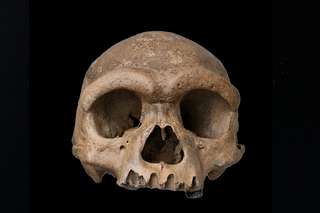
Pendant quinze ans, les Denisoviens n'ont eu ni visage ni contour. Juste de l'ADN extrait d'un fragment d'os sibérien grand comme un ongle. En 2025, un crâne exceptionnel découvert en Chine a tout changé. Homo longi, surnommé l'Homme dragon, donne enfin un visage à ce groupe humain fantôme. 
06/06/2026 futura-terre
Ce poisson préhistorique pourrait expliquer comment les animaux ont marché pour la première fois sur Terre
Antarctique crâne
Les scientifiques ont examiné l'intérieur du crâne d'un poisson de l'Antarctique vieux de 380 millions d'années, étroitement apparenté aux premiers animaux à avoir marché sur terre, révélant des indices surprenants sur la façon dont la vie a commencé à sortir de l'eau. Grâce à l’imagerie neutronique avancée, les chercheurs ont découvert que Koharalepis jarviki possédait des caractéristiques adaptées pour vivre près de la surface de l’eau, notamment des ouvertures dans son crâne qui auraient pu l’aider à avaler de l’air et un organe sensible à la lumière lié aux rythmes jour-nuit.
25/05/2026 sciencedaily-paleo ⚙ Traduction automatique
Les petits bras du T. rex pourraient avoir évolué pour une raison étonnamment brutale
mâchoire membre chasse prédateur proie Dinosauria crâne
Pourquoi le T. rex avait-il des bras si petits ? Les scientifiques pensent désormais que c’est parce que sa tête géante est devenue l’outil de chasse ultime. Dans plusieurs groupes de dinosaures, des crânes plus forts et des mâchoires écrasantes ont évolué parallèlement à des membres antérieurs rétrécis, en particulier chez les prédateurs chassant d'énormes proies. En d’autres termes, une fois que la morsure est devenue suffisamment mortelle, les bras ont peut-être cessé d’avoir de l’importance.
20/05/2026 sciencedaily ⚙ Traduction automatique
Un superbe crâne de stégosaure vieux de 150 millions d'années réécrit l'évolution des dinosaures
fossile Dacentrurus Dinosauria Stegosauria découverte évolution crâne
Une découverte spectaculaire de dinosaures en Espagne donne aux scientifiques un nouveau regard rare sur le monde des stégosaures. Les paléontologues ont découvert le crâne de stégosaure le mieux conservé jamais découvert en Europe, appartenant à l'emblématique dinosaure plaqué Dacentrurus armatus, qui parcourait la Terre il y a environ 150 millions d'années. Parce que les crânes de stégosaures sont extrêmement fragiles et ne survivent presque jamais intacts, le fossile aide les chercheurs à découvrir des détails jusqu'alors inconnus sur l'évolution de ces géants blindés.
17/05/2026 sciencedaily ⚙ Traduction automatique
1 2 3 4 5 6