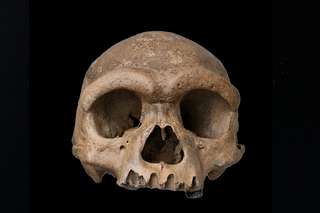
crâne

Type de vue

209 image(s) · 21 Actualités

Galerie d'images

Skeletal elements of Lophorhothon atopus. (A, B and C) Partial skull roof and braincase (holotype FMNH 27383) in dorsal, ventral, and left lateral views. (D) Partial left nasal of FMNH 27383 in lateral view. (E) Left prefrontal of FMNH 27383 in lateral view. (F) Partial left jugal of FMNH 27383 in medial view. (G) Detail of marginal denticles of the dentary tooth in (H). (H) Apical half of a dentary tooth crown AUMP 2295 in lingual view. (I) Maxillary tooth crown of FMNH 27383 in labial view. (J) Left pubis of AUMP 2295 in lateral view. (K) Iliac process of the left ilium of FMNH 27383 in lateral view.
Taxons Lophorhothon

Skeletal elements of Lophorhothon atopus. (A, B and C) Partial skull roof and braincase (holotype FMNH 27383) in dorsal, ventral, and left lateral views. (D) Partial left nasal of FMNH 27383 in lateral view. (E) Left prefrontal of FMNH 27383 in lateral view. (F) Partial left jugal of FMNH 27383 in medial view. (G) Detail of marginal denticles of the dentary tooth in (H). (H) Apical half of a dentary tooth crown AUMP 2295 in lingual view. (I) Maxillary tooth crown of FMNH 27383 in labial view. (J) Left pubis of AUMP 2295 in lateral view. (K) Iliac process of the left ilium of FMNH 27383 in lateral view.

dent holotype Lophorhothon partiel +1
The skull of the holotype of Acristavus, MOR 1155
Taxons Acristavus

The skull of the holotype of Acristavus, MOR 1155

holotype Acristavus Montanoceratops crâne
Holotype skull of Augustynolophus morrisi (LACM 2852) on display at the Natural History Museum of Los Angeles County.
Taxons Augustynolophus

Holotype skull of Augustynolophus morrisi (LACM 2852) on display at the Natural History Museum of Los Angeles County.

musée holotype Augustynolophus crâne
Reconstructed skull of Jaxartosaurus aralensis Riabinin, 1937. Only a posterior portion of the skull, as well as a surangular is known, with the rest of the skull being based mostly upon File:Aralosaurus skull.png. Jaxartosaurus is currently classified as a basal lambeosaurine, more derived than Aralosaurini, but more primitive than Parasaurolophini and Lambeosaurini. It might be more derived than Tsintaosaurini (Godefroit et al., 2004). References: 
Riabinin, A.M. (1937). "A New Finding of Dinosaurs in the Trans-Baikal Region". Ezhegodn. Vserossijskogo Palaeont. Obstcg. 11: 142–144
Godefroit, P.; Bolotsky, Y.L.; Van Itterbeeck, J. (2004). "The lambeosaurine dinosaur Amurosaurus riabinini, from the
Maastrichtian of Far Eastern Russia". Acta Palaeontologica Polonica 49(4): 585–618
Taxons Jaxartosaurus

Reconstructed skull of Jaxartosaurus aralensis Riabinin, 1937. Only a posterior portion of the skull, as well as a surangular is known, with the rest of the skull being based mostly upon File:Aralosaurus skull.png. Jaxartosaurus is currently classified as a basal lambeosaurine, more derived than Aralosaurini, but more primitive than Parasaurolophini and Lambeosaurini. It might be more derived than Tsintaosaurini (Godefroit et al., 2004). References: Riabinin, A.M. (1937). "A New Finding of Dinosaurs in the Trans-Baikal Region". Ezhegodn. Vserossijskogo Palaeont. Obstcg. 11: 142–144 Godefroit, P.; Bolotsky, Y.L.; Van Itterbeeck, J. (2004). "The lambeosaurine dinosaur Amurosaurus riabinini, from the Maastrichtian of Far Eastern Russia". Acta Palaeontologica Polonica 49(4): 585–618

Russie Maastrichtien Amurosaurus Aralosaurini +7
Partial skull of Manidens condorensis from the Middle Jurassic Cañadón Asfalto Formation of Argentina. Skull reconstructions in lateral view. Dashed lines indicate estimated edges. Abbreviations: a angular antfo antorbital fossa asaf anterior surangular foramen be buccal emargination bo basioccipital bt basal tubera d dentary d1, 2, 11 dentary tooth 1, 2, 11 emfo external mandibular fossa f frontal gl glenoid gr groove j jugal jfl jugal flange jh jugal horn m maxilla m1, 11 maxillary tooth 1, 11 n nasal pd predentary pm premaxilla po postorbital pof postorbital fossa popr paroccipital process q quadrate qj quadratojugal ri ridge sa surangular sq squamosal.
Taxons Manidens

Partial skull of Manidens condorensis from the Middle Jurassic Cañadón Asfalto Formation of Argentina. Skull reconstructions in lateral view. Dashed lines indicate estimated edges. Abbreviations: a angular antfo antorbital fossa asaf anterior surangular foramen be buccal emargination bo basioccipital bt basal tubera d dentary d1, 2, 11 dentary tooth 1, 2, 11 emfo external mandibular fossa f frontal gl glenoid gr groove j jugal jfl jugal flange jh jugal horn m maxilla m1, 11 maxillary tooth 1, 11 n nasal pd predentary pm premaxilla po postorbital pof postorbital fossa popr paroccipital process q quadrate qj quadratojugal ri ridge sa surangular sq squamosal.

dent Argentine Jurassique Jurassique moyen +4
Sarahsaurus aurifontanalis, referred skull (MCZ 8893), in (a) lateral, (b) occipital, (c) dorsal and (d) ventral views. an, angular; ar, articular; bo, basioccipital; bs, basisphenoid; ec, ectopterygoid; f, frontal; h, hyoid; j, jugal; l, lacrimal; ls, laterosphenoid; m, maxilla; n, nasal; op, opisthotic-exoccipital; p, parietal; po, postorbital; prf, prefrontal; pm, premaxilla; pt, pterygoid; q, quadrate; qj, quadratojugal; so, supraoccipital; sq, squamosal. Scale bar, 5 cm.
Taxons Sarahsaurus

Sarahsaurus aurifontanalis, referred skull (MCZ 8893), in (a) lateral, (b) occipital, (c) dorsal and (d) ventral views. an, angular; ar, articular; bo, basioccipital; bs, basisphenoid; ec, ectopterygoid; f, frontal; h, hyoid; j, jugal; l, lacrimal; ls, laterosphenoid; m, maxilla; n, nasal; op, opisthotic-exoccipital; p, parietal; po, postorbital; prf, prefrontal; pm, premaxilla; pt, pterygoid; q, quadrate; qj, quadratojugal; so, supraoccipital; sq, squamosal. Scale bar, 5 cm.

écaille Sarahsaurus crâne
Skull of the mosasaurid squamate Thalassotitan atrox from the late Maastrichtian of Sidi Daoui, Ouled Abdoun Basin, Khouribga Province, Morocco, North Africa.
Taxons Thalassotitan

Skull of the mosasaurid squamate Thalassotitan atrox from the late Maastrichtian of Sidi Daoui, Ouled Abdoun Basin, Khouribga Province, Morocco, North Africa.

Maroc Maastrichtien Mosasauridae Thalassotitan +1
Holotype of Ulughbegsaurus as well as the holotype placed on a reconstruction of Ulughbegsaurus's skull
Taxons Ulughbegsaurus

Holotype of Ulughbegsaurus as well as the holotype placed on a reconstruction of Ulughbegsaurus's skull

holotype Ulughbegsaurus crâne
Reconstructed skull of Einiosaurus procurvicornis on display at the Natural History Museum of Los Angeles County.
Taxons Einiosaurus

Reconstructed skull of Einiosaurus procurvicornis on display at the Natural History Museum of Los Angeles County.

musée Einiosaurus crâne
Montanoceratops cerorhynchus (Brown & Schlaikjer, 1942) - fossil ceratopsian dinosaur skeleton from the Cretaceous of Montana, USA. (MOR 542, Museum of the Rockies, Bozeman, Montana, USA)
The species name is sometimes incorrectly spelled "cerorhynchos".  The original publication spells it "cerorhynchus".  The genus name is sometimes incorrectly spelled "Montanaceratops".
Ceratopsians are the "horned dinosaurs".  They were large, quadrupedal, herbivorous dinosaurs having a beaked skull and a frill - an extension of bone behind the skull that partially covered the neck.  Ceratopsian dinosaurs are known from the Jurassic and Cretaceous.  The last members of the group died out at the Cretaceous-Tertiary boundary, 65 million years ago.
This is a partial skeleton of a juvenile Montanoceratops, a ceratopsian from the near-latest Cretaceous of western North America.  This type of ceratopsian lacked facial horns.


From exhibit signage:
Sixty-eight million years ago, when the horned dinosaurs Triceratops and Torosaurus inhabited the coastal plain near the inland ocean, primitive "horned" dinosaurs named Montanoceratops lived in uplands near the young Rocky Mountains.  These little protoceratopsians fed on plants with slicing teeth and narrow beaks similar to their giant three-horned relatives.


Classification: Animalia, Chordata, Vertebrata, Reptilia, Archosauria, Dinosauria, Ornithischia, Marginocephalia, Ceratopsia, Leptoceratopsidae
Stratigraphy: St. Mary River Formation, Maastrichtian Stage, Upper Cretaceous
Locality: Little Rocky Coulee, north of the town of Cut Bank, eastern Glacier County, northwestern Montana, USA


Info. at:

en.wikipedia.org/wiki/Montanoceratops
Taxons Montanoceratops

Montanoceratops cerorhynchus (Brown & Schlaikjer, 1942) - fossil ceratopsian dinosaur skeleton from the Cretaceous of Montana, USA. (MOR 542, Museum of the Rockies, Bozeman, Montana, USA) The species name is sometimes incorrectly spelled "cerorhynchos". The original publication spells it "cerorhynchus". The genus name is sometimes incorrectly spelled "Montanaceratops". Ceratopsians are the "horned dinosaurs". They were large, quadrupedal, herbivorous dinosaurs having a beaked skull and a frill - an extension of bone behind the skull that partially covered the neck. Ceratopsian dinosaurs are known from the Jurassic and Cretaceous. The last members of the group died out at the Cretaceous-Tertiary boundary, 65 million years ago. This is a partial skeleton of a juvenile Montanoceratops, a ceratopsian from the near-latest Cretaceous of western North America. This type of ceratopsian lacked facial horns. From exhibit signage: Sixty-eight million years ago, when the horned dinosaurs Triceratops and Torosaurus inhabited the coastal plain near the inland ocean, primitive "horned" dinosaurs named Montanoceratops lived in uplands near the young Rocky Mountains. These little protoceratopsians fed on plants with slicing teeth and narrow beaks similar to their giant three-horned relatives. Classification: Animalia, Chordata, Vertebrata, Reptilia, Archosauria, Dinosauria, Ornithischia, Marginocephalia, Ceratopsia, Leptoceratopsidae Stratigraphy: St. Mary River Formation, Maastrichtian Stage, Upper Cretaceous Locality: Little Rocky Coulee, north of the town of Cut Bank, eastern Glacier County, northwestern Montana, USA Info. at: en.wikipedia.org/wiki/Montanoceratops

os musée États-Unis Crétacé +10
Skull of a Parksosaurus
Taxons Parksosaurus

Skull of a Parksosaurus

Parksosaurus crâne
Kronosaurus queenslandicus (QM F18827; proposed neotype [part]) skull in dorsal view (modified from McHenry Citation2009). Scale = 30 cm.
Taxons Kronosaurus

Kronosaurus queenslandicus (QM F18827; proposed neotype [part]) skull in dorsal view (modified from McHenry Citation2009). Scale = 30 cm.

écaille Kronosaurus crâne
Paratype skull of Hamipterus tianshanensis on display at the Paleozoological Museum of China.
Taxons Hamipterus

Paratype skull of Hamipterus tianshanensis on display at the Paleozoological Museum of China.

musée Chine Hamipteridae Hamipterus +1
Paratype skull of Hamipterus tianshanensis on display at the Paleozoological Museum of China.
Taxons Hamipteridae

Paratype skull of Hamipterus tianshanensis on display at the Paleozoological Museum of China.

musée Chine Hamipteridae Hamipterus +1
Skull reconstruction of Incisivosaurus gauthieri.
Taxons Incisivosaurus

Skull reconstruction of Incisivosaurus gauthieri.

Incisivosaurus crâne
Sarcosaurus diagram of known material: reconstruction based on basal Ceratosaurs (such as Berberosaurus and Saltriovenator). The Skull was made to look more generic and less like more derived Ceratosaurs such as Ceratosaurus. "Liassaurus", referred to "cf. Sarcosaurus woodi" and is smaller than the holotype: material in light grey is preserved, but to what extent is uncertain as it is not figured.
References:
Carrano and Sampson (2004). "A review of coelophysoids (Dinosauria: Theropoda) from the Early Jurassic of Europe, with comments on the late history of the Coelophysoidea." N. Jb. Geol. Palaont. Mh., 2004(9): 537-558. (for figures of the material)
theropoddatabase.com/Coelophysoidea.htm#Sarcosauruswoodi (for measurements of "Liassaurus")

Allain, Ronan & Tykoski, Ronald & Aquesbi, Najat & Jalil, Nour-Eddine & Monbaron, Michel & Russell, Dale & Taquet, Philippe. (2007). An abelisauroid (Dinosauria: Theropoda) from the Early Jurassic of the High Atlas Mountains, Morocco, and the radiation of Ceratosaurs. Journal of Vertebrate Paleontology. 27. 10.1671/0272-4634(2007)27[610:AADTFT]2.0.CO;2. (for measurements for Berberosaurus)
Taxons Sarcosaurus

Sarcosaurus diagram of known material: reconstruction based on basal Ceratosaurs (such as Berberosaurus and Saltriovenator). The Skull was made to look more generic and less like more derived Ceratosaurs such as Ceratosaurus. "Liassaurus", referred to "cf. Sarcosaurus woodi" and is smaller than the holotype: material in light grey is preserved, but to what extent is uncertain as it is not figured. References: Carrano and Sampson (2004). "A review of coelophysoids (Dinosauria: Theropoda) from the Early Jurassic of Europe, with comments on the late history of the Coelophysoidea." N. Jb. Geol. Palaont. Mh., 2004(9): 537-558. (for figures of the material) theropoddatabase.com/Coelophysoidea.htm#Sarcosauruswoodi (for measurements of "Liassaurus") Allain, Ronan & Tykoski, Ronald & Aquesbi, Najat & Jalil, Nour-Eddine & Monbaron, Michel & Russell, Dale & Taquet, Philippe. (2007). An abelisauroid (Dinosauria: Theropoda) from the Early Jurassic of the High Atlas Mountains, Morocco, and the radiation of Ceratosaurs. Journal of Vertebrate Paleontology. 27. 10.1671/0272-4634(2007)27[610:AADTFT]2.0.CO;2. (for measurements for Berberosaurus)

Maroc Jurassique inférieur Jurassique holotype +8
1 2 3 4 5 6 7 8 9 10 11 12 13 14

Actualités

Daemonosaurus: Beast of the Week
Démonosaure : la bête de la semaine
Mexique États-Unis Trias supérieur Trias Daemonosaurus Dinosauria crâne
 Cette semaine, nous allons découvrir un premier dinosaure au look unique avec un nom très cool.  Rencontrez Daemonosaurus chaoliodus ! Daemonosaurus était un petit dinosaure carnivore qui vivait dans ce qui est aujourd'hui le Nouveau-Mexique, aux États-Unis, à la fin du Trias, il y a environ 205 à 200 millions d'années.  Du nez à la queue, on estime qu'il mesurait environ 5 à 7 pieds (1,5 à 2,2 m).  Il s’agit d’estimations basées sur le fait que seuls le crâne et le cou ont été retrouvés.  Le nom du genre se traduit par "Demo
05/04/2026 prehistoricbeastoftheweek ⚙ Traduction automatique
Les scientifiques ont trouvé un bébé dinosaure caché dans la roche et il est étonnamment mignon
os dessin Corée du Sud Dinosauria Doolysaurus tomographie découverte crâne
Des scientifiques ont découvert un bébé dinosaure rare en Corée du Sud et l'ont baptisé Doolysaurus, en hommage à un célèbre personnage de dessin animé. Grâce à des tomodensitogrammes de pointe, ils ont découvert des os cachés, notamment un crâne, dans la roche beaucoup plus rapidement que les méthodes traditionnelles. Le jeune dinosaure, peut-être duveteux et ressemblant à un agneau, avait même des calculs gastriques révélant qu'il mangeait un mélange de plantes et de petits animaux. Cette découverte suggère que de nombreux autres dinosaures pourraient encore être cachés dans les roches coréennes.
01/04/2026 sciencedaily ⚙ Traduction automatique
Des fossiles de poissons vieux de 400 millions d'années révèlent comment la vie a commencé à s'installer sur terre
Australie Chine fossile formation crâne
Les scientifiques ont découvert de nouveaux indices sur certains des premiers poissons de la Terre, mettant ainsi en lumière les origines anciennes des vertébrés qui ont fini par s’installer sur terre. En réanalysant de mystérieux fossiles de la célèbre formation australienne Gogo et en étudiant un crâne de poisson-poumon récemment reconstruit, vieux de 410 millions d'années et provenant de Chine, les chercheurs révèlent comment ces créatures primitives ont évolué.
12/03/2026 sciencedaily ⚙ Traduction automatique
Le tricératops avait un nez géant qui aurait pu refroidir sa tête massive
fossile Triceratops tomographie crâne
La tête massive du tricératops faisait peut-être plus que simplement montrer ces fameuses cornes. À l’aide de tomodensitogrammes et de reconstructions 3D de crânes fossiles, les chercheurs ont découvert un système nasal étonnamment complexe caché à l’intérieur de son énorme museau. Au lieu d’être simplement un nez surdimensionné pour sentir, il abritait probablement des réseaux complexes de nerfs et de vaisseaux sanguins, et même des structures spéciales qui aidaient à réguler la chaleur et l’humidité.
22/02/2026 sciencedaily ⚙ Traduction automatique
Cet animal ancien fut l'un des premiers à manger des plantes sur terre
dent fossile crâne
Il y a des centaines de millions d’années, les premiers animaux à ramper sur terre étaient de purs mangeurs de viande, alors même que les plantes avaient déjà envahi le paysage. Aujourd’hui, les scientifiques ont découvert un fossile vieux de 307 millions d’années qui réécrit cette histoire : l’un des premiers vertébrés terrestres connus à avoir commencé à manger des plantes. L'animal, nommé Tyrannoroter heberti, était une créature trapue de la taille d'un ballon de football avec un crâne rempli de dents spécialisées conçues pour écraser et broyer la végétation.
11/02/2026 sciencedaily ⚙ Traduction automatique
1 2 3 4 5