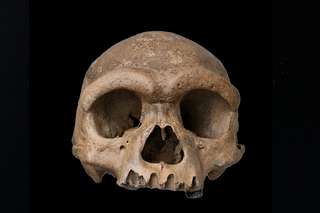
crâne

Type de vue

188 image(s) · 20 Actualités

Galerie d'images

Reconstructed skull of Archaeornithoides, known material in brown.
Taxons Archaeornithoides

Reconstructed skull of Archaeornithoides, known material in brown.

Archaeornithoides crâne
Skull of MPC-D 100/32-a (Rinchenia mongoliensis).
Taxons Rinchenia

Skull of MPC-D 100/32-a (Rinchenia mongoliensis).

Rinchenia crâne
Skull of Huanansaurus ganzhouensis (HGM41HIII-0443).
Taxons Huanansaurus

Skull of Huanansaurus ganzhouensis (HGM41HIII-0443).

Huanansaurus crâne
Skull of Banji long. The horizontal line projected through the posterodorsal corner of the antorbital fenestra is parallel to the line linking the articular end of the quadrate and the ventral margin of the premaxillae.
Taxons Banji

Skull of Banji long. The horizontal line projected through the posterodorsal corner of the antorbital fenestra is parallel to the line linking the articular end of the quadrate and the ventral margin of the premaxillae.

Banji crâne
Holotype of Jaculinykus yaruui gen. et sp. nov. (MPC-D 100/209). (A) Photograph of the specimen. (B) Explanatory drawing of (A). Highlighted areas refer to the indication of the skeletal elements; skull in green, tail in grey, pectoral girdle and forelimbs in red, pelvis and hind limbs in purple. (C) Reconstruction of Jaculinykus yaruui gen. et sp. nov. Grey areas are missing parts.
Taxons Jaculinykus

Holotype of Jaculinykus yaruui gen. et sp. nov. (MPC-D 100/209). (A) Photograph of the specimen. (B) Explanatory drawing of (A). Highlighted areas refer to the indication of the skeletal elements; skull in green, tail in grey, pectoral girdle and forelimbs in red, pelvis and hind limbs in purple. (C) Reconstruction of Jaculinykus yaruui gen. et sp. nov. Grey areas are missing parts.

membre bassin dessin holotype +3
A) Skull reconstruction of Murusraptor barrosaensis, MCF-PVPH-411. B) Body reconstruction of Murusraptor barrosaensis, MCF-PVPH-411.

Both illustrations show recovered elements in white. Scale bars: A = 10 cm, B = 1 m.
Taxons Murusraptor

A) Skull reconstruction of Murusraptor barrosaensis, MCF-PVPH-411. B) Body reconstruction of Murusraptor barrosaensis, MCF-PVPH-411. Both illustrations show recovered elements in white. Scale bars: A = 10 cm, B = 1 m.

écaille Megaraptora Megaraptoridae Murusraptor +1
A) Skull reconstruction of Murusraptor barrosaensis, MCF-PVPH-411. B) Body reconstruction of Murusraptor barrosaensis, MCF-PVPH-411.

Both illustrations show recovered elements in white. Scale bars: A = 10 cm, B = 1 m.
Taxons Megaraptora

A) Skull reconstruction of Murusraptor barrosaensis, MCF-PVPH-411. B) Body reconstruction of Murusraptor barrosaensis, MCF-PVPH-411. Both illustrations show recovered elements in white. Scale bars: A = 10 cm, B = 1 m.

écaille Megaraptora Megaraptoridae Murusraptor +1
A) Skull reconstruction of Murusraptor barrosaensis, MCF-PVPH-411. B) Body reconstruction of Murusraptor barrosaensis, MCF-PVPH-411.

Both illustrations show recovered elements in white. Scale bars: A = 10 cm, B = 1 m.
Taxons Megaraptoridae

A) Skull reconstruction of Murusraptor barrosaensis, MCF-PVPH-411. B) Body reconstruction of Murusraptor barrosaensis, MCF-PVPH-411. Both illustrations show recovered elements in white. Scale bars: A = 10 cm, B = 1 m.

écaille Megaraptora Megaraptoridae Murusraptor +1
Fig. 2. Selected cranial elements of Bicentenaria argentina nov. gen. et nov. sp. A, left lateral view of preserved caudal half of skull and jaws; B, right lateral view of preserved caudal half of skull and jaws; C, left quadrate and lower jaw in caudal view; D, fragmentary premaxillae with teeth in left lateral view; E, fragmentary left maxilla with tooth in lateral view. Abbreviations: an, angular; antf, antorbital fossa; art, articular; bs, basipterygoid process of basisphenoid; ch, notch for the chorda tympanica; gl, glenoid fossa; j, jugal; lc, lateral condyle of quadrate; lr, longitudinal ridge; ect, ectopterygoid; prar, right prearticular; pral, left prearticular; ptq, pterygoid ramus of quadrate; q, quadrate; qj, quadratojugal; sanl, left surangular; sanr, right surangular; rart, retroarticular process; t, tooth. Scale bars = 1 centimeter.
Taxons Bicentenaria

Fig. 2. Selected cranial elements of Bicentenaria argentina nov. gen. et nov. sp. A, left lateral view of preserved caudal half of skull and jaws; B, right lateral view of preserved caudal half of skull and jaws; C, left quadrate and lower jaw in caudal view; D, fragmentary premaxillae with teeth in left lateral view; E, fragmentary left maxilla with tooth in lateral view. Abbreviations: an, angular; antf, antorbital fossa; art, articular; bs, basipterygoid process of basisphenoid; ch, notch for the chorda tympanica; gl, glenoid fossa; j, jugal; lc, lateral condyle of quadrate; lr, longitudinal ridge; ect, ectopterygoid; prar, right prearticular; pral, left prearticular; ptq, pterygoid ramus of quadrate; q, quadrate; qj, quadratojugal; sanl, left surangular; sanr, right surangular; rart, retroarticular process; t, tooth. Scale bars = 1 centimeter.

écaille dent Argentine Bicentenaria +1
Proceratosaurus bradleyi holotype NHMUK PV R 4860. Almost complete skull and mandibles in articulation, hyoid element and anterior cervical vertebrae in oolite block.
Taxons Proceratosaurus

Proceratosaurus bradleyi holotype NHMUK PV R 4860. Almost complete skull and mandibles in articulation, hyoid element and anterior cervical vertebrae in oolite block.

musée holotype Proceratosauridae Proceratosaurus +1
Proceratosaurus bradleyi holotype NHMUK PV R 4860. Almost complete skull and mandibles in articulation, hyoid element and anterior cervical vertebrae in oolite block.
Taxons Proceratosauridae

Proceratosaurus bradleyi holotype NHMUK PV R 4860. Almost complete skull and mandibles in articulation, hyoid element and anterior cervical vertebrae in oolite block.

musée holotype Proceratosauridae Proceratosaurus +1
Photograph (A) and line drawing (B) of the skull of Asiatyrannus xui (ZMNH M30360) in right lateral view. The inset box in (A) indicates the position of the detailed jugal accessory horn in (C). acf accessory fossa of maxilla; ang angular; aof antorbital fenestra; cor cornual process; d dentary; d.t dentary tooth; emf external mandibular fenestra; en external naris; f frontal; gr groove; itf infratemporal fenestra; j jugal; jah jugal accessory horn; L left; la lacrimal; mf maxillary fenestra; mnvf maxillary neurovascular foramina; mx maxilla; nas nasal; nr nasal ridge; orb orbit; par parietal; pal palatine; pmx premaxilla; po postorbital; q quadrate; qj quadratojugal; R right; sa surangular; sf surangular foramen; snf subnarial foramen; sq squamosal; t1–6 maxillary tooth 1–6.
Taxons Asiatyrannus

Photograph (A) and line drawing (B) of the skull of Asiatyrannus xui (ZMNH M30360) in right lateral view. The inset box in (A) indicates the position of the detailed jugal accessory horn in (C). acf accessory fossa of maxilla; ang angular; aof antorbital fenestra; cor cornual process; d dentary; d.t dentary tooth; emf external mandibular fenestra; en external naris; f frontal; gr groove; itf infratemporal fenestra; j jugal; jah jugal accessory horn; L left; la lacrimal; mf maxillary fenestra; mnvf maxillary neurovascular foramina; mx maxilla; nas nasal; nr nasal ridge; orb orbit; par parietal; pal palatine; pmx premaxilla; po postorbital; q quadrate; qj quadratojugal; R right; sa surangular; sf surangular foramen; snf subnarial foramen; sq squamosal; t1–6 maxillary tooth 1–6.

dent dessin Asiatyrannus crâne
Skull diagram of Panguraptor lufengensis illustrating known material. Scale bar is 1 cm.
Taxons Panguraptor

Skull diagram of Panguraptor lufengensis illustrating known material. Scale bar is 1 cm.

écaille Panguraptor crâne
The skull of Zupaysaurus rougieri (A) in right lateral view. Scale bar equals 5 cm. Cropped from Figure 2 in the source.
anfe - antorbital fenestra
emf - external mandibular fenestra
itf - infratemporal fenestra
or - orbit
Taxons Zupaysaurus

The skull of Zupaysaurus rougieri (A) in right lateral view. Scale bar equals 5 cm. Cropped from Figure 2 in the source. anfe - antorbital fenestra emf - external mandibular fenestra itf - infratemporal fenestra or - orbit

écaille Zupaysaurus crâne
Skull diagram featuring the holotype skull (ROM 1790) of the ornithomimid Rativates evadens, from the Late Cretaceous period. Abbreviations: d, dentary; f, frontal; l, lacrimal; m, maxilla; n, nasal; pm, premaxila; ps, paraphenoid.
Taxons Rativates

Skull diagram featuring the holotype skull (ROM 1790) of the ornithomimid Rativates evadens, from the Late Cretaceous period. Abbreviations: d, dentary; f, frontal; l, lacrimal; m, maxilla; n, nasal; pm, premaxila; ps, paraphenoid.

Crétacé Crétacé supérieur holotype Ornithomimidae +2
Mounted skull of EMK 0012 (Lokiceratops rangiformis holotype). (A) Mounted skull in posterior view. (B) Mounted skull in right lateral view. (C) Mounted skull in dorsal view. (D) Mounted skull in left lateral view. Areas in gray are reconstructed. Minor changes from side to side and in the orbits are the result of post-depositional deformation. Photos contain parallax. Scale bar equals 1 m.
Taxons Lokiceratops

Mounted skull of EMK 0012 (Lokiceratops rangiformis holotype). (A) Mounted skull in posterior view. (B) Mounted skull in right lateral view. (C) Mounted skull in dorsal view. (D) Mounted skull in left lateral view. Areas in gray are reconstructed. Minor changes from side to side and in the orbits are the result of post-depositional deformation. Photos contain parallax. Scale bar equals 1 m.

écaille holotype Lokiceratops crâne
1 2 3 4 5 6 7 8 9 10 11 12

Actualités

Les scientifiques ont trouvé un bébé dinosaure caché dans la roche et il est étonnamment mignon
os dessin Corée du Sud Dinosauria Doolysaurus tomographie découverte crâne
Des scientifiques ont découvert un bébé dinosaure rare en Corée du Sud et l'ont baptisé Doolysaurus, en hommage à un célèbre personnage de dessin animé. Grâce à des tomodensitogrammes de pointe, ils ont découvert des os cachés, notamment un crâne, dans la roche beaucoup plus rapidement que les méthodes traditionnelles. Le jeune dinosaure, peut-être duveteux et ressemblant à un agneau, avait même des calculs gastriques révélant qu'il mangeait un mélange de plantes et de petits animaux. Cette découverte suggère que de nombreux autres dinosaures pourraient encore être cachés dans les roches coréennes.
01/04/2026 sciencedaily ⚙ Traduction automatique
Des fossiles de poissons vieux de 400 millions d'années révèlent comment la vie a commencé à s'installer sur terre
Australie Chine fossile formation crâne
Les scientifiques ont découvert de nouveaux indices sur certains des premiers poissons de la Terre, mettant ainsi en lumière les origines anciennes des vertébrés qui ont fini par s’installer sur terre. En réanalysant de mystérieux fossiles de la célèbre formation australienne Gogo et en étudiant un crâne de poisson-poumon récemment reconstruit, vieux de 410 millions d'années et provenant de Chine, les chercheurs révèlent comment ces créatures primitives ont évolué.
12/03/2026 sciencedaily ⚙ Traduction automatique
Le tricératops avait un nez géant qui aurait pu refroidir sa tête massive
fossile Triceratops tomographie crâne
La tête massive du tricératops faisait peut-être plus que simplement montrer ces fameuses cornes. À l’aide de tomodensitogrammes et de reconstructions 3D de crânes fossiles, les chercheurs ont découvert un système nasal étonnamment complexe caché à l’intérieur de son énorme museau. Au lieu d’être simplement un nez surdimensionné pour sentir, il abritait probablement des réseaux complexes de nerfs et de vaisseaux sanguins, et même des structures spéciales qui aidaient à réguler la chaleur et l’humidité.
22/02/2026 sciencedaily ⚙ Traduction automatique
Cet animal ancien fut l'un des premiers à manger des plantes sur terre
dent fossile crâne
Il y a des centaines de millions d’années, les premiers animaux à ramper sur terre étaient de purs mangeurs de viande, alors même que les plantes avaient déjà envahi le paysage. Aujourd’hui, les scientifiques ont découvert un fossile vieux de 307 millions d’années qui réécrit cette histoire : l’un des premiers vertébrés terrestres connus à avoir commencé à manger des plantes. L'animal, nommé Tyrannoroter heberti, était une créature trapue de la taille d'un ballon de football avec un crâne rempli de dents spécialisées conçues pour écraser et broyer la végétation.
11/02/2026 sciencedaily ⚙ Traduction automatique
Cet étrange petit dinosaure oblige à repenser l'évolution
os dent métabolisme Dinosauria Foskeia anatomie oiseau évolution mammifères étude crâne
Un petit dinosaure nouvellement identifié, Foskeia pelendonum, bouleverse les idées reçues de longue date sur l'évolution des dinosaures herbivores. Même si les adultes adultes étaient remarquablement petits et légers, leur anatomie était tout sauf simple : elles présentaient un crâne bizarre et hautement spécialisé et des traits évolutifs inattendus. Des études osseuses détaillées montrent que ces dinosaures ont mûri rapidement avec un métabolisme semblable à celui des oiseaux ou des mammifères, tandis que leurs dents et leur posture suggèrent une vie rapide et agile dans des forêts denses.
03/02/2026 sciencedaily ⚙ Traduction automatique
1 2 3 4