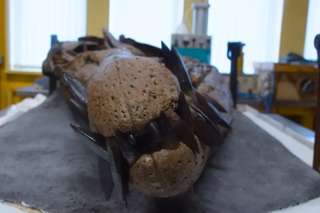
crâne

Type de vue

244 image(s) · 27 Actualités

Galerie d'images

Montage of four pachycephalosaurs. Clockwise from top left: Stegoceras, Prenocephale, Pachycephalosaurus and Homalocephale. These files are already on Commons with their respective licenses. This montage was made for the article Pachycephalosauria on Wikipedia.
File:Stegoceras mount.jpg
File:Dinosauria - Prenocephale.jpg
File:Fossil Pachycephalosaurus.jpg
File:Homalocephale skull.jpg
Taxons Goyocephalia

Montage of four pachycephalosaurs. Clockwise from top left: Stegoceras, Prenocephale, Pachycephalosaurus and Homalocephale. These files are already on Commons with their respective licenses. This montage was made for the article Pachycephalosauria on Wikipedia. File:Stegoceras mount.jpg File:Dinosauria - Prenocephale.jpg File:Fossil Pachycephalosaurus.jpg File:Homalocephale skull.jpg

fossile Dinosauria Domocephalinae Goyocephalia +10
Montage of four pachycephalosaurs. Clockwise from top left: Stegoceras, Prenocephale, Pachycephalosaurus and Homalocephale. These files are already on Commons with their respective licenses. This montage was made for the article Pachycephalosauria on Wikipedia.
File:Stegoceras mount.jpg
File:Dinosauria - Prenocephale.jpg
File:Fossil Pachycephalosaurus.jpg
File:Homalocephale skull.jpg
Taxons Homalocephaloidea

Montage of four pachycephalosaurs. Clockwise from top left: Stegoceras, Prenocephale, Pachycephalosaurus and Homalocephale. These files are already on Commons with their respective licenses. This montage was made for the article Pachycephalosauria on Wikipedia. File:Stegoceras mount.jpg File:Dinosauria - Prenocephale.jpg File:Fossil Pachycephalosaurus.jpg File:Homalocephale skull.jpg

fossile Dinosauria Domocephalinae Goyocephalia +10
Skull of Pteranodon sp. (specimen AMNH 7515) in the American Museum of Natural History.
Taxons Pteranodontia

Skull of Pteranodon sp. (specimen AMNH 7515) in the American Museum of Natural History.

musée spécimen Aponyctosauria Pteranodon +2
Skull of Pteranodon sp. (specimen AMNH 7515) in the American Museum of Natural History.
Taxons Aponyctosauria

Skull of Pteranodon sp. (specimen AMNH 7515) in the American Museum of Natural History.

musée spécimen Aponyctosauria Pteranodon +2
Several members of Pterodactyloidea (top to bottom):  Pteranodon, Pterodaustro, the skulls of several pterosaurs (Guidraco, Anhanguera, Tupandactylus, and an unnamed dsungaripterid), Quetzalcoatlus, Aerodactylus, and Coloborhynchus
Taxons Pterodactyloidea

Several members of Pterodactyloidea (top to bottom): Pteranodon, Pterodaustro, the skulls of several pterosaurs (Guidraco, Anhanguera, Tupandactylus, and an unnamed dsungaripterid), Quetzalcoatlus, Aerodactylus, and Coloborhynchus

Aerodactylus Anhanguera Coloborhynchus Dsungaripteridae +13
Several members of Pterodactyloidea (top to bottom):  Pteranodon, Pterodaustro, the skulls of several pterosaurs (Guidraco, Anhanguera, Tupandactylus, and an unnamed dsungaripterid), Quetzalcoatlus, Aerodactylus, and Coloborhynchus
Taxons Ornithocheiroidea

Several members of Pterodactyloidea (top to bottom): Pteranodon, Pterodaustro, the skulls of several pterosaurs (Guidraco, Anhanguera, Tupandactylus, and an unnamed dsungaripterid), Quetzalcoatlus, Aerodactylus, and Coloborhynchus

Aerodactylus Anhanguera Coloborhynchus Dsungaripteridae +13
Several members of Pterodactyloidea (top to bottom):  Pteranodon, Pterodaustro, the skulls of several pterosaurs (Guidraco, Anhanguera, Tupandactylus, and an unnamed dsungaripterid), Quetzalcoatlus, Aerodactylus, and Coloborhynchus
Taxons Lophocratia

Several members of Pterodactyloidea (top to bottom): Pteranodon, Pterodaustro, the skulls of several pterosaurs (Guidraco, Anhanguera, Tupandactylus, and an unnamed dsungaripterid), Quetzalcoatlus, Aerodactylus, and Coloborhynchus

Aerodactylus Anhanguera Coloborhynchus Dsungaripteridae +13
Several members of Pterodactyloidea (top to bottom):  Pteranodon, Pterodaustro, the skulls of several pterosaurs (Guidraco, Anhanguera, Tupandactylus, and an unnamed dsungaripterid), Quetzalcoatlus, Aerodactylus, and Coloborhynchus
Taxons Tapejaroidea

Several members of Pterodactyloidea (top to bottom): Pteranodon, Pterodaustro, the skulls of several pterosaurs (Guidraco, Anhanguera, Tupandactylus, and an unnamed dsungaripterid), Quetzalcoatlus, Aerodactylus, and Coloborhynchus

Aerodactylus Anhanguera Coloborhynchus Dsungaripteridae +13
Several members of Pterodactyloidea (top to bottom):  Pteranodon, Pterodaustro, the skulls of several pterosaurs (Guidraco, Anhanguera, Tupandactylus, and an unnamed dsungaripterid), Quetzalcoatlus, Aerodactylus, and Coloborhynchus
Taxons Dsungaripteroidea

Several members of Pterodactyloidea (top to bottom): Pteranodon, Pterodaustro, the skulls of several pterosaurs (Guidraco, Anhanguera, Tupandactylus, and an unnamed dsungaripterid), Quetzalcoatlus, Aerodactylus, and Coloborhynchus

Aerodactylus Anhanguera Coloborhynchus Dsungaripteridae +13
Several members of Pterodactyloidea (top to bottom):  Pteranodon, Pterodaustro, the skulls of several pterosaurs (Guidraco, Anhanguera, Tupandactylus, and an unnamed dsungaripterid), Quetzalcoatlus, Aerodactylus, and Coloborhynchus
Taxons Eupterodactyloidea

Several members of Pterodactyloidea (top to bottom): Pteranodon, Pterodaustro, the skulls of several pterosaurs (Guidraco, Anhanguera, Tupandactylus, and an unnamed dsungaripterid), Quetzalcoatlus, Aerodactylus, and Coloborhynchus

Aerodactylus Anhanguera Coloborhynchus Dsungaripteridae +13
Main skull block of Bentiabasaurus jacobsi holotype (MGUAN P183D) on temporary display at the Smithsonian National Museum of Natural History
Taxons Bentiabasaurus

Main skull block of Bentiabasaurus jacobsi holotype (MGUAN P183D) on temporary display at the Smithsonian National Museum of Natural History

musée holotype Bentiabasaurus crâne
Composite of the holotype (GM F10004) skull of Qianzhousaurus sinensis, lower jaw mirrowed. With authorization and permission by Dr. Stephen L. Brusatte.
Taxons Qianzhousaurus

Composite of the holotype (GM F10004) skull of Qianzhousaurus sinensis, lower jaw mirrowed. With authorization and permission by Dr. Stephen L. Brusatte.

holotype Qianzhousaurus crâne
Skull of Minotaurasaurus
Taxons Minotaurasaurus

Skull of Minotaurasaurus

Minotaurasaurus crâne
Holotype skull of Thalattoarchon saurophagis at the Field Museum of Natural History.
Taxons Thalattoarchon

Holotype skull of Thalattoarchon saurophagis at the Field Museum of Natural History.

musée holotype Thalattoarchon crâne
Figure description from paper: "Fig. 3 Wimanius odontopalatus Maisch & Matzke, 1998, holotype, GPIT-PV-76272. Photos courtesy of G. Bindellini (Milano). a The complete holotype. b Detail showing a part of the dentition. c Disarticulated bones from the posterior part of the skull
Taxons Wimanius

Figure description from paper: "Fig. 3 Wimanius odontopalatus Maisch & Matzke, 1998, holotype, GPIT-PV-76272. Photos courtesy of G. Bindellini (Milano). a The complete holotype. b Detail showing a part of the dentition. c Disarticulated bones from the posterior part of the skull

os description holotype Wimaniidae +2
Figure description from paper: "Fig. 3 Wimanius odontopalatus Maisch & Matzke, 1998, holotype, GPIT-PV-76272. Photos courtesy of G. Bindellini (Milano). a The complete holotype. b Detail showing a part of the dentition. c Disarticulated bones from the posterior part of the skull
Taxons Wimaniidae

Figure description from paper: "Fig. 3 Wimanius odontopalatus Maisch & Matzke, 1998, holotype, GPIT-PV-76272. Photos courtesy of G. Bindellini (Milano). a The complete holotype. b Detail showing a part of the dentition. c Disarticulated bones from the posterior part of the skull

os description holotype Wimaniidae +2
1 2 3 4 5 6 7 8 9 10 11 12 13 14 15 16

Actualités

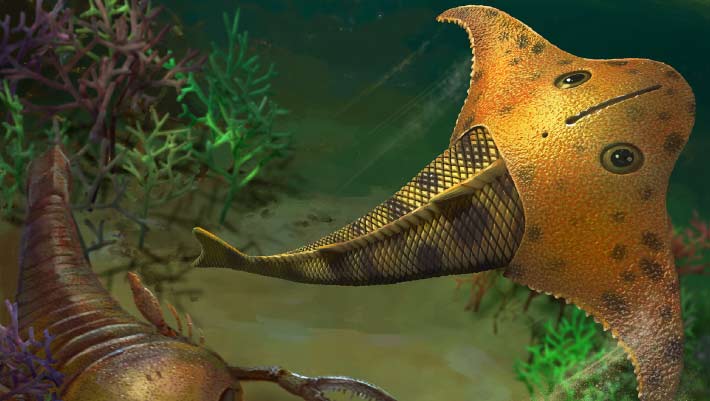
Meet Bataspis crux, Jawless Fish that Cruised Devonian Seas with Batwing Head
Rencontrez Bataspis crux, un poisson sans mâchoire qui naviguait dans les mers du Dévonien avec une tête de chauve-souris
mâchoire Chine Dévonien Dévonien poisson nouvelle espèce crâne
Des paléontologues chinois ont identifié une nouvelle espèce de poisson blindé et sans mâchoire provenant de roches vieilles d'environ 419 millions d'années, dont le crâne avait la forme d'une aile de chauve-souris et dont la tête inhabituelle en faisait un planeur efficace dans les mers du Dévonien. L'article Rencontrez Bataspis crux, un poisson sans mâchoire qui a navigué dans les mers du Dévonien avec une tête de chauve-souris est apparu en premier sur Sci.News : Breaking Science News.
18/08/2026 sci-news ⚙ Traduction automatique
Un fossile vieux de 30 ans cachait les os d'un mystérieux monstre marin ancien
os mâchoire Crétacé fossile Mosasaurus nouvelle espèce crâne
Des fossiles collectés à Osaka il y a plus de 30 ans ont révélé une surprise cachée à la vue de tous : quatre os jusqu'alors méconnus provenant d'un mosasaure géant du Crétacé. Parmi eux se trouve le premier prémaxillaire confirmé – l’os le plus en avant de la mâchoire supérieure – jamais identifié dans un fossile de mosasaure japonais. Plus intrigant encore, certaines parties du crâne présentent des caractéristiques anatomiques inhabituelles qui ne correspondent pas aux mosasaures connus, ce qui laisse penser que les restes appartiennent à une espèce entièrement nouvelle.
15/08/2026 sciencedaily ⚙ Traduction automatique
Un nouveau genre de dinosaure troodontidé du Nouveau-Mexique
os Mexique Campanien Crétacé Crétacé supérieur fossile Dinevenator Dinosauria Troodontidae nouvelle espèce crâne
Les paléontologues ont nommé une nouvelle espèce de dinosaure théropode du Nouveau-Mexique. Le dinosaure, Dinevenator Robustus, vivait il y a environ 73 millions d'années (stade faunique campanien du Crétacé supérieur). Les chercheurs ont identifié le dinosaure à partir d’un os fossile du crâne (un frontal) trouvé dans le nord-ouest du Nouveau-Mexique. Il représente un nouveau genre et une nouvelle espèce de troodontidé. Troodontidés
13/08/2026 everythingdinosaur ⚙ Traduction automatique
L’oiseau dodo possédait un monde sensoriel secret que les scientifiques découvrent seulement maintenant
oiseau tomographie découverte crâne
Les tomodensitogrammes des crânes de dodo les plus rares au monde suggèrent que l'oiseau disparu aurait pu avoir un odorat plus fort, un bec très sensible et un mode de vie qui s'étendait jusqu'à l'aube et au crépuscule. Ces découvertes contribuent à renverser des mythes vieux de plusieurs siècles et à révéler un animal bien plus complexe que le fameux dodo « stupide » de l’imagination populaire.
09/08/2026 sciencedaily-paleo ⚙ Traduction automatique
Un fossile oublié vient de révéler un nouveau prédateur du Trias datant d'il y a 210 millions d'années
mâchoire prédateur proie Mexique Trias fossile crâne
Un fossile négligé depuis près de 80 ans a révélé un parent de crocodile jusqu'alors inconnu qui vivait il y a 210 millions d'années dans ce qui est aujourd'hui le Nouveau-Mexique. Nommé Eosphorosuchus lacrimosa, ce prédateur de la taille d'un chacal avait un crâne renforcé, des muscles de mâchoire puissants et un museau court conçu pour s'attaquer à des proies plus grosses.
30/07/2026 sciencedaily ⚙ Traduction automatique
1 2 3 4 5 6