crâne

Type de vue

244 image(s) · 27 Actualités

Galerie d'images

Skull of Dromiceiomimus
Taxons Dromiceiomimus

Skull of Dromiceiomimus

Dromiceiomimus crâne
Skull of Saichania, Warsaw Museum of Evolution
Taxons Saichania

Skull of Saichania, Warsaw Museum of Evolution

musée Saichania évolution crâne
Skull of Oohkotokia horneri, gen. et sp. nov. (MOR 433, holotype)
Taxons Oohkotokia

Skull of Oohkotokia horneri, gen. et sp. nov. (MOR 433, holotype)

holotype Oohkotokia crâne
The incomplete skull and vertebrae of the holotype of Omphalosaurus nevadanus, seen in dorsal (left) and ventral view (right). This image was derived by combining plates 8 and 9 of Merriam (1906), done by an uncredited artist.
Legend:

A - angular
D - dentary
Pl - palatine
Pt - pterygoid
Sa - surangular
Sp - splenial
V - vertebrae
a, b, c - "doubtful elements"
Taxons Omphalosaurus

The incomplete skull and vertebrae of the holotype of Omphalosaurus nevadanus, seen in dorsal (left) and ventral view (right). This image was derived by combining plates 8 and 9 of Merriam (1906), done by an uncredited artist. Legend: A - angular D - dentary Pl - palatine Pt - pterygoid Sa - surangular Sp - splenial V - vertebrae a, b, c - "doubtful elements"

holotype Merriamia Omphalosaurus crâne
Restored Placochelys placodonta skull at the Museum für Naturkunde, Berlin.
Taxons Placochelys

Restored Placochelys placodonta skull at the Museum für Naturkunde, Berlin.

musée Placochelyidae Placochelys crâne
Comparison of cranial features between closely related southern Laramidian taxa; (A), Akainacephalus johnsoni (UMNH VP 20202) from the Late Cretaceous Kaiparowits Formation of Utah; and (B), Nodocephalosaurus kirtlandensis (SMP VP-900) from the Late Cretaceous Kirtland Formation of New Mexico, in left lateral views. Various synapomorphies are shared with N. kirtlandensis (highlighted in black and white arrows) and includes “flaring nostrils”; enlarged, laterally projecting, loreal osteoderms that are situated directly dorsal to the external nares. Other synapomorphies include pyramid-shaped nasal and frontal osteoderms positioned on the dorsal regions of the skull. A number of significant differences have been observed between both specimens; in A. johnsoni, the anterior, and posterior supraorbital bosses form an enlarged element that is somewhat backswept, whereas in N. kirtlandensis, the posterior and anterior supraorbital bosses are clearly defined as individual osteoderms, and are much smaller in size. Additionally, the squamosal horn in Akainacephalus is very small but is prominent and tetrahedrally shaped in Nodocephalosaurus. The quadratojugal horn in Akainacephalus is massive, has a subtriangular morphology in lateral view and projects almost entirely ventral, whereas in Nodocephalosaurus, the quadratojugal horn is smaller and has a typical fin-shaped morphology. Study sites: asob, anterior supraorbital boss; ext naris, external naris; laca, lacrimal caputegulum; loca, loreal caputegulum; naca, nasal caputegulae; orb, orbit; psob, posterior supraorbital boss; qjh, quadratojugal horn; sqh, squamosal horn.

Comparison of cranial features between closely related southern Laramidian taxa; (A), Akainacephalus johnsoni (UMNH VP 20202) from the Late Cretaceous Kaiparowits Formation of Utah; and (B), Nodocephalosaurus kirtlandensis (SMP VP-900) from the Late Cretaceous Kirtland Formation of New Mexico, in left lateral views. Various synapomorphies are shared with N. kirtlandensis (highlighted in black and white arrows) and includes “flaring nostrils”; enlarged, laterally projecting, loreal osteoderms that are situated directly dorsal to the external nares. Other synapomorphies include pyramid-shaped nasal and frontal osteoderms positioned on the dorsal regions of the skull. A number of significant differences have been observed between both specimens; in A. johnsoni, the anterior, and posterior supraorbital bosses form an enlarged element that is somewhat backswept, whereas in N. kirtlandensis, the posterior and anterior supraorbital bosses are clearly defined as individual osteoderms, and are much smaller in size. Additionally, the squamosal horn in Akainacephalus is very small but is prominent and tetrahedrally shaped in Nodocephalosaurus. The quadratojugal horn in Akainacephalus is massive, has a subtriangular morphology in lateral view and projects almost entirely ventral, whereas in Nodocephalosaurus, the quadratojugal horn is smaller and has a typical fin-shaped morphology. Study sites: asob, anterior supraorbital boss; ext naris, external naris; laca, lacrimal caputegulum; loca, loreal caputegulum; naca, nasal caputegulae; orb, orbit; psob, posterior supraorbital boss; qjh, quadratojugal horn; sqh, squamosal horn.

Mexique Kaiparowits Kirtland Crétacé +6
Riojasaurus skull cast, Copenhagen.
Taxons Riojasaurus

Riojasaurus skull cast, Copenhagen.

moulage Riojasauridae Riojasaurus crâne
Skull of Pistosaurus longaevus (cast - USNM 16107) in right, left and posterior views.
Taxons Pistosaurus

Skull of Pistosaurus longaevus (cast - USNM 16107) in right, left and posterior views.

moulage Pistosauria Pistosauridae crâne
Skull of Pistosaurus longaevus (cast - USNM 16107) in right, left and posterior views.
Taxons Pistosauridae

Skull of Pistosaurus longaevus (cast - USNM 16107) in right, left and posterior views.

moulage Pistosauria Pistosauridae crâne
Skull replica of Vagaceratops at Canadian Museum of Nature
Taxons Vagaceratops

Skull replica of Vagaceratops at Canadian Museum of Nature

musée Vagaceratops crâne
Skull cast of Anchiceratops ornatus (original specimen: TMP 1983.001.0001) on display at the University of Michigan Museum of Natural History.
Taxons Anchiceratops

Skull cast of Anchiceratops ornatus (original specimen: TMP 1983.001.0001) on display at the University of Michigan Museum of Natural History.

musée moulage spécimen Anchiceratops +1
Cranial remains of Arthropterygius chrisorum CCMGE 17–44/13328 (A–J) and PMO 222.669 (L, M).

(A, B) Right postfrontal in ventral (A) and dorsal (B) views. (C) Left lateral view on articulated postfrontal, prefrontal and nasal. (D) Left prefrontal in ventral view. (E, F) Right prefrontal in ventral (E) and dorsal (F) views. (G, H) left nasal in dorsal (G) and ventral (H) views. (I, J) Left jugal in medial (I) and lateral (J) views. (K) Cranial reconstruction, showing the depicted elements (colored). (L, M) oblique dorsal view and interpretation of sutures of the skull roof of PMO 222.669. Abbreviations: ffr, facet for the frontal; fnas, facet of the nasal; fpo, facet for the postorbital; fpref, facet for the prefrontal; fqj, facet for the quadratojugal; fsut, facet for the supratemporal; lw, lateral wing of the nasal lamella; nas, nasal; par, parietal; pf, parietal foramen; pref, prefrontal; sut, supratemporal. Both scale bars represent 10 cm.
Taxons Arthropterygius

Cranial remains of Arthropterygius chrisorum CCMGE 17–44/13328 (A–J) and PMO 222.669 (L, M). (A, B) Right postfrontal in ventral (A) and dorsal (B) views. (C) Left lateral view on articulated postfrontal, prefrontal and nasal. (D) Left prefrontal in ventral view. (E, F) Right prefrontal in ventral (E) and dorsal (F) views. (G, H) left nasal in dorsal (G) and ventral (H) views. (I, J) Left jugal in medial (I) and lateral (J) views. (K) Cranial reconstruction, showing the depicted elements (colored). (L, M) oblique dorsal view and interpretation of sutures of the skull roof of PMO 222.669. Abbreviations: ffr, facet for the frontal; fnas, facet of the nasal; fpo, facet for the postorbital; fpref, facet for the prefrontal; fqj, facet for the quadratojugal; fsut, facet for the supratemporal; lw, lateral wing of the nasal lamella; nas, nasal; par, parietal; pf, parietal foramen; pref, prefrontal; sut, supratemporal. Both scale bars represent 10 cm.

écaille Arthropterygius crâne
Skull of Lesothosaurus - ornithischian dinosaur
Taxons Lesothosaurus

Skull of Lesothosaurus - ornithischian dinosaur

Dinosauria Lesothosauria Ornithischia Stormbergia +1
Skull of Lesothosaurus - ornithischian dinosaur
Taxons Stormbergia

Skull of Lesothosaurus - ornithischian dinosaur

Dinosauria Lesothosauria Ornithischia Stormbergia +1
The nodosaurid dinosaur, Glyptodontopelta is mostly known from isolated osteoderms ("armor plates"). The specimen SMP VP-1580 (State Museum of Pennysylvania) is however, the most complete known specimen, comprising parts of the skull, hundreds of osteoderms and fragments. This specimen was discovered in 2003 by Warwick Fowler, in the Naashoibito Member of the Ojo Alamo Formation (Maatrichtian, Late Cretaceous) of the San Juan Basin, New Mexico, during an expedition led by Dr. Robert Sullivan.
Taxons Glyptodontopelta

The nodosaurid dinosaur, Glyptodontopelta is mostly known from isolated osteoderms ("armor plates"). The specimen SMP VP-1580 (State Museum of Pennysylvania) is however, the most complete known specimen, comprising parts of the skull, hundreds of osteoderms and fragments. This specimen was discovered in 2003 by Warwick Fowler, in the Naashoibito Member of the Ojo Alamo Formation (Maatrichtian, Late Cretaceous) of the San Juan Basin, New Mexico, during an expedition led by Dr. Robert Sullivan.

armure musée Mexique Denver +9
Reconstruction and restoration of the skull of Eolambia.

(A) Skull reconstruction of Eolambia in left lateral view by the lead author. Bones in white are unknown, bones in dark grey are based primarily upon the adult holotype (CEUM 9758) or paratype (CEUM 5212), and bones in light grey are based primarily upon juvenile elements from the Eo2 and WS8 bonebeds. Sutures and points of contact between bones are marked in black. Scale bar equals 10 cm; scale is calibrated with the dentary of CEUM 9758. (B) Life restoration of the head of Eolambia by Lukas Panzarin. Abbreviations: an, angular; d, dentary; f, frontal; j, jugal; l, lacrimal; mx, maxilla; na, nasal; pd, predentary; pmx, premaxilla; po, postorbital; prf, prefrontal; q, quadrate; qj, quadratojugal; sa, surangular; sq, squamosal.
Taxons Eolambia

Reconstruction and restoration of the skull of Eolambia. (A) Skull reconstruction of Eolambia in left lateral view by the lead author. Bones in white are unknown, bones in dark grey are based primarily upon the adult holotype (CEUM 9758) or paratype (CEUM 5212), and bones in light grey are based primarily upon juvenile elements from the Eo2 and WS8 bonebeds. Sutures and points of contact between bones are marked in black. Scale bar equals 10 cm; scale is calibrated with the dentary of CEUM 9758. (B) Life restoration of the head of Eolambia by Lukas Panzarin. Abbreviations: an, angular; d, dentary; f, frontal; j, jugal; l, lacrimal; mx, maxilla; na, nasal; pd, predentary; pmx, premaxilla; po, postorbital; prf, prefrontal; q, quadrate; qj, quadratojugal; sa, surangular; sq, squamosal.

os écaille holotype juvénile +2
1 2 3 4 5 6 7 8 9 10 11 12 13 14 15 16

Actualités

Ce fossile de dinosaure capture les derniers instants d'une attaque de T. rex
dent prédateur proie fossile Dinosauria Edmontosaurus Tyrannosaurus découverte crâne
Un crâne fossilisé d'Edmontosaure avec une dent de tyrannosaure encore incrustée dans son visage a fourni aux scientifiques de rares preuves d'une rencontre dramatique entre prédateur et proie. La découverte suggère que le carnivore géant a prononcé une morsure face-à-face incroyablement puissante, offrant de nouveaux indices sur la façon dont le tyrannosaure chassait.
14/07/2026 sciencedaily ⚙ Traduction automatique
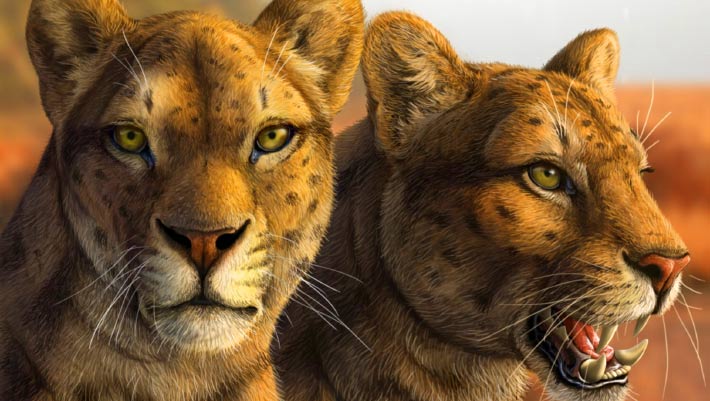
Early Saber-Toothed Cat Gets New Face after Decades of Mystery
Le premier chat à dents de sabre obtient un nouveau visage après des décennies de mystère
dent paléoart reconstitution États-Unis Pliocène mammifères crâne
Un crâne presque complet découvert il y a plusieurs décennies en Arizona a donné aux paléontologues leur aperçu le plus clair à ce jour d'Adelphailurus kansensis, une espèce énigmatique de félidés qui habitait l'Amérique du Nord il y a plus de 5 millions d'années et occupait une des premières branches de l'arbre généalogique des chats à dents de sabre. L'article Le premier chat à dents de sabre obtient un nouveau visage après des décennies de mystère est apparu en premier sur Sci.News : Breaking Science News.
29/06/2026 sci-news ⚙ Traduction automatique
Un superbe crâne de théropode exposé
musée fossile Tyrannosaurus crâne
Lors d'une visite au Museum für Naturkunde (Berlin) nous en avons profité pour photographier le magnifique crâne de Tristan le Tyrannosaurus rex.  Le crâne est l’un des crânes de tyrannosaure les plus complets et les mieux conservés connus de la science.  Les fossiles de T. rex, exposés à côté du crâne, ont été nommés Tristan Otto.  À
12/06/2026 everythingdinosaur ⚙ Traduction automatique
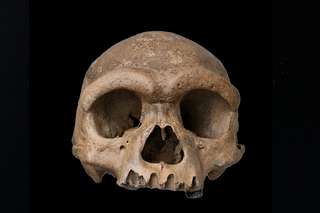
Les scientifiques pensaient les Denisoviens introuvables : cette découverte spectaculaire change désormais tout
os ADN Chine découverte Homo sapiens origine humaine crâne
Pendant quinze ans, les Denisoviens n'ont eu ni visage ni contour. Juste de l'ADN extrait d'un fragment d'os sibérien grand comme un ongle. En 2025, un crâne exceptionnel découvert en Chine a tout changé. Homo longi, surnommé l'Homme dragon, donne enfin un visage à ce groupe humain fantôme. 
06/06/2026 futura-terre
Ce poisson préhistorique pourrait expliquer comment les animaux ont marché pour la première fois sur Terre
Antarctique crâne
Les scientifiques ont examiné l'intérieur du crâne d'un poisson de l'Antarctique vieux de 380 millions d'années, étroitement apparenté aux premiers animaux à avoir marché sur terre, révélant des indices surprenants sur la façon dont la vie a commencé à sortir de l'eau. Grâce à l’imagerie neutronique avancée, les chercheurs ont découvert que Koharalepis jarviki possédait des caractéristiques adaptées pour vivre près de la surface de l’eau, notamment des ouvertures dans son crâne qui auraient pu l’aider à avaler de l’air et un organe sensible à la lumière lié aux rythmes jour-nuit.
25/05/2026 sciencedaily-paleo ⚙ Traduction automatique
1 2 3 4 5 6