←

crâne

Type de vue

215 image(s) · 30 Actualités

Galerie d'images

Skull of Jinchuanloong niedu (JCMF0132) in left lateral view.

Skull of Jinchuanloong niedu (JCMF0132) in left lateral view.

Jinchuanloong crâne
Jinchuanloong is a relatively basal sauropod that measured an estimated 10 m in length. Sauropod skulls typically don't preserve well in the fossil record, but Jinchuanloong is known mainly from the skull, and parts of the neck and tail. Like all sauropods, Jinchuanloong was a quadrupedal herbivore that used its long neck to reach the vegetation that it fed on.

Jinchuanloong is a relatively basal sauropod that measured an estimated 10 m in length. Sauropod skulls typically don't preserve well in the fossil record, but Jinchuanloong is known mainly from the skull, and parts of the neck and tail. Like all sauropods, Jinchuanloong was a quadrupedal herbivore that used its long neck to reach the vegetation that it fed on.

fossile Jinchuanloong crâne
Dinosaur sand sculptures at the Sand Sculpting Australia "Dinostory" exhibit held at Frankston, Victoria, Australia 2008/2009.The sculpture was the created with the combined efforts of an international team of sand sculpting artists: 
Karen Fralich (Canada) - children playing in foreground;
Peter Bignell (Tasmania, Australia) - Triceratops skull and logo;
Martijn Rijerse (Netherlands) - Tyrannosaurus rex scene;
Jino van Bruissenen and Christina Mija (NSW, Australia) - background panel.

Dinosaur sand sculptures at the Sand Sculpting Australia "Dinostory" exhibit held at Frankston, Victoria, Australia 2008/2009.The sculpture was the created with the combined efforts of an international team of sand sculpting artists: Karen Fralich (Canada) - children playing in foreground; Peter Bignell (Tasmania, Australia) - Triceratops skull and logo; Martijn Rijerse (Netherlands) - Tyrannosaurus rex scene; Jino van Bruissenen and Christina Mija (NSW, Australia) - background panel.

Australie Canada Pays-Bas Dinosauria +3
Various fossils pertaining to the holotype of the Triassic ichthyosaur Toretocnemus (originally Leptocheirus, also Merriamia) zitteli. This image is derived from plate 23 in Merriam (1903), done by an uncredited artist. The arrangement of the individual figures has been modified from the original (most notably, figures 3 and 4 were swapped to minimize confusion).
Original description:
Leptocheirus zitteli n. gen. and sp.
Figures reproduced natural size from the type specimen.

Fig. 1.— Right side of skull.
Fig. 2. — Cross-section of posterior portion of the lower jaw, taken above the point marked A on the lateral view of the skull.
Fig. 3. — Cross-section of the upper and lower jaws, taken at the break immediately behind the point marked Sp on the lateral view of the skull.
Fig. 4. — Lateral view of an anterior caudal centrum.
Legend (modified from original):

Ar - articular
A - angular
D - dentary
J - jugal
L - lacrimal
Mx - maxilla
Po - postorbital
Sa - surangular
Se - sclerotic ring
Sp - spenial
T - cross-section of tooth
X - doubtful element

Various fossils pertaining to the holotype of the Triassic ichthyosaur Toretocnemus (originally Leptocheirus, also Merriamia) zitteli. This image is derived from plate 23 in Merriam (1903), done by an uncredited artist. The arrangement of the individual figures has been modified from the original (most notably, figures 3 and 4 were swapped to minimize confusion). Original description: Leptocheirus zitteli n. gen. and sp. Figures reproduced natural size from the type specimen. Fig. 1.— Right side of skull. Fig. 2. — Cross-section of posterior portion of the lower jaw, taken above the point marked A on the lateral view of the skull. Fig. 3. — Cross-section of the upper and lower jaws, taken at the break immediately behind the point marked Sp on the lateral view of the skull. Fig. 4. — Lateral view of an anterior caudal centrum. Legend (modified from original): Ar - articular A - angular D - dentary J - jugal L - lacrimal Mx - maxilla Po - postorbital Sa - surangular Se - sclerotic ring Sp - spenial T - cross-section of tooth X - doubtful element

description Trias fossile holotype +7
Life restoration of Proceratosaurus bradleyi. Missing parts of skull are consistent with those of the related Guanlong per:[1] Body proportions are consistent with the skeletal reconstruction of Guanlong in fig. 11 here:[2]

Life restoration of Proceratosaurus bradleyi. Missing parts of skull are consistent with those of the related Guanlong per:[1] Body proportions are consistent with the skeletal reconstruction of Guanlong in fig. 11 here:[2]

Coeluridae Guanlong Proceratosaurus crâne
Barracudasauroides panxianensis, skull.
Stage :   Anisian from 247.2 million years ago until ~242 million years ago.
Size and weight : 118x62x545 cm – 79.4 Kg

Barracudasauroides panxianensis, skull. Stage : Anisian from 247.2 million years ago until ~242 million years ago. Size and weight : 118x62x545 cm – 79.4 Kg

Anisien Barracudasauroides Mixosauridae crâne
Diagram of the skull of Taniwhasaurus antarcticus, the areas in black being the known fossil material.
Reference source:

Álvarez–Herrera, Agnolin & Novas (2020) "A rostral neurovascular system in the mosasaur Taniwhasaurus antarcticus"

Diagram of the skull of Taniwhasaurus antarcticus, the areas in black being the known fossil material. Reference source: Álvarez–Herrera, Agnolin & Novas (2020) "A rostral neurovascular system in the mosasaur Taniwhasaurus antarcticus"

fossile Plioplatecarpinae Taniwhasaurus crâne
Pterodaustro skull
Taxons Ctenochasmatoidea

Pterodaustro skull

Archaeopterodactyloidea Aurorazhdarchidae Ctenochasmatoidea Euctenochasmatia +2
Pterodaustro skull
Taxons Euctenochasmatia

Pterodaustro skull

Archaeopterodactyloidea Aurorazhdarchidae Ctenochasmatoidea Euctenochasmatia +2
Pterodaustro skull
Taxons Archaeopterodactyloidea

Pterodaustro skull

Archaeopterodactyloidea Aurorazhdarchidae Ctenochasmatoidea Euctenochasmatia +2
Pterodaustro skull
Taxons Aurorazhdarchidae

Pterodaustro skull

Archaeopterodactyloidea Aurorazhdarchidae Ctenochasmatoidea Euctenochasmatia +2
Figure 4
The reconstruction of the skull and lower jaw of the holotype of Darwinopterus camposi sp. nov. (IVPP V 17957). Scale bar: 50 mm. Abbreviations: d, dentary; f, frontal; j, jugal; ltf, lower temporal fenestra; m, maxilla; man.sys, mandibular symphysis; naof, nasoantorbital fenestra; o, orbit; p, parietal; pm, premaxilla; pmcr, premaxillary crest; po, postorbital; prn, nasal process; q, quadrate; sq, squamosal; utf, upper temporal fenestra.
Taxons Monofenestrata

Figure 4 The reconstruction of the skull and lower jaw of the holotype of Darwinopterus camposi sp. nov. (IVPP V 17957). Scale bar: 50 mm. Abbreviations: d, dentary; f, frontal; j, jugal; ltf, lower temporal fenestra; m, maxilla; man.sys, mandibular symphysis; naof, nasoantorbital fenestra; o, orbit; p, parietal; pm, premaxilla; pmcr, premaxillary crest; po, postorbital; prn, nasal process; q, quadrate; sq, squamosal; utf, upper temporal fenestra.

crête écaille holotype Darwinoptera +3
Figure 4
The reconstruction of the skull and lower jaw of the holotype of Darwinopterus camposi sp. nov. (IVPP V 17957). Scale bar: 50 mm. Abbreviations: d, dentary; f, frontal; j, jugal; ltf, lower temporal fenestra; m, maxilla; man.sys, mandibular symphysis; naof, nasoantorbital fenestra; o, orbit; p, parietal; pm, premaxilla; pmcr, premaxillary crest; po, postorbital; prn, nasal process; q, quadrate; sq, squamosal; utf, upper temporal fenestra.
Taxons Darwinoptera

Figure 4 The reconstruction of the skull and lower jaw of the holotype of Darwinopterus camposi sp. nov. (IVPP V 17957). Scale bar: 50 mm. Abbreviations: d, dentary; f, frontal; j, jugal; ltf, lower temporal fenestra; m, maxilla; man.sys, mandibular symphysis; naof, nasoantorbital fenestra; o, orbit; p, parietal; pm, premaxilla; pmcr, premaxillary crest; po, postorbital; prn, nasal process; q, quadrate; sq, squamosal; utf, upper temporal fenestra.

crête écaille holotype Darwinoptera +3
Mounted replica of a composite skeleton of Edmontosaurus annectens on display at the University of Oxford Museum, Oxford, England. The original skeleton is compiled from disarticulated fossil bones from a bonebed of the Hell Creek Formation, exposed in the Ruth Mason Quarry in Harding County, South Dakota. It is 8.5 m (28 ft.) long and the skull is almost 1 m (39 in.) in length.[1][2]


↑ Dinosaurs in the Museum. Oxford University Museum of Natural History (brochure, PDF), p. 7

↑ BHI Fossil Replica Catalog 2012. Black Hills Institute of Geological Research, Inc., Hill City, SD, 2012 (PDF), p. 22
Taxons Edmontosaurini

Mounted replica of a composite skeleton of Edmontosaurus annectens on display at the University of Oxford Museum, Oxford, England. The original skeleton is compiled from disarticulated fossil bones from a bonebed of the Hell Creek Formation, exposed in the Ruth Mason Quarry in Harding County, South Dakota. It is 8.5 m (28 ft.) long and the skull is almost 1 m (39 in.) in length.[1][2] ↑ Dinosaurs in the Museum. Oxford University Museum of Natural History (brochure, PDF), p. 7 ↑ BHI Fossil Replica Catalog 2012. Black Hills Institute of Geological Research, Inc., Hill City, SD, 2012 (PDF), p. 22

os musée Hell Creek fossile +10
Mounted replica of a composite skeleton of Edmontosaurus annectens on display at the University of Oxford Museum, Oxford, England. The original skeleton is compiled from disarticulated fossil bones from a bonebed of the Hell Creek Formation, exposed in the Ruth Mason Quarry in Harding County, South Dakota. It is 8.5 m (28 ft.) long and the skull is almost 1 m (39 in.) in length.[1][2]


↑ Dinosaurs in the Museum. Oxford University Museum of Natural History (brochure, PDF), p. 7

↑ BHI Fossil Replica Catalog 2012. Black Hills Institute of Geological Research, Inc., Hill City, SD, 2012 (PDF), p. 22
Taxons Kritosaurini

Mounted replica of a composite skeleton of Edmontosaurus annectens on display at the University of Oxford Museum, Oxford, England. The original skeleton is compiled from disarticulated fossil bones from a bonebed of the Hell Creek Formation, exposed in the Ruth Mason Quarry in Harding County, South Dakota. It is 8.5 m (28 ft.) long and the skull is almost 1 m (39 in.) in length.[1][2] ↑ Dinosaurs in the Museum. Oxford University Museum of Natural History (brochure, PDF), p. 7 ↑ BHI Fossil Replica Catalog 2012. Black Hills Institute of Geological Research, Inc., Hill City, SD, 2012 (PDF), p. 22

os musée Hell Creek fossile +10
Mounted replica of a composite skeleton of Edmontosaurus annectens on display at the University of Oxford Museum, Oxford, England. The original skeleton is compiled from disarticulated fossil bones from a bonebed of the Hell Creek Formation, exposed in the Ruth Mason Quarry in Harding County, South Dakota. It is 8.5 m (28 ft.) long and the skull is almost 1 m (39 in.) in length.[1][2]


↑ Dinosaurs in the Museum. Oxford University Museum of Natural History (brochure, PDF), p. 7

↑ BHI Fossil Replica Catalog 2012. Black Hills Institute of Geological Research, Inc., Hill City, SD, 2012 (PDF), p. 22
Taxons Saurolophini

Mounted replica of a composite skeleton of Edmontosaurus annectens on display at the University of Oxford Museum, Oxford, England. The original skeleton is compiled from disarticulated fossil bones from a bonebed of the Hell Creek Formation, exposed in the Ruth Mason Quarry in Harding County, South Dakota. It is 8.5 m (28 ft.) long and the skull is almost 1 m (39 in.) in length.[1][2] ↑ Dinosaurs in the Museum. Oxford University Museum of Natural History (brochure, PDF), p. 7 ↑ BHI Fossil Replica Catalog 2012. Black Hills Institute of Geological Research, Inc., Hill City, SD, 2012 (PDF), p. 22

os musée Hell Creek fossile +10
1 2 3 4 5 6 7 8 9 10 11 12 13 14

Actualités

Un nouveau genre de dinosaure troodontidé du Nouveau-Mexique
os Mexique Campanien Crétacé Crétacé supérieur fossile Dinevenator Dinosauria Troodontidae nouvelle espèce crâne
Les paléontologues ont nommé une nouvelle espèce de dinosaure théropode du Nouveau-Mexique. Le dinosaure, Dinevenator Robustus, vivait il y a environ 73 millions d'années (stade faunique campanien du Crétacé supérieur). Les chercheurs ont identifié le dinosaure à partir d’un os fossile du crâne (un frontal) trouvé dans le nord-ouest du Nouveau-Mexique. Il représente un nouveau genre et une nouvelle espèce de troodontidé. Troodontidés
13/08/2026 everythingdinosaur ⚙ Traduction automatique
L’oiseau dodo possédait un monde sensoriel secret que les scientifiques découvrent seulement maintenant
oiseau tomographie découverte crâne
Les tomodensitogrammes des crânes de dodo les plus rares au monde suggèrent que l'oiseau disparu aurait pu avoir un odorat plus fort, un bec très sensible et un mode de vie qui s'étendait jusqu'à l'aube et au crépuscule. Ces découvertes contribuent à renverser des mythes vieux de plusieurs siècles et à révéler un animal bien plus complexe que le fameux dodo « stupide » de l’imagination populaire.
09/08/2026 sciencedaily-paleo ⚙ Traduction automatique
Un fossile oublié vient de révéler un nouveau prédateur du Trias datant d'il y a 210 millions d'années
mâchoire prédateur proie Mexique Trias fossile crâne
Un fossile négligé depuis près de 80 ans a révélé un parent de crocodile jusqu'alors inconnu qui vivait il y a 210 millions d'années dans ce qui est aujourd'hui le Nouveau-Mexique. Nommé Eosphorosuchus lacrimosa, ce prédateur de la taille d'un chacal avait un crâne renforcé, des muscles de mâchoire puissants et un museau court conçu pour s'attaquer à des proies plus grosses.
30/07/2026 sciencedaily ⚙ Traduction automatique
Ce fossile de dinosaure capture les derniers instants d'une attaque de T. rex
dent prédateur proie fossile Dinosauria Edmontosaurus Tyrannosaurus découverte crâne
Un crâne fossilisé d'Edmontosaure avec une dent de tyrannosaure encore incrustée dans son visage a fourni aux scientifiques de rares preuves d'une rencontre dramatique entre prédateur et proie. La découverte suggère que le carnivore géant a prononcé une morsure face-à-face incroyablement puissante, offrant de nouveaux indices sur la façon dont le tyrannosaure chassait.
14/07/2026 sciencedaily ⚙ Traduction automatique
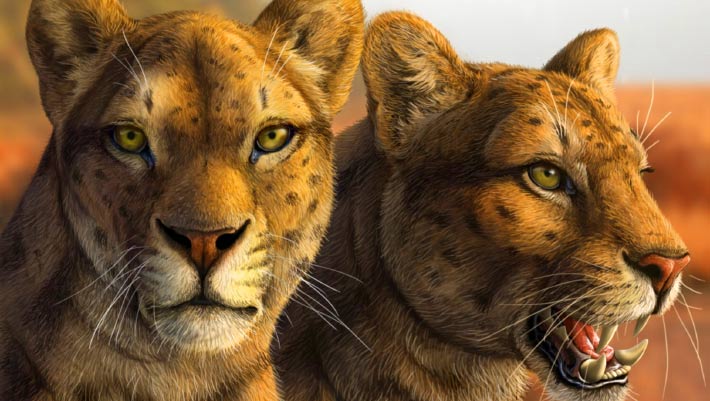
Early Saber-Toothed Cat Gets New Face after Decades of Mystery
Le premier chat à dents de sabre obtient un nouveau visage après des décennies de mystère
dent paléoart reconstitution États-Unis Pliocène mammifères crâne
Un crâne presque complet découvert il y a plusieurs décennies en Arizona a donné aux paléontologues leur aperçu le plus clair à ce jour d'Adelphailurus kansensis, une espèce énigmatique de félidés qui habitait l'Amérique du Nord il y a plus de 5 millions d'années et occupait une des premières branches de l'arbre généalogique des chats à dents de sabre. L'article Le premier chat à dents de sabre obtient un nouveau visage après des décennies de mystère est apparu en premier sur Sci.News : Breaking Science News.
29/06/2026 sci-news ⚙ Traduction automatique
1 2 3 4 5 6