←

crâne

Type de vue

215 image(s) · 30 Actualités

Galerie d'images

Skull of Yulong mini. The horizontal line projected through the posterodorsal corner of the antorbital fenestra is parallel to the line linking the articular end of the quadrate and the ventral margin of the premaxillae.
Taxons Yulong

Skull of Yulong mini. The horizontal line projected through the posterodorsal corner of the antorbital fenestra is parallel to the line linking the articular end of the quadrate and the ventral margin of the premaxillae.

Yulong crâne
Cast of the skull of Parapsicephalus purdoni (specimen AMNH 1694) in the American Museum of Natural History.
Taxons Parapsicephalus

Cast of the skull of Parapsicephalus purdoni (specimen AMNH 1694) in the American Museum of Natural History.

musée moulage spécimen Parapsicephalus +1
Sarahsaurus aurifontanalis, referred skull (MCZ 8893), in (a) lateral, (b) occipital, (c) dorsal and (d) ventral views. an, angular; ar, articular; bo, basioccipital; bs, basisphenoid; ec, ectopterygoid; f, frontal; h, hyoid; j, jugal; l, lacrimal; ls, laterosphenoid; m, maxilla; n, nasal; op, opisthotic-exoccipital; p, parietal; po, postorbital; prf, prefrontal; pm, premaxilla; pt, pterygoid; q, quadrate; qj, quadratojugal; so, supraoccipital; sq, squamosal. Scale bar, 5 cm.
Taxons Sarahsaurus

Sarahsaurus aurifontanalis, referred skull (MCZ 8893), in (a) lateral, (b) occipital, (c) dorsal and (d) ventral views. an, angular; ar, articular; bo, basioccipital; bs, basisphenoid; ec, ectopterygoid; f, frontal; h, hyoid; j, jugal; l, lacrimal; ls, laterosphenoid; m, maxilla; n, nasal; op, opisthotic-exoccipital; p, parietal; po, postorbital; prf, prefrontal; pm, premaxilla; pt, pterygoid; q, quadrate; qj, quadratojugal; so, supraoccipital; sq, squamosal. Scale bar, 5 cm.

écaille Sarahsaurus crâne
Holotype skull of Plesiotylosaurus crassidens (LACM 2759) on display at the Natural History Museum of Los Angeles County.
Taxons Plesiotylosaurus

Holotype skull of Plesiotylosaurus crassidens (LACM 2759) on display at the Natural History Museum of Los Angeles County.

musée holotype Plesiotylosaurus crâne
Skull of the mosasaurid squamate Thalassotitan atrox from the late Maastrichtian of Sidi Daoui, Ouled Abdoun Basin, Khouribga Province, Morocco, North Africa.
Taxons Thalassotitan

Skull of the mosasaurid squamate Thalassotitan atrox from the late Maastrichtian of Sidi Daoui, Ouled Abdoun Basin, Khouribga Province, Morocco, North Africa.

Maroc Maastrichtien Mosasauridae Thalassotitan +1
Alioramus altai skull in the exhibit, T. rex, The Ultimate Predator, in the American Museum of Natural History (with permission by Ben Miller).
Taxons Alioramini

Alioramus altai skull in the exhibit, T. rex, The Ultimate Predator, in the American Museum of Natural History (with permission by Ben Miller).

prédateur musée Alioramini Alioramus +1
Holotype of Ulughbegsaurus as well as the holotype placed on a reconstruction of Ulughbegsaurus's skull
Taxons Ulughbegsaurus

Holotype of Ulughbegsaurus as well as the holotype placed on a reconstruction of Ulughbegsaurus's skull

holotype Ulughbegsaurus crâne
Proceratosaurus bradleyi holotype NHMUK PV R 4860. Almost complete skull and mandibles in articulation, hyoid element and anterior cervical vertebrae in oolite block.
Taxons Proceratosauridae

Proceratosaurus bradleyi holotype NHMUK PV R 4860. Almost complete skull and mandibles in articulation, hyoid element and anterior cervical vertebrae in oolite block.

musée holotype Proceratosauridae Proceratosaurus +1
Proceratosaurus bradleyi holotype NHMUK PV R 4860. Almost complete skull and mandibles in articulation, hyoid element and anterior cervical vertebrae in oolite block.
Taxons Proceratosaurus

Proceratosaurus bradleyi holotype NHMUK PV R 4860. Almost complete skull and mandibles in articulation, hyoid element and anterior cervical vertebrae in oolite block.

musée holotype Proceratosauridae Proceratosaurus +1
Restored Placochelys placodonta skull at the Museum für Naturkunde, Berlin.
Taxons Placochelyidae

Restored Placochelys placodonta skull at the Museum für Naturkunde, Berlin.

musée Placochelyidae Placochelys crâne
Restored Placochelys placodonta skull at the Museum für Naturkunde, Berlin.
Taxons Placochelys

Restored Placochelys placodonta skull at the Museum für Naturkunde, Berlin.

musée Placochelyidae Placochelys crâne
Riojasaurus skull cast, Copenhagen.
Taxons Riojasauridae

Riojasaurus skull cast, Copenhagen.

moulage Riojasauridae Riojasaurus crâne
Riojasaurus skull cast, Copenhagen.
Taxons Riojasaurus

Riojasaurus skull cast, Copenhagen.

moulage Riojasauridae Riojasaurus crâne
A restoration of Rinconsaurus compared to a human ,

•  Based proportionally on fossil elements and skeletal reconstruction featured in the Rinconsaurus description,[1] with missing parts based on other titanosaur reconstructions. The remains of Rinconsaurus represent two adults and a juvenile all of which are incomplete; some of the proportions shown here, such as the neck, limb lengths, and skull shape are not certain.
•  Osteroderms are not yet known in Rinconsaurus.  The osteoderms shown here are based loosely on Mendozasaurus.[2] Osteoderms are known from at least 10 titanosaur genera spread across the family tree but it's not clear if all titanosaurs had them.[3] Titanosaur osteoderms are rare and their layout and position on the body are not certain. [4]
•  The colours and patterns, as with the majority of reconstructions of prehistoric creatures, are speculative.
•  Human silhouette approximately 180 cm tall.

NOTE: I often update my images. If you want to have any of my images on a website, please (if possible) don’t host/save it to the website server. I’d prefer it if the image's Wikimedia URL is used. This means that if I update an image, it will be updated on the site as well.  Thanks.   


References


↑ Coria, Jorge; B.J.G. Riga (2003). "Rinconsaurus caudamirus gen. et sp nov., a new titanosaurid (Dinosauria, Sauropoda) from the Late Cretaceous of Patagonia, Argentina". Revista Geologica de Chile 30 (2): 333–353. ISSN 0716-0208. Retrieved on 2007-05-21.

↑   González Riga B (2003) A new titanosaur (Dinosauria, Sauropoda) from the Upper Cretaceous of Mendoza, Argentina. Ameghiniana 40 (2) 

↑  Carrano, M.T. and D’Emic, M.D.  2015 'Osteoderms of the titanosaur sauropod dinosaur Alamosaurus sanjuanensis Gilmore, 1922'. Journal of Vertebrate Paleontology.

↑    Vidal D, Ortega F, Sanz JL (2014) Titanosaur Osteoderms from the Upper Cretaceous of Lo Hueco (Spain) and Their Implications on the Armor of Laurasian Titanosaurs. PLoS ONE 9(8): e102488. doi:10.1371/journal.pone.0102488
Taxons Rinconsauria

A restoration of Rinconsaurus compared to a human , • Based proportionally on fossil elements and skeletal reconstruction featured in the Rinconsaurus description,[1] with missing parts based on other titanosaur reconstructions. The remains of Rinconsaurus represent two adults and a juvenile all of which are incomplete; some of the proportions shown here, such as the neck, limb lengths, and skull shape are not certain. • Osteroderms are not yet known in Rinconsaurus. The osteoderms shown here are based loosely on Mendozasaurus.[2] Osteoderms are known from at least 10 titanosaur genera spread across the family tree but it's not clear if all titanosaurs had them.[3] Titanosaur osteoderms are rare and their layout and position on the body are not certain. [4] • The colours and patterns, as with the majority of reconstructions of prehistoric creatures, are speculative. • Human silhouette approximately 180 cm tall. NOTE: I often update my images. If you want to have any of my images on a website, please (if possible) don’t host/save it to the website server. I’d prefer it if the image's Wikimedia URL is used. This means that if I update an image, it will be updated on the site as well. Thanks. References ↑ Coria, Jorge; B.J.G. Riga (2003). "Rinconsaurus caudamirus gen. et sp nov., a new titanosaurid (Dinosauria, Sauropoda) from the Late Cretaceous of Patagonia, Argentina". Revista Geologica de Chile 30 (2): 333–353. ISSN 0716-0208. Retrieved on 2007-05-21. ↑ González Riga B (2003) A new titanosaur (Dinosauria, Sauropoda) from the Upper Cretaceous of Mendoza, Argentina. Ameghiniana 40 (2) ↑ Carrano, M.T. and D’Emic, M.D. 2015 'Osteoderms of the titanosaur sauropod dinosaur Alamosaurus sanjuanensis Gilmore, 1922'. Journal of Vertebrate Paleontology. ↑ Vidal D, Ortega F, Sanz JL (2014) Titanosaur Osteoderms from the Upper Cretaceous of Lo Hueco (Spain) and Their Implications on the Armor of Laurasian Titanosaurs. PLoS ONE 9(8): e102488. doi:10.1371/journal.pone.0102488

armure membre description Argentine +14
A restoration of Rinconsaurus compared to a human ,

•  Based proportionally on fossil elements and skeletal reconstruction featured in the Rinconsaurus description,[1] with missing parts based on other titanosaur reconstructions. The remains of Rinconsaurus represent two adults and a juvenile all of which are incomplete; some of the proportions shown here, such as the neck, limb lengths, and skull shape are not certain.
•  Osteroderms are not yet known in Rinconsaurus.  The osteoderms shown here are based loosely on Mendozasaurus.[2] Osteoderms are known from at least 10 titanosaur genera spread across the family tree but it's not clear if all titanosaurs had them.[3] Titanosaur osteoderms are rare and their layout and position on the body are not certain. [4]
•  The colours and patterns, as with the majority of reconstructions of prehistoric creatures, are speculative.
•  Human silhouette approximately 180 cm tall.

NOTE: I often update my images. If you want to have any of my images on a website, please (if possible) don’t host/save it to the website server. I’d prefer it if the image's Wikimedia URL is used. This means that if I update an image, it will be updated on the site as well.  Thanks.   


References


↑ Coria, Jorge; B.J.G. Riga (2003). "Rinconsaurus caudamirus gen. et sp nov., a new titanosaurid (Dinosauria, Sauropoda) from the Late Cretaceous of Patagonia, Argentina". Revista Geologica de Chile 30 (2): 333–353. ISSN 0716-0208. Retrieved on 2007-05-21.

↑   González Riga B (2003) A new titanosaur (Dinosauria, Sauropoda) from the Upper Cretaceous of Mendoza, Argentina. Ameghiniana 40 (2) 

↑  Carrano, M.T. and D’Emic, M.D.  2015 'Osteoderms of the titanosaur sauropod dinosaur Alamosaurus sanjuanensis Gilmore, 1922'. Journal of Vertebrate Paleontology.

↑    Vidal D, Ortega F, Sanz JL (2014) Titanosaur Osteoderms from the Upper Cretaceous of Lo Hueco (Spain) and Their Implications on the Armor of Laurasian Titanosaurs. PLoS ONE 9(8): e102488. doi:10.1371/journal.pone.0102488
Taxons Rinconsaurus

A restoration of Rinconsaurus compared to a human , • Based proportionally on fossil elements and skeletal reconstruction featured in the Rinconsaurus description,[1] with missing parts based on other titanosaur reconstructions. The remains of Rinconsaurus represent two adults and a juvenile all of which are incomplete; some of the proportions shown here, such as the neck, limb lengths, and skull shape are not certain. • Osteroderms are not yet known in Rinconsaurus. The osteoderms shown here are based loosely on Mendozasaurus.[2] Osteoderms are known from at least 10 titanosaur genera spread across the family tree but it's not clear if all titanosaurs had them.[3] Titanosaur osteoderms are rare and their layout and position on the body are not certain. [4] • The colours and patterns, as with the majority of reconstructions of prehistoric creatures, are speculative. • Human silhouette approximately 180 cm tall. NOTE: I often update my images. If you want to have any of my images on a website, please (if possible) don’t host/save it to the website server. I’d prefer it if the image's Wikimedia URL is used. This means that if I update an image, it will be updated on the site as well. Thanks. References ↑ Coria, Jorge; B.J.G. Riga (2003). "Rinconsaurus caudamirus gen. et sp nov., a new titanosaurid (Dinosauria, Sauropoda) from the Late Cretaceous of Patagonia, Argentina". Revista Geologica de Chile 30 (2): 333–353. ISSN 0716-0208. Retrieved on 2007-05-21. ↑ González Riga B (2003) A new titanosaur (Dinosauria, Sauropoda) from the Upper Cretaceous of Mendoza, Argentina. Ameghiniana 40 (2) ↑ Carrano, M.T. and D’Emic, M.D. 2015 'Osteoderms of the titanosaur sauropod dinosaur Alamosaurus sanjuanensis Gilmore, 1922'. Journal of Vertebrate Paleontology. ↑ Vidal D, Ortega F, Sanz JL (2014) Titanosaur Osteoderms from the Upper Cretaceous of Lo Hueco (Spain) and Their Implications on the Armor of Laurasian Titanosaurs. PLoS ONE 9(8): e102488. doi:10.1371/journal.pone.0102488

armure membre description Argentine +14
Collage of three leptoceratopsids, clockwise from top left: Prenoceratops, Montanoceratops and Leptoceratops. These files are already on Commons with their respective licenses. This montage was made for the article Leptoceratopsidae on Wikipedia.
File:The Childrens Museum of Indianapolis - Prenoceratops pieganensis -1.jpg
File:Montanoceratops Royal Tyrrell 1.jpg
File:Leptoceratopsidae - Leptoceratops.JPG
File:Leptoceratops skull Royal Tyrrell.jpg
Taxons Leptoceratopsidae

Collage of three leptoceratopsids, clockwise from top left: Prenoceratops, Montanoceratops and Leptoceratops. These files are already on Commons with their respective licenses. This montage was made for the article Leptoceratopsidae on Wikipedia. File:The Childrens Museum of Indianapolis - Prenoceratops pieganensis -1.jpg File:Montanoceratops Royal Tyrrell 1.jpg File:Leptoceratopsidae - Leptoceratops.JPG File:Leptoceratops skull Royal Tyrrell.jpg

musée Leptoceratops Leptoceratopsidae Montanoceratops +2
1 2 3 4 5 6 7 8 9 10 11 12 13 14

Actualités

Un nouveau genre de dinosaure troodontidé du Nouveau-Mexique
os Mexique Campanien Crétacé Crétacé supérieur fossile Dinevenator Dinosauria Troodontidae nouvelle espèce crâne
Les paléontologues ont nommé une nouvelle espèce de dinosaure théropode du Nouveau-Mexique. Le dinosaure, Dinevenator Robustus, vivait il y a environ 73 millions d'années (stade faunique campanien du Crétacé supérieur). Les chercheurs ont identifié le dinosaure à partir d’un os fossile du crâne (un frontal) trouvé dans le nord-ouest du Nouveau-Mexique. Il représente un nouveau genre et une nouvelle espèce de troodontidé. Troodontidés
13/08/2026 everythingdinosaur ⚙ Traduction automatique
L’oiseau dodo possédait un monde sensoriel secret que les scientifiques découvrent seulement maintenant
oiseau tomographie découverte crâne
Les tomodensitogrammes des crânes de dodo les plus rares au monde suggèrent que l'oiseau disparu aurait pu avoir un odorat plus fort, un bec très sensible et un mode de vie qui s'étendait jusqu'à l'aube et au crépuscule. Ces découvertes contribuent à renverser des mythes vieux de plusieurs siècles et à révéler un animal bien plus complexe que le fameux dodo « stupide » de l’imagination populaire.
09/08/2026 sciencedaily-paleo ⚙ Traduction automatique
Un fossile oublié vient de révéler un nouveau prédateur du Trias datant d'il y a 210 millions d'années
mâchoire prédateur proie Mexique Trias fossile crâne
Un fossile négligé depuis près de 80 ans a révélé un parent de crocodile jusqu'alors inconnu qui vivait il y a 210 millions d'années dans ce qui est aujourd'hui le Nouveau-Mexique. Nommé Eosphorosuchus lacrimosa, ce prédateur de la taille d'un chacal avait un crâne renforcé, des muscles de mâchoire puissants et un museau court conçu pour s'attaquer à des proies plus grosses.
30/07/2026 sciencedaily ⚙ Traduction automatique
Ce fossile de dinosaure capture les derniers instants d'une attaque de T. rex
dent prédateur proie fossile Dinosauria Edmontosaurus Tyrannosaurus découverte crâne
Un crâne fossilisé d'Edmontosaure avec une dent de tyrannosaure encore incrustée dans son visage a fourni aux scientifiques de rares preuves d'une rencontre dramatique entre prédateur et proie. La découverte suggère que le carnivore géant a prononcé une morsure face-à-face incroyablement puissante, offrant de nouveaux indices sur la façon dont le tyrannosaure chassait.
14/07/2026 sciencedaily ⚙ Traduction automatique
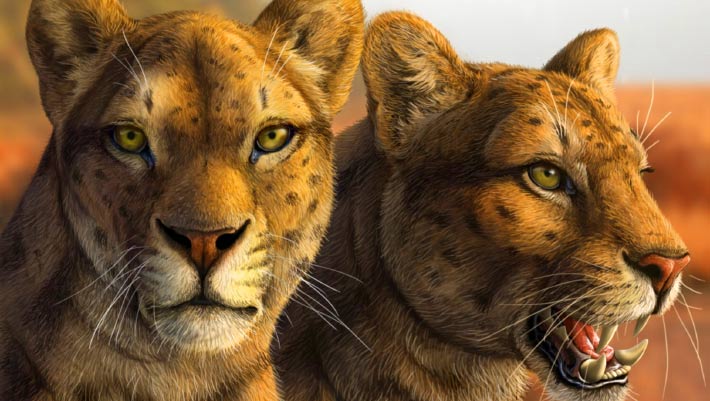
Early Saber-Toothed Cat Gets New Face after Decades of Mystery
Le premier chat à dents de sabre obtient un nouveau visage après des décennies de mystère
dent paléoart reconstitution États-Unis Pliocène mammifères crâne
Un crâne presque complet découvert il y a plusieurs décennies en Arizona a donné aux paléontologues leur aperçu le plus clair à ce jour d'Adelphailurus kansensis, une espèce énigmatique de félidés qui habitait l'Amérique du Nord il y a plus de 5 millions d'années et occupait une des premières branches de l'arbre généalogique des chats à dents de sabre. L'article Le premier chat à dents de sabre obtient un nouveau visage après des décennies de mystère est apparu en premier sur Sci.News : Breaking Science News.
29/06/2026 sci-news ⚙ Traduction automatique
1 2 3 4 5 6