←

Dinosauria

Taxon

251 image(s) · 248 Actualités

Voir la fiche

Galerie d'images

Huaxiazhoulong is a fairly large ankylosaurid dinosaur, at around 6 m in length. It was a robust quadruped with a beak and teeth adapted for processing its herbivorous diet. Huaxiazhoulong had an armor of osteoderms, and the characteristic ankylosaurid tail club which was likely used in defense against predators, as well as intraspecific combat.
Taxons Huaxiazhoulong

Huaxiazhoulong is a fairly large ankylosaurid dinosaur, at around 6 m in length. It was a robust quadruped with a beak and teeth adapted for processing its herbivorous diet. Huaxiazhoulong had an armor of osteoderms, and the characteristic ankylosaurid tail club which was likely used in defense against predators, as well as intraspecific combat.

armure défense prédateur Ankylosauridae +2
Holotype specimen of Notatesseraeraptor frickensis, a theropod dinosaur, in Sauriermuseum Frick .
Taxons Notatesseraeraptor

Holotype specimen of Notatesseraeraptor frickensis, a theropod dinosaur, in Sauriermuseum Frick .

holotype spécimen Dinosauria Notatesseraeraptor
Calvarius is a genus of styracosternan ornithopod from the Late Cretaceous of Spain. The name alludes to its chronostratigraphic proximity to the extinction event that wiped out the non-avian dinosaurs at the end of the Cretaceous. The highly modified metatarsal that is known from shows an example of convergent evolution, as it is more similar to non-iguanodontian ornithopods than to other styracosternans. It is thought that this is due to fulfilling a niche in its island habitat, resulting in Calvarius becoming a small-bodied animal, capable of rapid locomotion.
Taxons Calvarius

Calvarius is a genus of styracosternan ornithopod from the Late Cretaceous of Spain. The name alludes to its chronostratigraphic proximity to the extinction event that wiped out the non-avian dinosaurs at the end of the Cretaceous. The highly modified metatarsal that is known from shows an example of convergent evolution, as it is more similar to non-iguanodontian ornithopods than to other styracosternans. It is thought that this is due to fulfilling a niche in its island habitat, resulting in Calvarius becoming a small-bodied animal, capable of rapid locomotion.

locomotion Espagne Crétacé Crétacé supérieur +6
Illustration of the pelvis from the theropod dinosaur Siamotyrannus isanensis. Siamotyrannus lived in Thailand, according to scientists about 90 MYA. It has been estimated to a length of 7 meter, and a weight of about 2 tonnes. Scientists has been uncertain if Siamotyrannus is a member of the family Tyrannosauridae or to Sinraptoridae.
Taxons Siamotyrannus

Illustration of the pelvis from the theropod dinosaur Siamotyrannus isanensis. Siamotyrannus lived in Thailand, according to scientists about 90 MYA. It has been estimated to a length of 7 meter, and a weight of about 2 tonnes. Scientists has been uncertain if Siamotyrannus is a member of the family Tyrannosauridae or to Sinraptoridae.

bassin Thaïlande Dinosauria Siamotyrannus +2
Changchunsaurus parvus, a neornithischian dinosaur.
Taxons Changchunsaurus

Changchunsaurus parvus, a neornithischian dinosaur.

Changchunsaurus Dinosauria Neornithischia
A replica of MIWG 1530, the holotype of the indeterminate archosaur Yaverlandia bitholus. As seen from two angles.
Taxons Yaverlandia

A replica of MIWG 1530, the holotype of the indeterminate archosaur Yaverlandia bitholus. As seen from two angles.

holotype Dinosauria Maniraptora Yaverlandia
Notohypsilodon comodorensis, an elasmarian ornithopod dinosaur.
Taxons Notohypsilophodon

Notohypsilodon comodorensis, an elasmarian ornithopod dinosaur.

Dinosauria Elasmaria Notohypsilophodon
Holotype (MTM V 2009.192.1) of Ajkaceratops kozmai .mw-parser-output .smallcaps{font-variant:small-caps}Ősi et al., 2010 (Dinosauria: Ceratopsia), fused rostral and premaxillae, in lateral view, length of scale bar = 1 cm.
Taxons Ajkaceratops

Holotype (MTM V 2009.192.1) of Ajkaceratops kozmai .mw-parser-output .smallcaps{font-variant:small-caps}Ősi et al., 2010 (Dinosauria: Ceratopsia), fused rostral and premaxillae, in lateral view, length of scale bar = 1 cm.

écaille holotype Ajkaceratops Ceratopsia +1
Gandititan is a basal titanosaurian sauropod dinosaur from the Late Cretaceous of what is now China. It was a long-necked herbivore, typical of sauropods, with a relatively short tail, a characteristic of titanosaurs compared to other sauropods. Titanosauria have a wide range of body sizes, and Gandititan falls around the middle, slightly on the smaller side. Discovered with a fairly well articluated spine from neck to tail, Gandititan is estimated at about 14 m in total body length.
Taxons Gandititan

Gandititan is a basal titanosaurian sauropod dinosaur from the Late Cretaceous of what is now China. It was a long-necked herbivore, typical of sauropods, with a relatively short tail, a characteristic of titanosaurs compared to other sauropods. Titanosauria have a wide range of body sizes, and Gandititan falls around the middle, slightly on the smaller side. Discovered with a fairly well articluated spine from neck to tail, Gandititan is estimated at about 14 m in total body length.

Chine Crétacé Crétacé supérieur Dinosauria +2
Holotype of Ferrisaurus sustutensis, RBCM P900, on display in the Okanagan Heritage Museum exhibition Dinosaurs of BC, June-September 2024.
Taxons Ferrisaurus

Holotype of Ferrisaurus sustutensis, RBCM P900, on display in the Okanagan Heritage Museum exhibition Dinosaurs of BC, June-September 2024.

musée holotype Dinosauria Ferrisaurus
Astigmasaura is a medium-sized rebbachisaurid sauropod dinosaur from the Late Cretaceous period of what is now Argentina. Rebbachisaurids had highly pneumatized bones that helped them to hold their weight on their four pillar-like legs, and extremely long tails. Astigmasaura was likely a ground-level browsing herbivore.
Taxons Astigmasaura

Astigmasaura is a medium-sized rebbachisaurid sauropod dinosaur from the Late Cretaceous period of what is now Argentina. Rebbachisaurids had highly pneumatized bones that helped them to hold their weight on their four pillar-like legs, and extremely long tails. Astigmasaura was likely a ground-level browsing herbivore.

os Argentine Crétacé Crétacé supérieur +3
Illustration of Sinusonasus (Dinosauria, Theropoda, Coelurosauria, Deinonychosauria, Troodontidae). This restoration is an edited and updated version of a drawing I originally uploaded on Wikimedia at December 11th 2009 (which i turn is based on a fossil seen at http://site.sinodino.com/Museum/images/Sinusonasus.JPG.).
Taxons Sinusonasus

Illustration of Sinusonasus (Dinosauria, Theropoda, Coelurosauria, Deinonychosauria, Troodontidae). This restoration is an edited and updated version of a drawing I originally uploaded on Wikimedia at December 11th 2009 (which i turn is based on a fossil seen at http://site.sinodino.com/Museum/images/Sinusonasus.JPG.).

dessin musée fossile Coelurosauria +5
Rebbachisaurids are the latest known sauropod dinosaurs outside the titanosaur lineage. Cienciargentina is a rebbachisaurid from the Late Cretaceous, making it among the most recent. It had many hollow bones, and likely had batteries of teeth used for chewing, a rebbachisaurid feature unique among sauropods.
Taxons Cienciargentina

Rebbachisaurids are the latest known sauropod dinosaurs outside the titanosaur lineage. Cienciargentina is a rebbachisaurid from the Late Cretaceous, making it among the most recent. It had many hollow bones, and likely had batteries of teeth used for chewing, a rebbachisaurid feature unique among sauropods.

os Crétacé Crétacé supérieur Cienciargentina +3
Skeletal reconstruction of the Sauropod dinosaur Abdarainurus barsboldi based on holotype PIN 5669/1, as figured in Averianov and Lopatin, 2020. Outline is based on related Sauropods, modified from SlvrHwk.
Taxons Abdarainurus

Skeletal reconstruction of the Sauropod dinosaur Abdarainurus barsboldi based on holotype PIN 5669/1, as figured in Averianov and Lopatin, 2020. Outline is based on related Sauropods, modified from SlvrHwk.

holotype Abdarainurus Dinosauria
Reconstructed skull of Duriavenator hesperis showing known material (white) of the holotype and only known specimen. Unknown bones based on related Eustreptospondylus oxoniensis. Scale bar is 10cm, image is 10px/cm. Cranial anatomy based on Benson (2008) "A redescription of "Megalosaurus" hesperis (Dinosauria, Theropoda) from the Inferior Oolite (Bajocian, Middle Jurassic) of Dorset, United Kingdom"
Taxons Duriavenator

Reconstructed skull of Duriavenator hesperis showing known material (white) of the holotype and only known specimen. Unknown bones based on related Eustreptospondylus oxoniensis. Scale bar is 10cm, image is 10px/cm. Cranial anatomy based on Benson (2008) "A redescription of "Megalosaurus" hesperis (Dinosauria, Theropoda) from the Inferior Oolite (Bajocian, Middle Jurassic) of Dorset, United Kingdom"

os écaille Royaume-Uni Bajocien +11
Reconstructed skull of Wiehenvenator albati based on holotype specimen (white). Scale bar is 10cm, image if 10px/cm. Unknown material based on related Torvosaurus tanneri. Cranial anatomy based on Rauhut et al (2016) "A new megalosaurid theropod dinosaur from the late Middle Jurassic (Callovian) of north-western Germany: implications for theropod evolution and faunal turnover in the Jurassic"
Taxons Wiehenvenator

Reconstructed skull of Wiehenvenator albati based on holotype specimen (white). Scale bar is 10cm, image if 10px/cm. Unknown material based on related Torvosaurus tanneri. Cranial anatomy based on Rauhut et al (2016) "A new megalosaurid theropod dinosaur from the late Middle Jurassic (Callovian) of north-western Germany: implications for theropod evolution and faunal turnover in the Jurassic"

écaille Allemagne Callovien Jurassique +10
1 2 3 4 5 6 7 8 9 10 11 12 13 14 15 16

Actualités

Why Were There No Tiny Non-Avian Dinosaurs? Mammals May Have Been to Blame
Pourquoi n’y avait-il pas de petits dinosaures non aviaires ? Les mammifères pourraient être à blâmer
écologie prédateur reproduction Dinosauria évolution mammifères
Les dinosaures ont évolué pour devenir certains des plus grands animaux ayant jamais foulé la Terre, mais un nouveau modèle mathématique suggère que les premiers mammifères les auraient chassés des niches écologiques réservées aux plus petites créatures. Cet article, intitulé « Pourquoi n'y avait-il pas de minuscules dinosaures non aviens ? Les mammifères en seraient-ils responsables ? », a été initialement publié sur Sci.News: Breaking Science News.
10/08/2026 sci-news ⚙ Traduction automatique
Un fossile de reptile vieux de 240 millions d'années révèle un chapitre perdu avant les dinosaures et les crocodiles
prédateur Brésil Trias fossile Dinosauria évolution autres reptiles
Un reptile vieux de 240 millions d'années découvert au Brésil révèle à quoi ressemblait l'évolution juste avant l'avènement des dinosaures et des crocodiles. Le petit prédateur avait des pattes inhabituellement positionnées qui lui permettaient peut-être de se déplacer plus efficacement que de nombreux reptiles antérieurs. Ses proches parents étaient auparavant connus principalement sur d’autres continents, ce qui suggère que ces animaux anciens se sont répandus beaucoup plus loin dans le monde du Trias que les scientifiques ne le pensaient.
10/08/2026 sciencedaily ⚙ Traduction automatique
Les dinosaures sont devenus des géants – alors pourquoi ne sont-ils jamais devenus minuscules ?
écologie croissance Dinosauria évolution mammifères
Les dinosaures ont conquis la terre à des tailles énormes, mais étrangement, ils n'ont presque jamais évolué pour devenir de véritables animaux minuscules. De nouvelles recherches suggèrent que la physiologie à elle seule ne peut pas expliquer cette extrémité miniature manquante du spectre des dinosaures et que les premiers mammifères pourraient en être en partie responsables. Alors que les dinosaures empêchaient les mammifères de devenir grands, les petits mammifères pourraient leur rendre la pareille en occupant des niches écologiques qui auraient autrement pu accueillir des dinosaures de la taille d'une souris.
09/08/2026 sciencedaily ⚙ Traduction automatique
Un magnifique dinosaure en origami présenté à Everything Dinosaur
Dinosauria
Everything Dinosaur soutenir la créativité des fans d'animaux préhistoriques est un objectif clé de l'entreprise.  Nous rencontrons tellement de personnes talentueuses et extraordinaires et nous faisons tout ce que nous pouvons pour les encourager à poursuivre leurs rêves.  Par exemple, lors de la DinoCon le mois dernier, Sue et moi avons reçu un magnifique dinosaure en origami. UN
08/08/2026 everythingdinosaur ⚙ Traduction automatique
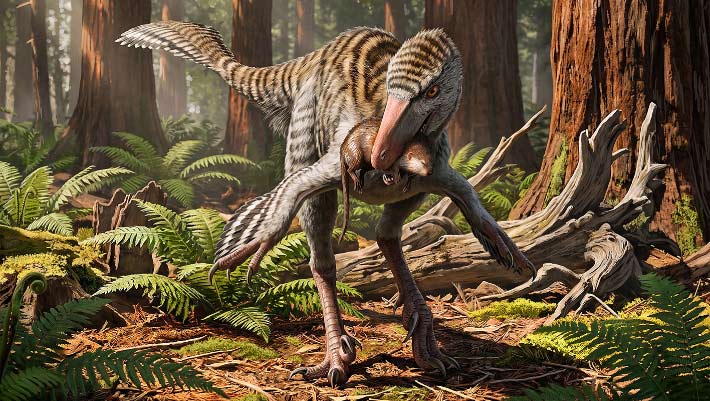
New Troodontid Dinosaur Genus Identified from Fossil Bone Found Decades Ago in New Mexico
Un nouveau genre de dinosaure troodontidé identifié à partir d'un os fossile découvert il y a plusieurs décennies au Nouveau-Mexique
os Mexique fossile Dinevenator Dinosauria Troodontidae oiseau
Les paléontologues ont décrit un nouveau genre de petit dinosaure ressemblant à un oiseau qui vivait dans ce qui est aujourd'hui le Nouveau-Mexique il y a environ 73 millions d'années. L'article Nouveau genre de dinosaures troodontidés identifié à partir d'os fossiles trouvés il y a des décennies au Nouveau-Mexique est apparu en premier sur Sci.News : Breaking Science News.
07/08/2026 sci-news ⚙ Traduction automatique
1 2 3 4 5 6 7 8 9 10 11 12 13 14 15 16 17 18 19 20 21 22 23 24 25 26 27 28 29 30 31 32 33 34 35 36 37 38 39 40 41 42 43 44 45 46 47 48 49 50